

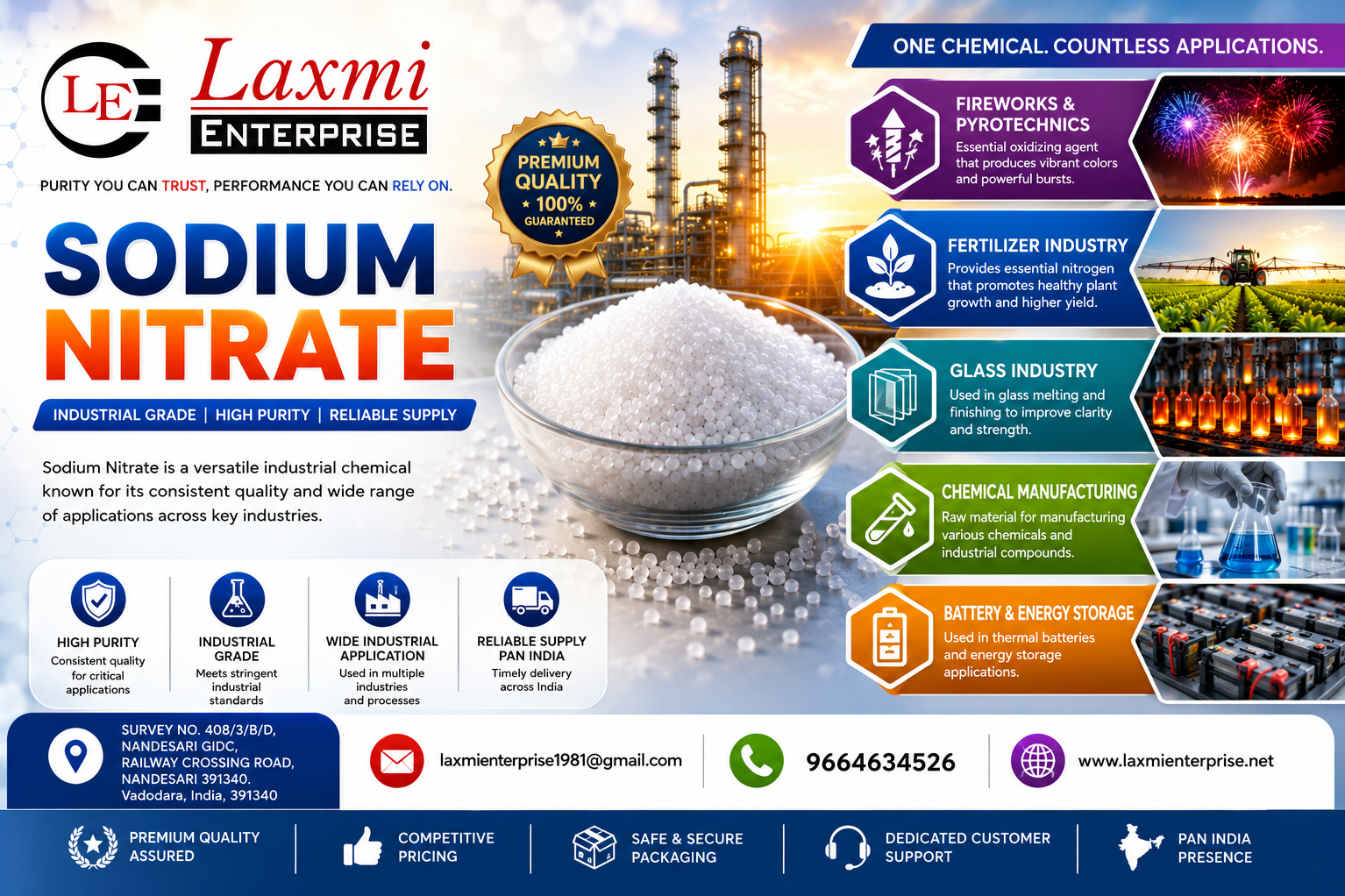
Sodium Nitrate Manufacturing Process Explained: Raw Materials, Chemical Reactions, Process Control, Quality Assurance, and Industrial Production
Sodium nitrate is more than just a white crystalline chemical. Behind every shipment supplied to glass manufacturers, heat treatment plants, specialty chemical producers, mining companies, and industrial processors is a carefully controlled manufacturing process. Product consistency depends not only on the purity of raw materials but also on reaction control, crystallization, filtration efficiency, drying conditions, particle size management, and quality assurance systems.
Many buyers evaluate sodium nitrate only by purity percentage, but experienced procurement engineers know that identical purity values do not always indicate identical product performance. Manufacturing technology determines crystal morphology, impurity profile, bulk density, moisture stability, flowability, dissolution characteristics, and long-term storage behavior.
This article provides a technical overview of how industrial sodium nitrate is manufactured, the science behind each production stage, common quality challenges, and the engineering practices that distinguish premium suppliers from commodity manufacturers.
Why Manufacturing Technology Matters
Two suppliers may both offer sodium nitrate with a purity above 99 percent, yet their products may perform differently in industrial applications because of differences in:
Crystal structure
Particle size distribution
Moisture control
Trace impurity profile
Filtration efficiency
Drying technology
Packaging systems
Process automation
These differences directly affect production efficiency, storage stability, dosing accuracy, and final product quality.
Industrial Chemistry of Sodium Nitrate
Sodium nitrate (NaNO3) is an inorganic nitrate salt composed of:
Sodium ion (Na⁺)
Nitrate ion (NO3⁻)
Its molecular weight is approximately 84.99 g/mol.
The nitrate ion is highly stable under normal storage conditions, making sodium nitrate an excellent oxidizing agent for numerous industrial applications.
Its strong water solubility, chemical stability, and predictable reaction behavior contribute to its widespread industrial use.
Major Commercial Manufacturing Routes
Commercial sodium nitrate is produced through several industrial routes depending on raw material availability, production economics, and required product purity.
Route 1. Neutralization Process
The most common industrial process involves neutralizing nitric acid with a sodium-containing alkali.
Typical reactants include:
Sodium carbonate
Sodium hydroxide
Sodium bicarbonate
Example reaction:
Nitric Acid + Sodium Carbonate → Sodium Nitrate + Carbon Dioxide + Water
This route provides:
High production efficiency
Good purity control
Continuous manufacturing capability
Economical large-scale production
Route 2. Double Decomposition Process
Some manufacturers produce sodium nitrate through ion exchange or salt conversion reactions.
Typical reactants may include nitrate salts and sodium salts.
Advantages include:
Flexible production
Controlled impurity profile
Specialized product grades
Route 3. Natural Mineral Recovery
Historically, sodium nitrate was recovered from naturally occurring nitrate deposits.
Although still important in some regions, synthetic production has become the dominant industrial method because it offers:
Better consistency
Controlled purity
Reliable supply
Lower batch variation
Stage 1. Raw Material Qualification
Premium production begins before manufacturing starts.
Every incoming raw material undergoes laboratory inspection.
Typical quality checks include:
Chemical purity
Moisture
Insoluble matter
Heavy metals
Chlorides
Sulphates
Density
Supplier certification
Substandard raw materials increase downstream processing costs and reduce final product quality.
Stage 2. Raw Material Preparation
Before reaction begins, raw materials are prepared for accurate dosing.
Preparation may include:
Size reduction
Dissolution
Screening
Storage homogenization
Controlled feeding
Accurate preparation minimizes process variation.
Stage 3. Reaction Engineering
Neutralization is not simply mixing two chemicals.
Modern plants continuously monitor:
Reaction temperature
pH
Acid concentration
Alkali concentration
Mixing intensity
Residence time
Improper control may lead to:
Incomplete reaction
Excess impurities
Lower yield
Product instability
Advanced automated reactors improve consistency significantly.
Heat Generation During Neutralization
Neutralization reactions release heat.
If heat removal is poorly controlled:
Crystal quality deteriorates
Side reactions increase
Equipment scaling develops
Product consistency decreases
Industrial reactors therefore include cooling systems that maintain narrow operating windows.
Stage 4. Clarification and Filtration
The reaction solution may contain:
Insoluble particles
Process residues
Foreign contaminants
Undissolved solids
Clarification removes these materials before crystallization.
Common equipment includes:
Pressure filters
Cartridge filters
Filter presses
Gravity clarification tanks
Efficient filtration improves:
Optical clarity
Crystal quality
Product purity
Equipment cleanliness
Stage 5. Concentration by Evaporation
After filtration, the sodium nitrate solution is concentrated.
Evaporation removes excess water until supersaturation is achieved.
Critical process variables include:
Steam pressure
Vacuum level
Temperature profile
Concentration control
Residence time
Poor evaporation control causes:
Irregular crystals
Higher moisture
Product segregation
Lower recovery
Stage 6. Controlled Crystallization
Crystallization is one of the most important stages.
The physical characteristics of sodium nitrate are largely determined here.
Engineers carefully control:
Cooling rate
Seed crystal addition
Solution concentration
Agitation speed
Crystal growth time
Well-controlled crystallization produces:
Uniform particle size
Better flowability
Higher bulk density
Lower dust formation
Improved dissolution characteristics
Crystal Engineering and Product Performance
Crystal morphology directly influences industrial performance.
Uniform crystals provide:
Better conveying
Accurate automatic dosing
Reduced bridging
Improved storage stability
Consistent dissolution rate
Irregular crystals often create handling problems throughout the supply chain.
Stage 7. Solid-Liquid Separation
Once crystals form, they are separated from the mother liquor.
Industrial equipment includes:
Centrifuges
Vacuum filters
Rotary filtration systems
Efficient separation minimizes:
Residual moisture
Product contamination
Yield loss
Stage 8. Drying Technology
Fresh crystals still contain surface moisture.
Drying systems commonly include:
Fluidized bed dryers
Rotary dryers
Hot air dryers
Critical parameters include:
Air temperature
Air velocity
Residence time
Final moisture specification
Excess drying may damage crystals.
Insufficient drying leads to:
Caking
Reduced shelf life
Packaging failures
Stage 9. Particle Size Classification
After drying, material passes through screening equipment.
Manufacturers classify products into:
Fine powder
Standard crystals
Coarse crystals
Granular grades
Customer-specific particle distributions
Consistent grading improves downstream manufacturing efficiency.
Stage 10. Quality Control Laboratory
Every production batch undergoes comprehensive laboratory testing.
Typical analyses include:
Chemical Properties
Sodium nitrate purity
Moisture
Chlorides
Sulphates
Nitrites
Insoluble matter
Physical Properties
Particle size
Bulk density
Appearance
Color
Flowability
Crystal uniformity
Trace Analysis
Iron
Heavy metals
Foreign contamination
Only batches meeting specification proceed to packaging.
Process Analytical Technology
Modern manufacturing increasingly uses real-time monitoring.
Online instruments measure:
Conductivity
Density
Temperature
Flow rate
Concentration
pH
This enables immediate process correction instead of waiting for laboratory results.
Benefits include:
Lower rejection
Better consistency
Reduced waste
Improved productivity
Process Safety
Although sodium nitrate itself is relatively stable, it is classified as an oxidizing substance.
Industrial plants therefore implement:
Dust control systems
Fire prevention measures
Segregated storage
Temperature monitoring
Controlled material handling
Emergency response procedures
Good manufacturing practice integrates both product quality and operational safety.
Packaging Engineering
Packaging is the final quality control step.
High-quality packaging protects against:
Moisture ingress
Physical damage
Contamination
Product loss
Industrial options include:
25 kg laminated bags
50 kg bags
Jumbo bags
Bulk loading systems
Export-grade moisture-resistant packaging
Each package is identified with:
Batch number
Manufacturing date
Net weight
Product grade
Storage instructions
Common Manufacturing Defects
Poor process control can result in:
High moisture content
Dust generation
Excess fines
Crystal breakage
Broad particle size distribution
Elevated chloride levels
Higher sulphate contamination
Product caking
Reduced purity
Inconsistent bulk density
Understanding these defects helps buyers evaluate supplier capability beyond price.
What Differentiates Premium Sodium Nitrate Manufacturers
Leading manufacturers invest in:
Automated dosing systems
Continuous process monitoring
Advanced filtration
Precision crystallization
Modern drying technology
In-house analytical laboratories
Batch traceability
ISO-based quality management
Process optimization
Preventive maintenance
These investments result in lower variability and better customer performance.
Future Developments
The sodium nitrate industry is moving toward:
Digital manufacturing
AI-assisted process optimization
Energy-efficient evaporation systems
Closed-loop water recycling
Predictive quality control
Automated packaging lines
Real-time impurity monitoring
Sustainable production technologies
These innovations improve both environmental performance and product consistency.
Conclusion
The quality of sodium nitrate is determined long before it reaches the customer. Every stage—from raw material qualification and reaction engineering to crystallization, drying, classification, and laboratory testing—contributes to the final product's purity, consistency, and industrial performance. Buyers who understand manufacturing science can make better supplier evaluations, reduce production risks, and achieve more reliable process outcomes. Rather than comparing only purity percentages, industrial purchasers should assess the manufacturer's process capability, quality assurance systems, and long-term consistency.
Frequently Asked Questions
Why can two sodium nitrate products with the same purity perform differently?
Because purity alone does not reflect crystal morphology, particle size distribution, moisture content, trace impurities, flowability, or manufacturing consistency. These factors significantly influence industrial performance.
Which manufacturing stage has the greatest impact on product quality?
Crystallization is one of the most critical stages because it determines crystal size, shape, bulk density, flowability, and dissolution behavior.
Why is filtration important before crystallization?
Filtration removes insoluble impurities and process residues that could interfere with crystal growth or contaminate the final product.
What causes sodium nitrate to cake during storage?
Excess residual moisture, inadequate drying, poor packaging, and exposure to humid conditions are the most common causes of caking.
Why is particle size distribution important?
Uniform particle size ensures predictable dissolution, accurate dosing, improved flowability, lower dust generation, and better compatibility with automated processing equipment.
What quality tests are typically performed on each production batch?
Manufacturers commonly test purity, moisture, chloride, sulphate, nitrite, water insoluble matter, particle size, bulk density, appearance, and selected trace metal impurities.
How does automation improve sodium nitrate manufacturing?
Automated process control maintains consistent reaction conditions, reduces human error, improves batch-to-batch uniformity, minimizes waste, and enhances product quality.
What should industrial buyers evaluate besides purity?
Buyers should assess manufacturing technology, laboratory capability, batch traceability, quality certifications, process control systems, packaging standards, and supplier consistency over time.