

Sodium Nitrate in Display Glass Manufacturing: LCD, LED, OLED, Touchscreen Glass, Optical Precision, Surface Uniformity, and Advanced Electronic Glass Production
Introduction
Every smartphone, tablet, laptop, television, smartwatch, medical monitor, industrial control panel, automotive infotainment system, and touchscreen kiosk depends on one essential material—high-performance display glass. While consumers often focus on display resolution, brightness, or processor speed, the quality of the glass itself plays an equally important role in delivering sharp images, accurate colors, responsive touch performance, and long-term durability.
Unlike conventional architectural or container glass, display glass is manufactured under extremely demanding process conditions. Manufacturers work within narrow production tolerances to achieve exceptional flatness, high optical transmission, low defect density, excellent chemical stability, and compatibility with advanced coatings. Even microscopic imperfections such as bubbles, stones, cords, inclusions, or slight surface distortions can reduce display performance or cause expensive production losses.
Although Sodium Nitrate (NaNO₃) is not the primary raw material in display glass, it contributes to the glass melting and refining process in formulations where it is used. During melting, it helps support oxidation conditions and assists refining reactions that improve melt quality. Cleaner molten glass forms the foundation for manufacturing glass substrates that meet demanding optical and processing requirements.
As electronic devices continue to become thinner, lighter, and more sophisticated, manufacturers increasingly focus on process consistency, defect reduction, and raw material quality. This article explores the role of Sodium Nitrate in display glass manufacturing, explains why refining quality matters, discusses production challenges, and answers the most common questions asked by engineers, quality managers, and procurement professionals.
Technical Note: Display glass manufacturing technologies vary by manufacturer and product type. The exact raw material formulations and refining systems are proprietary and differ across companies. The discussion below focuses on the general role of Sodium Nitrate where it is incorporated into suitable glass manufacturing processes.
Understanding Display Glass
Display glass is a specialized category of high-performance glass designed to provide optical clarity while protecting sensitive electronic components.
Depending on the application, display glass may require:
High transparency
Low haze
Excellent surface smoothness
Precise thickness control
High mechanical strength
Chemical durability
Scratch resistance
Coating compatibility
Dimensional stability
The manufacturing process is significantly more complex than that used for ordinary flat glass.
Where Display Glass Is Used
Display glass is found in numerous products, including:
Smartphones
Tablets
Laptop computers
Desktop monitors
Smart televisions
Automotive instrument clusters
Head-up displays (HUD)
Medical diagnostic equipment
Industrial touch panels
Banking kiosks
Retail self-service terminals
Smart home control systems
Wearable electronics
As technology advances, manufacturers continue to demand glass with improved optical and mechanical performance.
Why Optical Quality Is Critical
A display functions by transmitting light generated behind or within the screen.
Any imperfection in the glass may affect:
Image sharpness
Brightness
Contrast
Color accuracy
Touch sensitivity
User experience
For premium electronic products, maintaining exceptional optical quality is essential.
The Role of Sodium Nitrate During Glass Manufacturing
In glass manufacturing processes where Sodium Nitrate is included, its principal contribution is during the melting and refining stages.
Its functions may include:
Supporting oxidation reactions
Assisting refining
Promoting removal of dissolved gases
Improving melt homogeneity
Reducing optical defects
Helping stabilize furnace chemistry
These functions contribute to producing cleaner molten glass suitable for demanding applications.
Why Refining Matters in Electronic Glass
During melting, gases generated from raw material decomposition become trapped inside the molten glass.
If not removed efficiently, these gases may form:
Microscopic bubbles
Optical inclusions
Surface imperfections
Internal defects
Refining encourages these gases to escape before glass forming begins.
This results in a cleaner glass substrate with improved optical consistency.
Surface Quality Requirements
Electronic displays require exceptionally smooth glass surfaces.
Surface quality directly affects:
Touch sensor performance
Coating adhesion
Display brightness
Reflection control
User experience
Manufacturers therefore inspect surfaces carefully before downstream processing.
Importance of Melt Homogeneity
Uniform molten glass supports:
Stable refractive index
Consistent thickness
Uniform expansion
Better chemical strengthening
Reliable machining
Predictable polishing
A homogeneous melt reduces manufacturing variation.
Compatibility with Functional Coatings
Modern display glass may receive several advanced coatings.
Examples include:
Anti-reflective coatings
Anti-fingerprint coatings
Oleophobic coatings
Hydrophobic coatings
Conductive transparent coatings
The quality of the glass substrate influences the effectiveness and durability of these coatings.
Chemical Strengthening
Many display glass products undergo chemical strengthening to improve resistance to scratches and impacts.
Successful strengthening depends on:
Uniform glass composition
Controlled surface quality
Consistent chemistry
Minimal defects
The quality established during melting influences downstream processing.
Common Manufacturing Challenges
Display glass manufacturers continuously work to reduce:
Microscopic Bubbles
Tiny bubbles may scatter light and affect optical performance.
Stones
Unmelted particles can damage polishing equipment or reduce product quality.
Surface Scratches
Even minor scratches may become highly visible after assembly.
Optical Distortion
Distorted glass affects image quality and user experience.
Thickness Variations
Uniform thickness is essential for display assembly and touch performance.
Coating Defects
Poor substrate quality may reduce coating adhesion and long-term durability.
Quality Control During Production
Quality assurance teams typically monitor:
Light transmission
Surface roughness
Bubble count
Inclusion frequency
Thickness uniformity
Optical distortion
Glass flatness
Surface cleanliness
Dimensional accuracy
Coating compatibility
Advanced inspection systems help identify defects before further processing.
Why Raw Material Consistency Matters
Display glass manufacturing often operates continuously with narrow production tolerances.
Variations in raw materials may contribute to:
Process instability
Increased defects
Lower production yield
Additional quality inspections
Higher manufacturing costs
Consistent raw materials help maintain stable production.
Procurement Considerations
Procurement teams commonly evaluate Sodium Nitrate suppliers based on:
Chemical purity
Batch consistency
Moisture control
Packaging integrity
Certificate of Analysis (COA)
Technical support
Reliable logistics
Traceability
Long-term supply capability
Choosing a dependable supplier supports uninterrupted production.
Storage Recommendations
To preserve product quality:
Store in a dry location.
Protect from moisture.
Keep containers sealed.
Prevent contamination.
Follow applicable industrial safety procedures.
Proper storage contributes to consistent handling characteristics.
Why Manufacturers Choose Laxmi Enterprise
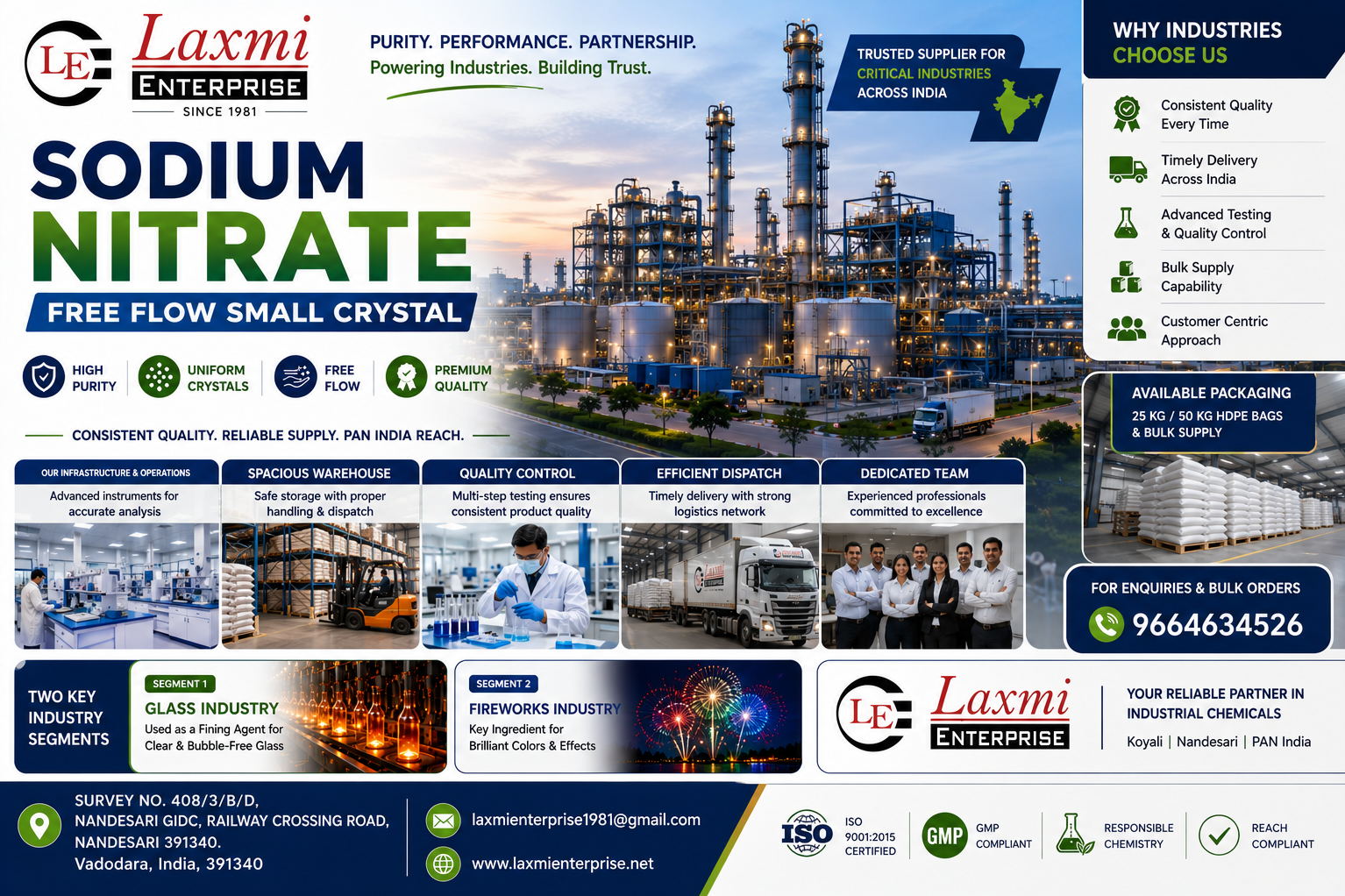
Laxmi Enterprise supplies industrial-grade Sodium Nitrate for a wide range of manufacturing applications across India.
Customers appreciate:
Consistent product quality
Reliable supply chain
Technical documentation
Prompt dispatch
Secure packaging
Competitive pricing
Customer-focused support
Long-term business relationships
Frequently Asked Questions (FAQ)
1. Why is display glass more difficult to manufacture than ordinary glass?
Display glass requires much tighter control over optical quality, thickness, flatness, and surface finish. Even microscopic defects that might be acceptable in conventional glass can affect image clarity, touch performance, or coating quality in electronic displays.
2. What role does Sodium Nitrate play in display glass manufacturing?
Where it is used in glass formulations, Sodium Nitrate supports oxidation and refining during the melting process. It helps create cleaner molten glass by assisting the removal of gases and promoting better melt homogeneity.
3. Does Sodium Nitrate improve touchscreen sensitivity?
No. Touch sensitivity is determined by the touchscreen design, sensor technology, and electronic components. Sodium Nitrate contributes earlier in manufacturing by helping produce a high-quality glass substrate where it is part of the refining system.
4. Why are microscopic bubbles a concern in display glass?
Tiny bubbles can scatter light, reduce optical clarity, interfere with display quality, and lead to rejection during inspection. High-quality refining aims to minimize these defects.
5. What is melt homogeneity, and why is it important?
Melt homogeneity means the molten glass has a uniform chemical composition and physical properties throughout. A homogeneous melt helps produce glass with consistent optical performance, thickness, and mechanical behavior.
6. How do coatings improve display glass?
Specialized coatings can reduce reflections, resist fingerprints, improve scratch resistance, or enhance user interaction. These coatings perform best when applied to a clean and uniform glass surface.
7. Does Sodium Nitrate become part of the finished electronic display?
Its primary function is during melting and refining. The exact chemical behavior depends on the glass formulation and manufacturing process used by the producer.
8. How do manufacturers inspect display glass?
Inspection typically includes measurements of optical transmission, flatness, thickness, bubble count, surface quality, distortion, and dimensional accuracy using advanced optical and automated inspection systems.
9. What industries purchase high-performance display glass?
Applications include consumer electronics, automotive displays, medical equipment, industrial automation, aviation, retail kiosks, telecommunications, defense systems, and smart appliances.
10. How should Sodium Nitrate be stored before use?
It should be stored in sealed packaging in a clean, dry, and well-ventilated environment. Proper storage helps maintain product consistency and reduces the risk of moisture absorption.
11. What documents are commonly required with industrial shipments?
Manufacturers generally expect a Certificate of Analysis (COA), product specifications, batch identification, packing details, safety documentation where applicable, and commercial shipping documents.
12. Why do manufacturers prefer long-term Sodium Nitrate suppliers?
Long-term suppliers often provide consistent product quality, dependable logistics, technical documentation, and reliable customer support, helping manufacturers maintain stable production and quality standards.