Sodium Sulphate for Glass Manufacturing: Applications, Quality Requirements & Complete Buyer's Guide (2026)
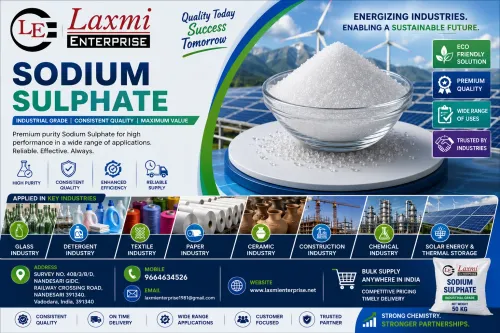
Sodium Sulphate is widely used in the glass industry as a fining agent that helps remove gas bubbles from molten glass, supporting improved clarity and production consistency in many formulations. Glass manufacturers evaluate Sodium Sulphate based on purity, moisture, particle size, iron content, chloride levels, and batch consistency. Selecting a technically reliable supplier with consistent quality and dependable logistics helps maintain stable furnace operations and product quality.
Table of Contents
Why Sodium Sulphate Is Used in Glass Manufacturing
The Role of Sodium Sulphate in Glass Production
How It Supports the Glass Melting Process
Glass Industry Quality Requirements
Important Technical Parameters
Storage and Handling at Glass Plants
Procurement Guide
Supplier Evaluation Checklist
Pan-India Supply for Glass Manufacturers
Frequently Asked Questions
Conclusion
Why Is Sodium Sulphate Used in Glass Manufacturing?
Quick Answer
Many glass manufacturers use Sodium Sulphate as part of the batch formulation because it can assist the fining process by helping remove entrapped gases from molten glass. This contributes to improved melt quality and more uniform finished products when used within an optimized glass formulation.
Glass production depends on carefully balanced raw materials. Even small variations in raw material quality can affect melting behavior, furnace efficiency, and the quality of the finished glass.
Because of this, procurement teams often evaluate suppliers not only on cost, but also on consistency, documentation, and technical support.
Understanding the Glass Manufacturing Process
Glass is produced by melting a carefully controlled mixture of raw materials at high temperatures.
Typical batch materials include:
Silica sand
Soda ash
Limestone
Dolomite (where required)
Feldspar (depending on formulation)
Recycled glass (cullet)
Selected refining or fining agents, including Sodium Sulphate in many formulations
Each raw material performs a specific function, and the exact formulation varies by glass type and manufacturer.
Role of Sodium Sulphate in the Glass Furnace
Quick Answer
In many glass formulations, Sodium Sulphate functions as a fining agent. During melting, it helps facilitate the removal of small gas bubbles, supporting improved homogeneity and optical quality in the finished glass.
If gas bubbles remain trapped in molten glass, they may lead to visible defects or reduced product quality.
A controlled fining process contributes to:
Better melt refinement.
Reduced visible bubbles.
Improved optical appearance.
More consistent production.
The effectiveness of Sodium Sulphate depends on the overall batch composition and furnace operating conditions.
Why Bubble Removal Matters
Gas bubbles can originate from:
Chemical reactions between raw materials.
Moisture present in the batch.
Air entrapped during charging.
Decomposition of certain raw materials.
If these bubbles are not adequately removed before forming, they can affect product quality.
Typical concerns include:
Optical distortion.
Visible seeds or bubbles.
Reduced product consistency.
Increased rejection rates.
A well-controlled fining process helps minimize these issues.
Types of Glass That May Use Sodium Sulphate
The use and specification of Sodium Sulphate vary by manufacturer and glass composition. It may be used in the production of:
Container glass.
Flat glass.
Architectural glass.
Automotive glass.
Decorative glass.
Patterned glass.
Certain specialty glass products.
The specific formulation should always be determined by the glass manufacturer.
Technical Requirements for Glass Manufacturers
Quick Answer
Glass manufacturers generally seek Sodium Sulphate with consistent quality rather than focusing on a single specification. Parameters such as purity, iron content, moisture, particle size, and water-insoluble matter are commonly reviewed because they can influence batch consistency and process control.
Common Evaluation Parameters
Parameter Why It Matters
Purity Supports predictable batch composition
Moisture Affects storage and handling
Iron Content Often monitored for quality-sensitive applications
Water-Insoluble Matter Can influence melt cleanliness
Particle Size Helps maintain uniform batching
Appearance Indicates product consistency
Batch Consistency Supports repeatable production
Buyers should establish acceptance criteria based on their own manufacturing process.
Why Consistency Is More Important Than Peak Purity
A supplier that delivers repeatable quality from batch to batch often provides greater operational value than one offering occasional high-purity batches with inconsistent characteristics.
Consistent material helps:
Reduce furnace adjustments.
Improve production planning.
Support stable product quality.
Minimize process variability.
Simplify incoming quality control.
Long-term consistency is therefore a key procurement objective.
Storage and Handling at Glass Plants
Quick Answer
Proper storage protects Sodium Sulphate from moisture, contamination, and physical damage. Good warehouse practices help maintain flowability and reduce handling issues before the material enters the glass batch preparation system.
Recommended practices:
Store indoors in a dry warehouse.
Keep packaging sealed until use.
Protect from rain and standing water.
Use pallets to reduce ground moisture exposure.
Rotate inventory using FIFO.
Inspect bags before charging to production.
These practices help preserve material quality during storage.
Packaging Options
Industrial suppliers commonly offer:
Packaging Typical Use
25 kg Bags Laboratory or lower-volume operations
50 kg Bags Standard industrial handling
500 kg Jumbo Bags Medium-scale production
1000 kg Jumbo Bags High-volume glass plants
Bulk Deliveries Large continuous users, where available
Packaging should be selected based on consumption rates, warehouse facilities, and material handling equipment.
Buyer Checklist Before Purchasing
Before placing an order, procurement teams should confirm:
Required grade.
Product specification.
Desired particle size.
Moisture limits.
Iron limits, if relevant.
Batch documentation.
COA availability.
TDS and SDS/MSDS.
Packaging requirements.
Delivery schedule.
Clear communication of these requirements helps suppliers recommend the most suitable product.
How to Evaluate a Supplier
Technical Capability
Consistent quality control.
Batch traceability.
Laboratory testing.
Technical documentation.
Supply Capability
Inventory availability.
Flexible packaging.
Reliable logistics.
Delivery planning.
Service Capability
Technical assistance.
Responsive communication.
Documentation support.
Long-term supply planning.
Selecting a supplier based on these factors can contribute to more reliable procurement.
Pan-India Supply for Glass Manufacturers
India's glass industry is concentrated in several manufacturing regions, including:
Gujarat
Rajasthan
Uttar Pradesh (including the Firozabad glass cluster)
Maharashtra
Haryana
Punjab
Delhi NCR
Madhya Pradesh
Telangana
Karnataka
Tamil Nadu
Andhra Pradesh
West Bengal
These regions produce a wide range of container, flat, architectural, automotive, and specialty glass products.
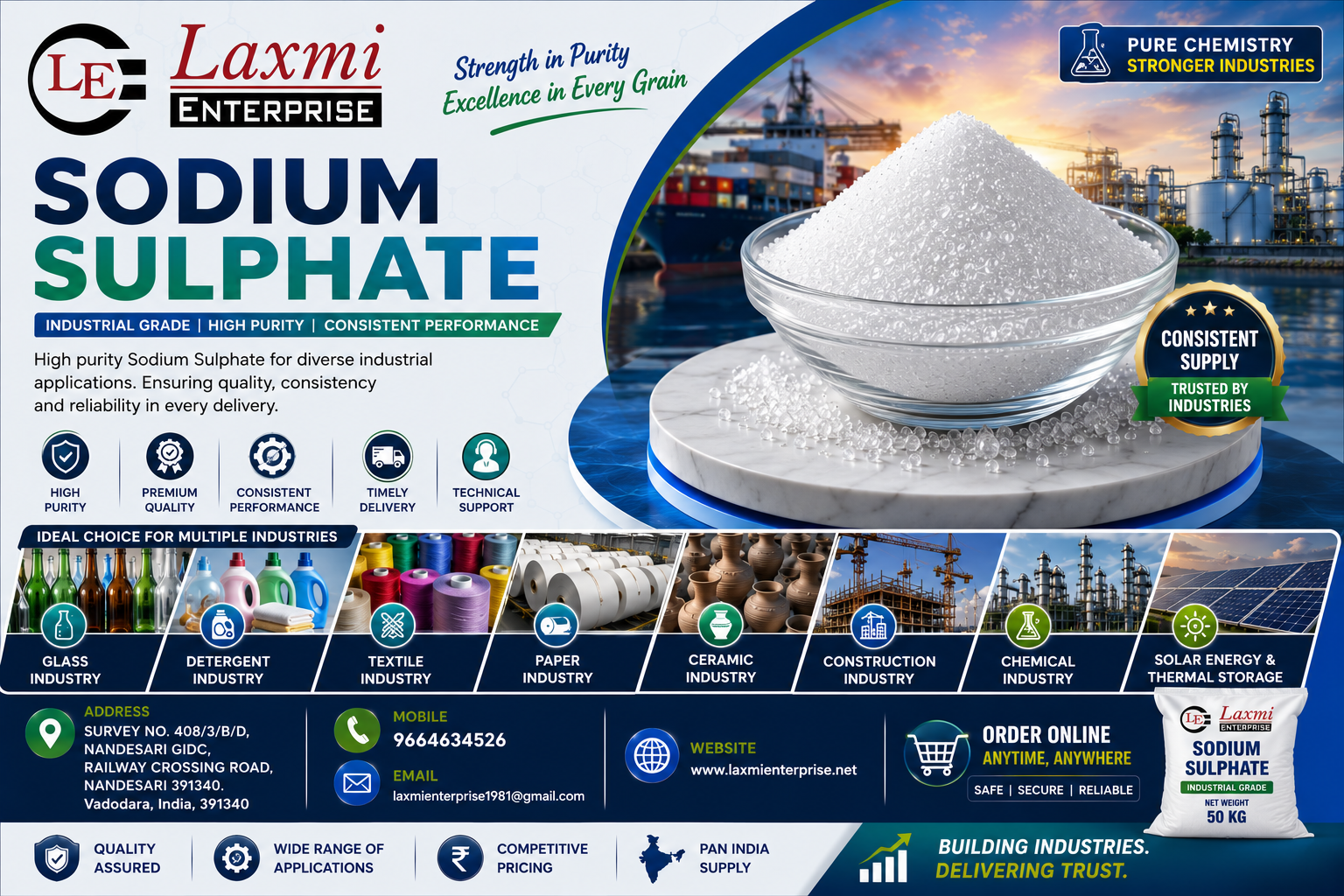
Laxmi Enterprise, based in Nandesari GIDC, Vadodara, Gujarat, supplies industrial-grade Sodium Sulphate to glass manufacturers across Pan India. The company supports customers with technical documentation, quality-focused sourcing, and logistics planning tailored to production schedules and procurement requirements.
Why Manufacturers Choose Long-Term Supply Partners
Glass furnaces operate continuously, and interruptions in raw material availability can affect production planning.
For this reason, many manufacturers value suppliers that can provide:
Consistent product specifications.
Predictable delivery schedules.
Batch traceability.
Technical documentation.
Responsive customer support.
A long-term supplier relationship can simplify procurement and improve operational stability.
Frequently Asked Questions
Does every glass manufacturer use Sodium Sulphate?
No. The composition of glass batches varies by product type, plant design, and manufacturing process. The decision to use Sodium Sulphate and the required dosage are determined by the glass manufacturer.
Why is iron content important?
Certain glass applications are sensitive to impurities. Manufacturers may specify iron limits as part of their quality requirements, depending on the product being produced.
Can moisture affect glass production?
Excess moisture can influence storage, handling, and batching. Keeping Sodium Sulphate dry helps maintain consistent flow and dosing characteristics.
What documents should accompany a shipment?
Industrial buyers commonly request a Certificate of Analysis (COA), Technical Data Sheet (TDS), Safety Data Sheet (SDS/MSDS), batch identification, and commercial shipping documents as applicable.
Conclusion
Sodium Sulphate remains an important raw material for many glass manufacturing processes because of its role in fining and its contribution to consistent melt quality. Selecting the appropriate grade requires consideration of purity, particle size, moisture, impurity profile, packaging, and supplier capability.
For glass manufacturers across India, dependable supply, technical documentation, and consistent batch quality are key factors in successful procurement. Laxmi Enterprise, located in Nandesari GIDC, Vadodara, Gujarat, supplies industrial-grade Sodium Sulphate to customers across Pan India, supporting glass manufacturers with application-focused guidance, quality documentation, and reliable logistics.
Keywords