Sodium Sulphate Quality Testing: Laboratory Methods, COA Interpretation & Industrial Quality Control Guide (2026)
Quality testing of Sodium Sulphate verifies that every batch meets the technical specifications required for industrial applications. Manufacturers commonly evaluate purity, moisture content, water-insoluble matter, chloride, iron, particle size, bulk density, and appearance before dispatch. A consistent quality control program, supported by Certificates of Analysis (COA) and traceable documentation, helps buyers reduce production risks and maintain process consistency.
Table of Contents
Why Quality Testing Is Important
Quality Assurance vs. Quality Control
Sampling Procedures
Laboratory Equipment
Appearance Inspection
Purity Testing
Moisture Determination
Water-Insoluble Matter Analysis
Chloride Testing
Iron Determination
Particle Size Analysis
Bulk Density Measurement
pH Measurement
COA Interpretation
Supplier Quality Evaluation
Buyer Inspection Checklist
Storage & Retesting
Frequently Asked Questions
Conclusion
Why Quality Testing Matters
Quick Answer
Quality testing confirms that Sodium Sulphate meets agreed technical specifications before it enters a manufacturing process. Even small variations in moisture, particle size, or impurity levels can affect handling, mixing, dissolution, or process performance in industries such as glass, detergents, textiles, paper, ceramics, and chemicals.
Reliable testing helps manufacturers:
Reduce production variability.
Minimize process interruptions.
Improve product consistency.
Support regulatory compliance where applicable.
Verify supplier performance over time.
Testing also strengthens confidence between buyers and suppliers by providing objective, batch-specific data.
Quality Assurance (QA) vs. Quality Control (QC)
Although often used together, Quality Assurance and Quality Control have different purposes.
Quality Assurance (QA) Quality Control (QC)
Focuses on preventing quality issues through systems and procedures Focuses on verifying that each batch meets specifications through inspection and testing
Includes documented processes, audits, and training Includes laboratory testing and batch release
Aims for long-term consistency Confirms compliance before dispatch
An effective supplier integrates both QA and QC into its operations.
Sampling Procedures
Quick Answer
Laboratory results are only meaningful if the sample accurately represents the entire batch. Proper sampling techniques help ensure that test results reflect the quality of the material actually supplied.
Why Sampling Matters
Sodium Sulphate stored in bags or bulk containers may show slight variation in particle distribution or moisture. A representative sample reduces the risk of misleading test results.
Good Sampling Practices
Use clean, dry sampling tools.
Collect samples from different locations within the batch.
Combine portions to create a representative composite sample.
Mix thoroughly before laboratory analysis.
Label samples with batch number, date, and source.
Store samples in sealed containers until testing.
Maintaining retained samples for a defined period can assist in investigating customer feedback or quality concerns.
Laboratory Equipment Commonly Used
Quality laboratories may use equipment such as:
Analytical balance.
Laboratory oven.
Desiccator.
Sieve shaker.
Moisture determination equipment.
Glassware (beakers, flasks, burettes).
Filtration apparatus.
pH meter.
Spectrophotometric instruments (where required).
Laboratory furnace (for specific procedures).
Equipment should be calibrated and maintained according to the laboratory's quality system.
Appearance Inspection
Quick Answer
Visual inspection is the first quality check performed on many batches. It helps identify obvious issues such as discoloration, contamination, moisture-related caking, or packaging damage before laboratory testing begins.
Inspectors typically evaluate:
Colour.
Crystal appearance.
Uniformity.
Presence of foreign particles.
Dust level.
Packaging condition.
Although visual inspection cannot replace laboratory testing, it provides an important first assessment.
Purity Testing
Purity indicates the proportion of Sodium Sulphate relative to other constituents.
Laboratory analysis confirms whether the product meets the agreed specification.
Higher purity is not always required; the appropriate specification depends on the intended industrial application.
When reviewing purity, buyers should also consider impurity levels rather than relying on a single percentage value.
Moisture Determination
Quick Answer
Moisture content influences storage stability, flowability, packaging performance, and handling characteristics. Excess moisture can contribute to caking and reduced material flow during processing.
Why Moisture Matters
High moisture may lead to:
Poor flow through conveyors.
Difficulty in automated dosing.
Reduced shelf stability.
Increased risk of caking during storage.
Routine moisture testing supports consistent product quality.
Water-Insoluble Matter Analysis
This test measures the amount of material that does not dissolve under specified laboratory conditions.
Low water-insoluble matter is generally preferred where complete dissolution is required, such as in textile dyeing or certain chemical formulations.
The significance of this parameter varies depending on the application.
Chloride Testing
Quick Answer
Chloride is a commonly monitored impurity in Sodium Sulphate. Certain industrial applications require tighter chloride control because elevated levels may influence downstream processes or customer specifications.
Chloride testing helps:
Verify product quality.
Maintain process consistency.
Compare batches over time.
Confirm compliance with agreed specifications.
Iron Determination
Iron is another impurity monitored in many specifications, particularly for applications sensitive to colour or product quality.
Laboratories analyze iron content to verify compliance with customer requirements.
Regular monitoring supports batch-to-batch consistency.
Particle Size Analysis
Particle size affects:
Flowability.
Dust generation.
Mixing efficiency.
Dissolution behaviour.
Feeding systems.
Laboratories commonly use sieve analysis to determine particle size distribution.
Consistent particle size contributes to more predictable manufacturing performance.
Bulk Density Measurement
Quick Answer
Bulk density measures the mass of Sodium Sulphate occupying a given volume. It influences packaging efficiency, warehouse storage, transportation, and automated material handling.
Bulk density can vary depending on:
Crystal size.
Moisture.
Manufacturing method.
Handling during packaging.
Because it affects logistics and dosing systems, buyers often include bulk density in procurement specifications.
pH Measurement
Although Sodium Sulphate is generally considered a neutral inorganic salt, laboratories may measure the pH of a prepared solution as part of routine quality evaluation.
This test can help identify unusual variations that may indicate contamination or process deviations.
How to Read a Certificate of Analysis (COA)
Quick Answer
A Certificate of Analysis (COA) summarizes the laboratory results for a specific production batch. Buyers should compare each reported value with the agreed purchase specification before accepting material.
A typical COA may include:
Product name.
Batch number.
Manufacturing or dispatch date.
Purity.
Moisture.
Water-insoluble matter.
Chloride.
Iron.
Appearance.
Test methods (where applicable).
Approval or release information.
Maintaining COA records supports traceability and quality management.
Supplier Quality Evaluation
Beyond laboratory results, procurement teams should evaluate whether the supplier demonstrates:
Consistent batch quality.
Reliable documentation.
Traceability.
Technical support.
Packaging integrity.
Complaint handling procedures.
Inventory management.
Delivery reliability.
These factors contribute to long-term supply stability.
Buyer Inspection Checklist
Upon receiving a shipment, buyers should verify:
Correct product grade.
Packaging condition.
Quantity received.
Batch numbers.
COA availability.
TDS and SDS/MSDS.
Visual appearance.
Storage conditions during transport.
If required, retain a representative sample before using the material in production.
Storage and Retesting
Proper storage helps preserve product quality.
Recommended practices include:
Store indoors in a clean, dry warehouse.
Keep bags sealed until use.
Protect from moisture and contamination.
Rotate inventory using FIFO.
Retest stored material if required by internal quality procedures.
Storage recommendations may vary depending on customer requirements and environmental conditions.
Pan-India Quality Support
Manufacturers across India increasingly expect suppliers to provide not only product but also technical documentation and quality support.
Industrial clusters in Gujarat, Maharashtra, Rajasthan, Delhi NCR, Punjab, Haryana, Uttar Pradesh, Madhya Pradesh, Chhattisgarh, Odisha, West Bengal, Karnataka, Telangana, Andhra Pradesh, Tamil Nadu, Kerala, Jharkhand, and Assam often require consistent quality documentation to support production and customer audits.
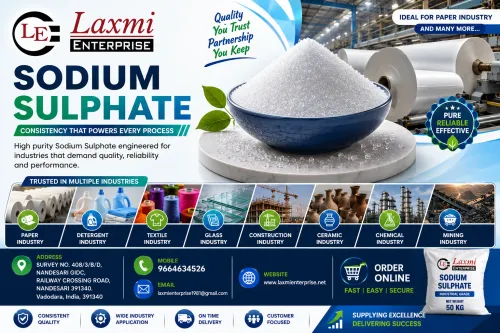
Laxmi Enterprise, located in Nandesari GIDC, Vadodara, Gujarat, supplies Sodium Sulphate to customers across Pan India, supporting procurement teams with batch documentation, technical information, and logistics planning based on customer requirements.
Frequently Asked Questions
Why should every batch be tested?
Batch testing helps verify that the supplied material meets the agreed specification and supports consistent manufacturing performance.
Is a COA sufficient for quality approval?
A COA is an important document, but many manufacturers also perform incoming inspection and, where required, their own laboratory verification before approving material for production.
How often should incoming material be inspected?
Inspection frequency depends on internal quality systems, supplier qualification, process criticality, and customer requirements. Many organizations establish inspection plans based on risk assessment.
What should I do if results differ from the COA?
Quarantine the material, review sampling procedures, compare test methods, and communicate with the supplier before making a final disposition. Maintaining retained samples can assist in resolving discrepancies.
Conclusion
Quality testing is a critical part of industrial procurement. By understanding sampling methods, laboratory tests, Certificates of Analysis, and supplier quality systems, buyers can make informed purchasing decisions and reduce operational risks.
A technically capable supplier provides more than product—it provides traceable documentation, consistent specifications, and support throughout the procurement process. For manufacturers across India, partnering with an experienced supplier helps strengthen quality assurance, improve production reliability, and support long-term supply continuity.
Keywords