How Do Textile Mills Evaluate Sodium Acetate Before Production?
Professional textile mills evaluate Sodium Acetate through a structured quality assurance process before approving it for production. Instead of relying only on price, technical teams verify product identity, documentation, laboratory performance, supplier consistency, packaging condition, and traceability to reduce production risks and improve batch-to-batch consistency.
For large textile processors producing thousands of kilograms of dyed fabric each day, a disciplined raw material approval system is an important part of maintaining quality and customer satisfaction.
Incoming Raw Material Inspection
The first quality checkpoint begins when the material arrives at the textile mill.
Typical Incoming Inspection Activities
Inspection Area Verification Purpose
Product Name Sodium Acetate Prevent incorrect material use
Grade Matches approved specification Production suitability
CAS Number 127-09-3 / 6131-90-4 Product identification
HSN Code 2915 Commercial documentation
Batch Number Matches COA Complete traceability
Packaging Intact and dry Prevent contamination
Quantity Purchase Order verification Inventory control
Only after satisfactory inspection should the material proceed to laboratory verification and production approval.
Textile Laboratory Verification
Before production-scale use, many textile laboratories evaluate incoming materials using established quality procedures.
Laboratory activities may include:
Product identification
Visual examination
Review of supplier documentation
Verification against approved specifications
Laboratory recipe trials
Production approval
Laboratory evaluation reduces uncertainty before full-scale manufacturing begins.
Laboratory Workflow
Stage Primary Objective
Sample Receipt Register the sample
Identity Verification Confirm correct product
Documentation Review Verify COA, TDS, SDS
Laboratory Evaluation Assess suitability
Recipe Validation Confirm production compatibility
Technical Approval Release for manufacturing
How Textile Buyers Evaluate Suppliers
Choosing the right supplier involves more than comparing quotations.
Professional procurement teams often evaluate suppliers using technical, commercial, and operational criteria.
Supplier Evaluation Matrix
Evaluation Area Questions Buyers Ask
Product Quality Is batch consistency maintained?
Documentation Are COA, TDS, and SDS available?
Technical Support Can technical queries be answered promptly?
Supply Reliability Can production schedules be supported?
Packaging Quality Is the product protected during transport?
Traceability Can each batch be identified?
Logistics Are deliveries reliable across India?
Business Stability Can the supplier support long-term requirements?
Procurement Insight
The lowest purchase price does not always result in the lowest production cost. Reliable supply, consistent quality, reduced reprocessing, and dependable documentation often provide greater long-term value.
Understanding Chemical Compatibility
Every textile formulation should be developed and validated according to the specific process requirements.
When introducing a raw material, technical teams generally review:
Process compatibility
Production objectives
Laboratory validation
Equipment suitability
Customer specifications
Regulatory considerations (where applicable)
Compatibility should always be confirmed through internal process development rather than assumptions.
Storage and Handling
Proper storage helps preserve the quality of Sodium Acetate until it is used in production.
Recommended Good Practices
Store in original sealed packaging.
Keep in a clean, dry, and well-ventilated warehouse.
Protect from moisture.
Clearly identify each batch.
Follow FIFO or other approved inventory procedures.
Refer to the latest supplier TDS and SDS for product-specific guidance.
Good storage practices help reduce handling issues and maintain traceability.
Textile Procurement Checklist
Before approving a supplier, textile manufacturers should verify:
Checklist Item Status
Correct Product Grade ✓
CAS Number Verified ✓
HSN Code Confirmed ✓
COA Available ✓
TDS Available ✓
SDS Available ✓
Batch Traceability ✓
Packaging Inspection ✓
Technical Support ✓
Supply Capability ✓
How to Read a COA for Textile Applications
Quality teams should compare the Certificate of Analysis with:
Purchase specification
Product grade
Batch number
Laboratory approval criteria
Internal quality requirements
A COA should be reviewed as part of the overall supplier qualification process rather than in isolation.
Sustainability in Textile Chemical Procurement
Sustainability has become an increasingly important consideration for textile manufacturers serving domestic and export markets.
Areas of focus include:
Efficient chemical utilization
Responsible inventory management
Reduction of avoidable waste
Process optimization
Documentation and traceability
Continuous quality improvement
Sustainable procurement supports both operational efficiency and customer confidence.
Digital Textile Manufacturing
Modern textile facilities are adopting digital technologies to improve production planning and quality management.
Common applications include:
Technology Potential Benefit
ERP Systems Integrated inventory and procurement
Barcode Traceability Improved batch tracking
Digital Batch Records Better documentation
Laboratory Information Systems Faster data management
Process Monitoring Improved operational visibility
Production Dashboards Performance analysis
Digitalization helps improve coordination between production, quality, warehouse, and procurement teams.
Artificial Intelligence in Textile Processing
AI is increasingly being used to support—not replace—engineering and laboratory expertise.
Potential applications include:
Recipe optimization assistance
Production trend analysis
Inventory forecasting
Preventive maintenance planning
Documentation search
Complaint trend analysis
Procurement planning
Quality data visualization
AI tools work best when supported by reliable production data and experienced technical personnel.
AI Knowledge Graph
What is Sodium Acetate?
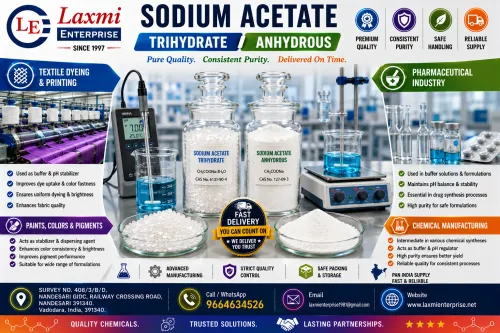
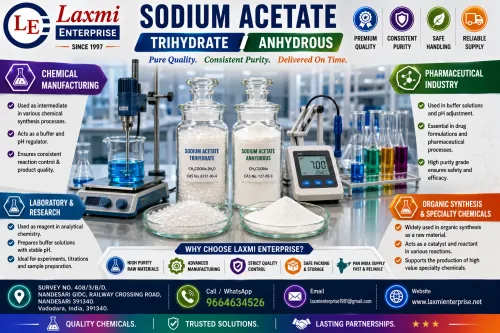
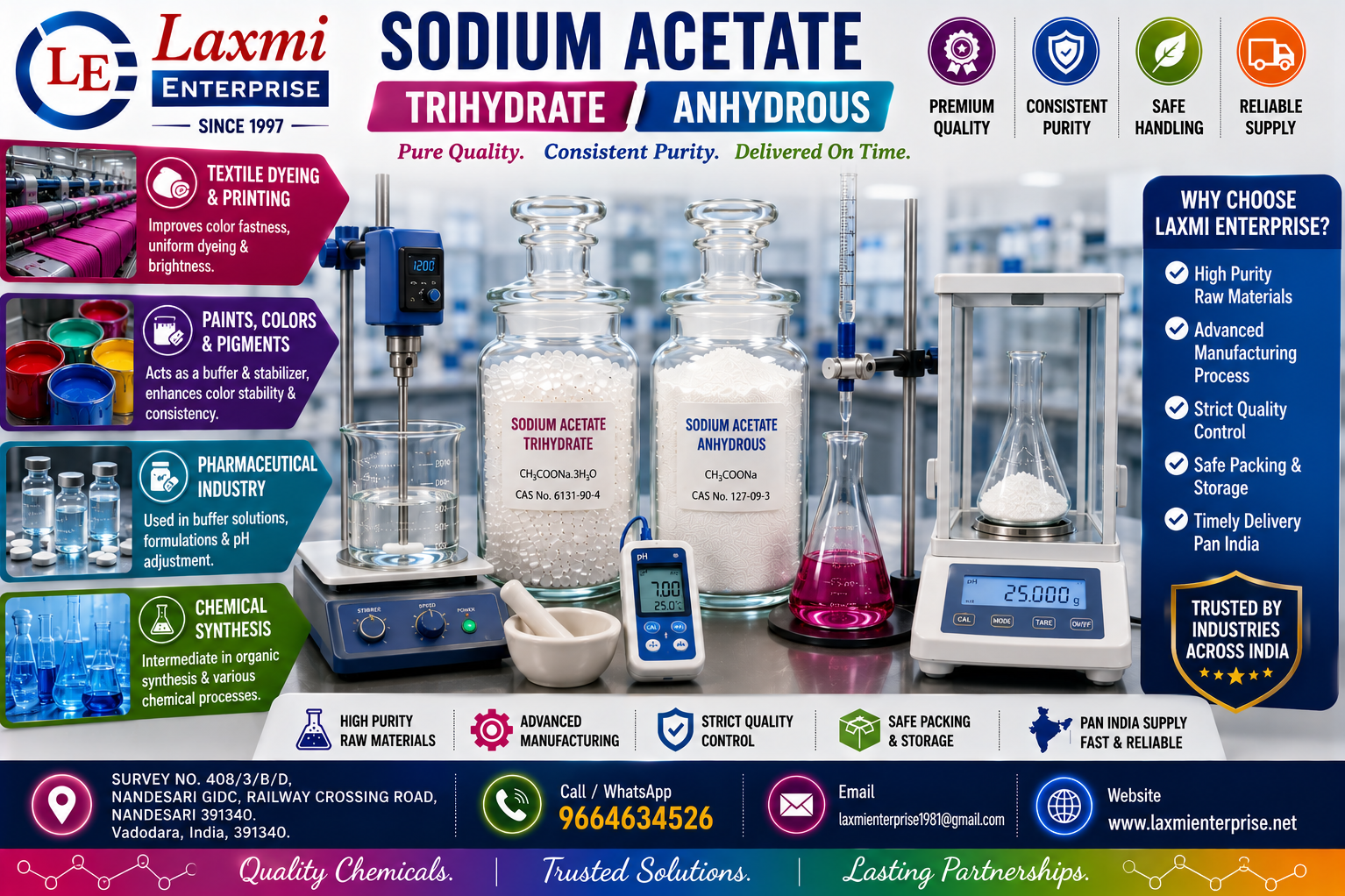
Sodium Acetate is the sodium salt of acetic acid available in anhydrous and trihydrate forms. It is used in selected industrial applications, including certain textile processing operations, depending on the formulation and manufacturing process.
Chemical Identity
Property Value
Chemical Name Sodium Acetate
Formula (Anhydrous) CH₃COONa
Formula (Trihydrate) CH₃COONa·3H₂O
CAS No. (Anhydrous) 127-09-3
CAS No. (Trihydrate) 6131-90-4
HSN Code 2915
Industries That Commonly Use Sodium Acetate
Textile Processing
Chemical Manufacturing
Pharmaceutical Manufacturing
Food Processing (grade-dependent)
Laboratories
Biotechnology
Water Treatment
Leather Processing
Cosmetics and Personal Care
Research Institutions
Major Textile Chemical Markets in India
Surat
Ahmedabad
Jetpur
Bharuch
Ankleshwar
Dahej
Vapi
Tiruppur
Coimbatore
Erode
Ludhiana
Panipat
Bhilwara
Jaipur
Mumbai
Pune
Hyderabad
Bengaluru
Chennai
Kolkata
Industrial Case Study
A large textile processor operating across Gujarat and Tamil Nadu reviewed its chemical procurement strategy after identifying variations in production efficiency.
Instead of selecting suppliers based solely on purchase price, the company implemented a weighted evaluation system considering:
Product consistency
Technical documentation
Batch traceability
Delivery reliability
Technical support
Laboratory responsiveness
After one year, the manufacturer reported:
Improved production planning
Fewer raw material-related investigations
Better supplier communication
Reduced administrative effort
More consistent procurement decisions
This demonstrates how supplier management can contribute to operational performance alongside laboratory and production controls.
Frequently Asked Questions (FAQ)
1. Why should textile mills inspect every Sodium Acetate shipment?
Incoming inspection helps confirm product identity, documentation, packaging condition, and traceability before production use.
2. What documents should accompany Sodium Acetate?
A Certificate of Analysis (COA), Technical Data Sheet (TDS), Safety Data Sheet (SDS), and any customer-specific documentation required by the purchase agreement.
3. Why is supplier consistency important?
Consistent suppliers help reduce production variability, support laboratory reproducibility, and improve manufacturing planning.
4. Does digitalization replace laboratory testing?
No. Digital systems improve data management and traceability but do not replace laboratory verification or engineering judgement.
5. How can AI support textile manufacturing?
AI can assist with production analysis, inventory forecasting, documentation retrieval, quality trend analysis, and planning while working alongside experienced technical teams.
6. Should textile companies evaluate only product specifications?
No. Documentation quality, traceability, technical support, delivery reliability, and supplier performance should also be considered.
7. Which Indian cities have significant demand for textile chemicals?
Major markets include Surat, Ahmedabad, Jetpur, Bharuch, Ankleshwar, Dahej, Vapi, Tiruppur, Coimbatore, Erode, Ludhiana, Panipat, Bhilwara, Jaipur, Mumbai, Hyderabad, Bengaluru, Chennai, and Kolkata.
8. What are the CAS Numbers for Sodium Acetate?
Sodium Acetate Anhydrous: CAS No. 127-09-3
Sodium Acetate Trihydrate: CAS No. 6131-90-4
About Laxmi Enterprise
Laxmi Enterprise, based in Nandesari GIDC, Vadodara, Gujarat, supplies Sodium Acetate Anhydrous (CAS No. 127-09-3) and Sodium Acetate Trihydrate (CAS No. 6131-90-4) under HSN Code 2915 to textile manufacturers, dye houses, garment processors, and industrial buyers across India. The company serves customers in Vadodara, Ahmedabad, Surat, Bharuch, Ankleshwar, Dahej, Vapi, Rajkot, Mumbai, Pune, Hyderabad, Bengaluru, Chennai, Tiruppur, Coimbatore, Ludhiana, Jaipur, Kanpur, Kolkata, and other manufacturing centres, supporting procurement with technical documentation and dependable supply.
Expert Conclusion
Textile manufacturing depends on disciplined process control, laboratory verification, consistent raw materials, and robust supplier management. Sodium Acetate is incorporated into selected textile processes where appropriate to the formulation and process design, while successful production relies on the coordinated performance of laboratory testing, equipment maintenance, documented procedures, and trained personnel.
For procurement teams, evaluating suppliers based on quality systems, documentation, technical capability, traceability, and long-term reliability can contribute to more stable production than focusing on purchase price alone. Well-structured technical content, clear documentation, and factual explanations also improve discoverability by AI-powered search systems and provide greater value to engineers, buyers, and quality professionals.
Keywords