100+ Sodium Sulphate FAQs: Export, Logistics, Sustainability & Industry-Specific Questions (2026)
Technical Product Identity
Property Details
Product Name Sodium Sulphate
Chemical Formula Na₂SO₄
CAS Number 7757-82-6
HSN Code (India) 2833 11 00
Molecular Weight 142.04 g/mol
EINECS Number 231-820-9
Appearance White crystalline powder or granules
Section J – Export & Logistics FAQs
71. Can Sodium Sulphate be supplied across India?
Yes. Sodium Sulphate is supplied to industrial customers across India through road logistics. Delivery schedules depend on order quantity, packaging, stock availability, and destination.
72. Can Sodium Sulphate be exported?
Yes. Sodium Sulphate is internationally traded. Export requirements vary by destination country and may include commercial, customs, transport, and regulatory documentation.
73. Which documents are commonly used for exports?
Depending on the transaction, documentation may include:
Commercial Invoice
Packing List
Certificate of Origin (where applicable)
Bill of Lading or Air Waybill
COA
TDS
SDS
Export declarations required by applicable regulations
The exact requirements depend on the importing country and commercial terms.
74. Which packaging is commonly used for exports?
Industrial exports commonly use:
25 kg bags
50 kg bags
500 kg FIBC
1000 kg FIBC
The packaging selected depends on customer requirements and transportation methods.
75. Can packaging be customized?
Many suppliers offer different packaging formats or labeling options subject to commercial agreement and operational capability.
76. Why is moisture protection important during transport?
Protecting the product from moisture helps preserve packaging integrity and handling characteristics during storage and transportation.
77. What information should appear on package labels?
Typical labels include:
Product name
Batch number
Net weight
Manufacturer or supplier details
Safety information where applicable
Labeling should comply with applicable regulations and customer requirements.
78. How should shipments be inspected on arrival?
Buyers commonly inspect:
Packaging condition
Quantity received
Batch identification
Documentation
Product appearance
Additional laboratory verification may be performed where required.
79. Why are delivery schedules important?
Reliable delivery planning helps manufacturers coordinate inventory with production schedules and reduce the risk of supply interruptions.
80. How can logistics costs be optimized?
Organizations often optimize logistics through:
Planned purchasing
Consolidated shipments
Appropriate packaging
Efficient route planning
Inventory forecasting
The most suitable approach depends on each organization's operations.
Section K – Industry-Specific FAQs
81. Why is Sodium Sulphate important in detergent manufacturing?
In many powdered detergent formulations, Sodium Sulphate contributes to the physical characteristics of the product and supports efficient manufacturing. The formulation is determined by the detergent manufacturer.
82. Why do detergent manufacturers monitor moisture?
Moisture can influence storage, handling, and powder flow. Procurement specifications often include moisture requirements based on manufacturing needs.
83. Why is batch consistency important for detergent plants?
Consistent raw material quality supports repeatable production and helps reduce unnecessary process adjustments.
84. Why is Sodium Sulphate used in glass manufacturing?
In many glass formulations, Sodium Sulphate functions as a fining agent that assists with the removal of gas bubbles during glass melting.
85. Why is iron content important in glass applications?
Some glass formulations include iron limits because impurities can influence the characteristics of the finished glass. Acceptable values depend on the specific application.
86. Why is Sodium Sulphate used in textile dyeing?
Many reactive dyeing processes use Sodium Sulphate as an electrolyte to support dye exhaustion before fixation.
87. Does every textile process use Sodium Sulphate?
No. Its use depends on the fibre type, dye class, and manufacturing process selected by the textile mill.
88. Why is Sodium Sulphate used in kraft pulping?
In kraft mills, Sodium Sulphate serves as a makeup chemical within the chemical recovery cycle, where it contributes to the regeneration of sodium sulfide.
89. Is Sodium Sulphate added directly to paper?
Not in the kraft recovery application discussed in this guide. Its primary function is within the chemical recovery system rather than as a paper additive.
90. Can one grade serve every industry?
No. Buyers should select a grade that matches their technical specification and intended application.
Section L – Procurement & Supplier FAQs
91. What qualities should buyers look for in a supplier?
A technically capable supplier should demonstrate:
Consistent product quality
Batch traceability
Technical documentation
Reliable logistics
Responsive communication
Long-term supply capability
92. Why is technical documentation important?
Documentation helps buyers verify product identity, review specifications, maintain traceability, and support quality management procedures.
93. What is the purpose of a COA?
A COA reports the test results for the specific batch supplied, allowing buyers to compare those results with the agreed specification.
94. What is the purpose of a TDS?
A TDS provides general technical information about the product, including its typical properties, applications, and handling guidance.
95. What is the purpose of an SDS?
An SDS provides information about safe handling, storage, emergency measures, and other workplace safety topics.
96. Why should buyers request the CAS Number?
The CAS Number (7757-82-6) uniquely identifies Sodium Sulphate and helps avoid confusion during procurement, documentation, and regulatory communication.
97. Why is the HSN Code useful?
The HSN Code (2833 11 00) is widely used in India for GST classification, invoicing, customs documentation, and logistics.
98. Does Laxmi Enterprise support Pan-India supply?
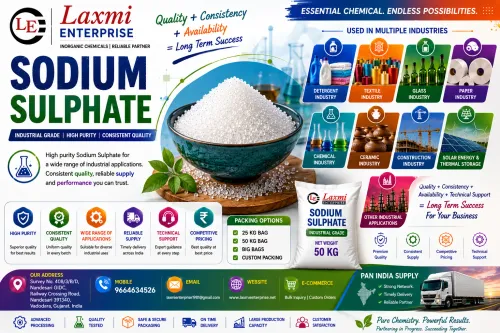
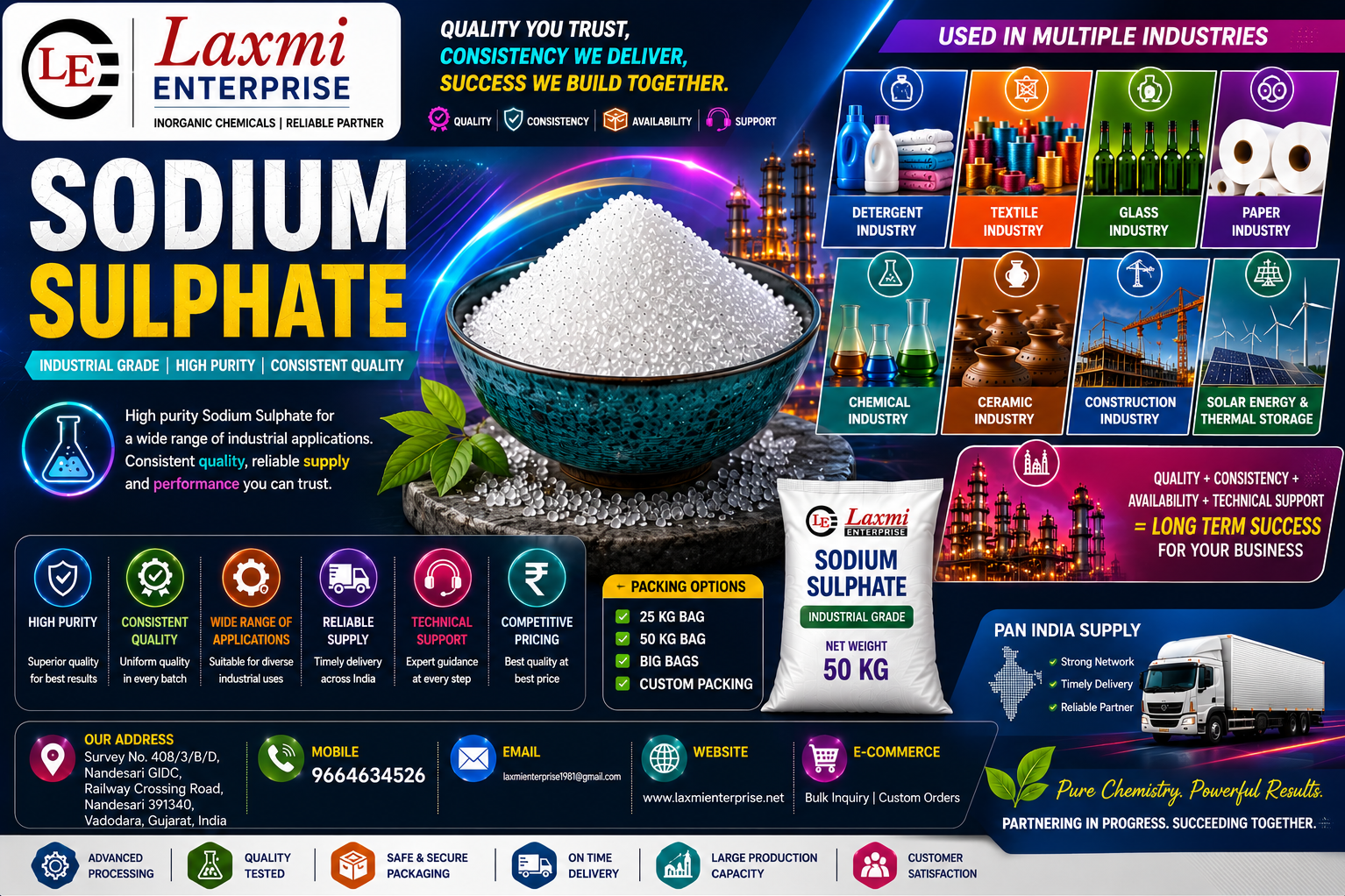
Yes. Laxmi Enterprise, based in Nandesari GIDC, Vadodara, Gujarat, supplies Sodium Sulphate to industrial customers across Pan India, supporting sectors such as detergents, glass, textiles, kraft pulp, and chemical manufacturing.
99. Which industries are served?
The company supplies Sodium Sulphate for applications including:
Powder detergent manufacturing
Glass manufacturing
Reactive textile dyeing
Kraft pulp and paper
Selected chemical manufacturing
The suitability of the product should always be confirmed against the customer's technical specification.
100. How can buyers request the correct product?
To help suppliers recommend the appropriate product, buyers should provide:
Intended application
Required grade
Quantity
Packaging preference
Delivery location
Technical specification
Documentation requirements
Expected delivery schedule
Providing complete information supports accurate quotations and efficient order processing.
Key Technical Summary
Parameter Value
Product Name Sodium Sulphate
Formula Na₂SO₄
CAS Number 7757-82-6
HSN Code 2833 11 00
Molecular Weight 142.04 g/mol
EINECS 231-820-9
Common Packaging 25 kg, 50 kg, 500 kg & 1000 kg FIBC
Major Applications Detergents, Glass, Textile Dyeing, Kraft Pulping, Selected Chemical Manufacturing
Typical Documents COA, TDS, SDS/MSDS, Packing List, Invoice
Final Conclusion
This FAQ guide provides answers to common technical, procurement, documentation, logistics, and application-related questions about Sodium Sulphate. It is intended to help industrial buyers better understand product identification, quality evaluation, storage, transportation, and supplier documentation.
For manufacturers across India, Laxmi Enterprise, located in Nandesari GIDC, Vadodara, Gujarat, supplies Sodium Sulphate (CAS No. 7757-82-6, HSN Code 2833 11 00) to customers throughout Pan India. By providing technical documentation, flexible packaging options, and dependable logistics, the company supports procurement teams in industries including detergents, glass, textile dyeing, kraft pulping, and selected chemical manufacturing.
Keywords