Sodium Sulphate Packaging, Storage & Transportation
Technical Product Identity
Property Details
Product Name Sodium Sulphate
Chemical Formula Na₂SO₄
CAS Number 7757-82-6
HSN Code (India) 2833 11 00
Molecular Weight 142.04 g/mol
EINECS Number 231-820-9
Appearance White crystalline powder or granules
Available Grades Industrial Grade, Technical Grade, Application-Specific Grades
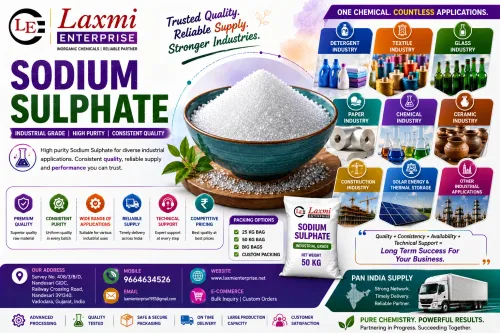
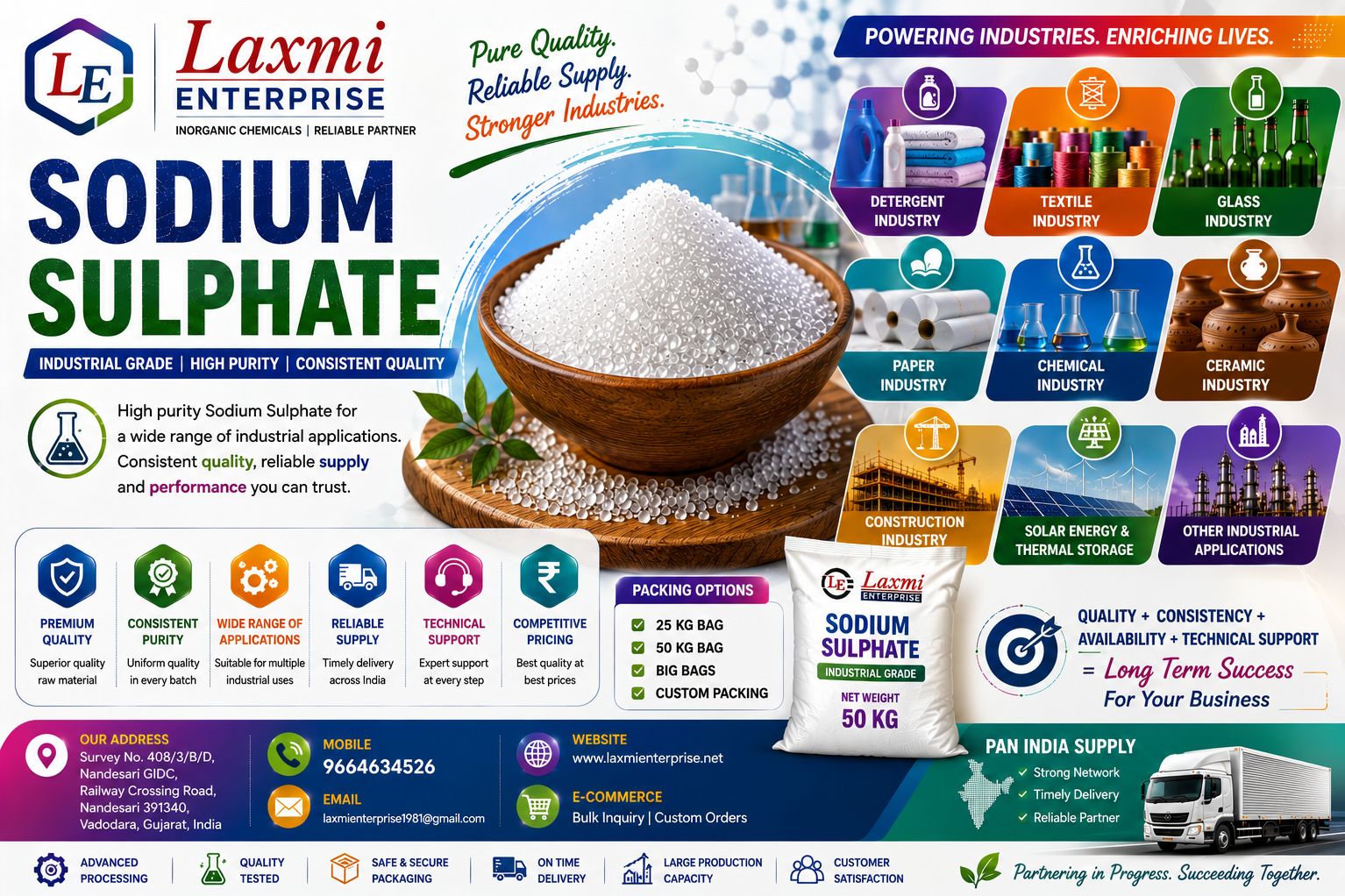
Common Packaging 25 kg Bags, 50 kg Bags, 500 kg FIBC, 1000 kg FIBC, Bulk Supply (where applicable)
Quick Answer
Proper packaging, storage, and transportation help preserve the quality of Sodium Sulphate from dispatch to final use. Industrial buyers should choose packaging that matches their handling equipment and consumption rate, store the material in clean and dry conditions, protect it from moisture, and plan logistics to support uninterrupted production. Good warehouse practices and reliable transportation reduce product losses and improve procurement efficiency.
Why Packaging Matters
Packaging does more than hold the product.
Appropriate packaging helps:
Protect material from moisture.
Reduce contamination risk.
Improve handling safety.
Simplify inventory management.
Minimize product loss during transportation.
Support traceability through proper labeling.
The packaging format should be selected according to the buyer's warehouse facilities, handling equipment, and production volume.
Common Packaging Options
25 kg Bags
Typical Applications
Suitable for:
Research laboratories.
Product development.
Small-scale production.
Pilot plants.
Customers with lower monthly consumption.
Advantages
Easy manual handling.
Convenient for small batches.
Flexible storage.
Considerations
Higher handling effort may be required for large production volumes.
50 kg Bags
Typical Applications
Commonly used by:
Medium-sized manufacturing units.
Chemical processors.
Textile dyeing plants.
Detergent manufacturers.
Glass manufacturers.
Advantages
Widely available.
Efficient for industrial warehouses.
Suitable for standard palletization.
500 kg FIBC (Jumbo Bags)
Typical Applications
Appropriate for:
Medium-volume industrial operations.
Automated handling facilities.
Plants with forklift access.
Advantages
Reduced manual handling.
Efficient warehouse utilization.
Faster loading and unloading.
1000 kg FIBC (Jumbo Bags)
Typical Applications
Frequently selected by:
Large detergent plants.
Major textile processing units.
Glass manufacturers.
Kraft pulp mills.
High-volume chemical manufacturers.
Advantages
Lower handling cost per tonne.
Faster material movement.
Better suited for bulk consumption.
The handling equipment and warehouse infrastructure should be capable of safely managing FIBC bags.
Bulk Supply
Where available and appropriate, bulk deliveries may be suitable for continuous high-volume consumers with dedicated storage and handling systems.
Bulk supply arrangements should be agreed between the supplier and buyer based on logistics, unloading facilities, and consumption patterns.
Packaging Selection Guide
Monthly Consumption Typical Packaging Choice
Small quantities 25 kg Bags
Medium quantities 50 kg Bags
High-volume production 500 kg or 1000 kg FIBC
Continuous large consumption Bulk supply (where applicable)
The final packaging decision should consider handling equipment, storage capacity, and operational requirements.
Warehouse Storage
Quick Answer
Sodium Sulphate should be stored in a clean, dry, covered warehouse to reduce exposure to moisture and contamination. Maintaining suitable storage conditions helps preserve product flowability and handling characteristics.
Recommended practices include:
Store indoors.
Protect from rain and standing water.
Keep packaging sealed until use.
Use pallets to avoid direct floor contact.
Maintain adequate ventilation.
Separate the product from incompatible or contaminating materials.
Storage recommendations may be adjusted according to site-specific conditions.
Moisture Protection
Although anhydrous Sodium Sulphate is relatively stable, prolonged exposure to moisture may affect handling characteristics.
To reduce moisture exposure:
Keep bags sealed.
Avoid damaged packaging.
Protect material during loading and unloading.
Minimize prolonged exposure to humid conditions.
Inspect packaging before warehouse acceptance.
Good moisture control contributes to easier handling and more consistent processing.
Inventory Management
Quick Answer
An organized inventory system helps reduce the likelihood of stock shortages, excessive storage time, and handling errors. Many industrial facilities use First-In, First-Out (FIFO) practices unless different procedures are required by their quality management system.
Good inventory management includes:
Clearly labeled storage locations.
Batch traceability.
Regular stock inspections.
Planned reorder levels.
Consumption monitoring.
Warehouse housekeeping.
Material Handling
Handling methods depend on the packaging format.
Examples include:
Small Bags
Manual handling (following workplace safety procedures).
Hand pallet trucks.
Standard warehouse equipment.
Jumbo Bags
Forklifts.
Cranes with suitable lifting attachments.
Bulk handling systems designed for FIBC use.
Personnel should follow workplace safety procedures and use equipment appropriate to the packaging type.
Transportation
Quick Answer
Transportation planning should protect the product from physical damage and moisture while ensuring timely delivery to support manufacturing schedules.
Key considerations include:
Route planning.
Transit time.
Vehicle suitability.
Weather conditions.
Packaging protection.
Loading and unloading arrangements.
Shipment documentation.
Reliable logistics are particularly important for industries operating continuous production lines.
Loading Best Practices
Before dispatch:
Verify packaging integrity.
Confirm product identification.
Check batch numbers.
Secure pallets or FIBC bags.
Protect the load from rain where necessary.
Ensure shipping documentation is complete.
These steps help reduce transport-related issues.
Incoming Goods Inspection
Upon receipt, buyers commonly verify:
Product name.
CAS Number: 7757-82-6.
HSN Code: 2833 11 00 (commercial documents).
Quantity received.
Packaging condition.
Batch numbers.
COA availability.
TDS and SDS/MSDS.
Visual appearance.
Inspection procedures should align with the organization's quality management system.
Industry-Specific Storage Considerations
Detergent Manufacturing
Large detergent plants often prefer packaging that integrates efficiently with automated handling systems. Storage practices should support consistent material flow to mixers and packaging lines.
Textile Processing
Textile dyeing units typically emphasize clean storage conditions to help maintain product quality before dissolution in the dye house.
Glass Manufacturing
Glass plants commonly review packaging integrity and batch documentation before introducing raw materials into batch preparation systems.
Kraft Pulp Mills
Paper and pulp manufacturers often coordinate deliveries with inventory planning to support continuous recovery operations and minimize storage congestion.
Documentation
Industrial buyers commonly request:
Certificate of Analysis (COA).
Technical Data Sheet (TDS).
Safety Data Sheet (SDS/MSDS).
Batch identification.
Packing list.
Commercial invoice.
Transport documentation, where applicable.
Maintaining complete records supports traceability and audit readiness.
Pan-India Supply
Major industrial demand exists throughout India, including:
Gujarat
Maharashtra
Rajasthan
Delhi NCR
Uttar Pradesh
Punjab
Haryana
Madhya Pradesh
Chhattisgarh
Odisha
West Bengal
Karnataka
Telangana
Andhra Pradesh
Tamil Nadu
Kerala
Jharkhand
Assam
Laxmi Enterprise, based in Nandesari GIDC, Vadodara, Gujarat, supplies Sodium Sulphate (CAS No. 7757-82-6, HSN Code 2833 11 00) across Pan India, supporting industrial buyers with packaging options, technical documentation, and logistics planning tailored to customer requirements.
Buyer Checklist
Before confirming dispatch or receipt:
✔ Verify CAS Number: 7757-82-6.
✔ Verify HSN Code: 2833 11 00.
✔ Confirm the agreed packaging.
✔ Review the COA.
✔ Check TDS and SDS/MSDS.
✔ Inspect packaging condition.
✔ Verify batch identification.
✔ Confirm delivery schedule.
✔ Ensure suitable warehouse space is available.
Frequently Asked Questions
Which packaging is best?
The most suitable packaging depends on production volume, warehouse facilities, and material handling equipment.
Can Sodium Sulphate be stored outdoors?
A covered, dry warehouse is generally preferred. Exposure to rain or prolonged moisture should be avoided to maintain packaging integrity and handling characteristics.
Why is FIFO recommended?
FIFO helps reduce extended storage periods and supports better inventory control in many industrial warehouses.
Why are the CAS Number and HSN Code included?
The CAS Number (7757-82-6) uniquely identifies Sodium Sulphate, while the HSN Code (2833 11 00) is used in India for commercial classification, GST, and logistics documentation.
Conclusion
Effective packaging, storage, and transportation practices are essential for maintaining the quality of Sodium Sulphate from supplier to production. Selecting suitable packaging, protecting the product from moisture, maintaining organized inventory, and coordinating reliable logistics all contribute to efficient industrial operations.
For manufacturers across India, Laxmi Enterprise, located in Nandesari GIDC, Vadodara, Gujarat, supplies Sodium Sulphate (CAS No. 7757-82-6, HSN Code 2833 11 00) to customers throughout Pan India, providing technical documentation, flexible packaging options, and dependable logistics to support industries including detergents, textiles, glass, paper & pulp, and chemical manufacturing.
Keywords