Why Is Laboratory Testing Important for Sodium Acetate?
Laboratory testing verifies that every batch of Sodium Acetate conforms to the agreed specification before it is released for industrial use. A structured laboratory testing program helps manufacturers, laboratories, and industrial buyers confirm product identity, evaluate quality characteristics, maintain batch consistency, and support reliable manufacturing processes.
For industries such as textiles, pharmaceuticals, food processing, biotechnology, laboratories, water treatment, leather, and chemical manufacturing, laboratory verification reduces production risk and strengthens confidence in incoming raw materials.
Objectives of Laboratory Testing
Professional laboratories perform testing to achieve several important objectives.
These include:
Confirming product identity.
Supporting batch approval.
Monitoring manufacturing consistency.
Detecting process variation.
Verifying compliance with specifications.
Supporting supplier qualification.
Improving customer confidence.
Maintaining complete traceability.
Laboratory Testing Workflow
Stage Activity Purpose
1 Sample Receipt Register and identify the sample
2 Sample Coding Maintain traceability
3 Visual Inspection Confirm physical appearance
4 Laboratory Evaluation Verify agreed quality parameters
5 Documentation Review Compare results with specifications
6 Quality Approval Support batch disposition
7 Record Retention Maintain laboratory history
Laboratory Insight
Reliable laboratory results begin with disciplined procedures rather than sophisticated instruments. Proper sampling, calibrated equipment, trained analysts, and documented methods contribute more to dependable results than any single analytical technique.
Sampling Procedures
Why Is Sampling So Important?
A laboratory result is only as reliable as the sample tested. If the collected sample does not accurately represent the production batch, even the most advanced analytical methods may produce misleading conclusions.
Representative sampling is therefore considered the first critical step in quality control.
Objectives of Sampling
A structured sampling program helps laboratories:
Obtain representative material.
Reduce sampling bias.
Improve analytical confidence.
Support traceability.
Strengthen audit readiness.
Recommended Sampling Workflow
Sampling Stage Purpose
Verify Product Identity Confirm correct material
Inspect Packaging Identify visible damage
Select Representative Sample Reflect the entire batch
Label Sample Maintain identification
Record Batch Information Support traceability
Transfer to Laboratory Preserve sample integrity
Engineering Insight
Sampling errors cannot usually be corrected during laboratory analysis. Representative sampling is therefore considered one of the most important quality control activities in chemical manufacturing.
Visual Inspection
Visual examination is generally the first laboratory assessment performed after sample receipt.
Laboratory personnel commonly evaluate:
Product appearance
Crystal condition
Powder consistency
Colour uniformity
Foreign matter
Evidence of contamination
Packaging observations
Visual inspection provides rapid information about the physical condition of the material before analytical testing begins.
Visual Inspection Checklist
Inspection Item Typical Observation Purpose
Colour Uniform appearance Detect abnormalities
Crystal Form Consistent physical form Confirm product condition
Free-Flowing Nature Normal handling characteristics Evaluate storage condition
Foreign Matter None observed Support product quality
Packaging Residue Acceptable condition Detect contamination
Product Identification
Product identification confirms that the received material matches the approved purchase specification.
Laboratories generally verify:
Product name
Grade
Batch number
CAS Number
Supplier documentation
Product labeling
Correct identification reduces the risk of material mix-ups and supports inventory control.
Identification Reference
Property Sodium Acetate Anhydrous Sodium Acetate Trihydrate
Product Name Sodium Acetate Anhydrous Sodium Acetate Trihydrate
Chemical Formula CH₃COONa CH₃COONa·3H₂O
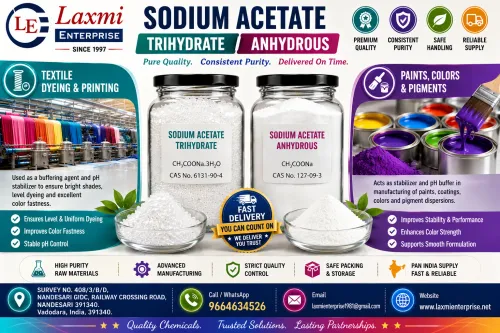
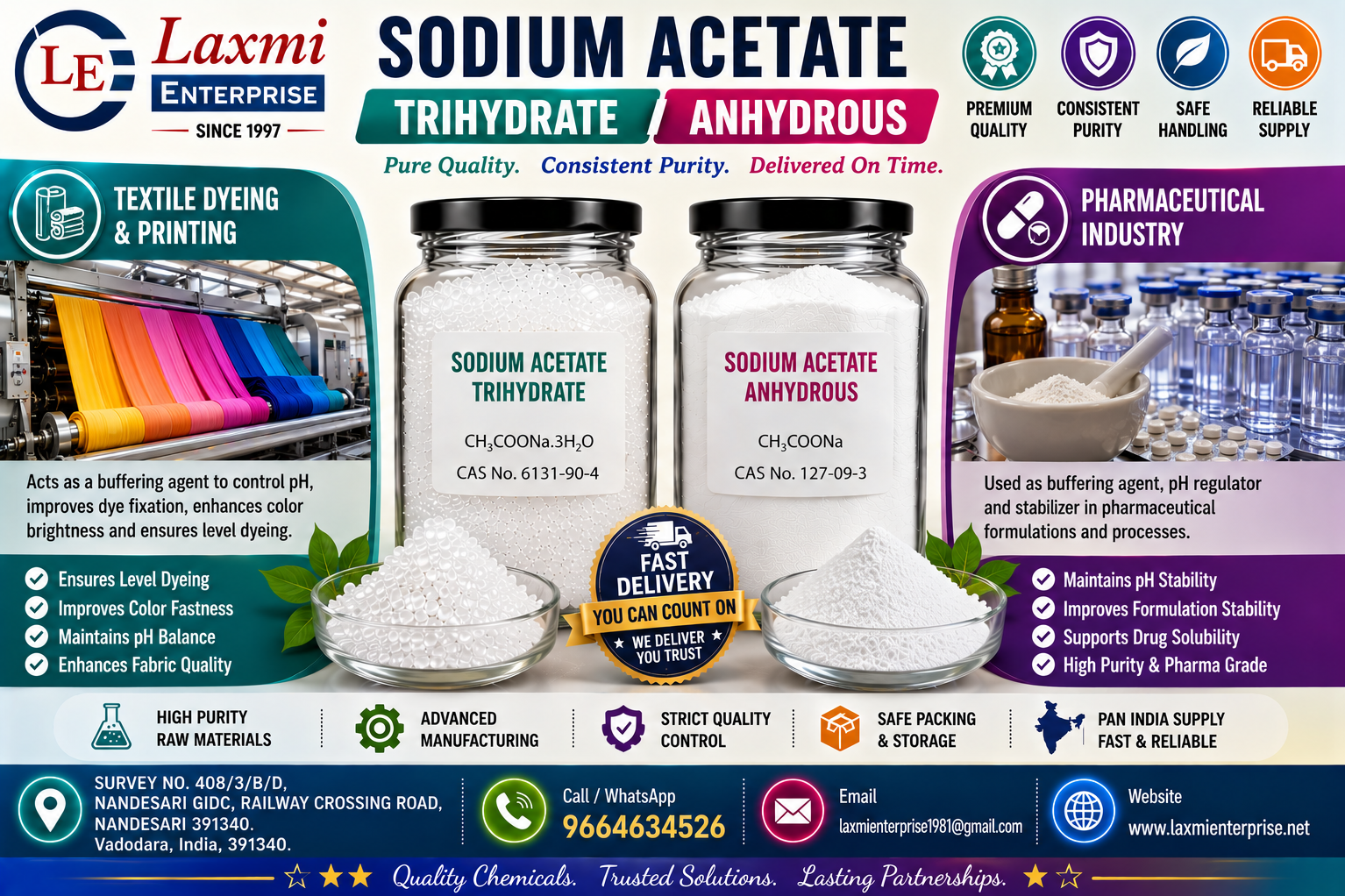
CAS Number 127-09-3 6131-90-4
HSN Code 2915 2915
Purity Evaluation
Purity evaluation helps determine whether the product complies with the agreed specification.
Rather than considering purity alone, laboratories typically review it together with:
Product identity
Grade
Manufacturing consistency
Supporting documentation
Customer requirements
This broader assessment provides a more meaningful understanding of product suitability.
Quality Insight
A product meeting its agreed specification consistently over time is often more valuable to manufacturers than occasional batches with marginally higher analytical values but inconsistent performance.
Moisture Evaluation
Moisture characteristics influence storage stability, handling, and downstream processing.
Laboratories monitor moisture to help ensure:
Stable warehouse storage.
Good flow characteristics.
Consistent packaging performance.
Reduced risk of caking.
Improved process reliability.
Why Moisture Control Matters
Potential Condition Possible Operational Effect
Elevated moisture Increased risk of caking
Stable moisture Better storage stability
Controlled packaging Improved product protection
Dry storage Better handling performance
Solubility Evaluation
One of the important quality characteristics of Sodium Acetate is its excellent water solubility.
Laboratories evaluate dissolution behavior because it influences:
Laboratory solution preparation
Industrial formulation
Process consistency
Manufacturing efficiency
Product acceptance
Consistent dissolution behavior supports predictable industrial performance.
Particle Size Evaluation
Particle characteristics affect:
Material flow
Packaging
Mixing
Automated feeding
Solution preparation
Dust generation
Manufacturers monitor particle characteristics to maintain consistent handling and process performance.
Particle Evaluation Objectives
Quality Objective Manufacturing Benefit
Uniform particle distribution Better process consistency
Stable flow properties Improved material handling
Controlled dust generation Cleaner work environment
Consistent packaging Better warehouse management
Bulk Density Evaluation
Bulk density is particularly important where automated material handling systems are used.
Consistent bulk density supports:
Inventory calculations.
Packaging efficiency.
Feeding consistency.
Process planning.
Actual acceptance criteria depend on the agreed product specification.
Laboratory Equipment
Professional quality laboratories typically employ calibrated equipment appropriate for their testing program.
Examples include:
Equipment Typical Laboratory Use
Precision Balance Accurate weighing
pH Meter Solution evaluation
Drying Oven Controlled drying procedures
Laboratory Glassware Sample preparation
Conductivity Meter Analytical measurements
Moisture Analysis Equipment Moisture evaluation
Sample Containers Sample preservation
Equipment selection varies according to laboratory scope and customer requirements.
Calibration Practices
Reliable measurements depend on properly maintained and calibrated instruments.
Good laboratory practice generally includes:
Scheduled calibration.
Preventive maintenance.
Calibration records.
Performance verification.
Equipment identification.
Operator training.
Calibration helps improve confidence in laboratory results and supports quality assurance.
Laboratory Best Practices
Well-managed laboratories typically follow these principles:
Use documented Standard Operating Procedures (SOPs).
Train laboratory personnel regularly.
Maintain complete records.
Preserve sample traceability.
Review unusual results before reporting.
Maintain clean laboratory conditions.
Verify instrument performance.
Archive laboratory records appropriately.
Industrial Case Study
A textile manufacturer in Ahmedabad experienced occasional variation in dye bath preparation despite using the same formulation.
The laboratory reviewed its incoming Sodium Acetate inspection process and found that sampling procedures varied between receiving shifts.
The company introduced:
Standardized sampling instructions.
Sample identification labels.
Analyst training.
Sampling documentation.
Routine internal audits.
Results:
Improved laboratory repeatability.
Better agreement between incoming inspections.
Reduced batch-to-batch variation.
Greater confidence in supplier evaluation.
The investigation demonstrated that consistent laboratory procedures are as important as the analytical tests themselves.
Frequently Asked Questions (FAQ)
1. Why is representative sampling essential?
Representative sampling helps ensure that laboratory results accurately reflect the quality of the entire production batch.
2. What is usually checked during visual inspection?
Laboratories commonly examine appearance, colour, crystal condition, foreign matter, and overall physical condition.
3. Why is moisture monitored?
Moisture characteristics influence storage stability, material handling, packaging performance, and product flow.
4. Is laboratory testing limited to purity?
No. Laboratories evaluate multiple quality characteristics including identity, appearance, moisture, solubility, particle characteristics, documentation, and traceability.
5. Why should laboratory instruments be calibrated?
Calibration improves measurement reliability and supports confidence in laboratory data.
6. How does particle size influence manufacturing?
Particle characteristics affect handling, mixing, dissolution, automated feeding, packaging, and overall process consistency.
7. Why are Standard Operating Procedures important?
SOPs help ensure laboratory activities are performed consistently, improving repeatability, traceability, and quality assurance.
8. How often should laboratory procedures be reviewed?
Review frequency depends on the laboratory's quality management system, customer requirements, regulatory expectations, and internal quality objectives.
Key Takeaways
Effective laboratory testing begins with representative sampling and extends through disciplined analytical procedures, calibrated equipment, complete documentation, and structured quality assurance. For Sodium Acetate, a robust laboratory program verifies not only product identity but also consistency, handling characteristics, and suitability for industrial applications. Buyers and manufacturers alike benefit from suppliers who combine reliable testing practices with comprehensive technical documentation and strong quality management systems.
Keywords