Sodium Sulphate Grades & Industrial Specifications: Complete Buyer's Guide (2026)
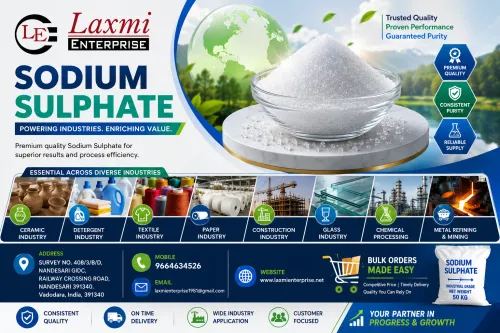
Selecting the correct Sodium Sulphate grade is one of the most important purchasing decisions for industrial manufacturers. Different industries—including glass, detergents, textiles, paper, ceramics, and chemical manufacturing—require different quality parameters such as purity, moisture, particle size, chloride content, and water-insoluble matter. Buyers should evaluate the complete technical specification, quality documentation, and supplier capability instead of comparing products on price alone.
Table of Contents
Why Grade Selection Matters
What Does 'Grade' Mean?
Types of Sodium Sulphate Grades
Technical Specifications
Industry-wise Grade Selection
Understanding Purity
Moisture Requirements
Particle Size Specifications
Water Insoluble Matter
Chloride Content
Iron Content
Bulk Density
Packaging Specifications
COA Interpretation
TDS & SDS Documentation
Supplier Evaluation Checklist
Frequently Asked Questions
Conclusion
Why Grade Selection Matters
Quick Answer
Not every Sodium Sulphate grade is suitable for every application. A product that performs well in detergent manufacturing may not meet the requirements of glass production or textile dyeing. Selecting the appropriate grade improves manufacturing consistency, minimizes quality issues, and reduces the likelihood of production interruptions.
Industrial buyers should consider:
Product application.
Required purity.
Critical impurities.
Moisture sensitivity.
Particle size.
Packaging requirements.
Storage conditions.
Regulatory or customer specifications.
Matching the material to the process is more important than choosing the highest available purity.
What Does 'Grade' Mean?
A grade is a combination of quality parameters agreed between the supplier and the customer. It may define:
Purity level.
Moisture limit.
Particle size distribution.
Chloride content.
Water-insoluble matter.
Iron content.
Packaging format.
Testing frequency.
Documentation requirements.
Grade names vary between suppliers, so procurement teams should always review the detailed specification sheet rather than relying solely on labels such as 'technical grade' or 'industrial grade.'
Common Sodium Sulphate Grades
Technical Grade
Technical Grade Sodium Sulphate is widely used across industrial sectors where consistent quality and dependable performance are required.
Typical applications include:
Glass manufacturing
Chemical processing
Textile dyeing
Paper production
Ceramic manufacturing
Industrial formulations
Buyers should confirm that the specification aligns with their process requirements.
Industrial Grade
Industrial Grade Sodium Sulphate is designed for high-volume manufacturing where product consistency, handling characteristics, and supply reliability are important.
Common users include:
Bulk chemical manufacturers.
Industrial processing plants.
Large production facilities.
Contract manufacturers.
Detergent Grade
Detergent manufacturers often focus on:
Uniform particle size.
Good flowability.
Controlled moisture.
Consistent appearance.
Reliable blending characteristics.
These properties help support stable manufacturing operations.
Glass Industry Grade
Glass manufacturers generally place greater emphasis on:
High purity.
Controlled iron content.
Low insoluble matter.
Consistent particle size.
Reliable batch uniformity.
These characteristics can contribute to predictable furnace performance and finished glass quality.
Textile Grade
Textile processing plants typically evaluate:
Solubility.
Chloride control.
Batch consistency.
Moisture level.
Dissolution behavior.
Reliable quality supports more consistent dyeing operations.
Understanding Purity
Quick Answer
Purity represents the proportion of Sodium Sulphate relative to other constituents. Higher purity generally means fewer impurities, but the appropriate purity depends on the manufacturing process rather than a universal benchmark.
Instead of requesting only a purity percentage, buyers should also review:
Water-insoluble matter.
Chlorides.
Iron.
Moisture.
Particle size.
Batch consistency.
A balanced specification often provides more value than focusing on a single parameter.
Moisture Requirements
Moisture affects:
Storage stability.
Product flow.
Packaging integrity.
Handling efficiency.
Process consistency.
Excess moisture may lead to caking or reduced flowability, especially in humid environments. Buyers should ensure moisture limits are appropriate for their application and storage conditions.
Particle Size Specifications
Particle size influences:
Dissolution rate.
Mixing performance.
Dust generation.
Conveying efficiency.
Automated feeding systems.
Different industries may require different particle size distributions. Procurement teams should communicate their preferred specification to the supplier.
Water-Insoluble Matter
Quick Answer
Water-insoluble matter consists of particles that do not dissolve under test conditions. Low levels are generally preferred where complete dissolution is important.
Industries such as:
Textile dyeing
Chemical processing
Glass manufacturing
often pay particular attention to this parameter because undissolved particles can affect process performance.
Chloride Content
Chloride is a naturally monitored impurity in many Sodium Sulphate specifications.
The acceptable level depends on:
End-use application.
Customer specifications.
Internal quality standards.
Process sensitivity.
Reviewing chloride values alongside other quality parameters provides a more complete assessment of product suitability.
Iron Content
Iron content is especially important in applications where product appearance or process sensitivity may be affected.
Glass manufacturers, for example, frequently include iron in their quality evaluation because trace levels can influence certain production requirements.
Buyers should verify iron values through the supplier's Certificate of Analysis.
Bulk Density
Bulk density influences:
Packaging efficiency.
Warehouse storage.
Truck loading.
Container utilization.
Automated dosing systems.
Because bulk density can vary with particle size and manufacturing conditions, it should be confirmed for the intended application.
Packaging Options
Industrial Sodium Sulphate is commonly supplied in:
Packaging Typical Application
25 kg Bags Small and medium consumption
50 kg Bags Standard industrial use
500 kg Jumbo Bags Bulk handling
1000 kg Jumbo Bags High-volume manufacturing
Bulk Transport Large continuous users
Packaging selection depends on consumption rate, warehouse facilities, and handling equipment.
Documents Buyers Should Request
A professional supplier should be able to provide documentation appropriate to the product and shipment, such as:
Certificate of Analysis (COA)
Technical Data Sheet (TDS)
Safety Data Sheet (SDS/MSDS)
Commercial Invoice
Packing List
Batch Identification
Transport Documentation (where applicable)
Reviewing these documents supports quality assurance and traceability.
How to Read a Certificate of Analysis (COA)
Quick Answer
A Certificate of Analysis summarizes the test results for a specific production batch. Buyers should compare each reported parameter with their purchase specification rather than assuming that every batch is identical.
A typical COA includes:
Batch number.
Manufacturing or dispatch date.
Purity.
Moisture.
Water-insoluble matter.
Chloride.
Iron.
Appearance.
Test methods (where provided).
Maintaining COA records helps support traceability and quality management.
Supplier Evaluation Checklist
Before finalizing a supplier, consider the following:
Technical Capability
Consistent product specifications.
Laboratory testing.
Batch traceability.
Technical support.
Supply Capability
Inventory availability.
Delivery planning.
Packaging flexibility.
Reliable logistics.
Documentation
COA.
TDS.
SDS/MSDS.
Batch identification.
Commercial Factors
Transparent quotations.
Clear communication.
Order flexibility.
Long-term supply capability.
A supplier that performs well across all four areas is generally better positioned to support ongoing industrial production.
Pan-India Supply Network
Manufacturers across India require dependable access to Sodium Sulphate for uninterrupted production. Major demand originates from industrial clusters in:
Gujarat
Maharashtra
Rajasthan
Delhi NCR
Uttar Pradesh
Punjab
Haryana
Madhya Pradesh
Chhattisgarh
Odisha
West Bengal
Jharkhand
Karnataka
Tamil Nadu
Telangana
Andhra Pradesh
Kerala
Assam
Laxmi Enterprise, located in Nandesari GIDC, Vadodara, Gujarat, supplies industrial-grade Sodium Sulphate to customers throughout Pan India. The company supports procurement teams with product documentation, application guidance, and logistics planning tailored to customer requirements.
Frequently Asked Questions
Is Technical Grade suitable for all industries?
No. The appropriate grade depends on the application's technical requirements. Buyers should review the complete specification rather than relying on the grade name.
Which specification is most important?
No single parameter determines quality. Purity, moisture, particle size, water-insoluble matter, chloride, iron, and documentation should be evaluated together.
Why should I request a COA?
A COA confirms the tested characteristics of the specific batch supplied, helping verify that it meets the agreed specification.
Can packaging be customized?
Many industrial suppliers offer different packaging formats depending on order quantity, handling equipment, and transportation requirements. Buyers should discuss packaging preferences before placing an order.
Conclusion
Selecting the correct Sodium Sulphate grade is a technical procurement decision that affects product quality, manufacturing efficiency, and long-term operational reliability. Rather than focusing only on price, buyers should assess the complete specification, supporting documentation, packaging, logistics, and supplier capability.
For manufacturers across India, working with a technically knowledgeable supplier can simplify procurement, improve consistency, and support efficient production. Laxmi Enterprise, based in Nandesari GIDC, Vadodara, Gujarat, supplies Sodium Sulphate to customers across Pan India, providing application-focused guidance, quality documentation, and dependable supply for a wide range of industrial sectors.
Keywords