Sodium Sulphate Manufacturing Process: Complete Industrial Guide (2026)
Sodium Sulphate is manufactured through both natural and synthetic routes. Commercial production includes recovery from natural mineral deposits and salt lakes, as well as by-product recovery from selected chemical manufacturing processes. The manufacturing route influences purity, particle size, moisture content, impurity profile, and suitability for industries such as glass, detergents, textiles, paper, ceramics, and chemical manufacturing. Industrial buyers should evaluate not only price but also product consistency, documentation, and quality testing before selecting a supplier.
Why Understanding the Manufacturing Process Matters
Many buyers focus on purity alone when purchasing Sodium Sulphate. However, two products with similar purity values may perform differently because of variations in manufacturing methods, crystal formation, drying processes, impurity levels, and quality control.
Understanding how Sodium Sulphate is produced helps procurement teams make informed decisions, reduce production risks, and choose material that matches their manufacturing requirements.
What Is Sodium Sulphate?
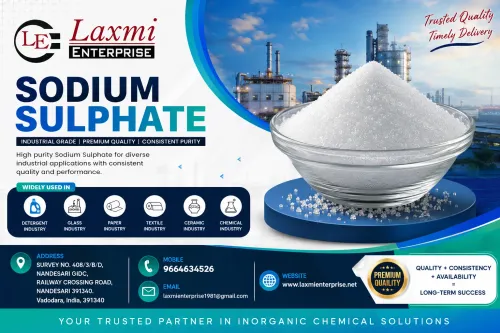
Sodium Sulphate (Na₂SO₄) is a stable inorganic salt widely used across numerous industries. It is valued for its chemical stability, water solubility, relatively low cost, and compatibility with a broad range of industrial processes.
Depending on the manufacturing method, Sodium Sulphate may be supplied as:
Anhydrous Sodium Sulphate
Sodium Sulphate Decahydrate (Glauber's Salt)
Technical Grade
Industrial Grade
High-Purity Grade
Customized Industrial Specifications
Among these, anhydrous Sodium Sulphate is the most commonly supplied form for industrial applications.
Manufacturing Routes of Sodium Sulphate
Commercial Sodium Sulphate is generally produced through two primary routes:
Manufacturing Route Typical Source Industrial Use
Natural Recovery Salt lakes and mineral deposits Large-volume industrial applications
Synthetic Recovery Chemical manufacturing processes Industrial-grade and application-specific material
Both routes can produce high-quality Sodium Sulphate when supported by appropriate purification and quality control.
Natural Production of Sodium Sulphate
Quick Answer
Natural Sodium Sulphate is recovered from mineral deposits and saline lakes. After extraction, it undergoes purification, crystallization, separation, drying, screening, and packaging to meet industrial quality requirements.
Step 1 – Resource Identification
Geological surveys identify Sodium Sulphate-bearing deposits, often associated with evaporite minerals formed through the natural evaporation of mineral-rich water over long periods.
These resources provide a stable raw material source for industrial production.
Step 2 – Extraction
The mineral-rich material is extracted using methods appropriate to the deposit, such as surface mining or solution recovery.
The objective is to obtain Sodium Sulphate while minimizing contamination from surrounding materials.
Step 3 – Dissolution
The extracted material is dissolved in water to create a solution containing Sodium Sulphate along with naturally occurring impurities.
Controlled dissolution improves downstream purification efficiency.
Step 4 – Purification
The solution is treated to reduce unwanted components, which may include:
Chlorides
Calcium salts
Magnesium compounds
Iron
Insoluble particles
Organic contaminants (where applicable)
Purification methods depend on the quality targets for the intended industrial application.
Step 5 – Crystallization
Purified solution is cooled or concentrated under controlled conditions to form Sodium Sulphate crystals.
Crystal size distribution is carefully managed because it influences:
Flowability
Handling
Drying efficiency
Packaging
End-use performance
Step 6 – Solid-Liquid Separation
Industrial equipment separates crystals from the remaining solution.
Efficient separation reduces residual moisture and improves downstream drying performance.
Step 7 – Drying
Drying converts the material into the required moisture specification.
Industrial drying systems may include:
Rotary dryers
Fluidized bed dryers
Hot air drying systems
Drying conditions influence product stability during storage and transportation.
Step 8 – Screening and Classification
After drying, Sodium Sulphate is screened into the required particle size range.
Uniform particle size supports:
Better handling
Reduced dust generation
Improved process consistency
Easier mixing with other raw materials
Step 9 – Packaging
The finished product is packed according to customer requirements.
Common packaging options include:
25 kg bags
50 kg bags
Jumbo bags (500–1000 kg)
Bulk truck loading (where applicable)
Packaging selection depends on customer consumption patterns and logistics.
Synthetic Production of Sodium Sulphate
Quick Answer
Synthetic Sodium Sulphate is commonly recovered as a by-product from selected industrial chemical processes. After recovery, it undergoes purification, crystallization, drying, and quality testing to achieve the required industrial specifications.
Rather than manufacturing Sodium Sulphate as the primary product, some industrial processes generate it during the production of other chemicals.
Recovered material is refined through multiple processing steps before being supplied to industrial users.
Advantages include:
Efficient resource utilization
Industrial-scale availability
Consistent production
Reliable supply for many applications
The exact production route varies depending on the originating chemical process.
Quality Control During Manufacturing
Quality control is integrated throughout production rather than being performed only after completion.
Typical checkpoints include:
Raw Material Inspection
Incoming materials are evaluated for suitability before processing.
Process Monitoring
Production teams monitor:
Temperature
Concentration
Crystallization conditions
Moisture
Process stability
Consistent process control helps maintain product uniformity.
Laboratory Testing
Finished batches are commonly tested for:
Purity
Moisture
Water-insoluble matter
Chloride
Iron
Particle size
Bulk density
Appearance
Testing confirms that each batch meets the intended specification.
Typical Industrial Specifications
Specifications vary by application, but buyers commonly review:
Parameter Typical Consideration
Purity According to customer specification
Moisture Controlled for storage stability
Chloride Application-dependent
Water Insoluble Matter Minimized
Iron Controlled where relevant
Particle Size Consistent distribution
Appearance White crystalline material
Packaging Customer-specific
Always verify values using the supplier's Certificate of Analysis (COA).
Factors Affecting Product Quality
Manufacturing quality depends on:
Raw material consistency
Purification efficiency
Crystallization control
Drying conditions
Particle size classification
Storage practices
Packaging quality
Laboratory testing
Process documentation
Well-controlled manufacturing contributes to more consistent industrial performance.
Manufacturing Challenges
Producers continually manage challenges such as:
Moisture control
Impurity reduction
Dust management
Crystal size consistency
Process efficiency
Energy consumption
Product handling
Storage stability
Addressing these factors supports reliable product quality.
Why Manufacturing Method Matters to Buyers
The production route can influence:
Product consistency
Handling characteristics
Impurity profile
Storage behavior
Performance in specific industrial applications
For this reason, procurement decisions should consider technical suitability in addition to cost.
Pan-India Supply Considerations
India's major demand for Sodium Sulphate comes from manufacturing clusters in:
Gujarat
Maharashtra
Rajasthan
Delhi NCR
Punjab
Haryana
Uttar Pradesh
Madhya Pradesh
Chhattisgarh
Telangana
Andhra Pradesh
Karnataka
Tamil Nadu
Kerala
West Bengal
Odisha
Jharkhand
Assam
Reliable suppliers coordinate packaging, inventory management, and transportation to serve customers across these industrial regions.
Laxmi Enterprise, located in Nandesari GIDC, Vadodara, Gujarat, supplies industrial-grade Sodium Sulphate to customers across Pan India, supporting industries with technical documentation, quality-focused sourcing, and logistics planning based on customer requirements.
Buyer Checklist Before Ordering
Before placing an order, confirm:
Required application
Grade required
Purity requirement
Moisture limit
Particle size
Packaging type
Quantity
Delivery schedule
COA availability
SDS/MSDS availability
Storage conditions
Transportation method
Providing these details helps ensure the selected material is suitable for the intended process.
Frequently Asked Questions
Does the manufacturing route affect quality?
Yes. Different production routes can result in differences in impurity profiles, crystal characteristics, and moisture content. Buyers should evaluate the supplier's specifications rather than relying solely on the production route.
Is natural Sodium Sulphate always better?
Not necessarily. Both natural and synthetic Sodium Sulphate can meet industrial requirements when produced under appropriate quality control systems.
Why is particle size important?
Particle size influences handling, blending, dust generation, dissolution behavior, and process consistency in many industrial applications.
What documents should buyers request?
Industrial buyers commonly request a Certificate of Analysis (COA), Technical Data Sheet (TDS), Safety Data Sheet (SDS/MSDS), and commercial documentation appropriate to the shipment.
Conclusion
The manufacturing process of Sodium Sulphate has a direct influence on product consistency, impurity profile, moisture content, and suitability for industrial applications. Understanding the differences between natural recovery and synthetic production enables buyers to make more informed procurement decisions.
For manufacturers across India, selecting a supplier that combines technical expertise, documented quality control, reliable packaging, and dependable logistics can contribute to smoother operations and long-term supply reliability.
Keywords