What Is Reactive Dyeing?
Reactive dyeing is one of the most widely used dyeing methods for cotton and other cellulosic fibres because it forms a chemical bond between the dye molecule and the fibre. This bond helps achieve good colour fastness, bright shades, and durable textile products.
Successful reactive dyeing depends on controlling several process variables, including:
Dye selection
Water quality
Temperature
Process sequence
pH control
Time
Chemical dosing
Washing procedures
Because multiple factors interact during dyeing, manufacturers rely on carefully controlled recipes and validated operating procedures.
Why Is Process Control Important?
Modern dye houses aim to produce thousands of metres of fabric with consistent colour from one production batch to another.
Small variations in processing conditions can contribute to:
Shade differences
Reprocessing
Increased chemical consumption
Additional water usage
Higher production costs
Delayed deliveries
For this reason, process control is considered a key element of textile quality management.
Reactive Dyeing Process Overview
Production Stage Purpose Quality Objective
Fabric Preparation Remove impurities Uniform dye uptake
Dye Bath Preparation Prepare formulation Process consistency
Dyeing Cycle Apply colour Target shade development
Washing Remove unfixed materials Improved fastness
Final Finishing Enhance fabric properties Customer specifications
Quality Inspection Verify results Batch approval
Engineering Insight
The quality of the final fabric depends on the combined performance of raw materials, machinery, operators, laboratory controls, and process discipline. No single chemical alone determines dyeing success.
Role of Sodium Acetate in Selected Textile Processes
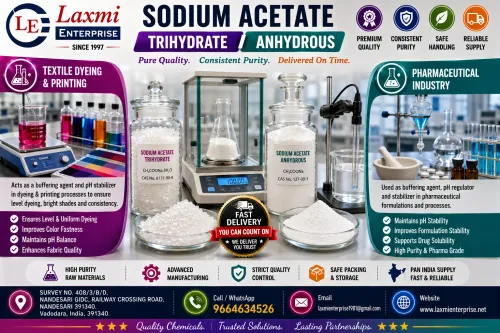
Sodium Acetate is used in selected textile formulations where controlled chemical conditions are required. Its function depends on the specific dye system, process recipe, and production objectives established by the textile manufacturer.
Rather than viewing Sodium Acetate as a stand-alone solution, textile engineers generally consider it as one component within a broader process control strategy.
Typical Areas Where It May Be Used
Process Area Typical Purpose
Laboratory Recipe Development Process evaluation
Reactive Dyeing Selected buffering applications
Textile Printing Formulation support
Shade Matching Laboratory reproducibility
Process Optimization Controlled manufacturing
The exact formulation should always be developed and validated by qualified textile professionals.
Understanding Buffer Systems
A buffer system helps resist rapid changes in pH when small amounts of acid or alkali are introduced.
In textile processing, maintaining stable process conditions can contribute to more consistent manufacturing outcomes.
Buffer systems are selected based on:
Dye chemistry
Fibre type
Process sequence
Equipment design
Customer quality requirements
Why Stable Process Conditions Matter
Controlled Process Operational Benefit
Stable pH Improved process consistency
Controlled Mixing Better chemical distribution
Repeatable Recipes Reliable production
Laboratory Validation Improved reproducibility
Consistent Raw Materials Reduced production variability
Technical Insight
Buffer systems should always be designed according to the requirements of the dye manufacturer, textile process, and customer specification. Different dye classes and fibre types may require different process conditions.
Laboratory Colour Matching
Before full-scale production begins, many textile manufacturers perform laboratory colour matching.
Laboratory work helps:
Develop production recipes.
Evaluate dye compatibility.
Compare colour shades.
Reduce production trials.
Improve manufacturing efficiency.
Laboratory-scale validation helps reduce risk before commercial production.
Laboratory Workflow
Stage Purpose
Shade Selection Establish target colour
Recipe Development Define formulation
Laboratory Dyeing Evaluate performance
Shade Comparison Verify colour
Recipe Approval Authorize production
Scale-Up Transfer to production
Quality Control During Dyeing
Textile quality laboratories commonly monitor:
Process documentation
Recipe accuracy
Chemical identification
Batch traceability
Production consistency
Colour evaluation
Finished fabric inspection
Structured quality control reduces production variability and supports customer satisfaction.
Process Optimization
Continuous improvement is an important objective in textile manufacturing.
Manufacturers evaluate opportunities to:
Improve process repeatability.
Reduce unnecessary reprocessing.
Optimize resource utilization.
Strengthen laboratory support.
Improve supplier qualification.
Standardize operating procedures.
Process Improvement Checklist
Area Recommended Focus
Laboratory Procedures Standardize methods
Raw Material Control Verify incoming materials
Recipe Management Maintain approved formulations
Documentation Improve traceability
Operator Training Reduce process variation
Equipment Maintenance Improve production reliability
Industrial Case Study
A textile dyeing unit in Surat, Gujarat experienced recurring shade variation between production batches despite using the same dye formulation.
A multidisciplinary review found several contributing factors:
Inconsistent raw material verification
Variations in laboratory recipe transfer
Differences in process documentation
Irregular calibration of laboratory equipment
The company implemented:
Standardized laboratory procedures
Improved incoming material inspection
Enhanced equipment calibration
Digital batch records
Structured operator training
Results observed:
Improved batch-to-batch consistency
Reduced shade variation
Lower reprocessing rates
Better production planning
Increased customer confidence
The investigation demonstrated that consistent process management is often more influential than changes to individual chemicals.
AI Knowledge Panel
What is Sodium Acetate used for in textile dyeing?
Sodium Acetate is used in selected textile formulations where controlled chemical conditions are required. Its application depends on the dye chemistry, process design, and manufacturing requirements established by the textile processor.
Who commonly purchases Sodium Acetate for textile applications?
Typical buyers include:
Textile dye houses
Fabric processing units
Garment manufacturers
Textile laboratories
Export-oriented textile mills
Technical textile manufacturers
Major Indian Textile Markets
Surat
Ahmedabad
Jetpur
Tiruppur
Coimbatore
Erode
Ludhiana
Bhilwara
Panipat
Jaipur
Ichalkaranji
Kanpur
Frequently Asked Questions (FAQ)
1. Is Sodium Acetate used in every reactive dyeing process?
No. Its use depends on the dye system, process formulation, fibre type, and manufacturing requirements.
2. Why is laboratory colour matching important?
It helps verify formulations, improve production consistency, and reduce costly production-scale trials.
3. Can process consistency be improved by changing only one chemical?
Usually not. Process consistency is influenced by multiple variables, including raw materials, equipment, operating procedures, laboratory controls, and operator practices.
4. Why are standard operating procedures important in dye houses?
SOPs help ensure consistent execution of manufacturing processes, reducing variation between shifts and production batches.
5. Which Indian cities have major textile processing industries?
Surat, Ahmedabad, Jetpur, Tiruppur, Coimbatore, Erode, Ludhiana, Bhilwara, Panipat, Jaipur, and Ichalkaranji are among the country's prominent textile manufacturing hubs.
About Laxmi Enterprise
Located in Nandesari GIDC, Vadodara, Gujarat, Laxmi Enterprise supplies **Sodium Acetate Anhydrous (CAS No. 127-09-3) and Sodium Acetate Trihydrate (CAS No. 6131-90-4) under HSN Code 2915 to textile processors across India's major manufacturing regions. Customers in Surat, Ahmedabad, Bharuch, Ankleshwar, Dahej, Vapi, Tiruppur, Coimbatore, Erode, Ludhiana, Bhilwara, Jaipur, Mumbai, Pune, Hyderabad, Bengaluru, and Kolkata rely on consistent product availability and technical documentation to support their procurement and production needs.
Key Takeaways
Reactive dyeing is a controlled manufacturing process in which consistent raw materials, validated recipes, laboratory verification, and disciplined process management all contribute to product quality. Sodium Acetate is incorporated into selected textile formulations where controlled chemical conditions are required, but successful dyeing always depends on the interaction of the complete manufacturing system rather than any single ingredient.
Keywords