

Chemical Identity and Technical Properties of Sodium Nitrate Free Flow
Sodium Nitrate Free Flow is a high-purity inorganic nitrate salt with the molecular formula NaNO₃. It is composed of sodium (Na⁺) and nitrate (NO₃⁻) ions, forming a stable crystalline compound widely recognized for its oxidizing properties, high water solubility, and excellent chemical stability under recommended storage conditions.
Industrially, Sodium Nitrate has become one of the most versatile nitrate compounds because it combines predictable chemical behavior with excellent physical handling characteristics. The Free Flow grade enhances these benefits by offering consistent particle size, improved flowability, and resistance to caking, making it suitable for automated manufacturing systems.
Unlike many raw materials that require special conditioning before use, Free Flow Sodium Nitrate is designed for immediate industrial application. Its uniform crystal structure allows it to discharge smoothly from storage bins, dissolve rapidly in aqueous systems, and blend uniformly with other process chemicals. These characteristics help improve production consistency, reduce downtime, and support modern continuous manufacturing operations.
Because of its stable composition and reliable performance, Sodium Nitrate Free Flow is widely used in chemical processing, specialty chemicals, glass manufacturing, ceramic production, thermal energy storage, pigment manufacturing, fertilizer production, and metal refining.
Chemical Identification
Property Description
Chemical Name Sodium Nitrate
Common Name Chile Saltpeter, Soda Niter
Chemical Formula NaNO₃
Molecular Weight 84.99 g/mol
CAS Number 7631-99-4
EC Number 231-554-3
Chemical Family Inorganic Nitrate Salt
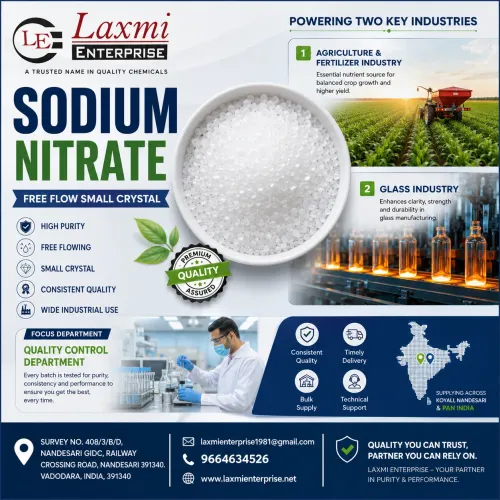
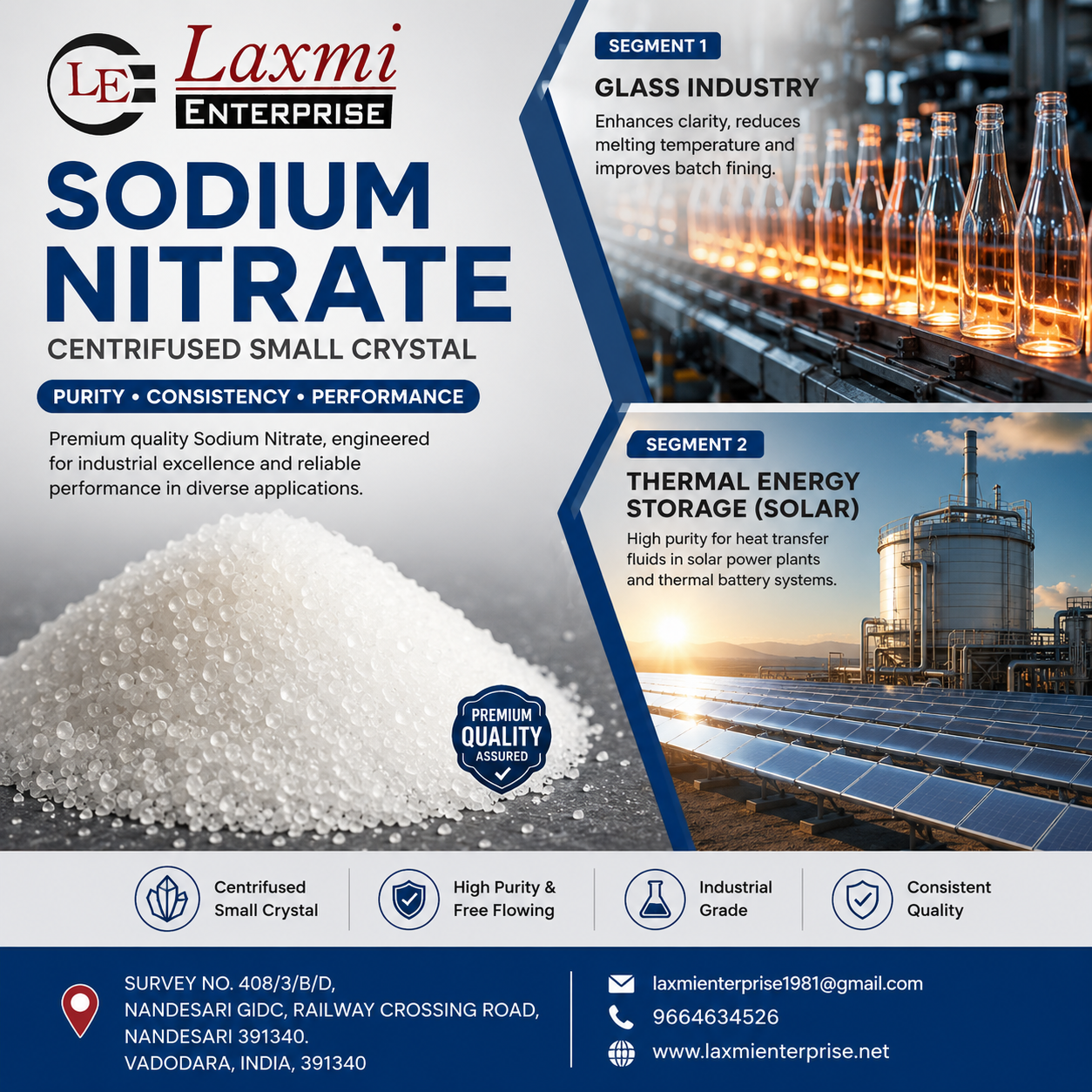
Appearance White Free Flow Crystalline Granules
Odor Odorless
Solubility Highly Soluble in Water
Nature Strong Oxidizing Compound
Physical Properties of Sodium Nitrate Free Flow
The physical characteristics of Sodium Nitrate play a significant role in determining its industrial performance. Manufacturers not only evaluate chemical purity but also examine particle size distribution, moisture content, bulk density, and flowability before selecting a product.
The Free Flow grade is engineered to improve these physical properties, ensuring reliable material handling throughout production.
Typical Physical Characteristics
White crystalline granules
Free-flowing appearance
Uniform particle size distribution
Excellent handling characteristics
High water solubility
Low moisture content
Consistent bulk density
Minimal dust generation
Reduced lump formation
Good storage stability
These properties enable efficient conveying, weighing, blending, and dosing in both batch and continuous manufacturing systems.
Chemical Properties of Sodium Nitrate
Chemically, Sodium Nitrate is known for its excellent stability and predictable behavior under controlled industrial conditions.
Some of its important chemical characteristics include:
Strong Oxidizing Ability
Sodium Nitrate functions as an oxidizing agent in many industrial reactions. Instead of acting as a fuel, it supplies oxygen where controlled oxidation is required, making it valuable in numerous chemical manufacturing processes.
Excellent Water Solubility
One of its most desirable properties is rapid dissolution in water. This allows manufacturers to prepare process solutions quickly while maintaining uniform concentration throughout production.
High Chemical Stability
When stored correctly in a cool and dry environment, Sodium Nitrate remains chemically stable for extended periods without significant degradation, allowing manufacturers to maintain inventory with confidence.
High Purity
Industrial applications often require Sodium Nitrate with high purity to minimize unwanted side reactions and maintain consistent product quality. Reliable quality control and documented Certificates of Analysis (COA) are therefore essential.
Compatibility with Industrial Processing
Its predictable chemical behavior makes Sodium Nitrate compatible with many industrial formulations and controlled manufacturing processes where nitrate ions play a functional role.
Why Physical Properties Matter in Manufacturing
Industrial buyers often focus on chemical purity alone. However, the physical properties of Sodium Nitrate can have an equally significant impact on production efficiency.
For example:
Uniform particle size supports consistent mixing.
Good flowability minimizes hopper blockages.
Low moisture content reduces caking during storage.
Stable bulk density improves dosing accuracy.
Rapid dissolution shortens processing time.
Reduced dust improves workplace cleanliness.
Consistent granule size enhances automated handling.
Collectively, these characteristics help manufacturers reduce downtime, improve batch consistency, and increase overall production efficiency.
Typical Technical Specifications
Although exact specifications may vary depending on industrial requirements, a typical Free Flow Sodium Nitrate product generally meets the following parameters:
Parameter Typical Specification
Sodium Nitrate (NaNO₃) ≥ 99%
Appearance White Free Flow Crystal
Moisture Low
Water Insoluble Matter Very Low
Chloride Controlled
Sulphate Controlled
Iron Trace Level
Particle Size Uniform
Bulk Density Consistent
Flowability Excellent
Actual specifications should always be verified using the supplier's Certificate of Analysis (COA).
Why High Purity Matters
Industrial manufacturing depends on consistency. Even small variations in raw material quality can affect reaction efficiency, product appearance, processing time, and equipment performance.
High-purity Sodium Nitrate helps manufacturers:
Improve product consistency.
Reduce unwanted impurities.
Enhance production efficiency.
Minimize process variation.
Achieve reliable batch-to-batch performance.
Lower the risk of production rejects.
Support quality assurance programs.
This is why procurement teams often prioritize suppliers that provide consistent quality, complete documentation, and dependable technical support.
Common Industrial Grades of Sodium Nitrate
Sodium Nitrate is available in several grades depending on the intended application.
Technical Grade
Suitable for most industrial manufacturing processes such as chemical processing, glass manufacturing, ceramics, pigments, and metal refining.
Industrial Grade
Designed for large-scale commercial manufacturing where reliable quality and consistent physical properties are required.
Commercial Grade
Used in applications where standard industrial specifications meet the process requirements.
The appropriate grade should always be selected based on the technical needs of the specific manufacturing process.
Key Takeaways
Sodium Nitrate (NaNO₃) is a high-purity inorganic nitrate salt.
The Free Flow grade offers superior handling and storage performance.
Uniform particle size and low moisture improve production efficiency.
Excellent water solubility supports rapid solution preparation.
High purity contributes to consistent manufacturing results.
Reliable quality control is essential for industrial applications.
Standard commercial packing is available in 25 kg, 50 kg, and 500 kg Jumbo Bags.
Technical FAQs
What is the molecular formula of Sodium Nitrate?
The molecular formula of Sodium Nitrate is NaNO₃, representing one sodium ion combined with one nitrate ion. This simple yet stable structure makes it suitable for a wide range of industrial applications.
What is the molecular weight of Sodium Nitrate?
The molecular weight of Sodium Nitrate is approximately 84.99 grams per mole, an important value used in chemical calculations and process formulations.
What is the CAS Number of Sodium Nitrate?
The internationally recognized CAS Number for Sodium Nitrate is 7631-99-4, which uniquely identifies the chemical for regulatory, procurement, and documentation purposes.
Why is low moisture content important?
Low moisture content helps preserve the product's free-flowing characteristics, minimizes caking during storage, and ensures smooth feeding through automated production equipment.
Does particle size affect industrial performance?
Yes. Uniform particle size contributes to better blending, more consistent dosing, improved dissolution, and reliable process control, especially in automated manufacturing systems.
Why do industries ask for a Certificate of Analysis (COA)?
A COA confirms that each production batch meets the required specifications for purity, moisture, particle size, and impurity levels. It provides traceability and confidence that the product is suitable for the intended industrial application.