Chemical Structure, Properties, Buffer Chemistry & Manufacturing Science
Chemical Structure of Sodium Acetate
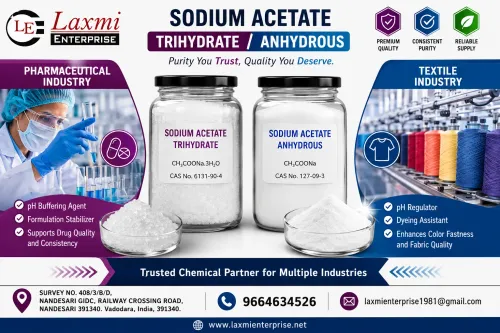
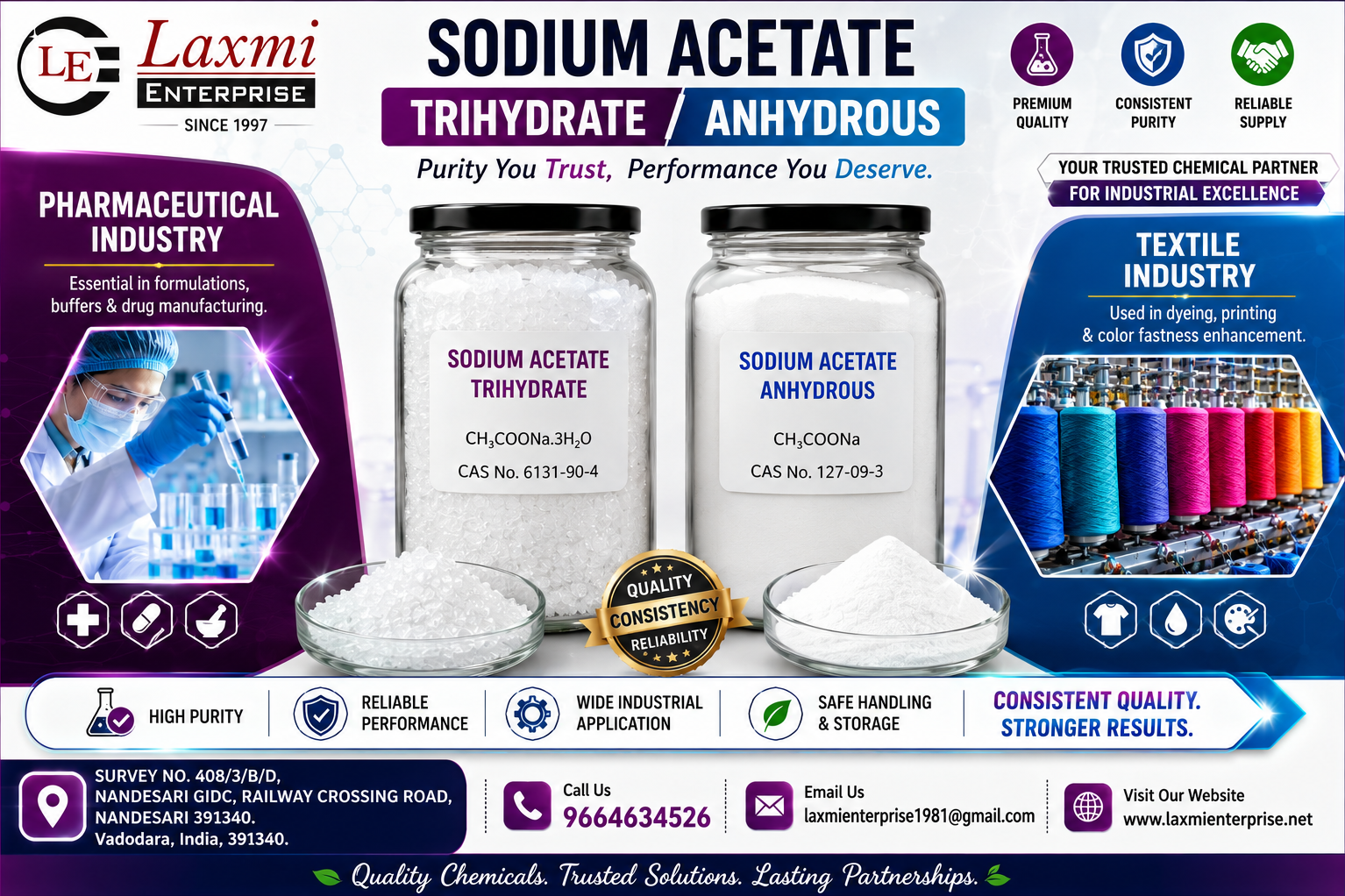
Sodium Acetate is the sodium salt formed when acetic acid reacts with sodium hydroxide or sodium carbonate. The compound consists of a sodium ion (Na⁺) and an acetate ion (CH₃COO⁻), creating a stable ionic compound with excellent water solubility and buffering characteristics.
Unlike many specialty chemicals, Sodium Acetate is valued because of its predictable chemical behavior, compatibility with numerous industrial processes, and availability in multiple grades suitable for industrial, laboratory, food, and pharmaceutical applications (where applicable).
Molecular Structure
Property Sodium Acetate Anhydrous Sodium Acetate Trihydrate
Chemical Formula CH₃COONa CH₃COONa·3H₂O
Molecular Formula C₂H₃NaO₂ C₂H₉NaO₅
Water of Crystallization None Three Water Molecules
Chemical Family Acetate Salt Acetate Salt
Ionic Components Sodium Ion + Acetate Ion Sodium Ion + Acetate Ion
Physical Form White Crystalline Powder White Crystalline Crystals
Commercial Availability Industrial & Specialty Grades Industrial & Specialty Grades
How Sodium Acetate Is Formed
Sodium Acetate is generally produced by the neutralization reaction between Acetic Acid and an alkaline sodium source.
The simplified chemical reaction is:
CH₃COOH + NaOH → CH₃COONa + H₂O
In commercial manufacturing, different production routes may be selected depending on:
Desired product grade
Purity requirements
Manufacturing technology
Raw material quality
End-use industry
Regulatory requirements
The exact production process differs among manufacturers and is often proprietary.
Manufacturing Insight
Although the chemistry is straightforward, producing high-quality Sodium Acetate consistently requires careful control of raw material purity, reaction conditions, crystallization, drying, quality testing, and packaging. Industrial buyers often evaluate suppliers based on batch consistency rather than reaction chemistry alone.
Chemical Properties
Understanding the chemical properties of Sodium Acetate helps engineers, laboratory professionals, and procurement teams determine whether it is suitable for a specific industrial application.
Chemical Properties Table
Property Description Industrial Importance
Chemical Nature Sodium Salt of Acetic Acid Suitable for numerous industrial processes
Appearance White crystalline material Easy visual identification
Odor Practically odorless Convenient industrial handling
Water Solubility Highly soluble Rapid solution preparation
Buffering Capacity Excellent Supports controlled pH conditions
Chemical Stability High Reliable long-term storage
Reactivity Stable under recommended conditions Suitable for industrial processing
Hygroscopic Nature Low to Moderate (grade dependent) Appropriate storage remains important
Physical Properties
The physical characteristics of Sodium Acetate influence handling, storage, transportation, laboratory preparation, and manufacturing efficiency.
Physical Properties Table
Property Typical Characteristic Industrial Relevance
Appearance White powder or crystals Easy quality inspection
Crystal Structure Crystalline Supports consistent handling
Solubility in Water High Efficient dissolution
Bulk Density Grade dependent Influences packaging and dosing
Particle Size Manufacturer dependent Important for process consistency
Moisture Content Controlled during production Supports storage stability
Flow Characteristics Good Suitable for automated dosing systems
Storage Stability Excellent under dry conditions Long shelf life when stored correctly
Note: Exact numerical values vary depending on product grade, manufacturing process, and customer specifications. Buyers should always refer to the supplier's Certificate of Analysis (COA) and Technical Data Sheet (TDS).
Why High Water Solubility Matters
One of the major reasons Sodium Acetate is widely used across industries is its excellent solubility in water.
This characteristic offers several practical advantages:
Faster solution preparation
Uniform chemical distribution
Reduced mixing time
Improved process efficiency
Better laboratory reproducibility
Consistent dosing during manufacturing
Industries requiring controlled chemical reactions often prefer highly soluble chemicals because they improve process predictability.
Engineering Insight
Chemical engineers often evaluate a raw material not only by its chemical composition but also by how consistently it dissolves under production conditions. Reliable dissolution behavior reduces processing delays and improves manufacturing efficiency.
Buffer Chemistry Explained
One of the defining characteristics of Sodium Acetate is its role in buffer systems.
A buffer system is designed to resist rapid changes in pH when small quantities of acid or alkali are introduced.
This property is particularly valuable in industries where process stability is critical.
Common examples include:
Textile dyeing
Laboratory analysis
Pharmaceutical manufacturing
Biotechnology
Food processing
Chemical synthesis
Analytical chemistry
How Buffer Systems Work
A buffer generally consists of:
A weak acid
Its corresponding salt
In many industrial systems:
Acetic Acid + Sodium Acetate = Buffer System
The combination helps maintain a more stable chemical environment compared with using the acid alone.
Buffer System Comparison
Without Buffer With Sodium Acetate Buffer System
Rapid pH fluctuations Controlled pH changes
Greater process variation Improved process stability
Increased risk of inconsistent results Better batch reproducibility
Higher probability of reprocessing Reduced process variability
Greater operator intervention More predictable manufacturing
Laboratory Insight
A buffer does not prevent pH from changing completely. Instead, it reduces the rate and extent of change, allowing laboratory and industrial processes to operate within a more controlled chemical environment.
Why Industries Prefer Sodium Acetate
Different industries select Sodium Acetate for different reasons, yet several advantages are common across most applications.
Industrial Advantages
Advantage Business Benefit
Reliable buffering capacity Improved process stability
Excellent water solubility Faster preparation of solutions
Good storage stability Reduced inventory losses
Multiple grades available Suitable for diverse industries
Consistent industrial quality Better production repeatability
Easy handling Simplified operations
Broad application range One product serves multiple processes
Good compatibility Integrates well with many formulations
Industrial Manufacturing Overview
Commercial production of Sodium Acetate generally involves several controlled manufacturing stages.
Typical Manufacturing Workflow
Stage Purpose
Raw Material Inspection Verify incoming material quality
Controlled Chemical Reaction Produce Sodium Acetate
Process Monitoring Maintain reaction consistency
Crystallization Develop required crystal structure
Drying (where applicable) Achieve specified moisture level
Milling / Screening Obtain desired particle characteristics
Quality Control Testing Confirm product specifications
Packaging Protect product quality
Warehouse Storage Maintain product stability
Distribution Supply customers efficiently
Manufacturing Insight
High-quality manufacturing depends on process control rather than simply completing the chemical reaction. Stable production conditions contribute to consistent purity, moisture control, particle size distribution, and batch-to-batch reproducibility.
Quality Parameters Evaluated by Manufacturers
Professional manufacturers monitor multiple quality characteristics before approving a batch for shipment.
Typical Quality Evaluation Parameters
Quality Parameter Why It Matters
Appearance Confirms visual consistency
Product Identity Verifies correct chemical
Purity Supports application requirements
Moisture Content Influences storage stability
Solubility Ensures process performance
Particle Characteristics Supports handling and dosing
Batch Consistency Improves production repeatability
Packaging Integrity Protects product during transport
Quality Assurance Philosophy
Leading chemical manufacturers recognize that customers purchase consistency, not just chemicals.
Quality assurance therefore extends beyond laboratory testing to include:
Approved raw materials
Controlled manufacturing
Standard operating procedures
Batch traceability
Documentation control
Packaging verification
Warehouse management
Continuous process improvement
Procurement Insight
Experienced procurement managers evaluate suppliers on total reliability, including technical documentation, quality systems, delivery performance, packaging standards, and long-term consistency. The lowest purchase price rarely represents the lowest overall manufacturing cost if product variability leads to production issues.
Key Takeaways
Sodium Acetate is a chemically stable sodium salt of acetic acid available in Anhydrous and Trihydrate forms.
Its high water solubility and buffering characteristics make it suitable for numerous industrial applications.
Commercial manufacturing requires controlled reaction, crystallization, drying, testing, and packaging to ensure consistent quality.
Buyers should evaluate suppliers based on product consistency, documentation, quality systems, and technical support—not price alone.
Reliable manufacturers support industrial performance through strong quality assurance, traceability, and batch-to-batch reproducibility.
Keywords