

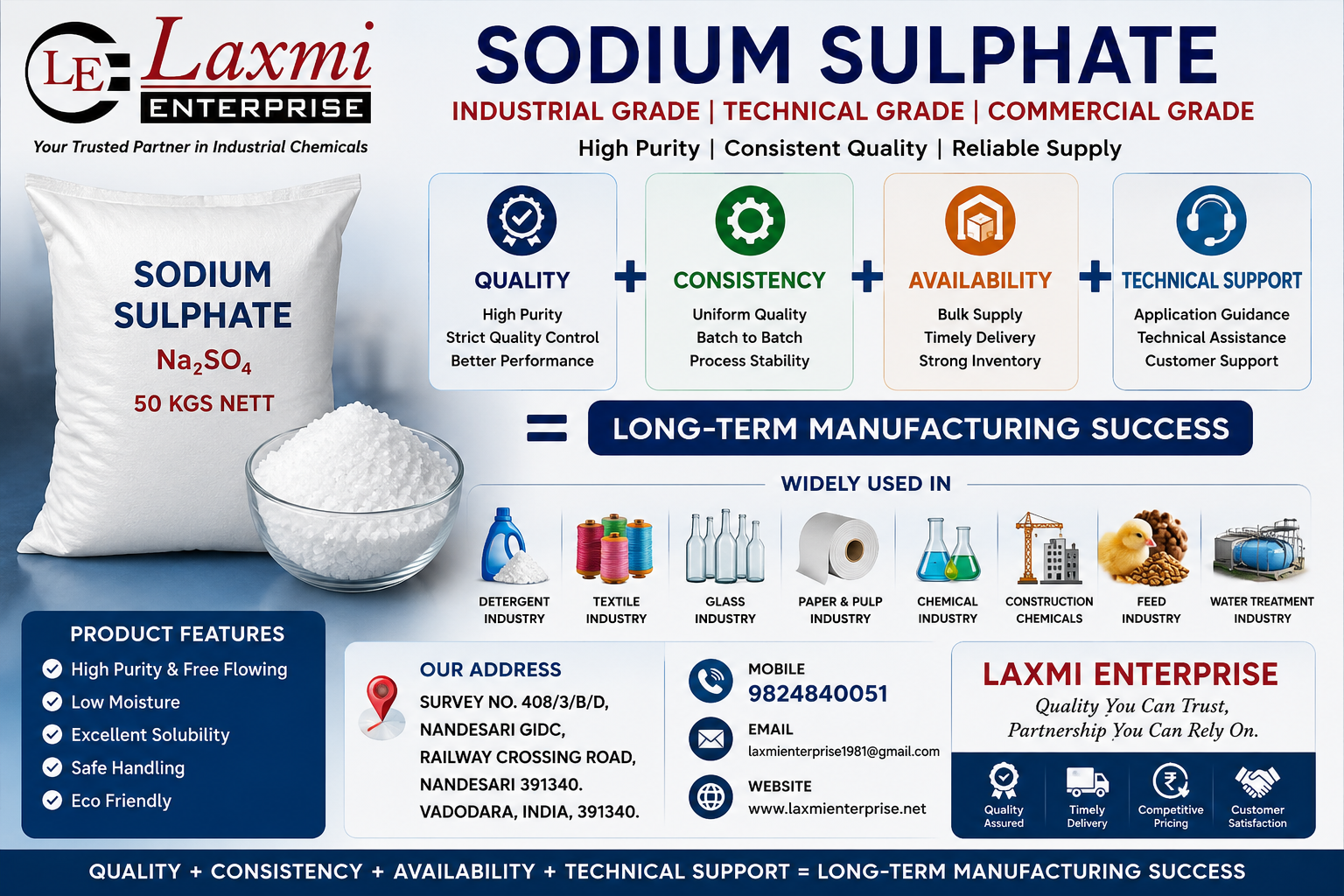
Controlled Chloride Levels in Sodium Sulphate: Why They Matter for Industrial Manufacturing
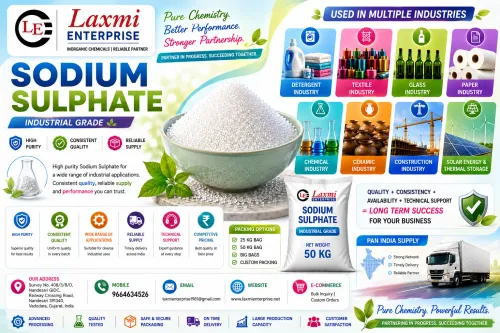
When selecting Sodium Sulphate for industrial applications, many manufacturers focus primarily on Sodium Sulphate purity. However, one of the most important quality parameters is the chloride content. Controlled chloride levels help maintain consistent manufacturing performance, protect production equipment, and improve the quality of finished products across several industries.
Chloride impurities may be introduced during the manufacturing process or through raw materials. Although small amounts of chloride are common in industrial-grade Sodium Sulphate, excessive chloride can create operational challenges depending on the application. For this reason, many manufacturers specify maximum allowable chloride levels as part of their purchasing requirements.
In the textile industry, controlled chloride levels contribute to stable dyeing conditions. Reactive dyeing processes require consistent chemical quality to achieve uniform dye exhaustion and shade reproducibility. Excess chloride may influence process consistency and increase the risk of variations between production batches. Textile processors therefore prefer Sodium Sulphate with controlled chloride content to support reliable color development and reduce the likelihood of reprocessing.
In the glass industry, low chloride levels are desirable because impurities can affect melting behavior and the quality of the finished glass. Manufacturers producing architectural, container, or specialty glass generally seek raw materials with tightly controlled impurity levels to minimize defects and maintain optical quality.
Paper and pulp manufacturers also benefit from controlled chloride levels. Lower chloride content helps reduce the potential for corrosion in process equipment operating under demanding chemical and thermal conditions. Maintaining cleaner process chemistry contributes to longer equipment life and more stable plant operations.
Chemical manufacturers frequently specify controlled chloride levels because impurities can influence reaction performance, catalyst efficiency, product quality, and downstream processing. High-purity Sodium Sulphate with consistent chloride content supports predictable manufacturing and improves batch-to-batch reproducibility.
Construction chemical manufacturers value controlled chloride levels, particularly in products used with cementitious systems. Depending on the formulation and application, limiting unnecessary chloride introduction can help manufacturers meet internal quality specifications and regulatory or customer requirements. Compatibility testing should always be carried out during product development.
Another important advantage of controlled chloride levels is equipment protection. High chloride concentrations can accelerate corrosion of stainless steel and other metallic equipment under certain operating conditions, especially where elevated temperatures, moisture, or aggressive process environments are present. Selecting Sodium Sulphate with controlled chloride content can contribute to longer equipment service life and reduced maintenance requirements.
Reliable Sodium Sulphate suppliers typically monitor chloride levels as part of their quality assurance program. Industrial buyers often request a Certificate of Analysis that includes Sodium Sulphate purity, chloride content, moisture, insoluble matter, particle size distribution, and other relevant quality parameters. This documentation provides confidence that each batch meets the required specification.
While acceptable chloride limits vary according to the manufacturing process, many industrial users specify Sodium Sulphate with chloride content below 0.30 percent, and more demanding applications may require even lower levels. The appropriate specification should always be determined according to the end use, process sensitivity, and product quality requirements.
Choosing Sodium Sulphate with controlled chloride levels is not simply about meeting a laboratory specification. It is an investment in consistent manufacturing, reliable product quality, reduced equipment maintenance, and long-term operational efficiency. Manufacturers that prioritize complete quality parameters rather than purity alone are better positioned to achieve stable production and superior process performance.
## Typical Chloride Specifications by Industry
| Industry | Typical Preferred Chloride Level |
| ----------------------- | --------------------------------------------------: |
| Textile Dyeing | ≤ 0.30% |
| Detergent Manufacturing | ≤ 0.50% |
| Glass Manufacturing | ≤ 0.10–0.20% |
| Chemical Manufacturing | ≤ 0.10–0.20% |
| Paper & Pulp | ≤ 0.30% |
| Construction Chemicals | Application-specific, generally as low as practical |