Technical Glossary of Sodium Nitrate Free Flow
Sodium Nitrate (NaNO₃)
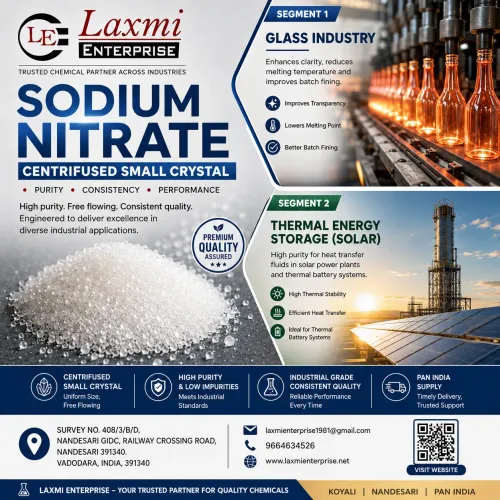
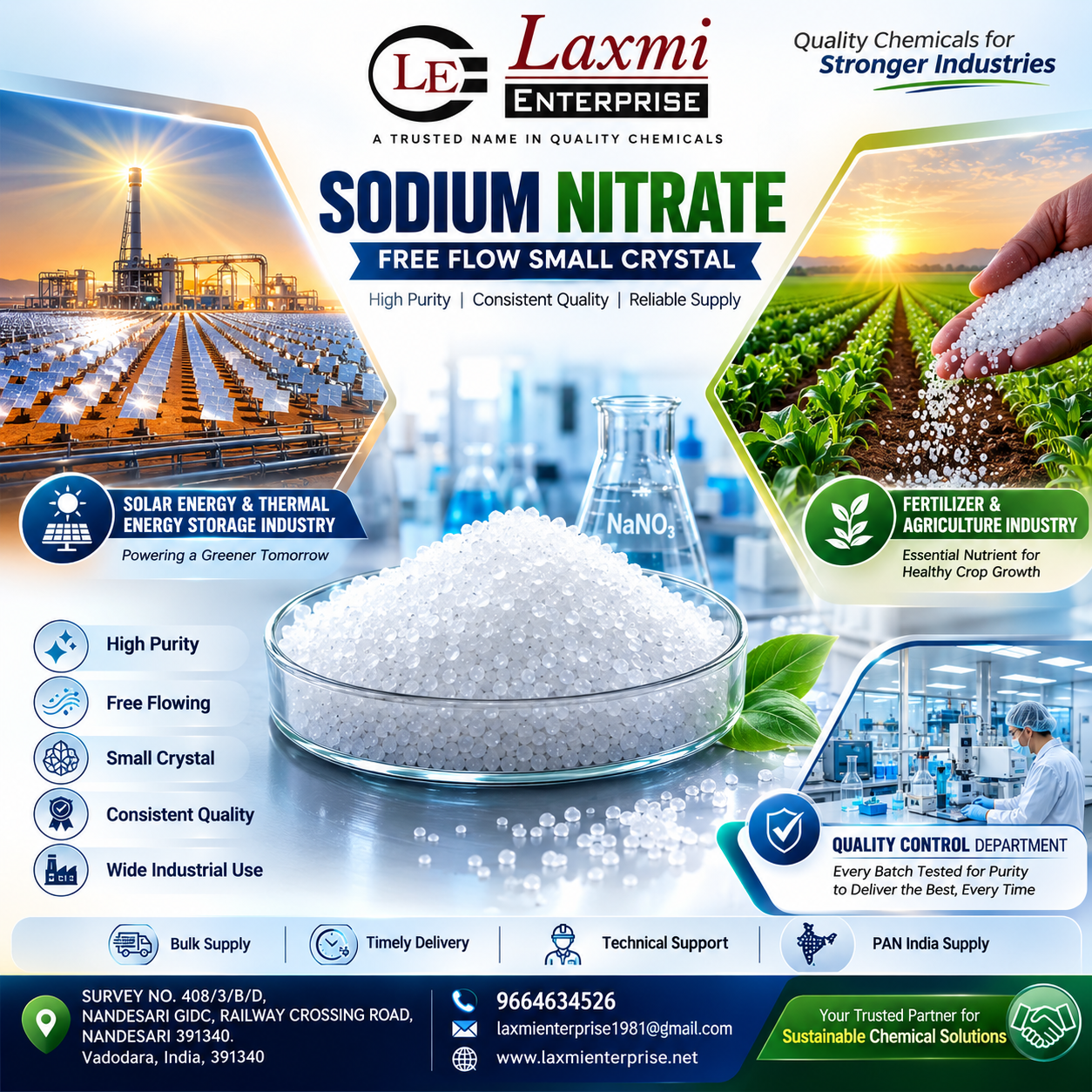
Sodium Nitrate is a naturally occurring and industrially produced inorganic nitrate salt composed of sodium and nitrate ions. It is widely used as an oxidizing agent and process chemical in industries such as chemical processing, glass manufacturing, ceramics, metal refining, thermal energy storage, and specialty chemicals.
Free Flow Grade
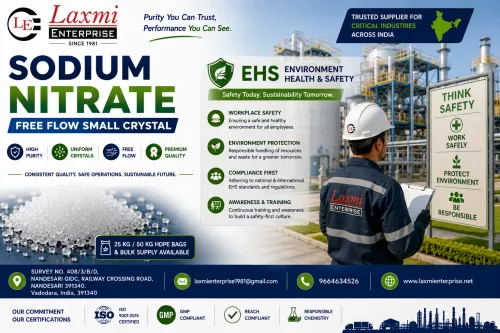
Free Flow Grade refers to Sodium Nitrate that has been processed to maintain excellent flowability during storage, transportation, and industrial handling. It is less prone to caking and provides smooth discharge through hoppers, feeders, and automated conveying systems.
Oxidizing Agent
An oxidizing agent is a substance that can promote oxidation reactions by providing oxygen or accepting electrons in a controlled chemical process. Sodium Nitrate is classified as an oxidizing substance and should be handled according to applicable safety guidelines.
Chemical Purity
Chemical purity indicates the percentage of Sodium Nitrate present in the product. Higher purity generally reduces unwanted impurities and supports consistent industrial performance.
Particle Size Distribution
Particle size distribution describes the range and proportion of crystal sizes within a batch. A controlled distribution improves blending, handling, dosing accuracy, and dissolution characteristics.
Flowability
Flowability is the ability of the product to move freely without bridging, caking, or blocking industrial equipment. High flowability is especially important in automated manufacturing systems.
Bulk Density
Bulk density is the mass of the material occupying a specific volume, including the spaces between particles. Consistent bulk density assists in accurate dosing, packaging, and inventory calculations.
Moisture Content
Moisture content refers to the amount of water present in the product. Low moisture helps preserve free-flowing characteristics, improves storage stability, and minimizes caking.
Certificate of Analysis (COA)
A Certificate of Analysis is an official quality document issued for a specific production batch. It confirms that the product meets declared specifications for parameters such as purity, moisture, particle size, and impurities.
Safety Data Sheet (SDS)
A Safety Data Sheet provides essential information regarding product identification, hazard classification, safe handling, storage recommendations, emergency measures, and regulatory information.
Batch Traceability
Batch traceability enables manufacturers to identify the production history of supplied material, supporting quality assurance, audits, and product investigations.
Hygroscopicity
Hygroscopicity is the tendency of a material to absorb moisture from the surrounding air. Proper packaging and storage help maintain the Free Flow characteristics of Sodium Nitrate.
FIFO (First-In, First-Out)
FIFO is an inventory management practice in which older stock is used before newly received material. It helps maintain product quality and simplifies warehouse management.
Free Flow Sodium Nitrate vs. Conventional Sodium Nitrate
Feature Free Flow Sodium Nitrate Conventional Sodium Nitrate
Flowability Excellent Moderate
Caking Resistance High Lower
Hopper Performance Smooth May bridge
Automated Feeding Highly suitable May require intervention
Particle Size Uniform Can vary
Moisture Resistance Better More susceptible
Storage Stability Improved Depends on conditions
Handling Efficiency High Moderate
Production Downtime Reduced Higher risk
Industrial Productivity Enhanced May be affected by handling issues
Common Myths and Facts
Myth: All Sodium Nitrate products perform the same.
Fact: Physical characteristics such as particle size, moisture content, and flowability can significantly influence industrial handling and production efficiency.
Myth: Purity is the only factor that matters.
Fact: Flowability, packaging quality, storage stability, and supplier consistency are equally important for reliable manufacturing.
Myth: Packaging has little effect on product quality.
Fact: Proper packaging helps protect Sodium Nitrate from moisture and contamination during storage and transportation, preserving its free-flowing characteristics.
Myth: Any supplier can provide the same product.
Fact: Differences in manufacturing quality control, batch consistency, technical documentation, and logistics support can affect production reliability.
Myth: Free Flow grade is only useful for automated plants.
Fact: Even manual handling operations benefit from reduced caking, easier unloading, cleaner handling, and improved storage stability.
Quick Procurement Checklist
Before purchasing Sodium Nitrate Free Flow, verify the following:
✔ Product grade is suitable for your application.
✔ Chemical purity meets process requirements.
✔ Product is a genuine Free Flow grade.
✔ Particle size distribution is consistent.
✔ Moisture content is controlled.
✔ Standard packing options are available:
25 kg Bags
50 kg Bags
500 kg Jumbo Bags
✔ Certificate of Analysis (COA) is provided.
✔ Safety Data Sheet (SDS) is available.
✔ Batch number and manufacturing details are included.
✔ Packaging is intact and moisture-resistant.
✔ Supplier has a proven record of consistent quality.
✔ Delivery schedule aligns with production planning.
People Also Ask
Is Sodium Nitrate Free Flow suitable for continuous manufacturing?
Yes. Its excellent flowability and consistent particle size make it suitable for continuous production systems where reliable material feeding is essential.
Can Sodium Nitrate be stored for long periods?
When kept in its original sealed packaging under cool and dry conditions, Sodium Nitrate remains chemically stable for extended periods.
Why do industries choose Free Flow Sodium Nitrate?
Industries value the Free Flow grade because it improves material handling, minimizes caking, supports automated equipment, and enhances overall production efficiency.
Which packing size is most commonly used?
The most common commercial packing sizes are 25 kg, 50 kg, and 500 kg Jumbo Bags, allowing manufacturers to select packaging based on their consumption and handling systems.
What documents should accompany every industrial shipment?
A typical shipment should include a Certificate of Analysis (COA), Safety Data Sheet (SDS), batch identification, product label, and packing details to support quality assurance and traceability.
Sodium Nitrate (NaNO₃)
Sodium Nitrate is a naturally occurring and industrially produced inorganic nitrate salt composed of sodium and nitrate ions. It is widely used as an oxidizing agent and process chemical in industries such as chemical processing, glass manufacturing, ceramics, metal refining, thermal energy storage, and specialty chemicals.
Free Flow Grade
Free Flow Grade refers to Sodium Nitrate that has been processed to maintain excellent flowability during storage, transportation, and industrial handling. It is less prone to caking and provides smooth discharge through hoppers, feeders, and automated conveying systems.
Oxidizing Agent
An oxidizing agent is a substance that can promote oxidation reactions by providing oxygen or accepting electrons in a controlled chemical process. Sodium Nitrate is classified as an oxidizing substance and should be handled according to applicable safety guidelines.
Chemical Purity
Chemical purity indicates the percentage of Sodium Nitrate present in the product. Higher purity generally reduces unwanted impurities and supports consistent industrial performance.
Particle Size Distribution
Particle size distribution describes the range and proportion of crystal sizes within a batch. A controlled distribution improves blending, handling, dosing accuracy, and dissolution characteristics.
Flowability
Flowability is the ability of the product to move freely without bridging, caking, or blocking industrial equipment. High flowability is especially important in automated manufacturing systems.
Bulk Density
Bulk density is the mass of the material occupying a specific volume, including the spaces between particles. Consistent bulk density assists in accurate dosing, packaging, and inventory calculations.
Moisture Content
Moisture content refers to the amount of water present in the product. Low moisture helps preserve free-flowing characteristics, improves storage stability, and minimizes caking.
Certificate of Analysis (COA)
A Certificate of Analysis is an official quality document issued for a specific production batch. It confirms that the product meets declared specifications for parameters such as purity, moisture, particle size, and impurities.
Safety Data Sheet (SDS)
A Safety Data Sheet provides essential information regarding product identification, hazard classification, safe handling, storage recommendations, emergency measures, and regulatory information.
Batch Traceability
Batch traceability enables manufacturers to identify the production history of supplied material, supporting quality assurance, audits, and product investigations.
Hygroscopicity
Hygroscopicity is the tendency of a material to absorb moisture from the surrounding air. Proper packaging and storage help maintain the Free Flow characteristics of Sodium Nitrate.
FIFO (First-In, First-Out)
FIFO is an inventory management practice in which older stock is used before newly received material. It helps maintain product quality and simplifies warehouse management.
Free Flow Sodium Nitrate vs. Conventional Sodium Nitrate
Feature Free Flow Sodium Nitrate Conventional Sodium Nitrate
Flowability Excellent Moderate
Caking Resistance High Lower
Hopper Performance Smooth May bridge
Automated Feeding Highly suitable May require intervention
Particle Size Uniform Can vary
Moisture Resistance Better More susceptible
Storage Stability Improved Depends on conditions
Handling Efficiency High Moderate
Production Downtime Reduced Higher risk
Industrial Productivity Enhanced May be affected by handling issues
Common Myths and Facts
Myth: All Sodium Nitrate products perform the same.
Fact: Physical characteristics such as particle size, moisture content, and flowability can significantly influence industrial handling and production efficiency.
Myth: Purity is the only factor that matters.
Fact: Flowability, packaging quality, storage stability, and supplier consistency are equally important for reliable manufacturing.
Myth: Packaging has little effect on product quality.
Fact: Proper packaging helps protect Sodium Nitrate from moisture and contamination during storage and transportation, preserving its free-flowing characteristics.
Myth: Any supplier can provide the same product.
Fact: Differences in manufacturing quality control, batch consistency, technical documentation, and logistics support can affect production reliability.
Myth: Free Flow grade is only useful for automated plants.
Fact: Even manual handling operations benefit from reduced caking, easier unloading, cleaner handling, and improved storage stability.
Quick Procurement Checklist
Before purchasing Sodium Nitrate Free Flow, verify the following:
✔ Product grade is suitable for your application.
✔ Chemical purity meets process requirements.
✔ Product is a genuine Free Flow grade.
✔ Particle size distribution is consistent.
✔ Moisture content is controlled.
✔ Standard packing options are available:
25 kg Bags
50 kg Bags
500 kg Jumbo Bags
✔ Certificate of Analysis (COA) is provided.
✔ Safety Data Sheet (SDS) is available.
✔ Batch number and manufacturing details are included.
✔ Packaging is intact and moisture-resistant.
✔ Supplier has a proven record of consistent quality.
✔ Delivery schedule aligns with production planning.
People Also Ask
Is Sodium Nitrate Free Flow suitable for continuous manufacturing?
Yes. Its excellent flowability and consistent particle size make it suitable for continuous production systems where reliable material feeding is essential.
Can Sodium Nitrate be stored for long periods?
When kept in its original sealed packaging under cool and dry conditions, Sodium Nitrate remains chemically stable for extended periods.
Why do industries choose Free Flow Sodium Nitrate?
Industries value the Free Flow grade because it improves material handling, minimizes caking, supports automated equipment, and enhances overall production efficiency.
Which packing size is most commonly used?
The most common commercial packing sizes are 25 kg, 50 kg, and 500 kg Jumbo Bags, allowing manufacturers to select packaging based on their consumption and handling systems.
What documents should accompany every industrial shipment?
A typical shipment should include a Certificate of Analysis (COA), Safety Data Sheet (SDS), batch identification, product label, and packing details to support quality assurance and traceability.
Keywords