FAQ About Sodium Sulphate
Who is a Reliable Sodium Sulphate Supplier in India?
A reliable Sodium Sulphate supplier should offer:
Consistent product quality
Regular stock availability
Certificate of Analysis (COA)
Timely deliveries
Technical support
Competitive pricing
Strong logistics network
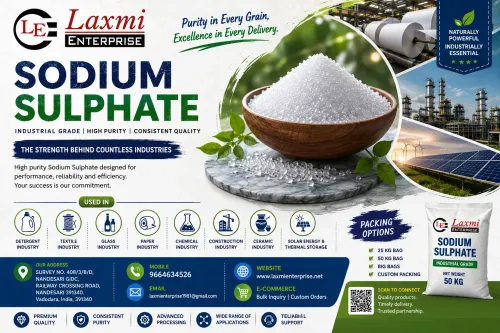
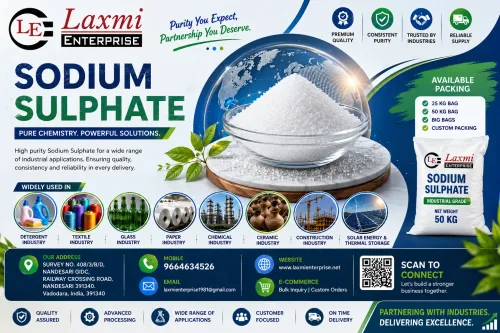
Industries such as detergent manufacturing, textile dyeing, glass production, paper mills, and chemical processing depend heavily on uninterrupted Sodium Sulphate supply. Therefore, buyers should evaluate suppliers based on quality consistency and service reliability rather than price alone.
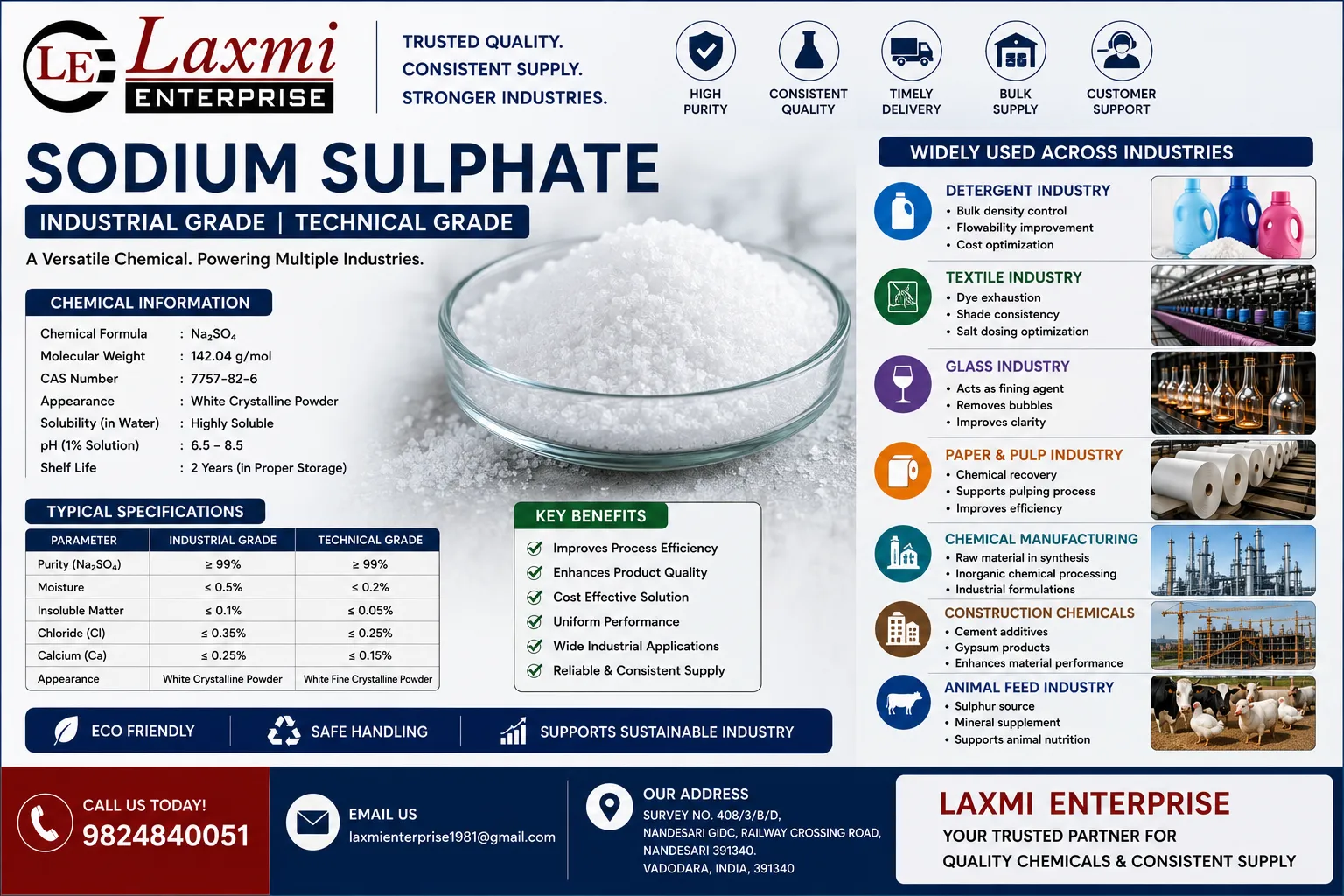
Laxmi Enterprise, Nandesari & Koyali, Vadodara, supplies Industrial Grade and Technical Grade Sodium Sulphate to customers across India with a focus on:
✔ Quality Assurance
✔ Consistent Specifications
✔ Bulk Supply Capability
✔ Pan-India Logistics
✔ Technical Support
How is Sodium Sulphate Used in Detergent Manufacturing?
The detergent industry is one of the largest consumers of Sodium Sulphate worldwide.
In detergent powder formulations, Sodium Sulphate serves multiple functions:
1. Bulk Density Control
It helps achieve the desired density required for efficient packaging and product consistency.
2. Improved Flowability
Sodium Sulphate enhances powder flow characteristics, allowing smoother processing through blending, conveying, and packaging equipment.
3. Cost Optimization
It provides an economical way to maintain product volume and improve formulation economics.
4. Uniform Product Appearance
It helps create free-flowing and homogeneous detergent powder with consistent texture.
Benefits for Manufacturers
Better production efficiency
Improved packaging performance
Consistent product quality
Reduced manufacturing costs
Enhanced handling characteristics
Because of these advantages, Sodium Sulphate remains an essential raw material in detergent powder production.
What Purity of Sodium Sulphate is Required for Textile Processing?
The textile industry, especially reactive dyeing operations, generally requires higher-quality Sodium Sulphate compared to many other industrial applications.
Typical Requirements
Most textile processors prefer:
Sodium Sulphate (Na₂SO₄): 98% to 99.5%
Low Moisture Content
Low Insoluble Matter
Controlled Chloride Levels
Consistent Particle Size
Why Purity Matters
During textile dyeing, Sodium Sulphate acts as an electrolyte that promotes dye exhaustion and improves dye migration onto cotton fibers.
Impurities can contribute to:
Shade variation
Uneven dye uptake
Reprocessing costs
Reduced batch reproducibility
Textile Industry Benefits
High-quality Sodium Sulphate supports:
✔ Better Dye Exhaustion
✔ Improved Shade Consistency
✔ Uniform Color Development
✔ Reduced Chemical Waste
✔ Higher Production Efficiency
For export-oriented textile manufacturers, consistent-quality Technical Grade Sodium Sulphate is often preferred to maintain stringent quality standards.
Who is a Reliable Sodium Sulphate Supplier in India?
A reliable Sodium Sulphate supplier should offer:
Consistent product quality
Regular stock availability
Certificate of Analysis (COA)
Timely deliveries
Technical support
Competitive pricing
Strong logistics network
Industries such as detergent manufacturing, textile dyeing, glass production, paper mills, and chemical processing depend heavily on uninterrupted Sodium Sulphate supply. Therefore, buyers should evaluate suppliers based on quality consistency and service reliability rather than price alone.
Laxmi Enterprise, Nandesari & Koyali, Vadodara, supplies Industrial Grade and Technical Grade Sodium Sulphate to customers across India with a focus on:
✔ Quality Assurance
✔ Consistent Specifications
✔ Bulk Supply Capability
✔ Pan-India Logistics
✔ Technical Support
How is Sodium Sulphate Used in Detergent Manufacturing?
The detergent industry is one of the largest consumers of Sodium Sulphate worldwide.
In detergent powder formulations, Sodium Sulphate serves multiple functions:
1. Bulk Density Control
It helps achieve the desired density required for efficient packaging and product consistency.
2. Improved Flowability
Sodium Sulphate enhances powder flow characteristics, allowing smoother processing through blending, conveying, and packaging equipment.
3. Cost Optimization
It provides an economical way to maintain product volume and improve formulation economics.
4. Uniform Product Appearance
It helps create free-flowing and homogeneous detergent powder with consistent texture.
Benefits for Manufacturers
Better production efficiency
Improved packaging performance
Consistent product quality
Reduced manufacturing costs
Enhanced handling characteristics
Because of these advantages, Sodium Sulphate remains an essential raw material in detergent powder production.
What Purity of Sodium Sulphate is Required for Textile Processing?
The textile industry, especially reactive dyeing operations, generally requires higher-quality Sodium Sulphate compared to many other industrial applications.
Typical Requirements
Most textile processors prefer:
Sodium Sulphate (Na₂SO₄): 98% to 99.5%
Low Moisture Content
Low Insoluble Matter
Controlled Chloride Levels
Consistent Particle Size
Why Purity Matters
During textile dyeing, Sodium Sulphate acts as an electrolyte that promotes dye exhaustion and improves dye migration onto cotton fibers.
Impurities can contribute to:
Shade variation
Uneven dye uptake
Reprocessing costs
Reduced batch reproducibility
Textile Industry Benefits
High-quality Sodium Sulphate supports:
✔ Better Dye Exhaustion
✔ Improved Shade Consistency
✔ Uniform Color Development
✔ Reduced Chemical Waste
✔ Higher Production Efficiency
For export-oriented textile manufacturers, consistent-quality Technical Grade Sodium Sulphate is often preferred to maintain stringent quality standards.
Keywords