

How Sodium Sulphate Purity Affects Manufacturing Performance Across Different Industries
Every manufacturer wants consistent production.
Whether the factory produces detergent powder, glass, paper, textiles or industrial chemicals, the expectation remains the same. Raw materials should perform consistently every day.
When production is stable, planning becomes easier.
Machine settings remain unchanged.
Quality checks become predictable.
Finished products maintain uniform standards.
Customers receive exactly what they expect.
While many production variables influence manufacturing performance, one factor often deserves more attention than it receives.
The purity of the raw material.
For Sodium Sulphate, purity is not simply a laboratory value mentioned on a specification sheet. It directly influences production stability, process efficiency and long-term manufacturing reliability.
Experienced manufacturers understand that buying a chemical and buying the right quality chemical are two completely different decisions.
Understanding Purity Beyond the Percentage
When procurement teams compare suppliers, they often begin by looking at the purity mentioned in the technical specification.
That number is important.
However, experienced production managers know that the discussion should not stop there.
A specification sheet provides information about the material.
Manufacturing provides information about performance.
The real question is whether the material performs consistently from one delivery to the next.
A supplier may provide an excellent first shipment.
The real challenge is maintaining the same quality throughout the year.
Production departments value repeatability more than occasional excellence.
Why Production Stability Depends on Raw Material Consistency
Modern manufacturing processes are designed around repeatable operating conditions.
Mixing times are established.
Processing temperatures are controlled.
Production rates are monitored.
Machine settings are optimised.
When raw material quality changes unexpectedly, production teams often need to make adjustments.
These adjustments may appear minor, but repeated changes reduce manufacturing efficiency.
Stable raw materials reduce unnecessary process variation.
This allows operators to concentrate on productivity instead of correcting avoidable problems.
Quality Begins Before the Material Enters Production
Many people believe quality control begins inside the laboratory.
In reality, quality begins much earlier.
It starts when a supplier establishes manufacturing standards.
It continues through product handling.
It depends on proper packaging.
It includes transportation and storage.
Finally, it reaches the customer's warehouse.
Every stage contributes to the condition of the material before it reaches the production line.
This is why manufacturers evaluate suppliers as carefully as they evaluate products.
Reliable suppliers create reliable manufacturing.
How Different Industries View Sodium Sulphate Quality
Every industry uses Sodium Sulphate differently.
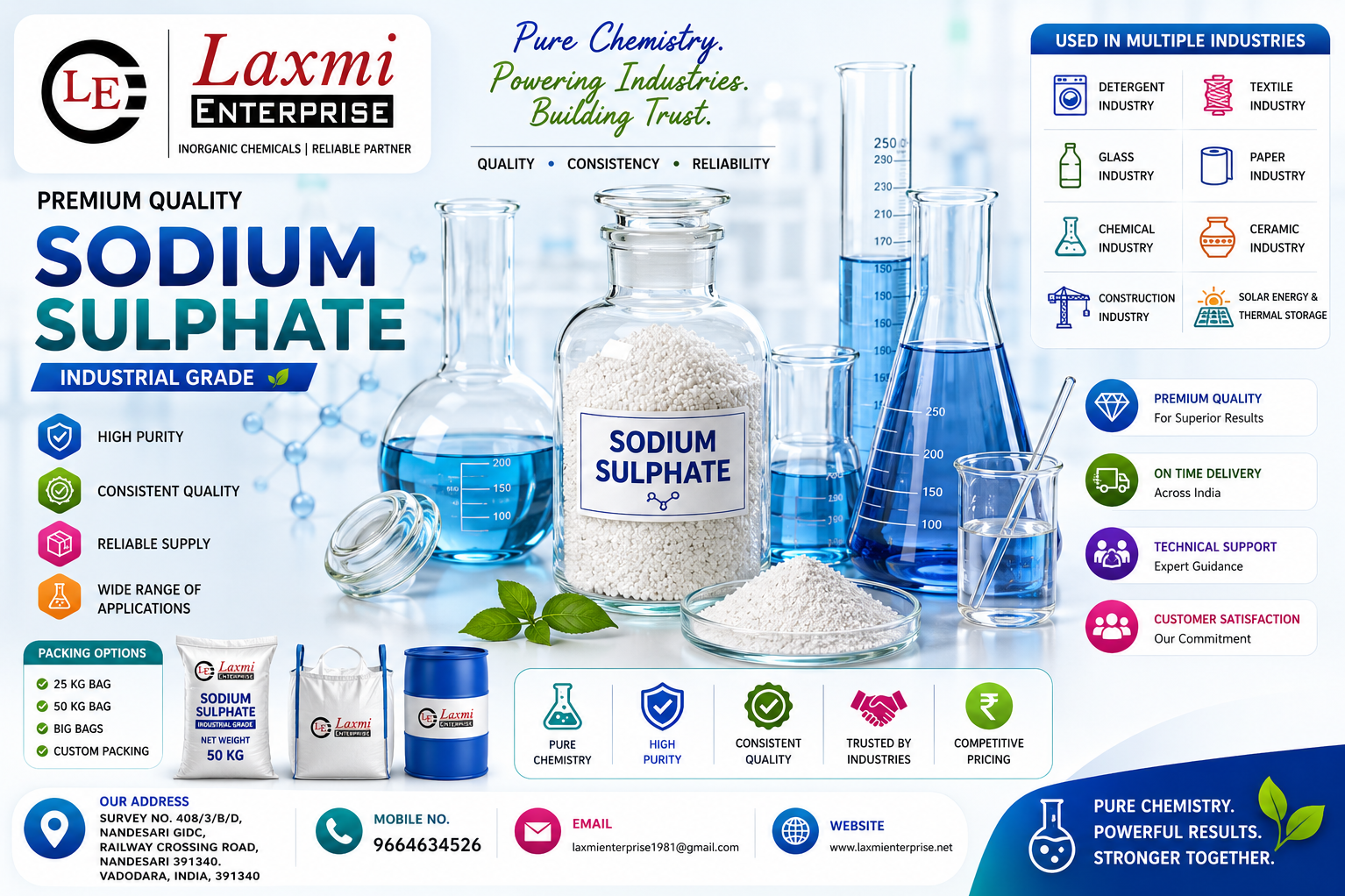
Detergent manufacturers focus on consistent production and efficient blending.
Glass manufacturers depend on stable batch preparation and uninterrupted furnace operation.
Paper manufacturers require dependable raw materials to maintain production efficiency.
Textile processors value consistent chemical behaviour throughout processing operations.
Although applications differ, every industry shares one common expectation.
The material should perform consistently every time it is used.
This consistency supports efficient manufacturing regardless of the production process.
The Hidden Cost of Quality Variations
Small quality variations rarely remain small.
Production teams spend additional time monitoring the process.
Quality departments increase inspections.
Warehouse personnel separate materials for observation.
Management becomes involved in operational discussions.
Eventually, customer deliveries may also be affected.
These indirect costs are rarely visible during procurement.
However, they influence manufacturing profitability every day.
Reliable quality helps prevent these unnecessary expenses.
Laboratory Testing Is Only Part of the Evaluation
Most manufacturers perform routine quality checks before approving incoming raw materials.
This is an essential practice.
However, experienced companies also evaluate practical production performance.
How smoothly does the material move through the process?
Does production remain stable?
Do operators report any unexpected behaviour?
Does the finished product maintain consistent quality?
Combining laboratory analysis with production feedback provides a much more complete understanding of supplier performance.
Production experience is just as valuable as laboratory data.
Choosing a Supplier Instead of Only Choosing a Product
Industrial procurement has changed significantly over the past decade.
Today, manufacturers are looking beyond individual purchase orders.
They are selecting long-term business partners.
Reliable suppliers contribute to production planning.
Inventory management.
Technical discussions.
Delivery scheduling.
Customer support.
This partnership approach creates greater value than purchasing based only on the lowest quotation.
Successful manufacturing depends on successful supplier relationships.
How Quality Influences Business Reputation
Customers expect consistency.
They expect every shipment to match the previous one.
They rarely think about the raw materials used to manufacture the product.
They simply evaluate the finished result.
For manufacturers, this means raw material quality directly influences customer confidence.
Reliable products strengthen business reputation.
Inconsistent products weaken it.
Choosing dependable suppliers therefore becomes an investment in customer satisfaction as well as production efficiency.
How Laxmi Enterprise Maintains Consistency
At Laxmi Enterprise, we understand that every bag of Sodium Sulphate supplied to a customer becomes part of their manufacturing process.
Operating from Nandesari GIDC, Vadodara, we supply Sodium Sulphate and other industrial chemicals to manufacturers across India.
Our focus extends beyond supplying material.
We work to maintain consistent quality, dependable packaging, organised inventory and reliable deliveries because we understand how important these factors are to modern manufacturing.
Our customers expect every shipment to perform consistently.
That expectation guides every aspect of our operations.
Many of our customer relationships have continued for decades because reliability remains our highest priority.
Final Thoughts
Purity should never be viewed as just another technical specification.
For manufacturers, it represents production stability.
It supports consistent processing.
It reduces unnecessary adjustments.
It strengthens customer confidence.
Businesses that invest in dependable raw materials usually experience smoother operations, stronger product quality and better long-term performance.
The strongest manufacturing companies understand that quality begins long before production starts.
It begins with choosing the right supplier.
Frequently Asked Questions
Why is Sodium Sulphate purity important in manufacturing?
Consistent purity helps maintain stable production conditions, improves process efficiency and supports uniform finished product quality across different industries.
How does raw material consistency improve manufacturing?
Consistent raw materials reduce process adjustments, improve production planning, minimise operational variation and help maintain efficient manufacturing.
Should manufacturers evaluate suppliers as well as products?
Yes. Supplier reliability, quality consistency, packaging, delivery performance and technical support all influence long-term manufacturing success.
Is laboratory testing enough when evaluating Sodium Sulphate?
Laboratory testing is important, but manufacturers should also evaluate practical production performance, consistency across multiple deliveries and supplier reliability.
Why do manufacturers choose Laxmi Enterprise?
Manufacturers across India choose Laxmi Enterprise because we combine consistent-quality Sodium Sulphate with dependable deliveries, professional customer support and decades of industrial experience. Operating from Nandesari GIDC, Vadodara, we help industries build reliable manufacturing processes through quality products and long-term partnerships.
About Laxmi Enterprise
Laxmi Enterprise is a trusted manufacturer, supplier and distributor of industrial chemicals based in Nandesari GIDC, Vadodara, Gujarat. We supply Sodium Sulphate, Sodium Nitrate, Sodium Acetate, Tri Sodium Phosphate and other industrial chemicals to manufacturers across detergent, glass, textile, paper, ceramic, construction, water treatment and chemical processing industries throughout India.
With decades of experience, we have earned the confidence of customers through consistent product quality, dependable logistics and professional service. Our commitment is to support Indian manufacturers with industrial chemicals that contribute to efficient production, reliable operations and sustainable business growth.