
How to Evaluate Sodium Sulphate Before Approving a New Supplier: A Technical Guide for Quality and Procurement Teams
Selecting a new Sodium Sulphate supplier is one of the most important decisions a manufacturing company makes.
Unlike office supplies or standard consumables, industrial chemicals become part of the manufacturing process itself. Every batch produced by the factory depends on the quality, consistency and reliability of the raw materials entering the production line.
A poor purchasing decision may not become visible immediately.
The first shipment might perform well.
The second shipment may also meet expectations.
The real challenge begins six months later when production volumes increase, customer demand grows and every department depends on a supplier who can consistently deliver the same quality.
For this reason, experienced manufacturers follow a structured supplier evaluation process before approving any new Sodium Sulphate supplier.
The objective is not simply to compare prices.
The objective is to reduce manufacturing risk.
Why Technical Evaluation Is More Important Than Commercial Evaluation
Most procurement discussions begin with pricing.
This is understandable because purchasing departments are expected to manage costs effectively.
However, technical evaluation should always come before commercial negotiation.
If a raw material cannot consistently support the manufacturing process, the purchase price becomes less important.
Production interruptions.
Additional quality inspections.
Machine adjustments.
Customer complaints.
All of these can cost significantly more than the initial savings achieved through a lower quotation.
The most successful manufacturers therefore begin with technical approval before discussing commercial terms.
Review the Product Specification Carefully
Every supplier should provide a detailed product specification.
The document should clearly identify important quality parameters relevant to industrial applications.
Quality teams should verify that the specification aligns with internal manufacturing requirements.
A specification sheet should not simply be filed for record purposes.
It should become part of the technical evaluation process.
Any uncertainty should be discussed before the first purchase order is issued.
A clear understanding at the beginning helps prevent misunderstandings later.
Request Consistency Instead of a Single Good Sample
Receiving one good laboratory sample is encouraging.
Receiving consistent quality over several months is much more valuable.
Manufacturers should focus on repeatability.
Can the supplier maintain the same quality throughout the year?
Can increasing production demand be supported without affecting product consistency?
Can every shipment meet the same technical expectations?
Consistency is one of the strongest indicators of a dependable industrial supplier.
Evaluate Packaging Standards
Technical quality alone is not sufficient.
Packaging protects the material throughout transportation, unloading and warehouse storage.
Quality teams should inspect packaging carefully.
Are the bags properly sealed?
Is the product identification clear?
Are batch details available where applicable?
Can warehouse personnel handle the material efficiently?
Strong packaging reduces handling risks and supports better inventory management.
Warehouse Feedback Should Be Included
Warehouse personnel interact with incoming raw materials before production begins.
Their observations are extremely valuable.
They can identify damaged packaging.
Handling difficulties.
Labelling problems.
Storage concerns.
Receiving efficiency.
Including warehouse feedback in supplier approval creates a more complete evaluation process.
Every department contributes a different perspective.
Production Trials Are Essential
Before approving a supplier for regular bulk purchases, manufacturers should perform controlled production trials.
Monitor how the material behaves during normal manufacturing.
Observe mixing characteristics.
Review production stability.
Evaluate finished product consistency.
Collect operator feedback.
Production experience provides practical information that laboratory testing alone cannot reveal.
This stage should never be rushed.
Review the Supplier's Manufacturing Experience
Experience matters.
A supplier serving industrial customers for many years usually understands manufacturing expectations better than a newly established trading business.
Ask practical questions.
Which industries do they supply?
Can they provide regular monthly quantities?
How do they manage increasing customer demand?
How do they ensure consistent product quality?
A supplier's operational experience often becomes one of their greatest strengths.
Evaluate Delivery Capability
Reliable logistics are just as important as reliable products.
A technically excellent material arriving several days late still creates manufacturing problems.
Review the supplier's dispatch process.
Understand transportation arrangements.
Discuss emergency delivery procedures.
Confirm average lead times.
Production planning becomes much easier when logistics remain predictable.
Assess Technical Support
Professional suppliers continue supporting customers after the material has been delivered.
Can technical questions be answered promptly?
Is the supplier accessible?
Are product-related discussions handled professionally?
Good technical support becomes particularly valuable when manufacturers introduce new products or expand production capacity.
Strong suppliers invest in customer relationships rather than only completing transactions.
Develop an Internal Supplier Approval Checklist
Many successful manufacturing companies create a standard approval checklist for every new chemical supplier.
The checklist may include the following.
Technical specification review.
Packaging inspection.
Production trial.
Quality evaluation.
Warehouse assessment.
Delivery capability.
Commercial review.
Management approval.
Using the same process for every supplier improves consistency and reduces procurement risk.
Structured evaluations create stronger purchasing decisions.
How Laxmi Enterprise Supports Technical Procurement
At Laxmi Enterprise, we understand that modern manufacturers expect much more than competitive pricing.
They expect technical consistency.
Reliable documentation.
Professional communication.
Dependable logistics.
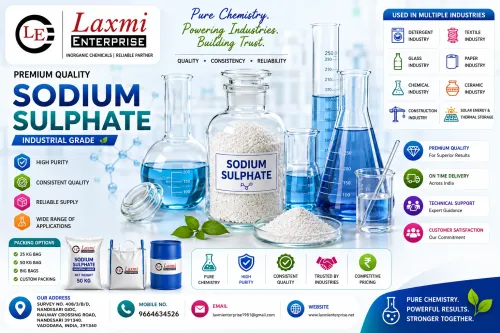
Operating from Nandesari GIDC, Vadodara, we supply Sodium Sulphate and other industrial chemicals to manufacturers across India.
We encourage customers to evaluate our products carefully because we believe confidence is built through performance.
Many of our long-term customers began with detailed technical discussions before placing their first order.
Those relationships continue today because we remain committed to delivering consistent quality and dependable service with every shipment.
Final Thoughts
Approving a new Sodium Sulphate supplier should always be a structured technical decision rather than a quick commercial comparison.
Manufacturers who invest time in supplier evaluation usually experience fewer production challenges, stronger product consistency and more dependable supply chains.
Reliable manufacturing begins with reliable raw materials.
Reliable raw materials begin with reliable suppliers.
Choosing the right partner today helps build a stronger manufacturing business for many years to come.
Frequently Asked Questions
What should manufacturers evaluate before approving a Sodium Sulphate supplier?
Manufacturers should evaluate product specifications, quality consistency, packaging, production performance, delivery capability, technical support and supplier experience before approving a new supplier.
Why are production trials important?
Production trials allow manufacturers to evaluate how the material performs under actual operating conditions before committing to long-term supply.
Should warehouse teams be involved in supplier approval?
Yes. Warehouse personnel provide valuable observations regarding packaging quality, handling, storage and receiving efficiency.
Why is supplier experience important?
Experienced suppliers generally have stronger quality systems, better logistics, greater production knowledge and a deeper understanding of industrial customer requirements.
Why do manufacturers across India choose Laxmi Enterprise?
Manufacturers across India choose Laxmi Enterprise because we combine decades of industrial experience with consistent-quality Sodium Sulphate, dependable deliveries and professional technical support. Operating from Nandesari GIDC, Vadodara, we help manufacturers strengthen their procurement process through reliable products and long-term partnerships.
About Laxmi Enterprise
Laxmi Enterprise is a trusted manufacturer, supplier and distributor of industrial chemicals based in Nandesari GIDC, Vadodara, Gujarat. We supply Sodium Sulphate, Sodium Nitrate, Sodium Acetate, Tri Sodium Phosphate and other industrial chemicals to manufacturers across detergent, glass, textile, paper, ceramic, construction, water treatment and chemical processing industries throughout India.
Our commitment is built on technical excellence, dependable quality and long-term customer relationships. Every shipment reflects our dedication to helping manufacturers achieve stable production, efficient operations and sustainable business growth through reliable industrial chemical solutions.