Industrial Applications of Sodium Nitrate – A Practical Guide for Engineers, Procurement Teams & Manufacturers
Why Is Sodium Nitrate Used in So Many Industries?
Sodium Nitrate is valued because it combines high water solubility, stable chemical properties, and versatility across numerous industrial processes. Rather than serving a single purpose, it performs different functions depending on the application, making it an important raw material in manufacturing, processing, and specialty industries.
Unlike many industrial chemicals that serve one specific role, Sodium Nitrate can act as:
An oxidizing component in selected industrial processes.
A source of nitrate ions for chemical reactions.
A raw material in downstream chemical manufacturing.
A processing aid in certain production systems.
A functional ingredient where controlled nitrate chemistry is required.
The specific role depends entirely on the manufacturing process and product requirements.
Which Industries Commonly Use Sodium Nitrate?
Industrial demand comes from a wide range of sectors.
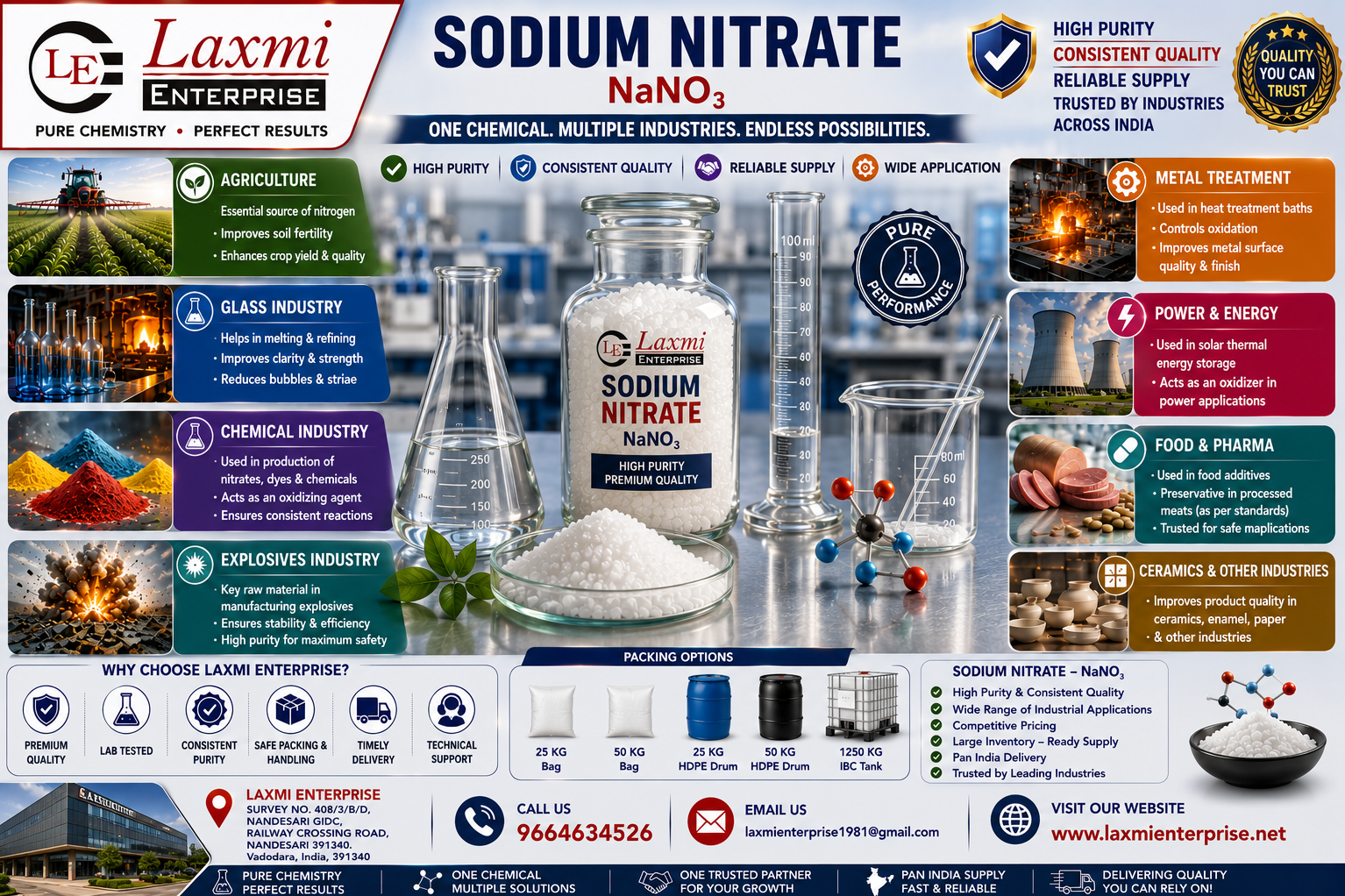
Some of the most common applications include:
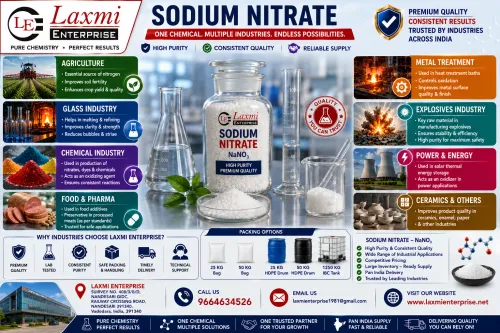
Industry Typical Purpose
Glass Manufacturing Raw material in selected glass formulations
Chemical Manufacturing Intermediate for various chemical processes
Fertilizer Industry Source of nitrate in specialized formulations
Heat Transfer Systems Component in certain molten salt mixtures
Metal Processing Used in selected industrial operations
Mining & Explosives Raw material in approved industrial formulations
Laboratory & Research Analytical and experimental applications
Ceramics Selected specialty formulations
Water Treatment Certain industrial treatment processes
Specialty Manufacturing Process-specific applications
Each industry places different priorities on purity, particle size, documentation, and supply consistency.
Why Do Different Industries Require Different Grades?
No single grade of Sodium Nitrate is ideal for every application. Manufacturing processes differ significantly, so buyers should select material based on technical requirements rather than assuming that one grade is universally suitable.
For example:
A continuous manufacturing process may prioritize:
Consistent purity.
Reliable particle size.
Stable supply.
Another industry may place greater emphasis on:
Packaging configuration.
Moisture characteristics.
Documentation requirements.
Batch consistency.
Understanding application requirements helps buyers avoid unnecessary costs and production issues.
Sodium Nitrate in the Glass Industry
Why Is Sodium Nitrate Used in Glass Manufacturing?
The glass industry uses Sodium Nitrate in specific formulations because it contributes to controlled manufacturing processes and supports the production of high-quality glass. The exact role depends on the glass composition, furnace conditions, and manufacturing technology employed by the producer.
Glass manufacturing demands exceptional process consistency.
Small variations in raw materials can influence furnace performance, product quality, and manufacturing efficiency.
For this reason, glass manufacturers often evaluate suppliers based on:
Consistent product quality.
Reliable batch-to-batch performance.
Stable supply capability.
Complete documentation.
Predictable delivery schedules.
Long-term consistency is generally more valuable than occasional high-purity batches.
Procurement Considerations for Glass Manufacturers
Glass manufacturers commonly evaluate:
Evaluation Area Importance
Batch Consistency Very High
Documentation Accuracy High
Reliable Supply Very High
Packaging Quality High
Traceability High
Technical Communication High
Production interruptions in continuous glass furnaces can have significant operational consequences, making supply reliability a key purchasing factor.
Practical Example
A float glass manufacturer schedules furnace operations months in advance.
If a shipment is delayed or documentation is incomplete, production planning may be disrupted even if the chemical quality is acceptable.
This illustrates why procurement decisions often extend beyond laboratory specifications.
Sodium Nitrate in Chemical Manufacturing
Why Is Sodium Nitrate Used in Chemical Processing?
Chemical manufacturers use Sodium Nitrate as a raw material in selected production processes where nitrate chemistry is required. Product consistency, documentation quality, and reliable supply are often as important as the chemical composition itself.
Chemical production frequently operates under controlled process conditions.
Variations in raw material quality can increase:
Process adjustments.
Quality investigations.
Production downtime.
Material evaluation time.
Consequently, chemical manufacturers generally seek suppliers capable of delivering repeatable product performance.
What Do Chemical Manufacturers Expect?
Typical expectations include:
Stable product quality.
Complete COA documentation.
Current SDS.
Reliable batch traceability.
Responsive technical communication.
Consistent packaging quality.
These requirements support both operational efficiency and regulatory compliance.
Sodium Nitrate in Fertilizer Manufacturing
Why Is Sodium Nitrate Used in Fertilizer Production?
Sodium Nitrate serves as a source of nitrate in certain specialized fertilizer formulations and industrial applications. Product selection depends on the formulation requirements, applicable regulations, and the manufacturer's production objectives.
Fertilizer manufacturers often evaluate:
Product consistency.
Bulk handling characteristics.
Packaging performance.
Delivery reliability.
Documentation accuracy.
Because production schedules are often seasonal, dependable logistics can be as important as product quality.
Seasonal Procurement Challenge
Demand for agricultural inputs may increase during specific periods of the year.
Organizations that plan purchases well in advance generally experience:
Better inventory control.
Reduced supply interruptions.
Improved production scheduling.
Greater purchasing flexibility.
Advance planning supports smoother operations during periods of increased demand.
Sodium Nitrate in Heat Transfer Systems
Why Is Sodium Nitrate Used in Thermal Applications?
Sodium Nitrate is used as a component in certain molten salt mixtures designed for industrial heat transfer and thermal energy storage applications. Material consistency and compliance with technical specifications are important because system performance depends on predictable chemical behavior.
Projects involving thermal systems often require:
Consistent raw material quality.
Reliable documentation.
Long-term supply planning.
Comprehensive traceability.
Because these systems may operate continuously for extended periods, procurement teams typically place a strong emphasis on supplier reliability.
Engineering Perspective
For thermal applications, procurement is not simply a purchasing activity—it is part of overall project risk management.
Selecting a dependable supplier can contribute to:
Predictable maintenance planning.
Reduced operational uncertainty.
Better documentation management.
Consistent project execution.
Extraction Summary
Major industries using Sodium Nitrate
Glass manufacturing.
Chemical manufacturing.
Fertilizer production.
Heat transfer systems.
Metal processing.
Mining and industrial explosives (where applicable).
Ceramics.
Water treatment.
Research laboratories.
Specialty manufacturing.
Common buying priorities across industries
Consistent product quality.
Reliable documentation.
Batch traceability.
Stable supply.
Responsive technical support.
Predictable delivery performance.
Why Is Sodium Nitrate Used in So Many Industries?
Sodium Nitrate is valued because it combines high water solubility, stable chemical properties, and versatility across numerous industrial processes. Rather than serving a single purpose, it performs different functions depending on the application, making it an important raw material in manufacturing, processing, and specialty industries.
Unlike many industrial chemicals that serve one specific role, Sodium Nitrate can act as:
An oxidizing component in selected industrial processes.
A source of nitrate ions for chemical reactions.
A raw material in downstream chemical manufacturing.
A processing aid in certain production systems.
A functional ingredient where controlled nitrate chemistry is required.
The specific role depends entirely on the manufacturing process and product requirements.
Which Industries Commonly Use Sodium Nitrate?
Industrial demand comes from a wide range of sectors.
Some of the most common applications include:
Industry Typical Purpose
Glass Manufacturing Raw material in selected glass formulations
Chemical Manufacturing Intermediate for various chemical processes
Fertilizer Industry Source of nitrate in specialized formulations
Heat Transfer Systems Component in certain molten salt mixtures
Metal Processing Used in selected industrial operations
Mining & Explosives Raw material in approved industrial formulations
Laboratory & Research Analytical and experimental applications
Ceramics Selected specialty formulations
Water Treatment Certain industrial treatment processes
Specialty Manufacturing Process-specific applications
Each industry places different priorities on purity, particle size, documentation, and supply consistency.
Why Do Different Industries Require Different Grades?
No single grade of Sodium Nitrate is ideal for every application. Manufacturing processes differ significantly, so buyers should select material based on technical requirements rather than assuming that one grade is universally suitable.
For example:
A continuous manufacturing process may prioritize:
Consistent purity.
Reliable particle size.
Stable supply.
Another industry may place greater emphasis on:
Packaging configuration.
Moisture characteristics.
Documentation requirements.
Batch consistency.
Understanding application requirements helps buyers avoid unnecessary costs and production issues.
Sodium Nitrate in the Glass Industry
Why Is Sodium Nitrate Used in Glass Manufacturing?
The glass industry uses Sodium Nitrate in specific formulations because it contributes to controlled manufacturing processes and supports the production of high-quality glass. The exact role depends on the glass composition, furnace conditions, and manufacturing technology employed by the producer.
Glass manufacturing demands exceptional process consistency.
Small variations in raw materials can influence furnace performance, product quality, and manufacturing efficiency.
For this reason, glass manufacturers often evaluate suppliers based on:
Consistent product quality.
Reliable batch-to-batch performance.
Stable supply capability.
Complete documentation.
Predictable delivery schedules.
Long-term consistency is generally more valuable than occasional high-purity batches.
Procurement Considerations for Glass Manufacturers
Glass manufacturers commonly evaluate:
Evaluation Area Importance
Batch Consistency Very High
Documentation Accuracy High
Reliable Supply Very High
Packaging Quality High
Traceability High
Technical Communication High
Production interruptions in continuous glass furnaces can have significant operational consequences, making supply reliability a key purchasing factor.
Practical Example
A float glass manufacturer schedules furnace operations months in advance.
If a shipment is delayed or documentation is incomplete, production planning may be disrupted even if the chemical quality is acceptable.
This illustrates why procurement decisions often extend beyond laboratory specifications.
Sodium Nitrate in Chemical Manufacturing
Why Is Sodium Nitrate Used in Chemical Processing?
Chemical manufacturers use Sodium Nitrate as a raw material in selected production processes where nitrate chemistry is required. Product consistency, documentation quality, and reliable supply are often as important as the chemical composition itself.
Chemical production frequently operates under controlled process conditions.
Variations in raw material quality can increase:
Process adjustments.
Quality investigations.
Production downtime.
Material evaluation time.
Consequently, chemical manufacturers generally seek suppliers capable of delivering repeatable product performance.
What Do Chemical Manufacturers Expect?
Typical expectations include:
Stable product quality.
Complete COA documentation.
Current SDS.
Reliable batch traceability.
Responsive technical communication.
Consistent packaging quality.
These requirements support both operational efficiency and regulatory compliance.
Sodium Nitrate in Fertilizer Manufacturing
Why Is Sodium Nitrate Used in Fertilizer Production?
Sodium Nitrate serves as a source of nitrate in certain specialized fertilizer formulations and industrial applications. Product selection depends on the formulation requirements, applicable regulations, and the manufacturer's production objectives.
Fertilizer manufacturers often evaluate:
Product consistency.
Bulk handling characteristics.
Packaging performance.
Delivery reliability.
Documentation accuracy.
Because production schedules are often seasonal, dependable logistics can be as important as product quality.
Seasonal Procurement Challenge
Demand for agricultural inputs may increase during specific periods of the year.
Organizations that plan purchases well in advance generally experience:
Better inventory control.
Reduced supply interruptions.
Improved production scheduling.
Greater purchasing flexibility.
Advance planning supports smoother operations during periods of increased demand.
Sodium Nitrate in Heat Transfer Systems
Why Is Sodium Nitrate Used in Thermal Applications?
Sodium Nitrate is used as a component in certain molten salt mixtures designed for industrial heat transfer and thermal energy storage applications. Material consistency and compliance with technical specifications are important because system performance depends on predictable chemical behavior.
Projects involving thermal systems often require:
Consistent raw material quality.
Reliable documentation.
Long-term supply planning.
Comprehensive traceability.
Because these systems may operate continuously for extended periods, procurement teams typically place a strong emphasis on supplier reliability.
Engineering Perspective
For thermal applications, procurement is not simply a purchasing activity—it is part of overall project risk management.
Selecting a dependable supplier can contribute to:
Predictable maintenance planning.
Reduced operational uncertainty.
Better documentation management.
Consistent project execution.
Extraction Summary
Major industries using Sodium Nitrate
Glass manufacturing.
Chemical manufacturing.
Fertilizer production.
Heat transfer systems.
Metal processing.
Mining and industrial explosives (where applicable).
Ceramics.
Water treatment.
Research laboratories.
Specialty manufacturing.
Common buying priorities across industries
Consistent product quality.
Reliable documentation.
Batch traceability.
Stable supply.
Responsive technical support.
Predictable delivery performance.
Keywords