
Sodium Acetate in Thermal Energy Storage & Phase Change Materials (PCM) – Latent Heat Storage, Supercooling, Crystallization Engineering, Renewable Energy Integration & Industrial Heat Recovery
As industries and governments work to improve energy efficiency and reduce carbon emissions, Thermal Energy Storage (TES) has become an increasingly important technology. Unlike batteries that store electrical energy, TES systems store thermal energy (heat) and release it when required.
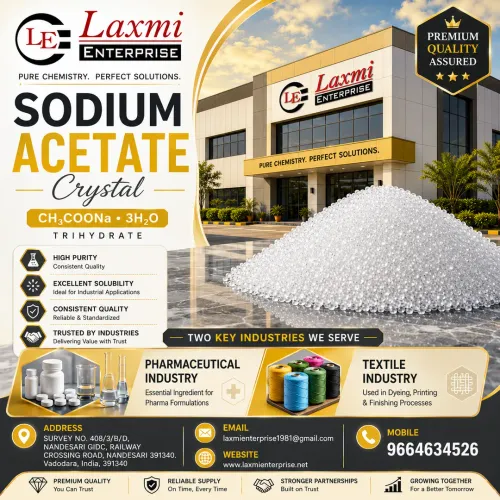
Among the many Phase Change Materials (PCMs) studied for thermal storage, Sodium Acetate Trihydrate (CH₃COONa·3H₂O) has attracted significant attention because of its ability to store and release latent heat during melting and crystallization. These characteristics have made it a subject of research and commercial use in applications such as reusable heat packs, solar thermal systems, building temperature regulation, and industrial heat recovery.
This article explains the science behind Sodium Acetate Trihydrate as a PCM, its engineering advantages, practical limitations, design considerations, and future opportunities.
What Is Thermal Energy Storage?
Thermal Energy Storage (TES) is the process of storing heat for later use.
Instead of generating heat exactly when needed, TES systems allow heat to be:
Stored
Retained
Transported
Released on demand
Common applications include:
Solar energy systems
District heating
HVAC systems
Industrial process heating
Waste heat recovery
TES can improve energy efficiency and reduce peak energy demand.
Understanding Phase Change Materials (PCM)
A Phase Change Material stores or releases a large amount of energy when it changes phase, typically between solid and liquid.
During melting:
The material absorbs heat.
Temperature remains nearly constant during the phase transition.
Energy is stored as latent heat.
During crystallization:
The material releases stored heat.
Temperature again remains relatively stable during the phase transition.
This property makes PCMs useful where controlled heat storage is required.
Why Sodium Acetate Trihydrate Is Used as a PCM
Sodium Acetate Trihydrate is attractive because it offers:
High latent heat storage capacity
Reversible phase transitions
Reusable thermal cycles
Relatively low cost compared with some specialty PCMs
Non-flammable characteristics under normal handling conditions
Availability at industrial scale
These properties have supported its adoption in several thermal management applications.
How Sodium Acetate Trihydrate Stores Heat
The thermal storage cycle involves three stages:
Stage 1 – Heating
The solid material absorbs heat as its temperature increases.
Stage 2 – Melting
Once the melting temperature is reached, additional heat causes the material to change from solid to liquid.
Instead of significantly increasing in temperature, much of the supplied energy is stored as latent heat.
Stage 3 – Cooling and Crystallization
As the liquid cools and crystallizes, the stored latent heat is released.
This controlled heat release makes Sodium Acetate Trihydrate valuable for thermal storage applications.
Latent Heat vs. Sensible Heat
Sensible Heat
Energy changes the temperature of a material.
Example:
Heating water from 20°C to 40°C.
Latent Heat
Energy changes the physical state without a significant temperature increase during the phase transition.
Example:
Melting Sodium Acetate Trihydrate.
Latent heat storage generally allows more energy to be stored within a relatively narrow temperature range.
Supercooling
One unique property of Sodium Acetate Trihydrate is its tendency to supercool.
Supercooling occurs when:
The liquid cools below its normal crystallization temperature.
It remains liquid instead of immediately forming crystals.
Once crystallization is initiated, stored heat is rapidly released.
This behavior is utilized in reusable heat packs but must be carefully managed in engineered thermal storage systems.
Crystallization Nucleation
Crystallization begins when a nucleation site is available.
Nucleation may occur through:
Seed crystals
Mechanical disturbance
Surface imperfections
Purpose-designed triggering mechanisms
Engineers study nucleation behavior to improve storage system reliability and cycling performance.
Thermal Cycling Performance
A practical PCM should withstand repeated heating and cooling cycles while maintaining:
Stable phase transition behavior
Consistent heat storage capacity
Acceptable physical stability
Predictable crystallization performance
Cycle testing helps evaluate long-term performance.
Thermal Conductivity
One challenge with many PCMs is relatively low thermal conductivity.
Researchers explore methods such as:
Metallic fins
Graphite additives
High-conductivity matrices
Composite PCM structures
These approaches aim to improve charging and discharging rates.
Encapsulation Technologies
To improve handling and system integration, PCMs may be encapsulated.
Common approaches include:
Macro-encapsulation
Large containers or modules holding the PCM.
Microencapsulation
Microscopic capsules dispersed into composite materials.
Shape-Stabilized Composites
PCM integrated into a supporting matrix to reduce leakage during melting.
Encapsulation selection depends on the application.
Renewable Energy Applications
Solar Thermal Systems
TES can store excess solar heat during sunny periods and release it later when solar energy is unavailable.
Building Energy Efficiency
PCM-containing building materials may help moderate indoor temperature fluctuations by absorbing and releasing heat.
Performance depends on building design, climate, and system integration.
Industrial Waste Heat Recovery
Industrial processes often generate recoverable heat.
PCM systems may capture part of this energy for later use, improving overall energy efficiency.
District Heating
Thermal storage systems can help balance heat production and demand in district heating networks.
HVAC Applications
Potential uses include:
Peak load reduction
Temperature stabilization
Cooling load management
Improved energy efficiency
System design determines actual performance benefits.
Reusable Heat Packs
One of the best-known commercial uses of Sodium Acetate Trihydrate is in reusable hand warmers and heat packs.
The operating principle involves:
Heating the pack to dissolve existing crystals.
Cooling the liquid into a supercooled state.
Triggering crystallization mechanically.
Releasing stored latent heat rapidly.
These products demonstrate practical latent heat storage on a small scale.
Research and Development Trends
Current areas of investigation include:
Composite PCMs
Nanomaterial-enhanced conductivity
Improved encapsulation
Reduced supercooling
Higher cycle stability
AI-assisted thermal system design
Hybrid energy storage systems
Research aims to expand performance and commercial viability.
Advantages
Potential advantages include:
High latent heat storage
Reusable thermal cycles
Relatively mature technology
Compatibility with renewable energy concepts
Potential reduction in energy consumption
Flexible integration into thermal systems
Performance depends on engineering design and operating conditions.
Engineering Challenges
Designers must address:
Supercooling behavior
Phase separation (where applicable)
Thermal conductivity limitations
Long-term cycling stability
Encapsulation durability
Heat exchanger design
Successful systems balance these factors through careful engineering.
Best Practices for Manufacturers
Manufacturers developing PCM products should:
Verify thermal performance through standardized testing.
Evaluate long-term cycling stability.
Optimize encapsulation methods.
Document thermal properties.
Implement robust quality control.
Best Practices for Industrial Buyers
When selecting Sodium Acetate Trihydrate for thermal storage applications, buyers should evaluate:
Product purity
Thermal performance data
Cycle stability
Consistency between batches
Technical documentation
Supplier expertise in PCM applications
Frequently Asked Questions (FAQ)
Why is Sodium Acetate Trihydrate used in thermal energy storage?
It stores and releases significant amounts of latent heat during melting and crystallization, making it useful in selected thermal energy storage applications.
What is latent heat?
Latent heat is the energy absorbed or released during a phase change without a significant change in temperature during the transition.
What is supercooling?
Supercooling occurs when a liquid cools below its normal crystallization temperature without immediately solidifying.
Why is supercooling important?
It enables stored thermal energy to remain available until crystallization is triggered, but it also requires careful engineering in larger thermal storage systems.
What is a Phase Change Material (PCM)?
A PCM stores or releases thermal energy through a reversible phase transition, typically between solid and liquid states.
Can Sodium Acetate Trihydrate improve building energy efficiency?
PCM-based systems may contribute to temperature regulation and energy efficiency when properly integrated into building designs.
Is Sodium Acetate Trihydrate used in solar energy systems?
Research and commercial systems have explored its use for storing heat collected from solar thermal installations.
What limits PCM performance?
Challenges may include low thermal conductivity, supercooling, phase separation, and long-term cycling behavior, depending on the material and system design.
How is PCM quality evaluated?
Manufacturers typically assess thermal properties, cycle stability, crystallization behavior, and consistency across production batches.
What should buyers request from suppliers?
Technical data sheets, thermal performance information, quality documentation, batch traceability, and guidance on the intended application.
Expert Insight: Thermal Storage Is a Key Technology for the Energy Transition
Thermal energy storage complements renewable energy by enabling heat to be stored when it is available and released when it is needed. Sodium Acetate Trihydrate has become one of the most recognized PCMs due to its latent heat storage characteristics and reusable crystallization cycle. Continued research into encapsulation, conductivity enhancement, and cycle stability is expected to broaden its role in energy-efficient buildings, industrial heat recovery, and renewable thermal systems.
Original Assets to Build
Technical Diagrams
Latent Heat Storage Cycle of Sodium Acetate Trihydrate
Phase Change (Solid ↔ Liquid) Energy Diagram
Supercooling and Crystallization Process
PCM Heat Storage System Architecture
Solar Thermal System with PCM Storage
Industrial Waste Heat Recovery Using PCM
Encapsulation Technologies (Macro vs. Micro)
Thermal Cycling Performance Curve
Building Energy Management with PCM
Thermal Conductivity Enhancement Concepts
Downloadable Resources
PCM Material Selection Checklist
Thermal Cycling Test Log
Heat Storage Performance Calculator
PCM System Design Worksheet
Thermal Property Data Collection Template
Building Energy Assessment Checklist
Industrial Heat Recovery Evaluation Form
Renewable Energy Integration Planning Guide
Original Photography
Solar thermal collector installation
Cross-section of a PCM storage tank
Reusable Sodium Acetate heat pack in operation
Laboratory thermal analysis equipment (e.g., DSC)
Industrial waste heat recovery system
Engineers evaluating thermal storage performance
Energy-efficient building with integrated thermal storage
Renewable energy research laboratory
Internal Linking Strategy
Link this article with:
Crystallization Engineering
Industrial Drying Technologies
Utility Systems & Energy Management
Sustainability & ESG
Future of Sodium Acetate
Biotechnology Applications
Supply Chain Management
Quality Testing
Industry 4.0
Sodium Acetate in Environmental & Water Treatment Applications