Sodium Nitrate Free Flow for Float Glass Manufacturing Industry
Industry Overview
The float glass industry requires raw materials that support consistent manufacturing, reliable quality, and efficient material handling. Sodium Nitrate Free Flow is evaluated as part of the overall raw material selection process based on its chemical quality, physical characteristics, documentation, and supply consistency.
Industrial procurement teams, production engineers, and quality departments typically assess Sodium Nitrate against their internal specifications and process requirements before approving it for production.
Engineering Requirements
Manufacturers generally evaluate:
Product purity
Batch consistency
Particle size distribution
Flowability
Moisture condition
Storage stability
Packaging integrity
Supplier documentation
Supply continuity
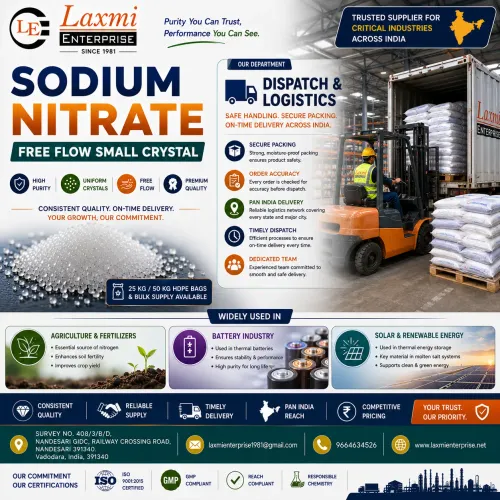
Standard Commercial Packing
Packing Suitable For
25 kg Bags Small production and laboratory requirements
50 kg Bags Regular manufacturing operations
500 kg Jumbo Bags Bulk handling and high-volume production
Procurement Checklist
Before approving a shipment:
✔ Product Name Verified
✔ Batch Number Available
✔ Certificate of Analysis (COA)
✔ Safety Data Sheet (SDS)
✔ Product Specification Sheet
✔ Proper Labeling
✔ Correct Packing Size
✔ Packaging Condition Verified
✔ Quantity Confirmed
✔ Documentation Complete
Industry-Specific Frequently Asked Questions
1. Why is Sodium Nitrate Free Flow evaluated before use in float glass manufacturing?
Every manufacturing process establishes its own technical requirements for incoming raw materials. Before Sodium Nitrate Free Flow is approved for production, engineering and quality teams generally review product specifications, batch documentation, physical characteristics, and consistency with internal purchasing requirements. This evaluation helps support stable production and traceability.
2. Why is batch consistency important?
Batch consistency helps manufacturing teams work with predictable raw material characteristics over time. Consistent quality can reduce unnecessary process adjustments, simplify inventory management, and improve repeatability across production cycles.
3. Which physical properties are commonly reviewed?
Organizations may review properties such as particle size distribution, flowability, moisture condition, crystal appearance, and packaging condition. The specific acceptance criteria depend on each manufacturer's internal quality standards.
4. Why is Free Flow performance important?
Free Flow characteristics improve handling during storage, warehouse movement, and material transfer. Better flowability may reduce handling interruptions associated with bridging or caking under appropriate storage conditions.
5. What documents should accompany each shipment?
Industrial buyers commonly request:
Certificate of Analysis (COA)
Safety Data Sheet (SDS)
Product Specification Sheet
Packing List
Commercial Invoice
Batch Identification
Additional documentation may be requested depending on customer or regulatory requirements.
6. Why should the COA be reviewed?
The Certificate of Analysis provides batch-specific quality information. Reviewing the COA helps buyers confirm that the supplied batch aligns with the agreed purchasing specification before acceptance into inventory.
7. What is the purpose of the Safety Data Sheet?
The Safety Data Sheet provides information about product identification, safe handling, storage recommendations, emergency measures, and regulatory information. Warehouse and production personnel should refer to the latest SDS supplied with the product.
8. Which packing size should I choose?
The most suitable packing depends on production volume and handling systems.
25 kg Bags – Suitable for smaller operations and manual handling.
50 kg Bags – Common choice for routine industrial production.
500 kg Jumbo Bags – Preferred where bulk handling equipment is available.
9. Why is packaging condition important?
Packaging protects the product during transportation and storage. Inspecting packaging on receipt helps identify damage, moisture exposure, or labeling issues before the material enters inventory.
10. What should warehouse personnel inspect?
Warehouse teams commonly verify:
Product name
Batch number
Packaging condition
Quantity received
Labels
Supporting documentation
Inspection procedures should follow the organization's quality management system.
11. Why is traceability important?
Traceability links each shipment to its supporting quality records. Maintaining batch identification helps organizations manage inventory, conduct audits, and investigate quality-related questions if necessary.
12. How should Sodium Nitrate Free Flow be stored?
The product should be stored in accordance with the supplier's recommendations and applicable regulations. In general, organizations should keep the material in a clean, dry, well-ventilated storage area, protect it from moisture, and retain it in its original packaging until use.
13. Why is FIFO recommended?
FIFO (First-In, First-Out) supports orderly inventory rotation by using older stock before newer stock. This helps improve inventory control and reduce prolonged storage.
14. How can procurement teams evaluate suppliers?
Supplier evaluation commonly includes reviewing:
Product consistency
Technical documentation
Packaging quality
Delivery performance
Communication
Long-term supply capability
Organizations often supplement these factors with supplier audits or performance reviews where appropriate.
15. Why do manufacturers maintain technical documentation?
Documentation supports quality management, supplier qualification, inventory traceability, customer communication, and audit readiness. Maintaining organized records helps improve consistency throughout the supply chain.
16. Can the same Sodium Nitrate specification be used for every glass manufacturer?
Not necessarily. Product specifications should be selected according to the manufacturer's process requirements and internal quality standards. Buyers should confirm compatibility with their intended application before procurement.
17. Why do production teams communicate with procurement?
Feedback from production helps procurement teams understand how the material performs in practice, supporting supplier evaluation, specification refinement, and long-term purchasing decisions.
18. What are the benefits of working with a reliable supplier?
A reliable supplier can contribute through:
Consistent product quality
Accurate documentation
Reliable deliveries
Technical support
Appropriate packaging
Stable long-term supply
These factors help manufacturers maintain efficient operations and reduce procurement-related risks.
19. Why is inventory management important?
Effective inventory management supports production continuity, improves stock visibility, helps maintain traceability, and reduces the likelihood of shortages or excess inventory.
20. What should buyers verify before approving a shipment?
Before approval, organizations commonly verify:
Product identity
Batch number
COA
SDS
Product Specification
Packaging condition
Quantity received
Label accuracy
Packing size (25 kg, 50 kg, or 500 kg Jumbo Bag)
Purchase order compliance
Keywords