

Sodium Nitrate in Glass Defect Analysis: Understanding Bubbles, Seeds, Stones, Striae, Cords, Inclusions, Optical Distortion, Root Cause Analysis, and Process Improvement
Every glass manufacturer strives for one objective—to produce glass that is optically clear, mechanically reliable, and consistent from the first sheet to the last. Whether the end product is an automotive windshield, solar panel glass, architectural float glass, mirror glass, display glass, or specialty optical glass, quality begins inside the melting furnace. Once a defect becomes part of the molten glass, removing it later is almost impossible. Instead, manufacturers must identify the root cause, correct the process, and prevent the defect from recurring.
Glass defects are not merely cosmetic. A small bubble may distort vision in an automotive windshield, an inclusion can reduce the strength of tempered glass, and a stone trapped inside optical glass may render an expensive lens unusable. Even slight variations in the refractive properties of glass can affect display panels, photovoltaic modules, or scientific instruments.
For this reason, defect analysis is a critical part of every glass manufacturing operation. Modern quality control combines process monitoring, laboratory testing, microscopic examination, and production data to identify where and why defects occur.
Among the many process variables that influence glass quality, refining chemistry plays an important role. In manufacturing processes where Sodium Nitrate (NaNO₃) is incorporated into the glass batch, it supports oxidation and refining reactions that help create a cleaner, more homogeneous molten glass. Although Sodium Nitrate alone cannot eliminate every defect, it contributes to the refining stage by assisting gas removal and supporting stable furnace conditions when used appropriately within the overall glass formulation.
This article explains the most common glass defects, their possible causes, practical troubleshooting methods, and the role of process control in achieving consistent production quality.
Why Glass Defect Analysis Matters
A single defective glass sheet may represent only a small financial loss. However, when a process issue continues unnoticed for several production shifts, manufacturers may lose thousands of square meters of glass, consume unnecessary energy, and disrupt customer deliveries.
Effective defect analysis helps manufacturers:
Improve product quality
Reduce rejection rates
Increase furnace productivity
Lower production costs
Improve customer satisfaction
Extend furnace campaign life
Reduce raw material waste
Support continuous process improvement
Defect analysis is therefore both a technical and an economic necessity.
Where Glass Defects Begin
Contrary to common belief, many defects originate long before the glass reaches the cutting or coating stage.
Possible sources include:
Raw material contamination
Incorrect batch formulation
Inadequate mixing
Furnace temperature variations
Incomplete melting
Poor refining
Refractory wear
Handling damage
Coating process variations
Understanding the origin of a defect is the first step toward solving it.
The Role of Sodium Nitrate in Defect Prevention
In suitable glass manufacturing processes, Sodium Nitrate contributes during the melting and refining stages.
Its general functions include:
Supporting oxidation reactions
Assisting refining
Promoting removal of dissolved gases
Improving melt homogeneity
Helping stabilize furnace chemistry
These functions support the production of cleaner molten glass and may reduce the likelihood of certain refining-related defects.
Common Glass Defects and Their Possible Causes
1. Bubbles
What are bubbles?
Bubbles are pockets of gas trapped inside the glass during melting or refining.
Why do they occur?
Possible causes include:
Incomplete refining
Excess gas generation
Furnace temperature fluctuations
Short residence time
Poor batch mixing
How can manufacturers reduce them?
Manufacturers generally improve refining efficiency, optimize furnace conditions, maintain consistent batch quality, and monitor process stability.
2. Seeds
Seeds are extremely small bubbles that may not be visible without magnification.
Although tiny, they can reduce the optical quality of premium glass products.
Possible causes include:
Early-stage refining issues
Rapid melting
Insufficient gas removal
Localized furnace instability
3. Stones
Stones are unmelted or partially melted particles trapped inside the glass.
Possible sources include:
Raw material contamination
Refractory fragments
Incomplete melting
Batch segregation
Stone defects are particularly critical in optical and display glass.
4. Striae
Striae appear as streaks or regions with slightly different optical properties.
They usually result from:
Incomplete melt homogenization
Temperature gradients
Local composition differences
Poor mixing
Striae can distort light passing through the glass.
5. Cords
Cords are elongated regions of non-uniform glass composition.
They may occur due to:
Poor batch distribution
Inadequate mixing
Furnace flow irregularities
Incomplete homogenization
6. Inclusions
Inclusions are foreign particles trapped inside the glass.
Possible sources include:
Contaminated raw materials
Furnace refractory wear
Dust contamination
Equipment wear
7. Optical Distortion
Optical distortion affects the way light passes through glass.
It may result from:
Thickness variation
Striae
Surface waviness
Non-uniform cooling
Internal stress
Automotive and display glass manufacturers carefully monitor distortion levels.
8. Surface Defects
Common surface defects include:
Scratches
Roller marks
Coating irregularities
Handling damage
Although many occur after melting, poor glass quality may increase downstream processing problems.
Root Cause Analysis
When a defect appears repeatedly, manufacturers avoid making assumptions. Instead, they investigate the production process systematically.
Typical steps include:
Identify the defect.
Determine when it first appeared.
Review production records.
Examine furnace conditions.
Verify raw material quality.
Inspect batch composition.
Evaluate refining performance.
Implement corrective action.
Monitor results.
Standardize improvements.
This structured approach helps prevent recurring quality issues.
Process Parameters That Influence Glass Quality
Production teams routinely monitor:
Furnace temperature profile
Glass level
Residence time
Melt viscosity
Batch composition
Pull rate
Furnace pressure
Bubble count
Glass thickness
Optical transmission
Surface quality
Cooling profile
Maintaining consistency across these parameters supports stable production.
Importance of Raw Material Consistency
Stable raw materials help reduce process variation.
Manufacturers generally evaluate incoming materials for:
Chemical purity
Moisture content
Particle size
Batch consistency
Contamination
Storage condition
Consistent raw materials contribute to predictable furnace performance.
Procurement Considerations
When purchasing Sodium Nitrate, manufacturers typically evaluate:
Product purity
Reliable supply
Batch traceability
Certificate of Analysis (COA)
Moisture control
Packaging quality
Technical support
Delivery performance
Choosing a reliable supplier supports production consistency.
Storage Recommendations
Proper storage helps preserve material quality.
Recommended practices include:
Store in dry conditions.
Keep packaging sealed.
Avoid contamination.
Protect from moisture.
Follow applicable industrial safety procedures.
Why Manufacturers Choose Laxmi Enterprise
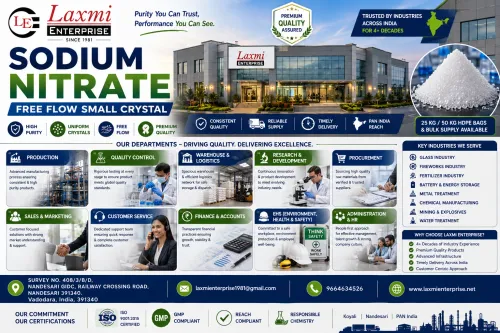
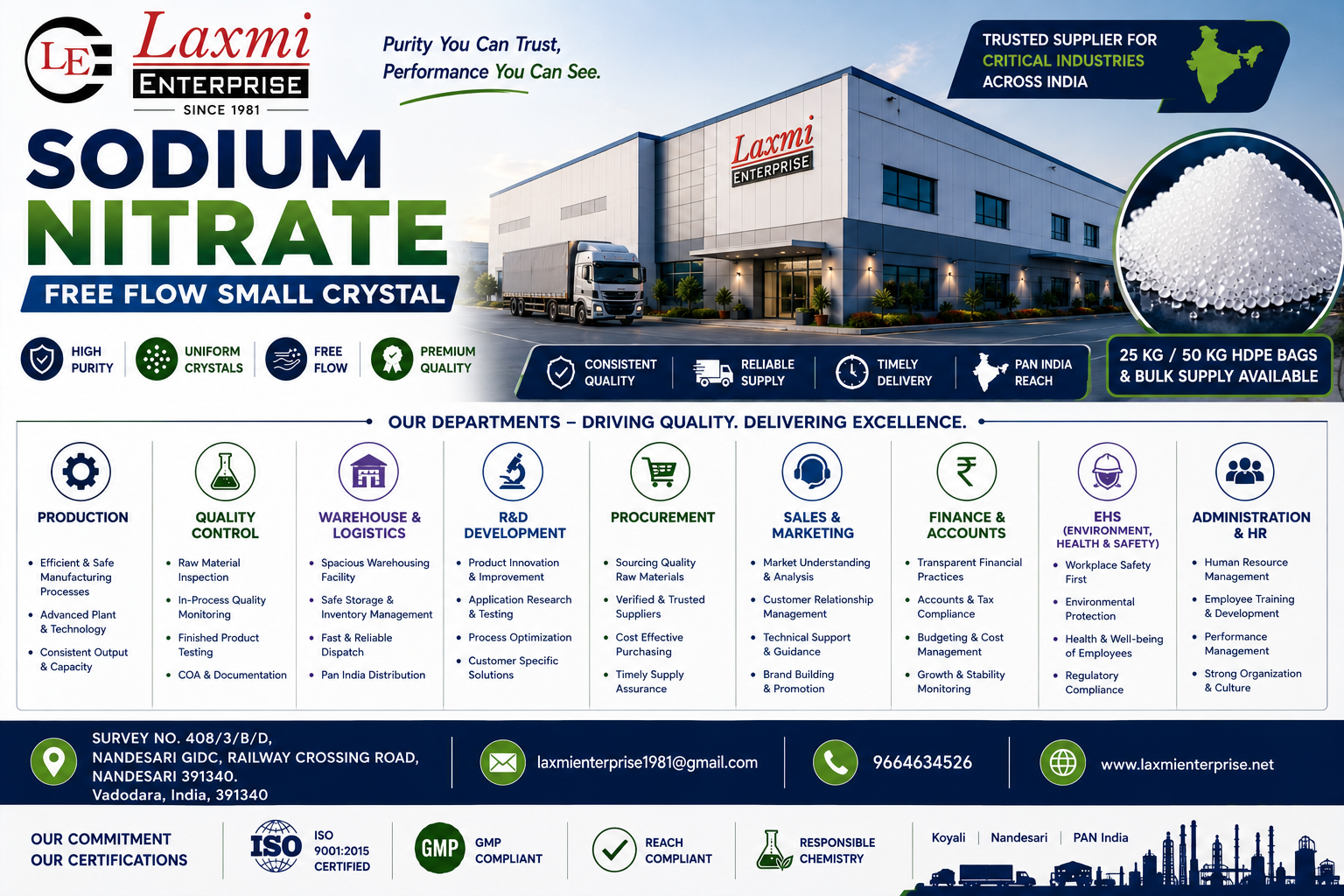
Laxmi Enterprise supplies industrial-grade Sodium Nitrate to customers across India for glass manufacturing and other industrial applications.
Customers choose Laxmi Enterprise because of:
Consistent product quality
Reliable nationwide supply
Technical documentation
Secure packaging
Competitive pricing
Prompt deliveries
Responsive customer service
Long-term business partnerships
Frequently Asked Questions (FAQ)
1. What is the most common defect in float glass manufacturing?
One of the most frequently encountered defects is bubble formation. Bubbles may develop when gases generated during melting are not completely removed during refining. Their size, quantity, and location determine whether the glass meets customer specifications.
2. What is the difference between a bubble and a seed?
A bubble is generally a visible gas pocket trapped within the glass, while a seed is a much smaller gas inclusion that may only be detected under magnification or during detailed optical inspection. Both originate from gas entrapment but differ in size.
3. Can Sodium Nitrate eliminate all glass defects?
No. Sodium Nitrate is only one component of the overall glass manufacturing process. Where it is used, it supports oxidation and refining during melting, but final glass quality also depends on raw materials, furnace operation, batch formulation, temperature control, residence time, equipment condition, and quality management.
4. Why do stones appear inside glass?
Stones usually originate from unmelted raw materials, refractory fragments, or contamination introduced during production. Their presence indicates that further investigation into raw material quality, furnace condition, or melting efficiency may be required.
5. What causes striae in glass?
Striae are generally associated with non-uniform glass composition or temperature variations within the molten glass. They may develop when the melt is not fully homogenized before forming.
6. Why is root cause analysis important?
Simply removing defective products does not solve the underlying problem. Root cause analysis identifies why the defect occurred so manufacturers can implement permanent corrective actions and improve future production.
7. How do manufacturers detect microscopic defects?
Quality laboratories use a combination of visual inspection, automated optical inspection systems, microscopes, polarized light analysis, imaging equipment, and process data to identify defects that may not be visible during routine observation.
8. Can raw material quality influence defect rates?
Yes. Variations in purity, particle size, moisture content, or contamination can affect melting behavior and refining efficiency. Consistent incoming raw materials help maintain stable production conditions.
9. What should a procurement team verify before accepting Sodium Nitrate?
Procurement teams commonly review the Certificate of Analysis (COA), batch number, packaging condition, product specifications, delivery documentation, and any agreed quality requirements before accepting a shipment.
10. Does furnace temperature affect defect formation?
Yes. Furnace temperature influences melting, refining, viscosity, and gas removal. Temperature variations may contribute to defects such as bubbles, stones, striae, or incomplete melting if not properly controlled.
11. Why is melt homogeneity important?
A homogeneous melt helps produce glass with consistent optical properties, uniform thickness, stable refractive behavior, and fewer localized defects. It is one of the key objectives of glass refining.
12. How can manufacturers reduce long-term defect rates?
Reducing defect rates requires a combination of high-quality raw materials, well-maintained equipment, optimized batch formulation, stable furnace operation, effective refining, regular quality inspections, employee training, and continuous process improvement rather than relying on a single corrective action.
Conclusion
Glass defect analysis is much more than identifying imperfections—it is a systematic approach to understanding the entire manufacturing process. Every bubble, stone, stria, or inclusion provides valuable information about furnace performance, raw material quality, refining efficiency, and process stability. By investigating these indicators and applying corrective measures, manufacturers can improve yield, reduce waste, and consistently produce high-quality glass.
Where incorporated into suitable glass formulations, Sodium Nitrate supports oxidation and refining during melting, contributing to cleaner molten glass and more consistent manufacturing conditions. Combined with disciplined process control, quality assurance, and reliable raw material sourcing, it helps manufacturers meet the demanding standards of today's automotive, solar, architectural, display, and specialty glass industries.