

Sodium Nitrate in Optical Glass Manufacturing: Precision Glass Melting, High-Purity Refining, Refractive Index Stability, Defect Control, and Advanced Scientific Applications
When people think about optical glass, they often imagine camera lenses, telescopes, microscopes, binoculars, or laser systems. However, optical glass is far more than ordinary transparent material. It is a highly engineered product manufactured under extremely controlled conditions where even microscopic variations in composition, internal structure, or optical uniformity can affect the performance of the final instrument.
Unlike conventional float glass used in windows or architectural applications, optical glass is produced for applications where precision is measured in microns rather than millimeters. Whether the glass is used in a medical imaging system, a satellite camera, a scientific microscope, or a defense-grade optical instrument, manufacturers demand exceptional clarity, consistent refractive properties, minimal inclusions, and outstanding chemical stability.
Achieving this level of precision begins long before shaping or polishing the glass. It starts during the melting and refining stages, where carefully selected raw materials are transformed into a homogeneous molten mass. At this stage, refining chemistry becomes critically important because trapped gases, unmelted particles, or chemical inconsistencies can permanently affect optical performance.
Among the refining chemicals used in suitable glass formulations, Sodium Nitrate (NaNO₃) supports oxidation and refining during the melting process. Although it is used in relatively small quantities compared to primary glass-forming materials, its contribution to melt quality can help manufacturers reduce defects and improve process consistency.
It is important to note that optical glass encompasses many different formulations and manufacturing technologies. The exact composition, refining system, and production methods vary depending on the manufacturer and the intended application. This article explains the general role of Sodium Nitrate where it is incorporated into optical glass manufacturing processes, while avoiding claims that apply universally to every optical glass composition.
What Is Optical Glass?
Optical glass is a specialized glass manufactured for applications where light transmission, refraction, dispersion, and optical uniformity are critical.
Unlike standard commercial glass, optical glass is designed to provide predictable optical behavior across its entire volume.
Manufacturers carefully control:
Chemical composition
Refractive index
Dispersion characteristics
Internal homogeneity
Surface quality
Mechanical stability
Thermal properties
These characteristics enable precise control of light in scientific and industrial equipment.
Where Optical Glass Is Used
Optical glass is found in a wide range of advanced technologies, including:
Camera lenses
Smartphone camera modules
Binoculars
Microscopes
Telescopes
Medical imaging equipment
Laser optics
Spectrometers
Defense observation systems
Aerospace optical instruments
Fiber-optic components
Scientific laboratory equipment
Industrial inspection systems
Each application places unique demands on the glass substrate.
Why Purity Is Essential
In architectural glass, a small inclusion may have little impact on functionality.
In optical glass, however, microscopic defects can:
Scatter light
Reduce image sharpness
Lower transmission efficiency
Introduce optical distortion
Affect measurement accuracy
For this reason, manufacturers place exceptional emphasis on raw material quality and refining efficiency.
The Role of Sodium Nitrate During Glass Melting
Where Sodium Nitrate is incorporated into the glass batch, it primarily supports the melting and refining stages.
Its general functions include:
Supporting oxidation reactions
Assisting gas removal
Improving melt homogeneity
Helping reduce optical defects
Contributing to stable furnace conditions
Its performance depends on the overall batch formulation and manufacturing process.
Why Refining Is Important
Glass melting generates gases from chemical reactions occurring between raw materials.
If these gases remain trapped, they may form defects such as:
Seeds
Bubbles
Blisters
Inclusions
Refining promotes the release of these gases before the molten glass is formed into optical products.
This helps create a cleaner and more uniform glass melt.
Melt Homogeneity
One of the defining characteristics of optical glass is internal uniformity.
A homogeneous melt contributes to:
Stable refractive index
Uniform optical performance
Reduced distortion
Better machining
Improved polishing
Consistent product quality
Maintaining homogeneity is one of the principal objectives of glass refining.
Refractive Index Stability
The refractive index determines how light bends when passing through glass.
Optical manufacturers require extremely consistent refractive properties because even slight variations may affect:
Lens performance
Imaging accuracy
Focus quality
Optical calibration
Although refractive index depends mainly on glass composition, refining quality helps support overall consistency.
Importance of Surface Quality
After melting, optical glass typically undergoes extensive machining and polishing.
Surface quality influences:
Light transmission
Reflection control
Coating performance
Scratch resistance
Assembly precision
Reducing internal defects during melting supports these downstream processes.
Compatibility with Optical Coatings
Many optical components receive specialized coatings, including:
Anti-reflective coatings
Mirror coatings
Beam-splitting coatings
Protective coatings
Infrared coatings
A clean and homogeneous glass substrate provides a more suitable surface for coating application.
Manufacturing Challenges
Optical glass manufacturers work continuously to minimize:
Bubbles
Entrapped gases reduce image quality.
Stones
Unmelted particles interfere with machining and polishing.
Striae
Chemical variations create localized changes in optical properties.
Inclusions
Foreign particles reduce optical performance.
Refractive Variations
Internal inconsistencies may affect lens accuracy.
Surface Imperfections
Minor scratches or defects become highly visible in precision optics.
Quality Control During Production
Manufacturers generally inspect:
Optical transmission
Bubble count
Inclusion frequency
Refractive index
Surface quality
Internal homogeneity
Dimensional accuracy
Stress distribution
Color consistency
Surface flatness
Advanced inspection equipment helps ensure compliance with demanding specifications.
Importance of Consistent Raw Materials
Stable production depends on consistent incoming materials.
Variations in raw material quality may influence:
Furnace stability
Refining behavior
Melt consistency
Product yield
Manufacturing efficiency
Many manufacturers therefore establish strict supplier qualification procedures.
Procurement Considerations
Industrial buyers commonly evaluate suppliers based on:
Product purity
Batch consistency
Moisture control
Packaging quality
Certificate of Analysis (COA)
Technical documentation
Reliable logistics
Traceability
Long-term supply capability
Reliable sourcing helps support consistent manufacturing.
Storage Recommendations
To maintain product quality:
Store in dry conditions.
Keep packaging tightly sealed.
Protect against contamination.
Avoid unnecessary moisture exposure.
Follow industrial handling and safety procedures.
Proper storage supports consistent material performance.
Why Manufacturers Choose Laxmi Enterprise
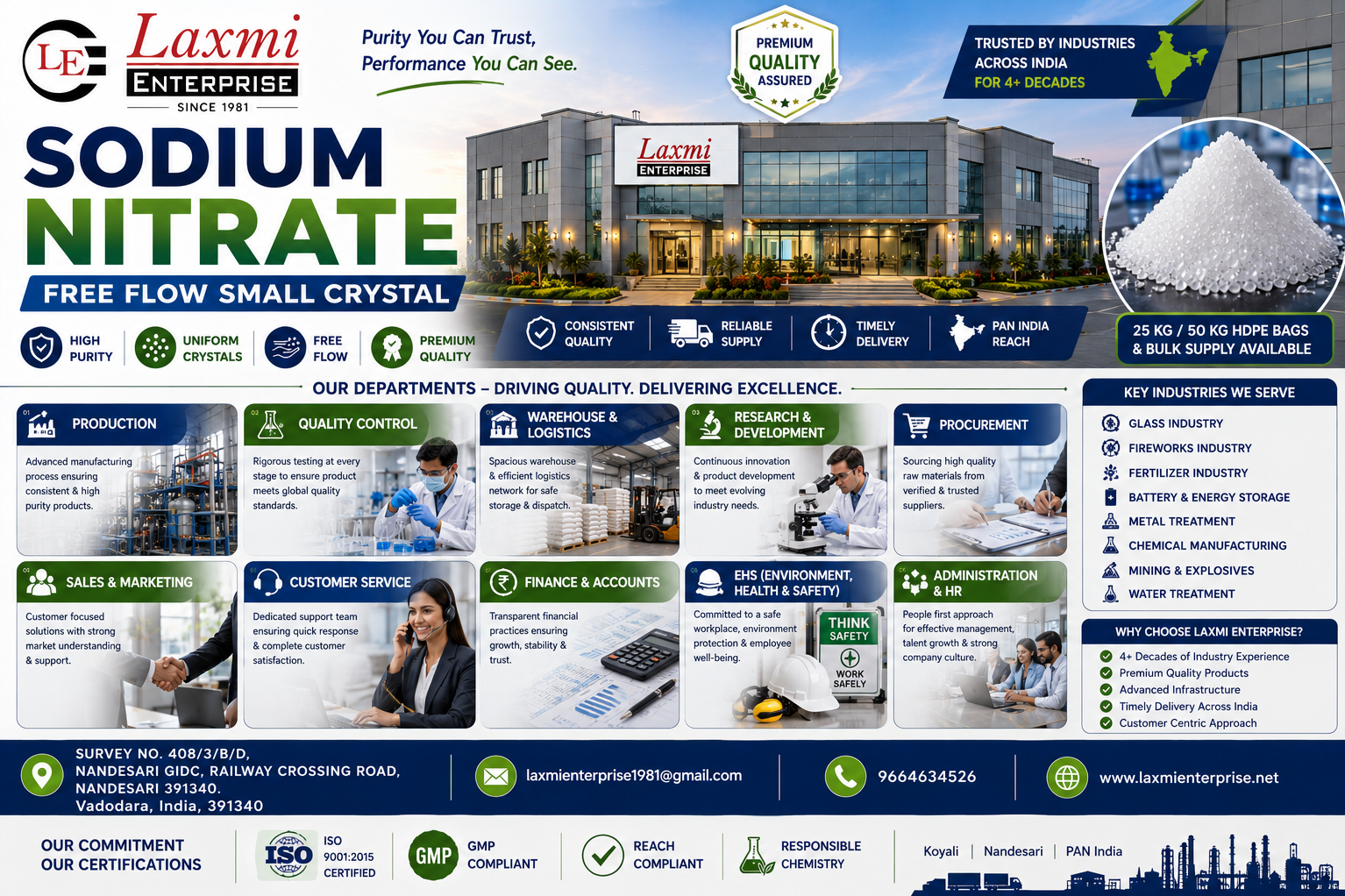
Laxmi Enterprise supplies industrial-grade Sodium Nitrate to customers across India for glass manufacturing and numerous industrial applications.
Customers value:
Consistent product quality
Reliable nationwide supply
Secure industrial packaging
Prompt deliveries
Technical documentation
Responsive customer support
Long-term business partnerships
Frequently Asked Questions (FAQ)
1. Why is optical glass different from ordinary glass?
Optical glass is manufactured with much tighter control over chemical composition, internal homogeneity, refractive properties, and defect levels. These characteristics are essential for scientific, medical, photographic, and industrial optical applications where precision is critical.
2. What role does Sodium Nitrate play in optical glass manufacturing?
Where it is included in the formulation, Sodium Nitrate supports oxidation and refining during glass melting. Its role is to help create cleaner molten glass by assisting the removal of gases and promoting a more homogeneous melt.
3. Does Sodium Nitrate determine the refractive index of optical glass?
No. The refractive index is primarily determined by the overall chemical composition of the glass. Sodium Nitrate contributes to refining and process consistency rather than directly setting optical constants.
4. Why are microscopic bubbles unacceptable in optical glass?
Bubbles can scatter light, reduce image clarity, interfere with precision measurements, and affect the performance of lenses or optical instruments. Manufacturers therefore strive to minimize bubble formation during refining.
5. What is melt homogeneity?
Melt homogeneity refers to the uniform distribution of chemical components throughout the molten glass. A homogeneous melt helps produce optical glass with consistent refractive properties and reduced distortion.
6. How do manufacturers inspect optical glass?
Inspection may include measurements of refractive index, light transmission, internal homogeneity, bubble count, inclusions, stress distribution, surface quality, and dimensional accuracy using specialized optical instruments.
7. Does Sodium Nitrate remain in the finished optical component?
Its principal function occurs during melting and refining. The final composition of the finished glass depends on the complete manufacturing process and the formulation selected by the producer.
8. Why is supplier consistency important?
Consistent raw materials support stable furnace operation, predictable refining behavior, and reliable production quality. Long-term consistency also helps manufacturers reduce process variability.
9. What industries depend on optical glass?
Optical glass is widely used in medical diagnostics, photography, defense, aerospace, telecommunications, industrial automation, scientific research, semiconductor inspection, and precision instrumentation.
10. What documents should accompany Sodium Nitrate shipments?
Industrial buyers typically expect a Certificate of Analysis (COA), product specifications, batch identification, packing details, safety documentation where applicable, and commercial shipping records.
11. How should Sodium Nitrate be stored?
It should be stored in sealed containers in a dry, clean, and well-ventilated environment. Proper storage helps maintain product quality and minimizes moisture absorption.
12. Why do manufacturers prefer established suppliers?
Established suppliers generally offer consistent product quality, dependable logistics, technical documentation, and responsive support, helping manufacturers maintain stable production and quality standards.
Conclusion
Precision optical components depend on precision glass, and precision glass begins with carefully controlled melting and refining. While Sodium Nitrate represents only one part of suitable refining systems, its role in supporting oxidation and promoting cleaner molten glass contributes to the production of high-quality optical substrates where it is used.
For manufacturers seeking reliable industrial-grade Sodium Nitrate backed by consistent quality, dependable supply, and technical documentation, Laxmi Enterprise continues to support India's glass, chemical, and advanced manufacturing industries with products designed for demanding industrial applications.