
Here’s a detailed technical and industrial overview of Sodium Nitrate (NaNO₃) —
specifically focusing on its role in dyeing and textile manufacturing applications.
This information is ideal for creating a technical datasheet, product brochur
or SEO content for suppliers or exporters like Laxmi Enterprise, Vadodara.
Quality Standards
Conforms to IS: 8797-1978 (Sodium Nitrate, Technical Grade)
Meets industrial export specifications as per ISO 9001:2015 certified manufacturing standards
REACH & RoHS compliant
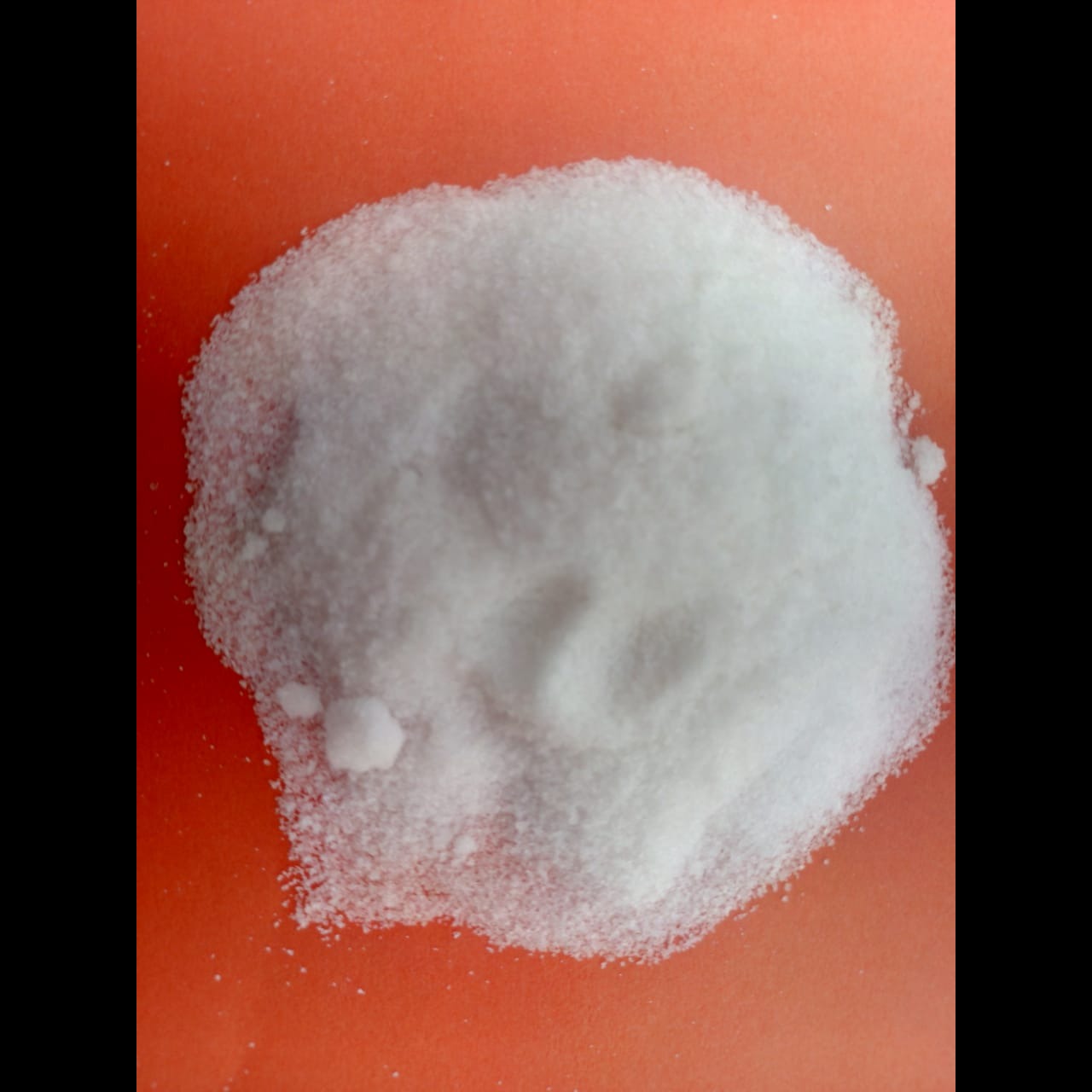
Supply Form Crystalline / Powder
Grades Available Industrial / Technical / High Purity
Purity Range 98.5% – 99.5%
Monthly Capacity* 2000+ MT
Export Markets Middle East, Africa, Asia, Europe
Ports of Dispatch Mundra / Nhava Sheva, In
Role of Sodium Nitrate in Detergent Manufacturing
Sodium nitrate serves as a multifunctional ingredient in detergent formulations — primarily acting as an oxidizing stabilizer, viscosity modifier, and processing aid.
It supports detergent quality, performance, and shelf-life stability, especially in powdered detergents and liquid formulations.
Oxidizing Agent
Acts as a mild, non-chlorine oxidizer, preventing decomposition of active ingredients such as surfactants, enzymes, and perfumes.
Maintains product whiteness and prevents discoloration caused by organic impurities or iron contamination.
B. Process Stabilizer
Prevents thermal degradation of detergent components during spray drying and granulation.
Increases production stability by maintaining consistent viscosity and flow properties.
C. Alkali Balancer / Electrolyte
Helps maintain ionic balance in liquid detergent systems.
Improves solubility and uniform distribution of other salts like sodium sulfate or carbonate.
Reduces formation of lumps or hard cakes in detergent powders.
D. Anti-Caking & Drying Aid
Enhances free-flowing characteristics of powder detergents.
Prevents moisture absorption in high-humidity environments.
Promotes faster drying during spray tower processing.
E. Environmentally Safe Oxidizer
Preferred over strong oxidizers (like sodium perborate or dichromates) due to:
Non-toxic and non-corrosive nature
Eco-friendly by-products (mainly nitrogen compounds)
Compatibility with biodegradable surfactants
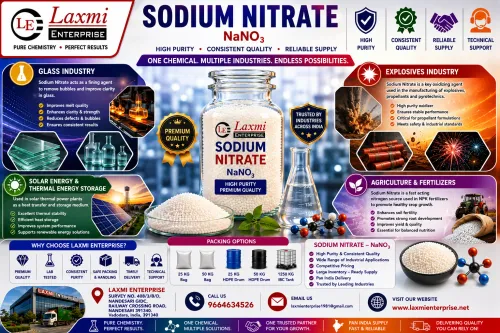
Export Information – Laxmi Enterprise
Manufacturer & Exporter:
LAXMI ENTERPRISE
Vadodara, Gujarat, India
Grade Available Industrial / Technical
Purity Range 98.5% – 99.5% Monthly Capacity 2000+ MT
Applications Detergents, Textiles, Glass, Metal Treatment
FertilizersExport Markets Middle East, Africa, Asia, Europe
Ports of Dispatch Mundra / Nhava Sheva, India
Quick overview
Chemical: sodium nitrate (NaNO₃). Strongly soluble, an oxidizing salt that releases nitrate (NO₃⁻) and sodium (Na⁺) in solution.
Primary roles in wastewater: supply nitrate as an electron
acceptor (for denitrification), suppress H₂S formation in
sewers/anaerobic zones by stimulating nitrate-reducing and
sulfide-oxidizing bacteria, and sometimes as a nutrient source. It
does not directly remove nitrogen — it supplies the oxidized
nitrogen form used in subsequent biological reactions.
H₂S control in sewers and anaerobic zones
Dosing nitrate promotes nitrate-reducing sulfide-oxidizing bacteria, which oxidize sulfide (H₂S/HS⁻) to sulfate while reducing nitrate — reducing odour, corrosion and safety hazards.
This is often used in sewer dosing or wet-well dosing and can be controlled via H₂S sensors, ORP, or flow/slug-dosing strategies.
Support for denitrification (as nitrate source)
In anoxic zones, heterotrophic bacteria use nitrate as an electron acceptor to reduce NO₃⁻ → N₂, removing bioavailable nitrogen when organic carbon is present.
Note: denitrification consumes nitrate;
adding sodium nitrate increases nitrate load and must be balanced with downstream processes or discharge limits.
Process tuning
Can be used for process control in sequencing batch reactors,
partial nitrification/anammox systems (carefully), and to prevent
sulfide-induced problems in collectors.
Dosing guidance & practical control
Pilot & lab tests are essential. Biological communities and wastewater composition strongly affect effectiveness; bench jar tests and a short pilot are recommended before full-scale dosing.
Control strategies
Monitoring parameters
Always monitor:
Nitrate (NO₃⁻) and nitrite (NO₂⁻)
Ammonia (NH₄⁺/NH₃)
Dissolved oxygen (DO) and oxidation–reduction potential (ORP)
Sulfide (H₂S/total sulfide) and sulfate (SO₄²⁻)
pH and temperature heterotrophic denitrification)
Flow and applied dose (mass balance)
Safety & handling
Oxidizer: store away from combustible materials and reducing agents. Avoid contamination with organics.
Hygroscopic — keep dry and in sealed containers.
PPE: gloves, eye protection; for large-scale handling use dust control/respiratory protection as needed.
Spill response: sweep up, avoid release to surface waters; prevent reactions with organic spills.
Corrosivity/compatibility: compatible with many materials but check for long-term piping/corrosion effects.
Characterize wastewater (sulfide, sulfate, COD, nitrate, nitrite, flow, pH, temp).
Bench jar tests to confirm sulfide oxidation/denitrification behavior and check nitrite formation.
Pilot test in-field with monitoring (H₂S, ORP, NO₃⁻, NO₂⁻).
Design feed system (metering pumps, storage, dosing point, interlocks).
Control strategy (ORP/H₂S or flow-proportional).
Safety plan and SDS review (storage, PPE, spill plans).
Regulatory check — confirm final effluent nitrate/nitrogen limits and permitting.
• sodium nitrate
• NaNO3
• sodium nitrate CAS 7631-99-4
• sodium nitrate chemical formula
• sodium nitrate properties
• sodium nitrate specification
• sodium nitrate SDS
• Chile saltpeter
• Peru saltpeter
• nitrate of soda
• nitric acid sodium salt
• sodium salt of nitric acid
• sodium nitrate supplier
• sodium nitrate manufacturer
• sodium nitrate exporter
• sodium nitrate distributor
• sodium nitrate price
• buy sodium nitrate online
• bulk sodium nitrate for sale
• industrial grade sodium nitrate
• food grade sodium nitrate
• pharmaceutical grade sodium nitrate