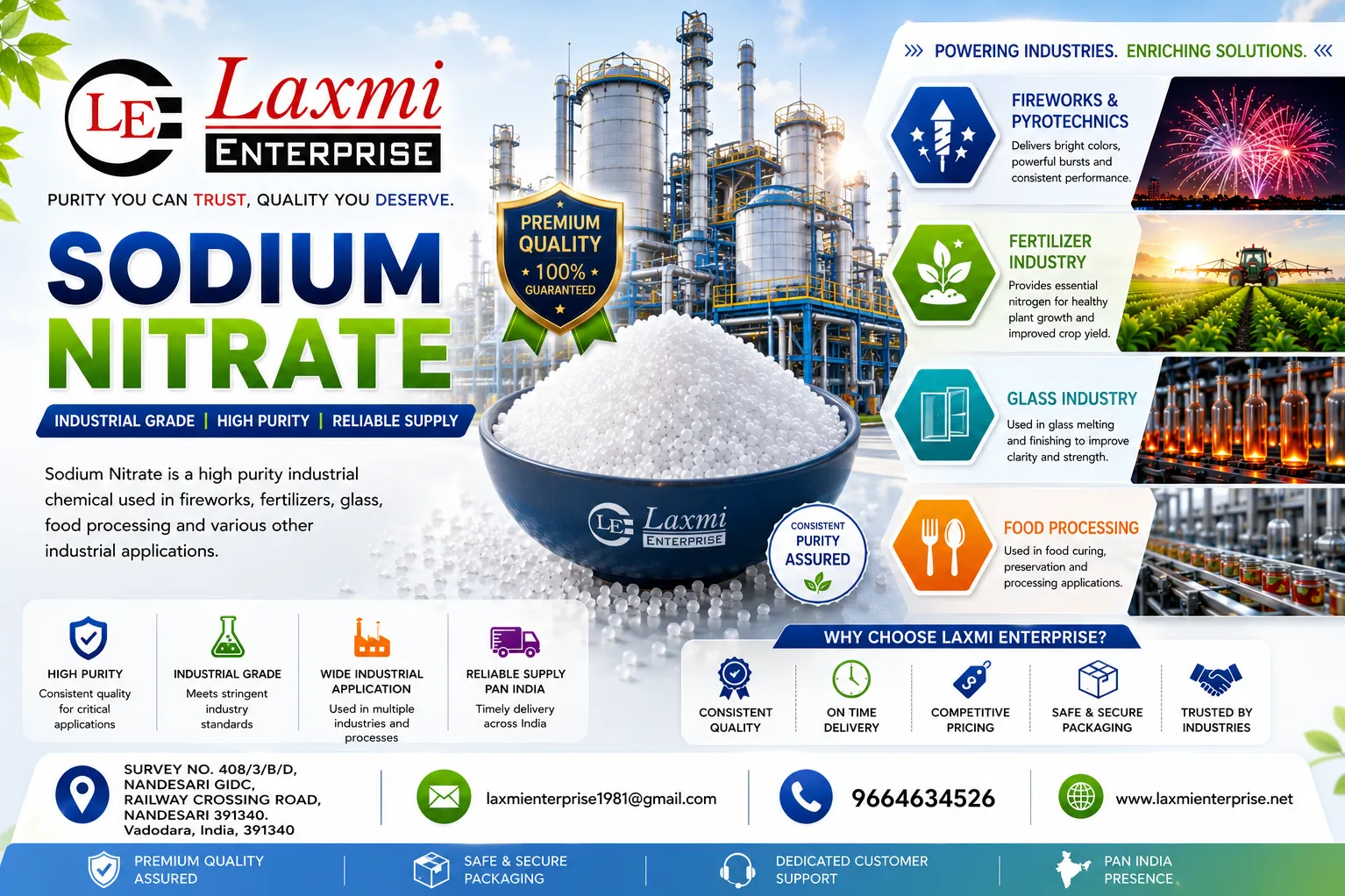
Sodium Nitrate Storage and Shelf Life: Scientific Principles, Packaging Technologies, Warehouse Engineering, Moisture Control, and Long-Term Stability
Sodium nitrate is widely recognized for its chemical stability and long service life. However, this stability should not be mistaken for immunity to improper storage. Across industries such as glass manufacturing, specialty chemicals, mining, heat treatment, metal finishing, water treatment, and laboratory applications, product performance often depends as much on storage conditions as on manufacturing quality.
Many industrial users experience problems such as caking, reduced flowability, contaminated material, packaging failure, inaccurate dosing, and increased handling costs—not because the sodium nitrate was manufactured incorrectly, but because it was stored improperly after production.
An industrial warehouse is not simply a place to keep bags of chemicals. It is an engineered environment designed to maintain product integrity from the day the material is manufactured until the day it enters the customer's production process.
This article explores the science behind sodium nitrate storage, explains how environmental conditions influence product stability, discusses modern packaging technologies, and provides practical warehouse management strategies for maintaining long-term product quality.
Understanding Chemical Stability
Chemical stability refers to the ability of a substance to retain its original chemical composition during storage under recommended conditions.
Sodium nitrate possesses excellent chemical stability because:
The nitrate ion remains relatively stable under normal temperatures.
It does not readily decompose during routine storage.
It maintains consistent oxidizing properties when protected from contamination.
It has a relatively low tendency to react with atmospheric gases under standard warehouse conditions.
However, chemical stability does not eliminate physical changes that may occur because of environmental exposure.
These physical changes include:
Moisture absorption
Particle agglomeration
Surface caking
Crystal bridging
Packaging deterioration
Contamination during handling
Chemical Stability Versus Physical Stability
This distinction is often misunderstood.
Chemical Stability
Chemical stability means the molecular composition remains unchanged.
For example:
Purity remains essentially constant.
Molecular structure is preserved.
Oxidizing characteristics remain predictable.
Physical Stability
Physical stability refers to characteristics such as:
Particle size
Crystal integrity
Flowability
Bulk density
Free-flowing behavior
Packaging condition
A product may remain chemically acceptable while becoming physically difficult to handle.
Why Storage Conditions Matter
Industrial storage influences:
Production efficiency
Material handling
Dissolution performance
Automatic feeding systems
Inventory management
Product appearance
Customer satisfaction
Poor storage can increase:
Production interruptions
Cleaning requirements
Material waste
Labor costs
Packaging damage
Quality complaints
Moisture: The Primary Storage Challenge
Although sodium nitrate is chemically stable, moisture remains its most significant storage concern.
Moisture can originate from:
High relative humidity
Condensation
Damaged packaging
Water leaks
Improper warehouse ventilation
Outdoor exposure during unloading
Even small amounts of absorbed moisture can gradually alter the material's handling characteristics.
How Moisture Affects Sodium Nitrate
Moisture promotes:
Surface crystal bonding
Formation of hard lumps
Reduced free flow
Increased dust after mechanical breaking
Uneven feeding into process equipment
The product may still meet chemical specifications while becoming operationally inconvenient.
Hygroscopic Behavior
Sodium nitrate exhibits hygroscopic tendencies under certain environmental conditions.
This means it can absorb moisture from humid air when exposed for extended periods.
The rate of moisture uptake depends on:
Relative humidity
Temperature
Air circulation
Exposure duration
Particle surface area
Packaging quality
Fine powders generally absorb moisture faster than coarse crystals because of their larger surface area.
Relative Humidity and Product Stability
Relative humidity is one of the most important environmental parameters in chemical storage.
As humidity increases:
Moisture absorption increases.
Surface caking becomes more likely.
Packaging life may decrease.
Material handling becomes more difficult.
Warehouses in coastal or monsoon-prone regions require additional humidity control measures.
Temperature Effects
Under recommended storage conditions, sodium nitrate remains thermally stable.
However, excessive temperature fluctuations may create indirect problems.
Rapid temperature changes can produce condensation inside partially filled containers.
Condensation introduces localized moisture, increasing the likelihood of:
Caking
Crystal bridging
Packaging deterioration
Maintaining relatively stable warehouse temperatures helps minimize these risks.
Packaging Technology: The First Line of Protection
Packaging is more than a transportation requirement—it is a critical component of quality preservation.
An effective packaging system must protect against:
Moisture ingress
Dust contamination
Mechanical damage
Ultraviolet exposure where applicable
Handling stress
Long-distance transportation
Common Industrial Packaging Options
Laminated HDPE Woven Bags
Widely used for industrial chemicals because they provide:
Good mechanical strength
Moisture resistance
Stackability
Cost efficiency
Inner Polyethylene Liners
Many manufacturers incorporate polyethylene liners inside woven bags.
Benefits include:
Additional moisture barrier
Reduced contamination
Improved shelf stability
Better export performance
Jumbo Bags
Used for bulk industrial consumption.
Advantages include:
Reduced manual handling
Lower packaging waste
Faster unloading
Improved warehouse efficiency
Moisture Barrier Packaging
For export shipments or long-term storage, advanced moisture-resistant materials may be selected to minimize humidity exposure during transit.
Warehouse Design Considerations
A properly engineered warehouse protects product quality through environmental control and efficient material handling.
Important design features include:
Adequate Ventilation
Ventilation helps reduce:
Humidity accumulation
Temperature gradients
Condensation
Elevated Flooring
Products should never be placed directly on concrete floors.
Concrete may transmit moisture through capillary action.
Using pallets provides:
Air circulation
Moisture isolation
Easier forklift handling
Roof Integrity
Warehouse roofs should be regularly inspected for:
Water leakage
Condensation
Structural damage
Even minor leaks may affect stored chemicals over time.
Wall Clearance
Chemical bags should not be stacked directly against walls.
Maintaining clearance improves:
Air movement
Inspection access
Moisture prevention
Scientific Principles of Bag Stacking
Improper stacking can damage both packaging and product quality.
Recommended practices include:
Uniform stack alignment
Stable pallet placement
Controlled stack height
Even load distribution
Excessive stacking pressure may deform lower bags and increase the risk of package failure.
First In, First Out Inventory Management
Professional chemical warehouses commonly follow the FIFO principle.
This means:
First In, First Out
Older inventory is issued before newly manufactured batches.
Benefits include:
Better stock rotation
Reduced storage duration
Lower aging risk
Improved traceability
Some highly regulated industries also use FEFO:
First Expired, First Out
Batch Traceability During Storage
Every pallet should remain identifiable throughout storage.
Typical identification includes:
Batch number
Manufacturing date
Quantity
Warehouse location
Inspection status
Traceability supports:
Product recalls
Customer investigations
Inventory control
Regulatory audits
Storage Inspection Program
Routine warehouse inspections should verify:
Packaging condition
Moisture exposure
Stack stability
Label readability
Pest control
Cleanliness
Water leakage
Inventory accuracy
Preventive inspections reduce long-term quality issues.
Transportation and Storage Interface
Product quality may be affected before the material reaches the warehouse.
Transportation considerations include:
Covered vehicles
Dry loading conditions
Weather protection
Secure palletization
Impact prevention
Careful unloading minimizes packaging damage.
Shelf Life
When stored under recommended conditions, sodium nitrate generally maintains its chemical quality for extended periods.
However, shelf life depends on:
Packaging quality
Warehouse environment
Moisture exposure
Handling frequency
Storage temperature
Inventory rotation
Rather than relying solely on time, many manufacturers recommend periodic inspection of stored inventory.
Long-Term Stability Monitoring
Large industrial users often perform periodic evaluations including:
Visual inspection
Moisture testing
Flowability assessment
Particle condition
Packaging integrity
Certificate review where applicable
These inspections help determine whether stored material remains suitable for production.
Common Storage Mistakes
Frequent mistakes include:
Storing bags outdoors
Direct floor contact
Broken packaging left unrepaired
Poor inventory rotation
Exposure to rain during unloading
Overstacking pallets
Ignoring warehouse humidity
Mixing different production batches
Inadequate labeling
Most storage-related quality problems originate from these preventable issues.
Storage Near Incompatible Materials
As an oxidizing chemical, sodium nitrate should be segregated from materials that could react adversely under abnormal conditions.
Warehouse layout should include clear separation from incompatible chemicals and combustible materials in accordance with applicable safety regulations and site-specific risk assessments.
Proper segregation reduces the likelihood of accidental contamination and supports safe warehouse operations.
Digital Warehouse Management
Modern chemical warehouses increasingly use digital systems such as:
Warehouse Management Systems (WMS)
Barcode identification
QR code traceability
RFID tracking
Environmental monitoring sensors
Automated inventory reporting
These technologies improve inventory accuracy, reduce human error, and support complete product traceability.
Sustainability in Chemical Storage
Leading manufacturers are improving warehouse sustainability through:
Recyclable packaging
Energy-efficient lighting
Solar-powered facilities
Rainwater management
Reduced packaging waste
Optimized transportation planning
Sustainable storage practices lower operational costs while reducing environmental impact.
Best Practices for Industrial Buyers
When evaluating a sodium nitrate supplier, ask:
What packaging materials are used?
Are moisture-resistant liners included?
How is warehouse humidity controlled?
Is FIFO inventory management followed?
How are export shipments protected from moisture?
Are pallets used for storage?
Is each batch fully traceable?
What inspections are performed before dispatch?
Suppliers with robust storage systems generally deliver more consistent product quality.
Conclusion
The long-term performance of sodium nitrate depends not only on manufacturing quality but also on scientifically managed storage practices. Moisture control, appropriate packaging, warehouse engineering, inventory rotation, traceability, and regular inspections all contribute to preserving product integrity throughout the supply chain. Industrial users who understand these principles can minimize material loss, improve handling efficiency, reduce production disruptions, and ensure that sodium nitrate performs consistently from warehouse to process line.
Frequently Asked Questions
Does sodium nitrate have a shelf life?
Sodium nitrate is chemically stable for extended periods when stored under recommended conditions. Practical shelf life depends on packaging integrity, environmental conditions, and proper inventory management rather than time alone.
Why does sodium nitrate become hard during storage?
Hardening usually results from moisture absorption, condensation, or prolonged pressure during stacking, causing crystal bonding and caking.
Should sodium nitrate bags be stored directly on the floor?
No. Bags should be placed on pallets or other elevated platforms to reduce moisture exposure and improve air circulation.
Why is humidity control important?
High humidity increases the likelihood of moisture absorption, caking, reduced flowability, and packaging deterioration.
What is the purpose of FIFO inventory management?
FIFO ensures older inventory is used before newer inventory, reducing storage duration and maintaining consistent product quality.
Can damaged bags affect product quality?
Yes. Torn or punctured packaging allows moisture and contaminants to enter, increasing the risk of caking and reducing handling performance.
How often should stored sodium nitrate be inspected?
Inspection frequency depends on storage duration and environmental conditions, but routine checks for packaging condition, moisture exposure, labels, and stack stability are recommended.
What information should remain visible during storage?
Each pallet or package should clearly display the product name, batch number, manufacturing date, quantity, and traceability information to support inventory control and quality assurance.
Sodium nitrate is widely recognized for its chemical stability and long service life. However, this stability should not be mistaken for immunity to improper storage. Across industries such as glass manufacturing, specialty chemicals, mining, heat treatment, metal finishing, water treatment, and laboratory applications, product performance often depends as much on storage conditions as on manufacturing quality.
Many industrial users experience problems such as caking, reduced flowability, contaminated material, packaging failure, inaccurate dosing, and increased handling costs—not because the sodium nitrate was manufactured incorrectly, but because it was stored improperly after production.
An industrial warehouse is not simply a place to keep bags of chemicals. It is an engineered environment designed to maintain product integrity from the day the material is manufactured until the day it enters the customer's production process.
This article explores the science behind sodium nitrate storage, explains how environmental conditions influence product stability, discusses modern packaging technologies, and provides practical warehouse management strategies for maintaining long-term product quality.
Understanding Chemical Stability
Chemical stability refers to the ability of a substance to retain its original chemical composition during storage under recommended conditions.
Sodium nitrate possesses excellent chemical stability because:
The nitrate ion remains relatively stable under normal temperatures.
It does not readily decompose during routine storage.
It maintains consistent oxidizing properties when protected from contamination.
It has a relatively low tendency to react with atmospheric gases under standard warehouse conditions.
However, chemical stability does not eliminate physical changes that may occur because of environmental exposure.
These physical changes include:
Moisture absorption
Particle agglomeration
Surface caking
Crystal bridging
Packaging deterioration
Contamination during handling
Chemical Stability Versus Physical Stability
This distinction is often misunderstood.
Chemical Stability
Chemical stability means the molecular composition remains unchanged.
For example:
Purity remains essentially constant.
Molecular structure is preserved.
Oxidizing characteristics remain predictable.
Physical Stability
Physical stability refers to characteristics such as:
Particle size
Crystal integrity
Flowability
Bulk density
Free-flowing behavior
Packaging condition
A product may remain chemically acceptable while becoming physically difficult to handle.
Why Storage Conditions Matter
Industrial storage influences:
Production efficiency
Material handling
Dissolution performance
Automatic feeding systems
Inventory management
Product appearance
Customer satisfaction
Poor storage can increase:
Production interruptions
Cleaning requirements
Material waste
Labor costs
Packaging damage
Quality complaints
Moisture: The Primary Storage Challenge
Although sodium nitrate is chemically stable, moisture remains its most significant storage concern.
Moisture can originate from:
High relative humidity
Condensation
Damaged packaging
Water leaks
Improper warehouse ventilation
Outdoor exposure during unloading
Even small amounts of absorbed moisture can gradually alter the material's handling characteristics.
How Moisture Affects Sodium Nitrate
Moisture promotes:
Surface crystal bonding
Formation of hard lumps
Reduced free flow
Increased dust after mechanical breaking
Uneven feeding into process equipment
The product may still meet chemical specifications while becoming operationally inconvenient.
Hygroscopic Behavior
Sodium nitrate exhibits hygroscopic tendencies under certain environmental conditions.
This means it can absorb moisture from humid air when exposed for extended periods.
The rate of moisture uptake depends on:
Relative humidity
Temperature
Air circulation
Exposure duration
Particle surface area
Packaging quality
Fine powders generally absorb moisture faster than coarse crystals because of their larger surface area.
Relative Humidity and Product Stability
Relative humidity is one of the most important environmental parameters in chemical storage.
As humidity increases:
Moisture absorption increases.
Surface caking becomes more likely.
Packaging life may decrease.
Material handling becomes more difficult.
Warehouses in coastal or monsoon-prone regions require additional humidity control measures.
Temperature Effects
Under recommended storage conditions, sodium nitrate remains thermally stable.
However, excessive temperature fluctuations may create indirect problems.
Rapid temperature changes can produce condensation inside partially filled containers.
Condensation introduces localized moisture, increasing the likelihood of:
Caking
Crystal bridging
Packaging deterioration
Maintaining relatively stable warehouse temperatures helps minimize these risks.
Packaging Technology: The First Line of Protection
Packaging is more than a transportation requirement—it is a critical component of quality preservation.
An effective packaging system must protect against:
Moisture ingress
Dust contamination
Mechanical damage
Ultraviolet exposure where applicable
Handling stress
Long-distance transportation
Common Industrial Packaging Options
Laminated HDPE Woven Bags
Widely used for industrial chemicals because they provide:
Good mechanical strength
Moisture resistance
Stackability
Cost efficiency
Inner Polyethylene Liners
Many manufacturers incorporate polyethylene liners inside woven bags.
Benefits include:
Additional moisture barrier
Reduced contamination
Improved shelf stability
Better export performance
Jumbo Bags
Used for bulk industrial consumption.
Advantages include:
Reduced manual handling
Lower packaging waste
Faster unloading
Improved warehouse efficiency
Moisture Barrier Packaging
For export shipments or long-term storage, advanced moisture-resistant materials may be selected to minimize humidity exposure during transit.
Warehouse Design Considerations
A properly engineered warehouse protects product quality through environmental control and efficient material handling.
Important design features include:
Adequate Ventilation
Ventilation helps reduce:
Humidity accumulation
Temperature gradients
Condensation
Elevated Flooring
Products should never be placed directly on concrete floors.
Concrete may transmit moisture through capillary action.
Using pallets provides:
Air circulation
Moisture isolation
Easier forklift handling
Roof Integrity
Warehouse roofs should be regularly inspected for:
Water leakage
Condensation
Structural damage
Even minor leaks may affect stored chemicals over time.
Wall Clearance
Chemical bags should not be stacked directly against walls.
Maintaining clearance improves:
Air movement
Inspection access
Moisture prevention
Scientific Principles of Bag Stacking
Improper stacking can damage both packaging and product quality.
Recommended practices include:
Uniform stack alignment
Stable pallet placement
Controlled stack height
Even load distribution
Excessive stacking pressure may deform lower bags and increase the risk of package failure.
First In, First Out Inventory Management
Professional chemical warehouses commonly follow the FIFO principle.
This means:
First In, First Out
Older inventory is issued before newly manufactured batches.
Benefits include:
Better stock rotation
Reduced storage duration
Lower aging risk
Improved traceability
Some highly regulated industries also use FEFO:
First Expired, First Out
Batch Traceability During Storage
Every pallet should remain identifiable throughout storage.
Typical identification includes:
Batch number
Manufacturing date
Quantity
Warehouse location
Inspection status
Traceability supports:
Product recalls
Customer investigations
Inventory control
Regulatory audits
Storage Inspection Program
Routine warehouse inspections should verify:
Packaging condition
Moisture exposure
Stack stability
Label readability
Pest control
Cleanliness
Water leakage
Inventory accuracy
Preventive inspections reduce long-term quality issues.
Transportation and Storage Interface
Product quality may be affected before the material reaches the warehouse.
Transportation considerations include:
Covered vehicles
Dry loading conditions
Weather protection
Secure palletization
Impact prevention
Careful unloading minimizes packaging damage.
Shelf Life
When stored under recommended conditions, sodium nitrate generally maintains its chemical quality for extended periods.
However, shelf life depends on:
Packaging quality
Warehouse environment
Moisture exposure
Handling frequency
Storage temperature
Inventory rotation
Rather than relying solely on time, many manufacturers recommend periodic inspection of stored inventory.
Long-Term Stability Monitoring
Large industrial users often perform periodic evaluations including:
Visual inspection
Moisture testing
Flowability assessment
Particle condition
Packaging integrity
Certificate review where applicable
These inspections help determine whether stored material remains suitable for production.
Common Storage Mistakes
Frequent mistakes include:
Storing bags outdoors
Direct floor contact
Broken packaging left unrepaired
Poor inventory rotation
Exposure to rain during unloading
Overstacking pallets
Ignoring warehouse humidity
Mixing different production batches
Inadequate labeling
Most storage-related quality problems originate from these preventable issues.
Storage Near Incompatible Materials
As an oxidizing chemical, sodium nitrate should be segregated from materials that could react adversely under abnormal conditions.
Warehouse layout should include clear separation from incompatible chemicals and combustible materials in accordance with applicable safety regulations and site-specific risk assessments.
Proper segregation reduces the likelihood of accidental contamination and supports safe warehouse operations.
Digital Warehouse Management
Modern chemical warehouses increasingly use digital systems such as:
Warehouse Management Systems (WMS)
Barcode identification
QR code traceability
RFID tracking
Environmental monitoring sensors
Automated inventory reporting
These technologies improve inventory accuracy, reduce human error, and support complete product traceability.
Sustainability in Chemical Storage
Leading manufacturers are improving warehouse sustainability through:
Recyclable packaging
Energy-efficient lighting
Solar-powered facilities
Rainwater management
Reduced packaging waste
Optimized transportation planning
Sustainable storage practices lower operational costs while reducing environmental impact.
Best Practices for Industrial Buyers
When evaluating a sodium nitrate supplier, ask:
What packaging materials are used?
Are moisture-resistant liners included?
How is warehouse humidity controlled?
Is FIFO inventory management followed?
How are export shipments protected from moisture?
Are pallets used for storage?
Is each batch fully traceable?
What inspections are performed before dispatch?
Suppliers with robust storage systems generally deliver more consistent product quality.
Conclusion
The long-term performance of sodium nitrate depends not only on manufacturing quality but also on scientifically managed storage practices. Moisture control, appropriate packaging, warehouse engineering, inventory rotation, traceability, and regular inspections all contribute to preserving product integrity throughout the supply chain. Industrial users who understand these principles can minimize material loss, improve handling efficiency, reduce production disruptions, and ensure that sodium nitrate performs consistently from warehouse to process line.
Frequently Asked Questions
Does sodium nitrate have a shelf life?
Sodium nitrate is chemically stable for extended periods when stored under recommended conditions. Practical shelf life depends on packaging integrity, environmental conditions, and proper inventory management rather than time alone.
Why does sodium nitrate become hard during storage?
Hardening usually results from moisture absorption, condensation, or prolonged pressure during stacking, causing crystal bonding and caking.
Should sodium nitrate bags be stored directly on the floor?
No. Bags should be placed on pallets or other elevated platforms to reduce moisture exposure and improve air circulation.
Why is humidity control important?
High humidity increases the likelihood of moisture absorption, caking, reduced flowability, and packaging deterioration.
What is the purpose of FIFO inventory management?
FIFO ensures older inventory is used before newer inventory, reducing storage duration and maintaining consistent product quality.
Can damaged bags affect product quality?
Yes. Torn or punctured packaging allows moisture and contaminants to enter, increasing the risk of caking and reducing handling performance.
How often should stored sodium nitrate be inspected?
Inspection frequency depends on storage duration and environmental conditions, but routine checks for packaging condition, moisture exposure, labels, and stack stability are recommended.
What information should remain visible during storage?
Each pallet or package should clearly display the product name, batch number, manufacturing date, quantity, and traceability information to support inventory control and quality assurance.
Keywords