

* INDUSTRIAL FOOD SODIUM SULFATE USES*
Role as a Drying and Dehydration Agent
Sodium sulfate is widely used as a drying agent in both laboratory and industrial processes due to its high affinity for water.
a. In Laboratories
Anhydrous sodium sulfate is added to organic solutions to remove traces of water after liquid–liquid extraction or washing steps.
It acts slowly but efficiently, forming hydrated crystals without reacting chemically with most organic compounds.
Commonly used for drying organic solvents such as ethers, esters, and hydrocarbons.
b. In Industrial Applications
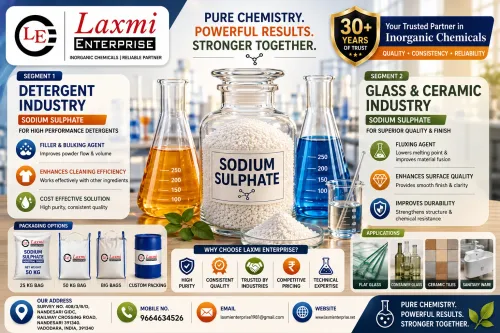
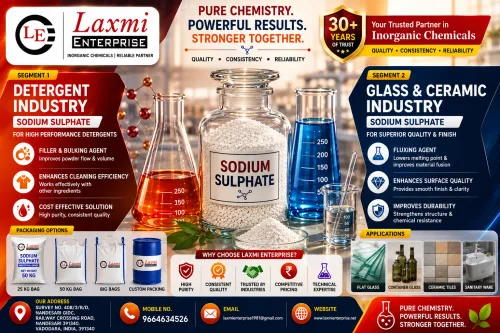
Used in detergent and soap manufacturing to remove moisture and maintain free-flowing powder.
Functions as a dehydrating agent in the manufacture of certain dyes, glass, and kraft paper.
Applied in textile processing to promote uniform dyeing and water removal.
4. Advantages as a Drying Agent
Chemically inert — does not react with most organic compounds.
Non-toxic and inexpensive.
High capacity for water absorption (up to 25% of its own weight).
Easy to handle and regenerate by heating.Safety and Handling
Non-toxic, but avoid inhalation of dust.
Store in a dry, well-ventilated area.
Wear gloves and safety goggles when handling.
Avoid contact with strong acidsPackaging and Storage
Supplied in 25–50 kg HDPE bags or fiber drums.
Store in dry, moisture-free conditions to maintain its anhydrous state.Common Synonyms
Thenardite (anhydrous form)
Glauber’s salt (decahydrate form)
Sodium sulphate anhydrousSodium sulfate — extraction from saline (brine)
Below I’ve outlined practical, industry-oriented ways to recover sodium sulfate (Na₂SO₄) from saline/brine streams — from small lab scale to full industrial practice — plus key operating tips, common problems and next steps you can take right away
Short summary / principle
Sodium sulfate is recovered from saline by concentrating the brine and inducing selective crystallization of sodium sulfate (often as the decahydrate, then converting to anhydrous if required). The main levers are concentration, temperature control, seeding, impurity removal, and crystal washing/drying. For some feed compositions, chemical pretreatment or secondary precipitation steps are needed to remove divalent cations (Ca, Mg) and sulfate-insoluble contaminants.
Typical process flow (industrial scale)
Feed conditioning / pretreatment
Remove suspended solids (screening, filtration).
Remove Ca²⁺/Mg²⁺ by lime (Ca(OH)₂) or soda ash (Na₂CO₃) softening → precipitate carbonates/hydroxides; filter.
Remove organics/colloids (activated carbon, flocculation) if fouling is an issue.
Adjust pH if needed (neutral/slightly alkaline is common
Concentration
Evaporative concentration (solar ponds, multiple-effect evaporator, mechanical vapor recompression, or simple open pans) to raise dissolved solids until Na₂SO₄ is near/above crystallization limit.
For low-grade brines, solar evaporation in shallow ponds is economical where climate permits.
Cooling crystallization: If temperature drop induces Na₂SO₄·10H₂O crystallization (see note on decahydrate below), cool the concentrated brine and seed to give selective Na₂SO₄ crystals.
Evaporative crystallization: Continue evaporation until Na₂SO₄ crystallizes out; seed to control crystal size.
Use fractional crystallization to separate NaCl and other salts — exploit differences in solubility/temperature dependence.
Solid–liquid separation
Centrifuges, vacuum filters, or rotary drum filters to separate crystals from mother liquor.
Washing
Wash crystals with cold wash liquor (usually mother liquor saturated at the wash temperature) to remove adhering impurities and NaCl.
Conversion / drying
If decahydrate was crystallized, heat to dehydrate to anhydrous Na₂SO₄ (thenardite) in rotary dryers or fluid bed dryers; controlled heating avoids cake hardening.
Final milling/classification as required.
Mother liquor handling
Recycle to the evaporator or further treat to recover other salts (NaCl, MgCl₂) or to concentrate further.
Dispose or treat brine responsibly to avoid environmental damage.
3) Important technical notes & practical tips
Decahydrate behavior
Sodium sulfate commonly crystallizes as Glauber’s salt (Na₂SO₄·10H₂O) below ~32.4°C; above that temperature the anhydrous form is stable. This means temperature control is important: cooling below ~32°C often encourages decahydrate formation which can be exploited for selective crystallization. (Industrial practice uses this property for fractional separation from mixtures like NaCl.)
Separation from NaCl and other salts
NaCl and Na₂SO₄ have different solubility/temperature dependences. Fractional crystallization (careful control of concentration and temperature plus seeding) can selectively crystallize Na₂SO₄ first in many brine compositions.
If brine has very high NaCl relative to sulfate, selective recovery is harder — you may need multi-stage crystallizers or chemical modification.
Pretreatment is critical
Ca²⁺/Mg²⁺ cause scale and incorporate into crystals (bad product quality). Softening via lime/soda ash is commonly used.
Organic fouling reduces yield and clogs filters — consider carbon treatment or coagulation.
Crystal habit / seed control
Use controlled seeding and agitation to produce uniform crystals and avoid fine “mud” which is difficult to filter.
Continuous crystallizers (forced circulation, draft tube) give better control for large plants.
Drying & conversion
If decahydrate crystals are produced, drying requires heat to remove water without fusing the crystals. Typical drying step converts Na₂SO₄·10H₂O → Na₂SO₄ (anhydrous) at elevated temperature; heat profiles must avoid sintering.
sodium sulphate supplier in Vadodara
- sodium sulphate manufacturer in Gujarat
- buy sodium sulphate in India
- sodium sulphate exporter Asia Pacific
Informational: what is sodium sulphate, uses of sodium sulphate
- Commercial: sodium sulphate price per kg, supplier comparison
- Transactional: buy sodium sulphate online, bulk sodium sulphate for sale
- Long-tail: sodium sulphate for detergents, sodium sulphate for glass industry
Energy & economics
Evaporation is energy intensive — where climate allows, solar evaporation ponds are the cheapest (very low CAPEX/OPEX but slow).
Mechanical vapor recompression or multi-effect evaporators reduce steam demand at higher capital cost.
* Equipment options (by scale)
Laboratory / small pilot: rotary evaporator (small), hotplate concentration + cooling crystallization, Buchner filtration, oven or vacuum oven drying.
Small industrial: single-effect evaporator, batch crystallizers, centrifuge or vacuum belt filter, rotary dryer.
Large industrial: multiple-effect evaporators / MVR, continuous forced-circulation crystallizers, centrifuges/centrifugal dryers, fluid bed dryers, automated washing/handling.
* Quality control & specifications
Typical purity specs: Na₂SO₄ assay, moisture (for anhydrous), NaCl content, insolubles, heavy metals.
Washing with saturated cold liquor lowers NaCl contamination.
If product is for detergents, pigments, or industrial feedstocks, tailor purity targets accordingly.
* Environmental, safety & regulatory
Manage brine discharge and salinity — local discharge permits may be required.
Handle lime, caustic or acidic consumers of pretreatment carefully (pH control).
Dust control for dry product (explosion risk generally low but respirable dust safety needed).
*Example quick lab procedure (bench scale)
Filter saline to remove solids.
If Ca/Mg present, add stoichiometric lime or soda ash to precipitate (stir, allow settle), filter out precipitates.
Heat solution to evaporate water until near saturation at room temp (concentrated).
Cool slowly to ≈20–25°C and add Na₂SO₄ seed crystals; allow crystallization (overnight).
Vacuum filter the crystals, wash with cold (≈5–10°C) saturated Na₂SO₄ solution to remove NaCl, then dry at 100–120°C to convert to anhydrous product.
* Common problems & fixes
Fine crystals / sludge → increase seeding, reduce supersaturation by slower cooling, use anti-nucleation control.
High NaCl contamination → use lower wash temperature, multiple wash steps, or staged fractional crystallization.
Scale on evaporator → improve pretreatment, anti-scaling chemicals, periodic cleaning.
Low yield → check losses in mother liquor; concentrate further or implement mother liquor recycling.
* When to choose which method
Solar pond evaporation: low-cost, suitable in hot arid climates, large land requirement.
Evaporative/crystallization with MVR or multiple-effect: energy efficient for continuous production where steam/electricity available.
Batch lab crystallization: research, small volumes, or pilot testing.
10) Next steps I can do for you right now
Draft a simple process flow diagram (PFD) / SOP for a lab/pilot plant.
Run a mass balance & yield estimate if you give feed composition (Na⁺, Cl⁻, SO₄²⁻, Ca²⁺, Mg²⁺ in g/L or wt%) and desired daily capacity.
Produce a cost/energy comparison (solar vs evaporative) for your local conditions if you give climate/energy costs.
Create an SEO product page description or a product spec sheet for selling recovered sodium sulfate.
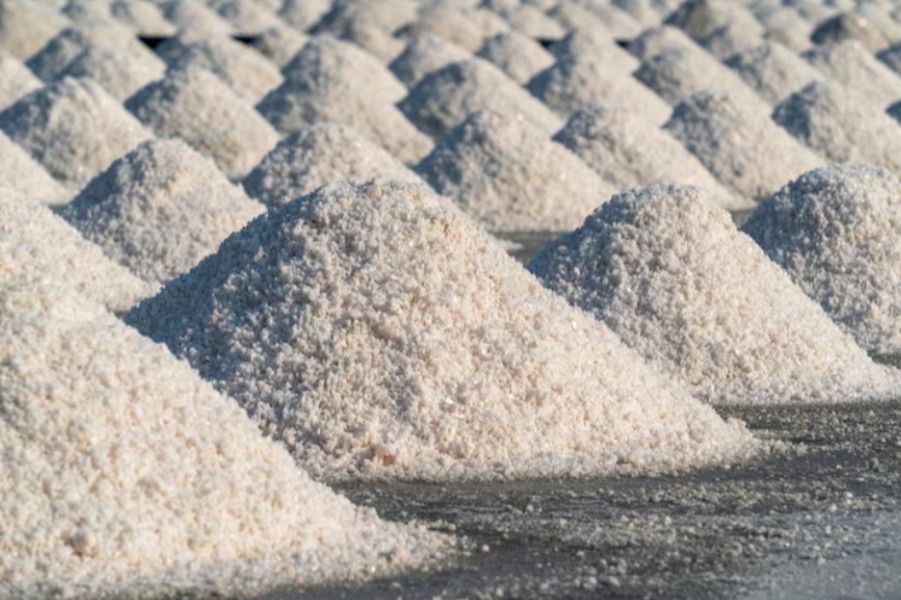
[[SODIUM SULFATE EXTRACTION FROM SALINE LAKES, LAXMI ENTERPRISE, VADODRA, GUJARAT.INDIA.]]