

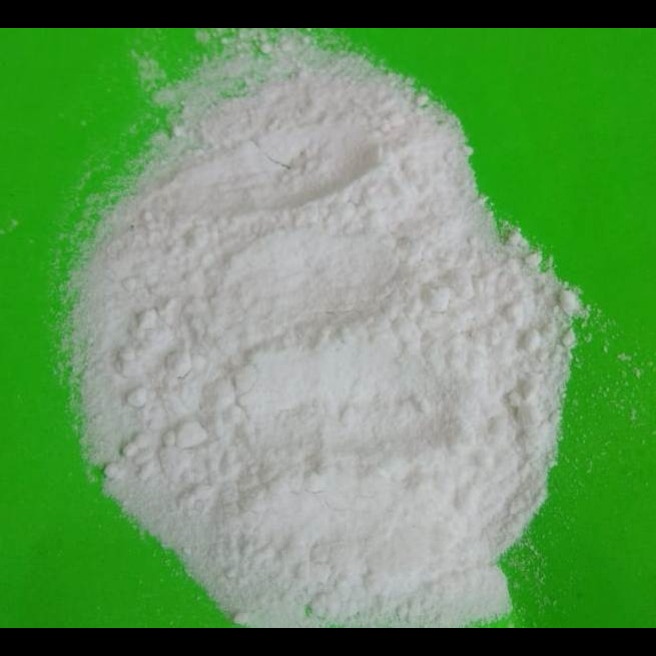
| **Grade Name / Type** | **Form** | **Purity (Na₂SO₄ %)** | **Typical Moisture %** | **Applications**
| **Anhydrous Sodium Sulfate (Technical Grade)** | White crystalline / powder | 98–99.5% | <0.5% | Detergent powders, glass, dyes, pulp & paper |
| **Anhydrous Sodium Sulfate (Pure / LR Grade)** | Fine powder | ≥99.5% | <0.2% | Laboratory use, pharma intermediates, specialty chemicals |
| **Sodium Sulfate Decahydrate (Glauber’s Salt)** | Crystals | 99% (on salt basis) | ~55% (water of crystallization) | Textiles (dyeing), tanning, cooling mixtures |
| **Refined Sodium Sulfate (Detergent Grade)** | Uniform crystalline / powder | 99% (low iron) | <0.5% | Household detergent and detergent cake industry |
| **By-product Sodium Sulfate (Chemical Process Grade)** | Granular / powder | 90–98% | 1–2% | General industrial use; cheaper alternative for non-critical detergents |
Major Industrial Applications in Gujarat
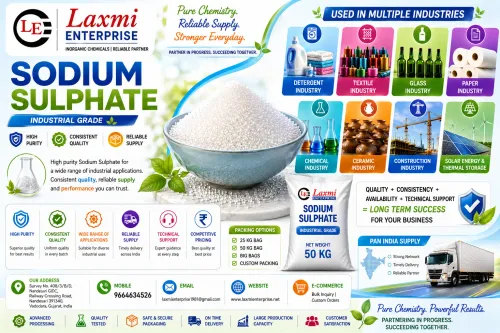
Detergent manufacturing (Ankleshwar, Vadodara, Ahmedabad): as filler and flow aid.
Textile processing and dyeing (Surat, Jetpur): leveling agent and electrolyte.
Glass manufacturing (Bharuch, Halol): flux to remove air bubbles.
Paper and pulp industry: kraft process recovery.
Chemical synthesis: used in sodium silicate, sodium sulfide, and sodium dichromate manufacture.
3. Key Manufacturers & Suppliers in Gujarat
Company Name Location Main Grade(s) Remarks
Gujarat Narmada Valley Fertilizers & Chemicals (GNFC) Bharuch Technical / Detergent grade High-quality by-product sodium sulfate
Tata Chemicals Ltd. Mithapur Anhydrous pure grade Export quality, high purity
Searles India Ltd. Kutch Glauber’s salt (decahydrate) Large-scale natural source
KPL International / Aditya Birla Chemicals Vadodara Refined detergent grade Widely used by detergent formulators
Shree Sulphate Industries Ankleshwar Technical & detergent grade Common local supplier
Laxmi Chemicals / Laxmi Enterprise (regional traders) Vadodara Technical / refined sodium sulfate Distributor of GNFC and Searles material
4. Indicative Market Prices (as of late 2025)
Grade Approx. Price (₹/kg, ex-Gujarat)
By-product (Technical, 95–98%) ₹4.5 – ₹6.0
Refined Detergent Grade (99%) ₹7 – ₹9
Pure / LR Grade (≥99.5%) ₹18 – ₹25
Glauber’s Salt (Decahydrate) ₹3 – ₹5
Prices vary with purity, moisture content, and packaging (25 kg / 50 kg bags or bulk supply).
5. Packaging & Delivery
Standard pack: 50 kg HDPE bags with inner liner.
Bulk: Jumbo bags (1 MT) for industrial customers.
Available ex-works or delivered via tankers or trucks across Gujarat.
Should be stored in dry warehouses to avoid moisture pickup and caking.
Would you like me to compile a supplier contact list or procurement-ready data sheet for Sodium Sulfate
What Is a Filler in Detergents?
A filler is an inert, inexpensive substance added to detergent formulations to:
Adjust active ingredient concentration,
Improve flow and handling, and
Optimize cost and bulk density of the product.
Sodium sulfate is the most widely used filler in the detergent industry — globally and in India.
2. Role of Sodium Sulfate as a Filler
Function Explanation
1. Diluent for Active Ingredients Sodium sulfate dilutes concentrated surfactants (like LABSA, SLES) and builders (like sodium carbonate), allowing uniform distribution and safer handling.
2. Bulk & Density Control It adds bulk to the detergent powder, adjusting the product’s apparent density and texture — important for packaging and consumer perception.
3. Flowability Improvement Sodium sulfate crystals improve the free-flowing nature of the powder, preventing lump formation and caking during storage.
4. Moisture Control It absorbs minor moisture from other ingredients, maintaining the powder’s dryness and preventing agglomeration.
5. Uniform Distribution of Additives Acts as a carrier for perfumes, colorants, optical brighteners, and enzymes — ensuring even dispersion.
6. Cost Optimization Reduces overall formulation cost by partially replacing expensive active surfactants or builders without affecting usability.
3. Typical Usage Levels
Type of Detergent % Sodium Sulfate Used Purpose
Economy / low-cost detergent 30–50% Major filler to reduce cost
Standard household detergent 15–30% Balanced performance and cost
Premium / concentrated detergent 0–15% Minimal filler — focus on actives
Spray-dried detergent base powder 20–40% Helps maintain powder structure and flow
4. Physical and Chemical Properties That Make It Ideal
Property Benefit in Formulation
Chemically inert Doesn’t react with surfactants or builders
White crystalline solid Maintains color brightness of the detergent
Non-hygroscopic (anhydrous form) Helps prevent caking if stored dry
Moderate solubility in water Dissolves without residue in wash water
Stable at high temperature Withstands spray drying and packaging processes
5. Processing Benefits
Easier spray drying: Sodium sulfate stabilizes slurry viscosity and improves tower drying.
Particle uniformity: Ensures even granule size in post-blended detergent powders.
Flow enhancer: Improves flow through hoppers and packaging lines.
6. Economic & Market Impact
In India, sodium sulfate can make up 20–40% of the total detergent mass in economy formulations.
Replacing part of expensive surfactants (like LABSA) with Na₂SO₄ allows companies to offer affordable detergent powders without drastically reducing cleaning efficiency.
7. Considerations and Limitations
Excessive use (>50%) can lower detergent performance.
Absorbs moisture in humid conditions, leading to caking
— needs proper storage.
- sodium sulphate supplier
- sodium sulphate manufacturer
- sodium sulphate exporter
- bulk sodium sulphate
- industrial sodium sulphate
- sodium sulphate price
Not suitable for liquid detergents (low solubility benefit as filler).
*Summary
Sodium Sulfate acts as a functional, cost-effective, and stable filler in detergent powders.
It improves handling, flow, and product appearance while balancing cost and performance — making it indispensable in mass-market detergent formulations.
Would you like me to prepare a technical data sheet (TDS) or MSDS-style summary specifically titled
“Sodium Sulfate – Role and Application as Filler in Detergents