

Sodium Sulphate Complete Technical Guide with Frequently Asked Questions for Industrial Buyers Manufacturers and Quality Professionals
Introduction
Sodium sulphate is one of the most important industrial inorganic salts used across detergent manufacturing, glass production, textile dyeing, pulp and paper processing, chemical manufacturing, ceramics, leather processing, and numerous specialty industries. Although it appears to be a simple white crystalline powder, its quality, purity, particle size, moisture level, and chemical composition significantly influence industrial productivity, product quality, and manufacturing efficiency.
Industrial buyers rarely purchase sodium sulphate based only on price. They evaluate technical specifications, laboratory reports, packaging quality, consistency between batches, logistics capability, and supplier reliability. A high-quality sodium sulphate helps reduce production downtime, improves process stability, minimizes waste, and delivers consistent results across manufacturing operations.
For procurement teams, production managers, quality control professionals, laboratory chemists, and plant engineers, understanding sodium sulphate goes beyond knowing its chemical formula. It includes understanding manufacturing methods, quality testing, storage conditions, application-specific requirements, handling practices, and supplier evaluation criteria.
This guide combines technical knowledge with practical answers to the questions most frequently asked by industrial users. Whether you are selecting a supplier, reviewing a Certificate of Analysis, troubleshooting quality issues, or learning about industrial applications, the following information provides a comprehensive reference to support informed decisions.
Understanding Sodium Sulphate
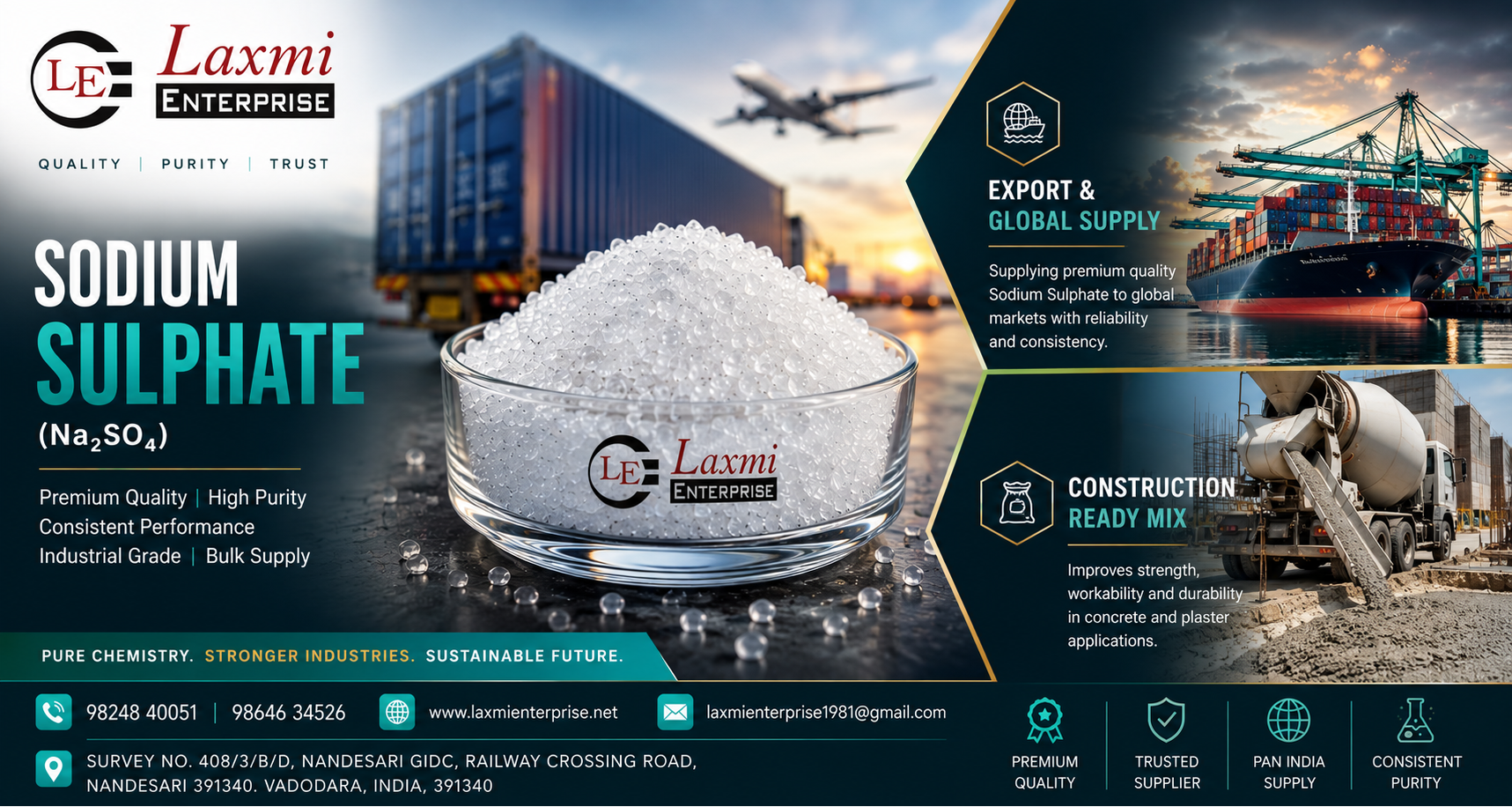
Sodium sulphate is an inorganic salt with the chemical formula Na₂SO₄. It is valued for its chemical stability, water solubility, compatibility with many industrial formulations, and cost-effective performance. Depending on the manufacturing process and intended application, sodium sulphate is supplied in different grades with varying purity levels and physical characteristics.
Its performance depends on maintaining consistent chemical composition and controlling impurities such as chlorides, iron, and water-insoluble matter. Proper drying, packaging, and storage further ensure that the product reaches customers in usable condition.
Frequently Asked Questions About Sodium Sulphate Basics
What is sodium sulphate
Sodium sulphate is an inorganic chemical compound composed of sodium, sulfur, and oxygen. It is widely used as a process chemical and functional ingredient in numerous industrial manufacturing operations.
What is the chemical formula of sodium sulphate
The chemical formula is Na₂SO₄, indicating two sodium atoms, one sulfur atom, and four oxygen atoms.
What is the molecular weight of sodium sulphate
The molecular weight of anhydrous sodium sulphate is approximately 142.04 g/mol.
What does sodium sulphate look like
It generally appears as a white crystalline powder or free-flowing granules, depending on the manufacturing process and particle size specification.
Is sodium sulphate soluble in water
Yes. Sodium sulphate dissolves readily in water, making it suitable for applications requiring rapid dissolution and uniform mixing.
Is sodium sulphate acidic or alkaline
Sodium sulphate is generally considered a neutral salt under normal industrial conditions.
Does sodium sulphate absorb moisture
Anhydrous sodium sulphate has limited moisture absorption under normal storage conditions, but prolonged exposure to high humidity can increase surface moisture and promote caking.
Is sodium sulphate flammable
No. Sodium sulphate is non-flammable and does not support combustion.
Is sodium sulphate explosive
No. It is chemically stable and is not classified as an explosive material.
Why is sodium sulphate used in industries
Its stability, purity, affordability, and compatibility with numerous industrial processes make it a preferred raw material in manufacturing.
Chemical and Physical Properties
The physical and chemical characteristics of sodium sulphate determine how it performs during production, transportation, storage, and industrial processing. Manufacturers closely monitor purity, particle size, moisture content, density, and solubility to ensure reliable performance.
These properties also influence equipment feeding, mixing efficiency, product consistency, and overall manufacturing economics.
Frequently Asked Questions About Chemical Properties
Why is purity important
Higher purity minimizes contamination, improves process consistency, and reduces production defects.
Why is particle size controlled
Uniform particle size improves handling, mixing, dissolution, and dosing accuracy.
What is bulk density
Bulk density is the weight of sodium sulphate occupying a defined volume and is important for packaging, storage, and automated feeding systems.
Does particle size affect production
Yes. Fine material dissolves more quickly, while coarse particles may improve flowability depending on the application.
Can sodium sulphate change during storage
Improper storage conditions, particularly exposure to moisture, can alter physical characteristics such as flowability and free-flowing behavior.
Does sodium sulphate react with most industrial chemicals
It remains stable with many industrial materials, although compatibility should always be evaluated within specific manufacturing processes.
Why is appearance inspected
Visual inspection can reveal contamination, discoloration, moisture exposure, or foreign material before laboratory testing.
Does whiteness indicate quality
A clean, bright appearance often reflects good manufacturing and purification practices, although laboratory analysis is required for confirmation.
Can impurities affect production
Yes. Even small amounts of unwanted impurities may reduce manufacturing efficiency or product quality in sensitive applications.
Why is consistency important
Consistent material properties enable predictable production performance and reduce process variation.
Manufacturing and Production Quality
Industrial sodium sulphate may originate from natural mineral deposits, recovery from chemical manufacturing processes, or synthetic production. Regardless of the source, quality depends on purification, drying, screening, packaging, and laboratory verification before dispatch.
Each production stage is monitored to maintain consistency and comply with customer specifications.
Frequently Asked Questions About Manufacturing
How is sodium sulphate manufactured
It may be produced through natural extraction, chemical synthesis, or recovery from other industrial processes, followed by purification and drying.
Why is drying important
Drying removes excess moisture, improving storage stability and handling characteristics.
What is product screening
Screening separates particles into specified size ranges to achieve consistent product quality.
Why is quality checked after production
Laboratory testing confirms that every production batch meets the required technical specifications before shipment.
Can different manufacturing methods produce different quality
Yes. Raw materials, processing technology, purification efficiency, and quality control systems all influence the final product.
Is every batch tested
Reputable manufacturers routinely analyze production batches before dispatch to verify compliance with quality requirements.
What happens if a batch fails quality testing
The batch is investigated, corrective actions are taken, and it is not released until it meets the required specifications or is appropriately reprocessed.
Why is packaging completed only after quality approval
This helps ensure that only compliant material is packed and shipped to customers.
Does manufacturing influence purity
Yes. Process control, purification, and raw material quality directly affect purity levels.
Why is process consistency important
Consistent manufacturing reduces quality variation and supports reliable industrial performance.