
Sodium Sulphate in Reactive Dyeing: A Technical Guide for Textile Manufacturers
Why Sodium Sulphate is Essential in Modern Textile Dyeing
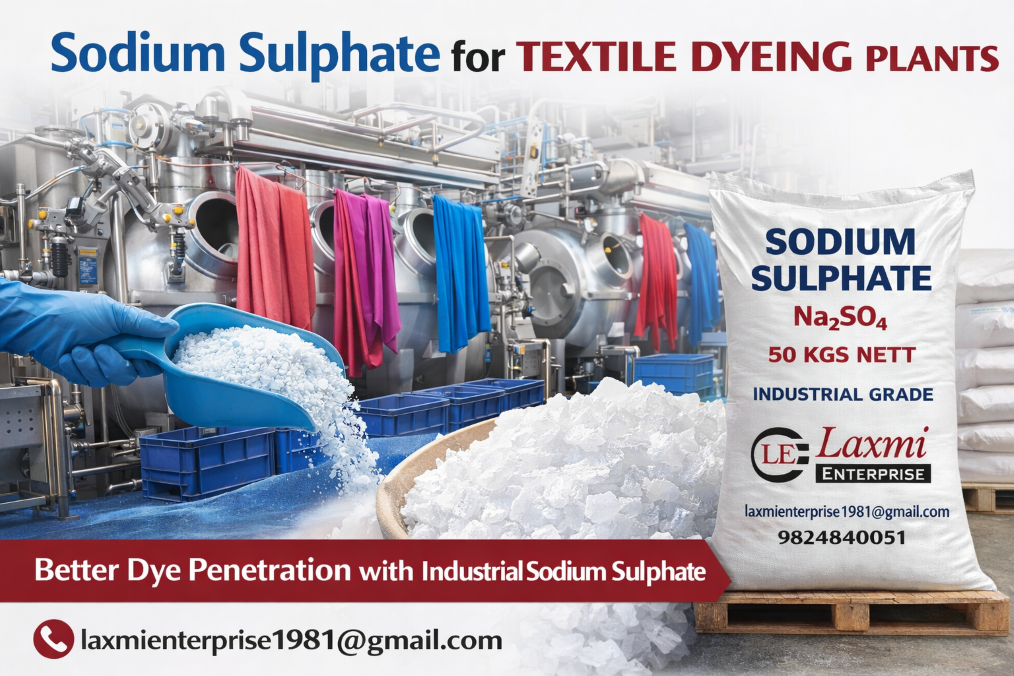
The textile industry is one of the largest consumers of Sodium Sulphate worldwide. From cotton processing units to export-oriented textile dye houses, Sodium Sulphate plays a critical role in achieving consistent dyeing results, better dye exhaustion, and improved shade reproducibility.
Textile clusters such as Surat, Ahmedabad, Jetpur, Tiruppur, Erode, Ludhiana, Panipat, Bhilwara, Pali, Balotra, and Kanpur rely heavily on Sodium Sulphate for reactive dyeing operations. As dyeing technology continues to evolve, manufacturers are increasingly focusing on process efficiency, color consistency, and cost optimization.
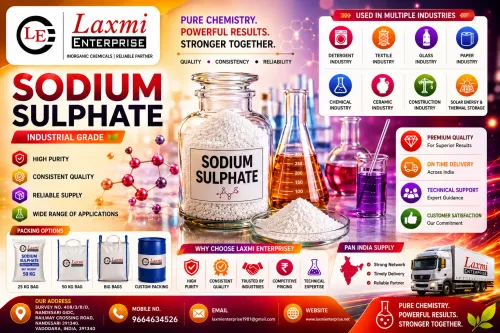
At Laxmi Enterprise, Koyali-Nandesari, Vadodara, we supply industrial-grade Sodium Sulphate to textile processors seeking reliable performance and consistent dyeing results.
The Science Behind Reactive Dyeing
Reactive dyes are widely used for cotton and cellulosic fibers because of their excellent wash fastness and bright shades. However, dye molecules naturally carry a negative charge, and cotton fibers in water also develop a negative surface charge.
This electrostatic repulsion prevents efficient dye absorption.
Sodium Sulphate acts as an electrolyte that reduces this repulsion and promotes dye migration from the dye bath to the fiber surface. As a result, the dye is absorbed more efficiently and uniformly.
Dye Exhaustion Improvement
Dye exhaustion refers to the percentage of dye transferred from the dye bath onto the textile material.
Without proper electrolyte concentration:
* Lower dye uptake
* Higher dye wastage
* Increased effluent load
* Uneven coloration
With optimized Sodium Sulphate dosing:
* Improved dye exhaustion rates
* Better dye utilization
* Reduced color loss
* Lower processing costs
* Reduced wastewater burden
Higher dye exhaustion directly contributes to improved production economics and sustainability.
Shade Consistency and Reproducibility
One of the most important objectives in textile dyeing is achieving repeatable shades from batch to batch.
Inconsistent salt quality can result in:
* Shade variation
* Patchy dyeing
* Reprocessing costs
* Customer complaints
Consistent industrial-grade Sodium Sulphate helps maintain:
* Uniform dye migration
* Controlled dye absorption
* Batch-to-batch reproducibility
* Improved color matching
* Reduced shade correction requirements
For export-oriented textile manufacturers, shade consistency is critical for meeting international quality standards.
Salt Dosing Optimization
Modern dye houses increasingly focus on optimized salt dosing rather than excessive salt usage.
Typical benefits of optimized Sodium Sulphate dosing include:
* Improved process control
* Lower chemical consumption
* Better dye fixation
* Reduced operational costs
* Improved environmental performance
Process engineers often monitor:
* Salt concentration
* Dye concentration
* Liquor ratio
* Temperature profile
* pH conditions
to maximize dyeing efficiency.
Textile Processing Benefits of Sodium Sulphate
Industrial-grade Sodium Sulphate offers several advantages in textile processing:
Technical Benefits
* Enhanced dye exhaustion
* Improved dye penetration
* Better shade uniformity
* Consistent batch performance
* Reduced reprocessing
Commercial Benefits
* Improved production efficiency
* Lower chemical wastage
* Reduced operating costs
* Better product quality
* Higher customer satisfaction
Environmental Benefits
* Reduced dye discharge
* Lower wastewater load
* Improved resource utilization
* Better sustainability performance
Case Study: Reactive Dyeing Unit Improvement
A textile processing unit faced recurring issues related to shade variation and high dye consumption.
After implementing a consistent Sodium Sulphate supply program and optimizing salt dosing procedures, the plant observed:
* Improved shade reproducibility
* Higher dye exhaustion rates
* Reduced dye losses
* Lower chemical costs
* Better production stability
The result was improved manufacturing efficiency and greater customer confidence in finished textile products.
Why Textile Manufacturers Trust Consistent Sodium Sulphate Supply
Successful dyeing operations depend on:
* Product quality
* Consistency
* Availability
* Technical support
Textile processors increasingly prefer suppliers capable of delivering reliable Sodium Sulphate specifications with uninterrupted supply support.
Why Choose Laxmi Enterprise
Laxmi Enterprise, Koyali-Nandesari, Vadodara, supplies Sodium Sulphate to textile processing units across India with a focus on:
* Consistent industrial-grade quality
* Reliable supply chain support
* Bulk availability
* Pan-India logistics
* Long-term industrial partnerships
Trust Formula
Trust = Quality + Consistency + Availability + Service
For textile manufacturers, Sodium Sulphate is not simply a raw material. It is a process-support chemical that directly influences dye exhaustion, shade consistency, and production efficiency.
Contact
Laxmi Enterprise
Koyali & Nandesari, Vadodara, Gujarat, India
Mobile: +91 98248 40051
Email: [laxmienterprise1981@gmail.com](mailto:laxmienterprise1981@gmail.com)
Website: [www.laxmienterprise.net](http://www.laxmienterprise.net)
Sodium Sulphate for textile industry, Sodium Sulphate for reactive dyeing, textile dyeing chemicals, dye exhaustion improvement, shade consistency in textile dyeing, Sodium Sulphate supplier India, Sodium Sulphate supplier Gujarat, industrial grade Sodium Sulphate, textile processing chemicals, dyeing auxiliary chemicals, Sodium Sulphate for cotton dyeing, reactive dyeing salt supplier, textile chemical supplier Vadodara, Sodium Sulphate procurement, textile manufacturing chemicals.