Sodium Sulphate in Textile Dyeing & Processing
Purchasing Sodium Sulphate should be treated as a strategic procurement decision rather than a commodity purchase. Textile mills benefit from evaluating quality consistency, documentation, logistics capability, packaging options, technical support, and supplier reliability alongside commercial pricing.
A structured procurement process helps reduce:
Production interruptions.
Shade variation caused by inconsistent raw materials.
Emergency purchasing.
Inventory shortages.
Customer complaints related to process instability.
The objective is to establish a long-term supply relationship that supports consistent manufacturing performance.
Step-by-Step Procurement Workflow
A practical procurement workflow may include:
Define the technical specification for the intended dyeing process.
Request product documentation, including the Certificate of Analysis (COA), Technical Data Sheet (TDS), and Safety Data Sheet (SDS/MSDS).
Evaluate sample material through laboratory and production trials.
Confirm packaging, delivery schedules, and logistics.
Approve the supplier based on technical and commercial criteria.
Monitor incoming batches through routine quality checks.
Review supplier performance periodically.
Following a documented workflow supports consistency and traceability.
Supplier Evaluation Matrix
Quick Answer
A supplier should be evaluated across multiple criteria rather than on price alone. A balanced assessment helps procurement teams identify suppliers that can support long-term production requirements.
Evaluation Area Typical Considerations
Product Quality Batch consistency, specification compliance
Documentation COA, TDS, SDS/MSDS, batch traceability
Technical Support Product knowledge, application guidance
Supply Capability Inventory planning, delivery reliability
Packaging Bag quality, labeling, packaging options
Communication Responsiveness, issue resolution
Commercial Terms Transparent quotations and agreed terms
This type of matrix can be adapted to an organization's internal supplier approval process.
Questions to Ask Before Approving a Supplier
Before placing a regular purchase order, procurement teams may wish to ask:
Can you provide a COA for each batch?
Is batch traceability maintained?
What quality checks are performed before dispatch?
Which packaging options are available?
How are products protected during transportation?
Can you support scheduled deliveries?
What is the typical lead time?
How are customer quality concerns investigated?
Can technical documentation be supplied with every shipment?
The answers help assess the supplier's operational capability as well as product quality.
Packaging Selection
Packaging should align with the mill's storage facilities and handling systems.
Common industrial options include:
Packaging Type Typical Use
25 kg bags Pilot plants, laboratories, lower-volume consumption
50 kg bags Standard industrial operations
500 kg FIBC (jumbo bags) Medium-volume users
1000 kg FIBC High-volume production facilities
Bulk transport Large continuous operations where appropriate
The choice depends on warehouse infrastructure, lifting equipment, and production volume.
Warehouse Management Best Practices
Proper storage preserves material quality before use.
Recommended practices include:
Store in a clean, dry, covered warehouse.
Protect bags from rain and excessive humidity.
Keep packaging sealed until required.
Stack bags according to safe handling practices.
Avoid direct contact with the floor by using pallets.
Follow a First-In, First-Out (FIFO) inventory system.
Inspect packaging periodically for damage.
Good warehouse practices help maintain flowability and reduce the risk of contamination.
Transportation Considerations
Textile manufacturers often operate on tight production schedules, making reliable logistics an important part of procurement planning.
When arranging transportation, consider:
Route planning.
Transit time.
Weather conditions.
Packaging protection.
Loading and unloading facilities.
Delivery scheduling.
Documentation accompanying the shipment.
Effective coordination between the supplier and the buyer helps reduce delays.
Inventory Planning
Maintaining the right inventory level helps balance production continuity with warehouse costs.
Procurement teams often consider:
Average monthly consumption.
Seasonal demand fluctuations.
Supplier lead time.
Safety stock requirements.
Warehouse capacity.
Inventory planning should be reviewed regularly based on production schedules and demand forecasts.
Sustainability Considerations
Quick Answer
Many textile manufacturers are strengthening sustainability initiatives throughout their operations. Responsible procurement includes evaluating product quality, minimizing waste, improving inventory management, and optimizing transportation.
Examples of sustainable practices include:
Reducing unnecessary reprocessing by maintaining consistent raw material quality.
Improving warehouse management to reduce product losses.
Optimizing transportation to improve delivery efficiency.
Supporting recycling and waste reduction initiatives where appropriate.
Sustainability objectives vary by organization and should align with applicable regulations and customer requirements.
Documentation for Industrial Buyers
Procurement teams commonly request:
Certificate of Analysis (COA).
Technical Data Sheet (TDS).
Safety Data Sheet (SDS/MSDS).
Batch identification.
Commercial invoice.
Packing list.
Transport documentation, where applicable.
Maintaining organized documentation supports traceability and audit readiness.
Pan-India Supply for Textile Manufacturing
India's textile industry spans multiple manufacturing regions, each with unique production strengths:
Gujarat: Surat, Ahmedabad, Vadodara.
Rajasthan: Bhilwara, Pali.
Punjab: Ludhiana.
Haryana: Panipat.
Maharashtra: Bhiwandi, Ichalkaranji.
Tamil Nadu: Tiruppur, Erode, Karur, Coimbatore.
Telangana: Hyderabad and surrounding industrial areas.
Karnataka: Bengaluru and textile processing clusters.
Uttar Pradesh: Kanpur and textile manufacturing centres.
West Bengal: Kolkata region and surrounding textile units.
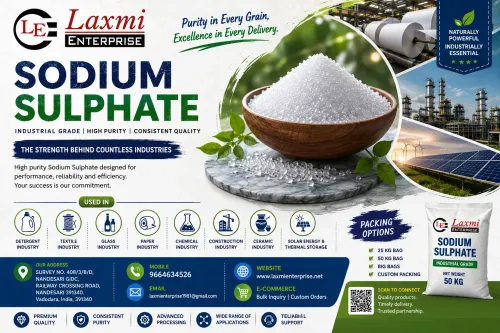
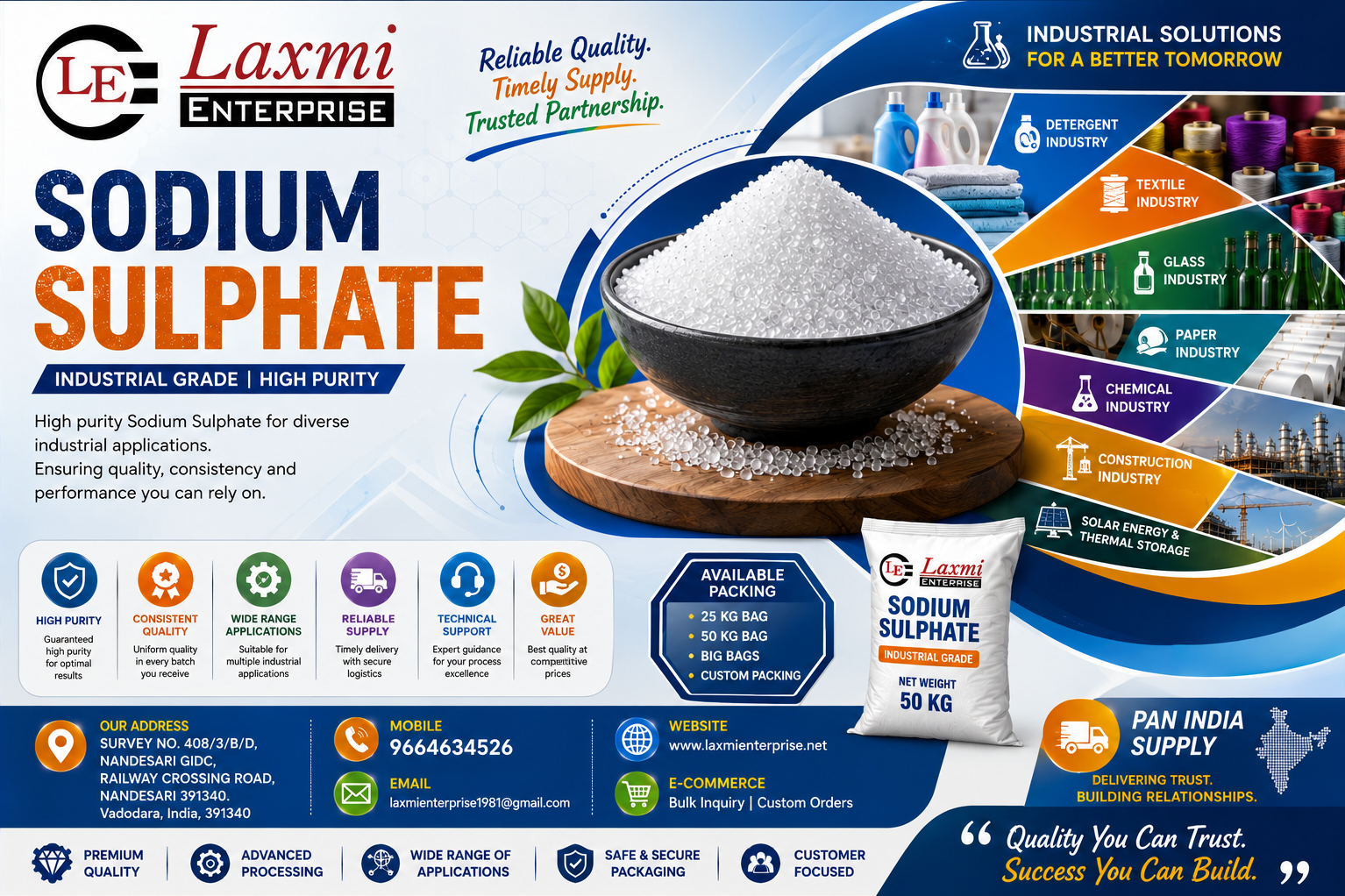
Laxmi Enterprise, based in Nandesari GIDC, Vadodara, Gujarat, supplies industrial-grade Sodium Sulphate to customers across Pan India, supporting textile manufacturers with technical documentation, flexible packaging options, and logistics planning tailored to production requirements.
Frequently Asked Questions
1. Is Sodium Sulphate suitable for every textile process?
No. Its use depends on the fibre type, dye class, and process design. Manufacturers should follow validated dyeing procedures and application-specific recommendations.
2. Does higher purity always produce better dyeing results?
Not necessarily. The appropriate specification depends on the process. Consistency across all quality parameters is often more important than maximizing a single value.
3. Why is particle size important?
Particle size affects dissolution, handling, and mixing. Consistent particle size contributes to predictable processing.
4. Why should every batch include a COA?
A COA documents the tested characteristics of the specific batch supplied and supports quality verification.
5. How should Sodium Sulphate be stored?
Store it in a clean, dry warehouse in sealed packaging, protected from moisture and contamination.
6. What packaging should I choose?
The appropriate packaging depends on consumption rate, warehouse facilities, and handling equipment.
7. Can I evaluate a supplier using only price?
Price is only one factor. Technical capability, documentation, quality consistency, logistics, and service are also important.
8. How often should incoming material be inspected?
Inspection frequency depends on the organization's quality system, supplier qualification, and process requirements.
9. What documents should accompany each shipment?
Typical documents include a COA, TDS, SDS/MSDS, batch identification, commercial invoice, packing list, and other shipment documents as applicable.
10. Which industries use textile-grade Sodium Sulphate?
Textile-grade Sodium Sulphate is primarily used by dyeing and processing units working with suitable dyeing systems. The exact application depends on the manufacturer's process.
Internal Linking Opportunities
To strengthen topical authority, this article should link to related resources such as:
What Is Sodium Sulphate?
Sodium Sulphate Manufacturing Process.
Chemical & Physical Properties.
Grades & Industrial Specifications.
Laboratory Testing & COA Interpretation.
Sodium Sulphate for Glass Manufacturing.
Sodium Sulphate for Detergent Manufacturing.
Packaging, Storage & Transportation Guide.
Complete Buyer's Guide.
Market Trends and Industry Applications.
A well-structured internal linking strategy helps users explore related topics and supports search engines in understanding the breadth of your Sodium Sulphate content.
Conclusion
Sodium Sulphate is an important process chemical in many textile dyeing operations, particularly where controlled dye exhaustion is required. Successful implementation depends on selecting the appropriate grade, maintaining consistent process control, and sourcing material that meets agreed technical specifications.
For textile manufacturers, procurement decisions should consider the complete picture: product quality, documentation, packaging, logistics, supplier capability, and long-term reliability. These factors contribute to consistent production, improved operational efficiency, and stronger quality assurance.
Laxmi Enterprise, located in Nandesari GIDC, Vadodara, Gujarat, supplies industrial-grade Sodium Sulphate to textile manufacturers across Pan India. By supporting customers with technical documentation, application-focused guidance, and reliable logistics, the company helps procurement teams source Sodium Sulphate with confidence for a wide range of textile processing requirements.
Keywords