Sodium Sulphate in Textile Dyeing: Why Consistent Quality Leads to Better Dyeing Results
The textile industry is built on precision.
A slight variation in shade can result in an entire batch being rejected. Uneven dye absorption can increase production costs. Delays in processing can affect delivery schedules and customer commitments. Because of this, textile manufacturers pay close attention to every stage of the dyeing process, from water quality and dye selection to temperature control and the quality of auxiliary chemicals.
One raw material that quietly supports this process is Sodium Sulphate.
Although it does not receive the same attention as dyes or processing chemicals, it plays an important role in achieving uniform colour development on fabric. Manufacturers who have spent years in textile processing understand that consistent raw materials often make the difference between predictable production and repeated troubleshooting.
At Laxmi Enterprise, Nandesari, Vadodara, we regularly interact with textile processors, dye houses and chemical buyers across India. One thing becomes clear during these conversations. Every manufacturer wants consistency. They want every batch of fabric to match the previous one without spending valuable production time making unnecessary adjustments.
That objective starts with dependable raw materials.
Understanding the Role of Sodium Sulphate in Textile Processing
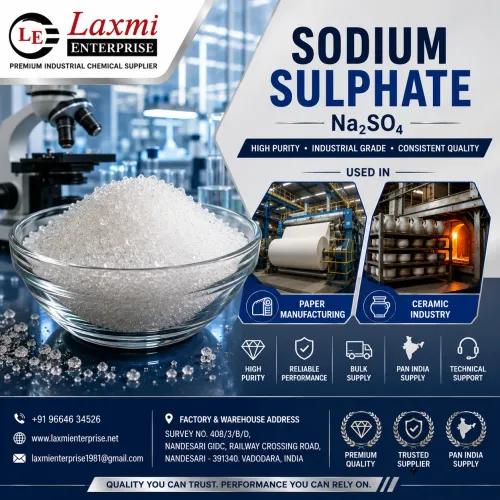
During reactive dyeing, particularly on cotton and other cellulosic fibres, Sodium Sulphate is used to support the movement of dye molecules from the dye bath onto the fabric.
Without proper control of this stage, dye uptake may become uneven, leading to differences in shade across the fabric.
When the process is properly managed and the raw materials remain consistent, dye penetration becomes more uniform and manufacturers are better able to achieve repeatable colour results.
Every textile mill develops its own process parameters based on machinery, fabric type, dyes and production requirements. Even though formulations vary, consistent chemical quality remains important in every operation.
Why Shade Consistency Matters
For many textile manufacturers, colour is their reputation.
Fashion brands expect identical shades across thousands of metres of fabric.
Export buyers compare new production with approved samples.
Garment manufacturers rely on consistency when cutting and stitching fabrics produced on different dates.
Even small colour variations can create expensive problems.
Additional processing consumes water, chemicals, steam, electricity and labour. Production schedules become tighter, delivery commitments become more difficult to meet and manufacturing costs increase.
Reducing these variations begins with controlling every part of the dyeing process, including the quality of the chemicals entering the dye bath.
The Difference Between Buying Chemicals and Building a Reliable Supply Chain
Purchasing departments often receive quotations from several suppliers.
While price is naturally an important consideration, experienced textile manufacturers usually evaluate suppliers from a wider perspective.
Can the supplier maintain the same quality throughout the year?
Will deliveries arrive when production requires them?
Does the supplier understand the textile industry?
Can they support increasing production volumes?
These questions often have a greater impact on manufacturing efficiency than minor price differences.
Reliable suppliers contribute to reliable production.
Challenges Faced by Textile Dye Houses
Every dye house has experienced days when production does not go according to plan.
A colour develops differently than expected.
Laboratory results do not match bulk production.
Machine settings require repeated adjustments.
Production teams begin investigating dyes, water quality and equipment before eventually reviewing the raw materials themselves.
Although there may be several contributing factors, consistent chemical quality always reduces one important source of variation.
That is why many experienced dye houses prefer working with suppliers who have established quality standards and dependable supply systems.
Supporting Large-Scale Textile Production
Modern textile manufacturing operates at remarkable speed.
Continuous dyeing ranges, jet dyeing machines, winch dyeing equipment and other advanced processing systems require carefully controlled production conditions.
Interruptions caused by inconsistent raw materials affect far more than a single machine.
They influence planning, labour utilisation, delivery schedules and customer confidence.
For manufacturers producing fabric every day, stability in raw material supply becomes an essential part of efficient operations.
Storage and Handling
Good storage practices help preserve chemical quality after delivery.
Sodium Sulphate should be stored in a clean, dry warehouse away from excessive moisture.
Original packaging should remain properly sealed until the material is required for production.
Warehouse teams should also follow systematic inventory rotation to ensure older stock is consumed before newly received material.
Simple handling procedures often contribute to more consistent production performance.
Industries That Depend on Textile Dyeing
Textile processing supports many industries beyond fashion.
Manufacturers producing home textiles, industrial fabrics, uniforms, medical textiles, automotive fabrics, technical textiles and export garments all depend on consistent dyeing quality.
As customer expectations continue to rise, manufacturers are placing greater emphasis on quality assurance throughout the production process.
Reliable raw materials remain one of the foundations of that effort.
Why Manufacturers Value Experience
The chemical industry is built on long-term relationships.
Manufacturers prefer suppliers who understand their production requirements rather than simply processing orders.
At Laxmi Enterprise, we believe that every delivery represents an opportunity to strengthen customer confidence.
Operating from Nandesari, Vadodara, we supply industrial chemicals to customers across India with a focus on dependable quality, timely deliveries and professional service.
Many of our customers have worked with us for years because they know consistency cannot be achieved through occasional success. It is built through reliable performance over time.
The Advantage of Gujarat's Chemical Infrastructure
Gujarat has become one of India's leading centres for chemical manufacturing and industrial supply.
Regions such as Nandesari, Vadodara, Ankleshwar, Bharuch, Dahej and Vapi support thousands of manufacturers across multiple industries.
This well-developed industrial network enables efficient transportation, better supply chain management and reliable access to industrial chemicals for customers throughout India.
For textile manufacturers operating in Gujarat as well as other industrial states, dependable logistics help maintain uninterrupted production.
Looking Ahead
India's textile industry continues to expand through investments in technology, exports and sustainable manufacturing practices.
As production standards become more demanding, manufacturers increasingly recognise that consistent raw materials support consistent results.
Every successful textile business depends on repeatability.
Customers expect the same shade today that they received six months ago.
Meeting those expectations requires discipline throughout the production process and dependable partners throughout the supply chain.
Choosing a reliable Sodium Sulphate supplier is one part of that larger commitment to quality.
At Laxmi Enterprise, we remain committed to supporting textile manufacturers with industrial chemicals that help create stable production, dependable supply and long-term business relationships.
Frequently Asked Questions
Why is Sodium Sulphate used in textile dyeing?
It supports the dyeing process by helping achieve more uniform dye absorption, particularly in the dyeing of cotton and other cellulosic fibres.
Does the quality of Sodium Sulphate affect shade consistency?
Consistent chemical quality helps reduce process variations and supports more repeatable dyeing results when used within a properly controlled manufacturing process.
Which textile industries use Sodium Sulphate?
It is commonly used by cotton processing units, textile dye houses, fabric manufacturers, home textile producers, garment fabric processors and technical textile manufacturers.
What should textile manufacturers consider when selecting a supplier?
Most manufacturers evaluate consistency, delivery reliability, packaging quality, technical understanding, stock availability and long-term business support rather than focusing only on price.
How does Laxmi Enterprise support textile manufacturers?
From our facility in Nandesari, Vadodara, we supply industrial-grade Sodium Sulphate to textile manufacturers across India with an emphasis on consistent quality, dependable deliveries and responsive customer service.
The textile industry is built on precision.
A slight variation in shade can result in an entire batch being rejected. Uneven dye absorption can increase production costs. Delays in processing can affect delivery schedules and customer commitments. Because of this, textile manufacturers pay close attention to every stage of the dyeing process, from water quality and dye selection to temperature control and the quality of auxiliary chemicals.
One raw material that quietly supports this process is Sodium Sulphate.
Although it does not receive the same attention as dyes or processing chemicals, it plays an important role in achieving uniform colour development on fabric. Manufacturers who have spent years in textile processing understand that consistent raw materials often make the difference between predictable production and repeated troubleshooting.
At Laxmi Enterprise, Nandesari, Vadodara, we regularly interact with textile processors, dye houses and chemical buyers across India. One thing becomes clear during these conversations. Every manufacturer wants consistency. They want every batch of fabric to match the previous one without spending valuable production time making unnecessary adjustments.
That objective starts with dependable raw materials.
Understanding the Role of Sodium Sulphate in Textile Processing
During reactive dyeing, particularly on cotton and other cellulosic fibres, Sodium Sulphate is used to support the movement of dye molecules from the dye bath onto the fabric.
Without proper control of this stage, dye uptake may become uneven, leading to differences in shade across the fabric.
When the process is properly managed and the raw materials remain consistent, dye penetration becomes more uniform and manufacturers are better able to achieve repeatable colour results.
Every textile mill develops its own process parameters based on machinery, fabric type, dyes and production requirements. Even though formulations vary, consistent chemical quality remains important in every operation.
Why Shade Consistency Matters
For many textile manufacturers, colour is their reputation.
Fashion brands expect identical shades across thousands of metres of fabric.
Export buyers compare new production with approved samples.
Garment manufacturers rely on consistency when cutting and stitching fabrics produced on different dates.
Even small colour variations can create expensive problems.
Additional processing consumes water, chemicals, steam, electricity and labour. Production schedules become tighter, delivery commitments become more difficult to meet and manufacturing costs increase.
Reducing these variations begins with controlling every part of the dyeing process, including the quality of the chemicals entering the dye bath.
The Difference Between Buying Chemicals and Building a Reliable Supply Chain
Purchasing departments often receive quotations from several suppliers.
While price is naturally an important consideration, experienced textile manufacturers usually evaluate suppliers from a wider perspective.
Can the supplier maintain the same quality throughout the year?
Will deliveries arrive when production requires them?
Does the supplier understand the textile industry?
Can they support increasing production volumes?
These questions often have a greater impact on manufacturing efficiency than minor price differences.
Reliable suppliers contribute to reliable production.
Challenges Faced by Textile Dye Houses
Every dye house has experienced days when production does not go according to plan.
A colour develops differently than expected.
Laboratory results do not match bulk production.
Machine settings require repeated adjustments.
Production teams begin investigating dyes, water quality and equipment before eventually reviewing the raw materials themselves.
Although there may be several contributing factors, consistent chemical quality always reduces one important source of variation.
That is why many experienced dye houses prefer working with suppliers who have established quality standards and dependable supply systems.
Supporting Large-Scale Textile Production
Modern textile manufacturing operates at remarkable speed.
Continuous dyeing ranges, jet dyeing machines, winch dyeing equipment and other advanced processing systems require carefully controlled production conditions.
Interruptions caused by inconsistent raw materials affect far more than a single machine.
They influence planning, labour utilisation, delivery schedules and customer confidence.
For manufacturers producing fabric every day, stability in raw material supply becomes an essential part of efficient operations.
Storage and Handling
Good storage practices help preserve chemical quality after delivery.
Sodium Sulphate should be stored in a clean, dry warehouse away from excessive moisture.
Original packaging should remain properly sealed until the material is required for production.
Warehouse teams should also follow systematic inventory rotation to ensure older stock is consumed before newly received material.
Simple handling procedures often contribute to more consistent production performance.
Industries That Depend on Textile Dyeing
Textile processing supports many industries beyond fashion.
Manufacturers producing home textiles, industrial fabrics, uniforms, medical textiles, automotive fabrics, technical textiles and export garments all depend on consistent dyeing quality.
As customer expectations continue to rise, manufacturers are placing greater emphasis on quality assurance throughout the production process.
Reliable raw materials remain one of the foundations of that effort.
Why Manufacturers Value Experience
The chemical industry is built on long-term relationships.
Manufacturers prefer suppliers who understand their production requirements rather than simply processing orders.
At Laxmi Enterprise, we believe that every delivery represents an opportunity to strengthen customer confidence.
Operating from Nandesari, Vadodara, we supply industrial chemicals to customers across India with a focus on dependable quality, timely deliveries and professional service.
Many of our customers have worked with us for years because they know consistency cannot be achieved through occasional success. It is built through reliable performance over time.
The Advantage of Gujarat's Chemical Infrastructure
Gujarat has become one of India's leading centres for chemical manufacturing and industrial supply.
Regions such as Nandesari, Vadodara, Ankleshwar, Bharuch, Dahej and Vapi support thousands of manufacturers across multiple industries.
This well-developed industrial network enables efficient transportation, better supply chain management and reliable access to industrial chemicals for customers throughout India.
For textile manufacturers operating in Gujarat as well as other industrial states, dependable logistics help maintain uninterrupted production.
Looking Ahead
India's textile industry continues to expand through investments in technology, exports and sustainable manufacturing practices.
As production standards become more demanding, manufacturers increasingly recognise that consistent raw materials support consistent results.
Every successful textile business depends on repeatability.
Customers expect the same shade today that they received six months ago.
Meeting those expectations requires discipline throughout the production process and dependable partners throughout the supply chain.
Choosing a reliable Sodium Sulphate supplier is one part of that larger commitment to quality.
At Laxmi Enterprise, we remain committed to supporting textile manufacturers with industrial chemicals that help create stable production, dependable supply and long-term business relationships.
Frequently Asked Questions
Why is Sodium Sulphate used in textile dyeing?
It supports the dyeing process by helping achieve more uniform dye absorption, particularly in the dyeing of cotton and other cellulosic fibres.
Does the quality of Sodium Sulphate affect shade consistency?
Consistent chemical quality helps reduce process variations and supports more repeatable dyeing results when used within a properly controlled manufacturing process.
Which textile industries use Sodium Sulphate?
It is commonly used by cotton processing units, textile dye houses, fabric manufacturers, home textile producers, garment fabric processors and technical textile manufacturers.
What should textile manufacturers consider when selecting a supplier?
Most manufacturers evaluate consistency, delivery reliability, packaging quality, technical understanding, stock availability and long-term business support rather than focusing only on price.
How does Laxmi Enterprise support textile manufacturers?
From our facility in Nandesari, Vadodara, we supply industrial-grade Sodium Sulphate to textile manufacturers across India with an emphasis on consistent quality, dependable deliveries and responsive customer service.
Keywords