Why Quality Matters More Than Price
One of the most common misconceptions in industrial purchasing is that sodium sulphate is a commodity where the lowest price automatically represents the best value. While price is undoubtedly an important commercial consideration, experienced procurement professionals understand that the true cost of a raw material extends far beyond the purchase price.
The impact of inconsistent quality often becomes visible only after the material enters production. Variations in purity, moisture content, particle size, chloride, iron, or packaging quality can lead to production interruptions, additional laboratory testing, process adjustments, customer complaints, and increased waste. These hidden costs frequently outweigh any initial savings achieved through a lower purchase price.
For this reason, many manufacturing organizations now evaluate suppliers using a Total Cost of Ownership (TCO) approach rather than focusing exclusively on the invoice value. This broader perspective considers product consistency, laboratory support, logistics, documentation, and long-term reliability.
A dependable sodium sulphate supplier helps customers achieve:
Stable manufacturing performance
Consistent product quality
Reduced production downtime
Lower rejection rates
Improved inventory planning
Better traceability
Reliable technical documentation
Long-term supply continuity
Quality should therefore be viewed as an operational investment rather than an additional expense.
How to Select the Right Sodium Sulphate Supplier
Selecting a supplier is not simply a purchasing decision; it is a strategic partnership that influences production efficiency and business continuity.
A structured supplier evaluation should consider both technical capability and commercial reliability.
1. Product Quality
Review the supplier's technical specifications and determine whether they align with your manufacturing requirements.
Important quality parameters include:
Purity
Moisture
Chloride
Iron
Water insoluble matter
Particle size
Bulk density
Appearance
2. Laboratory Capability
Reliable suppliers invest in quality control laboratories capable of verifying product specifications before dispatch.
Evaluate whether the supplier provides:
Batch testing
Certificate of Analysis
Technical Data Sheet
Safety Data Sheet
Batch traceability
Documented quality procedures
3. Manufacturing Consistency
Consistency is one of the strongest indicators of supplier capability.
Ask questions such as:
Are all batches tested?
How are raw materials controlled?
What quality checkpoints exist during manufacturing?
How are non-conforming batches handled?
4. Packaging Standards
Packaging protects the product throughout transportation and storage.
Consider:
Moisture resistance
Bag strength
Proper labeling
Batch identification
Storage instructions
Palletization practices
5. Supply Reliability
Production schedules depend on dependable deliveries.
Evaluate:
Inventory availability
Production capacity
Delivery performance
Geographic coverage
Emergency supply capability
6. Technical Support
Good suppliers do more than deliver chemicals.
They assist customers with:
Product selection
Technical specifications
Laboratory interpretation
Storage recommendations
Process-related guidance
Strong technical support often becomes invaluable during production troubleshooting.
Common Purchasing Mistakes
Many procurement challenges arise not because of poor suppliers, but because buyers evaluate products using incomplete criteria.
Some of the most common mistakes include:
Purchasing Only on Price
The lowest quotation does not always provide the lowest manufacturing cost.
Ignoring Technical Specifications
Assuming all sodium sulphate is identical can lead to production problems.
Not Reviewing Laboratory Reports
Every incoming batch should be supported by quality documentation appropriate to your quality procedures.
Overlooking Packaging Quality
Damaged packaging can introduce contamination and moisture before production even begins.
Failing to Evaluate Long-Term Consistency
One successful delivery does not guarantee future consistency.
Not Understanding Application Requirements
Different industries require different product characteristics.
The correct specification depends on the manufacturing process rather than a universal standard.
The Future of Sodium Sulphate
Global manufacturing continues to evolve through automation, digital quality systems, sustainable production practices, and increasing customer expectations.
These changes are influencing the sodium sulphate industry in several ways.
Future developments are likely to include:
Greater emphasis on consistent quality
Improved laboratory automation
Enhanced traceability
Better technical documentation
Stronger supplier partnerships
Digital Certificates of Analysis
Improved logistics planning
Customer-specific product customization
Industrial buyers are also becoming more technically informed. Procurement decisions increasingly involve cross-functional teams including production engineers, laboratory personnel, quality managers, and sustainability professionals.
As a result, suppliers who combine product quality with technical expertise and dependable service are better positioned to build long-term customer relationships.
Laxmi Enterprise's Approach to Industrial Supply
For industrial buyers, the value of a supplier is measured not only by the product supplied but also by the confidence the supplier brings to the purchasing process.
A quality-focused supplier supports customers through:
Consistent product quality
Clear technical documentation
Batch traceability
Reliable packaging
Timely deliveries
Responsive communication
Technical understanding of customer applications
Continuous improvement
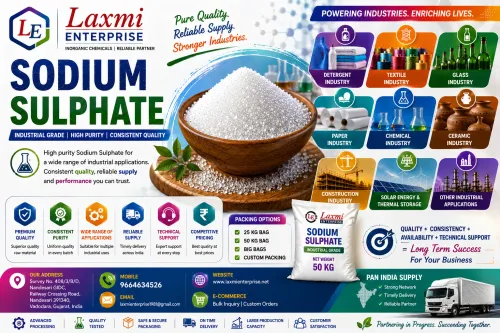
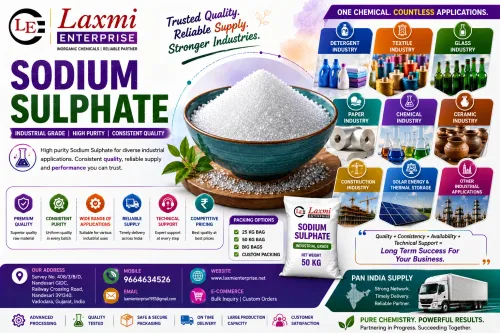
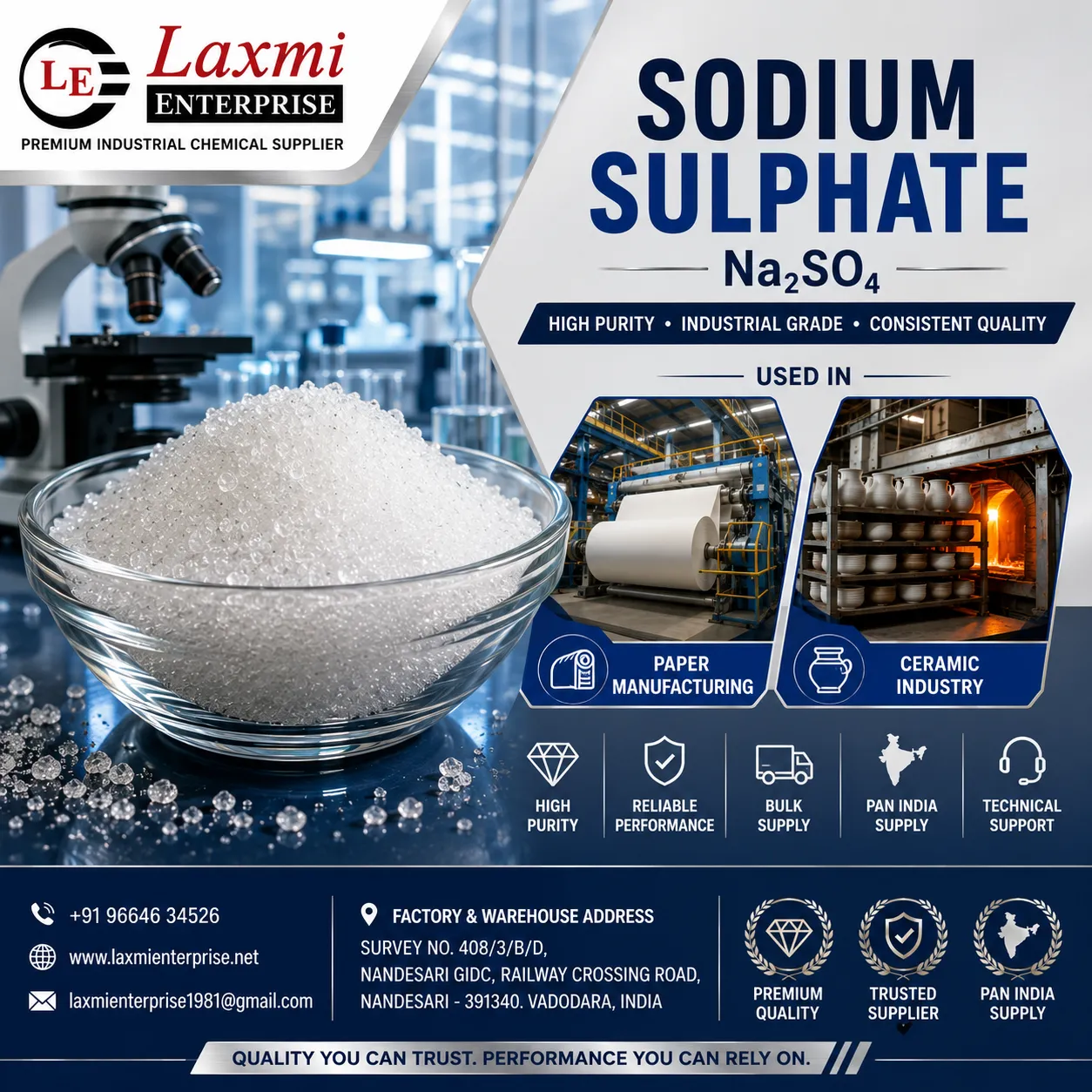
Laxmi Enterprise focuses on supplying sodium sulphate with an emphasis on quality verification, documentation, and dependable industrial service. By understanding the requirements of industries such as detergents, glass, textiles, pulp and paper, ceramics, and chemicals, the company aims to support customers with products that meet agreed technical specifications and are backed by appropriate quality documentation.
Rather than treating sodium sulphate as a generic commodity, the objective is to provide a product that contributes to stable manufacturing operations and long-term customer confidence.
Advanced Frequently Asked Questions
1. Why do experienced buyers compare suppliers using technical parameters instead of price alone?
Technical parameters provide insight into how consistently a product will perform during manufacturing. Stable quality often reduces hidden production costs and improves operational reliability.
2. What is the first document a procurement team should review?
The Technical Data Sheet (TDS) provides an overview of the product's typical characteristics and intended specifications. It should be reviewed alongside the Certificate of Analysis (COA) for the supplied batch.
3. Why is batch traceability important?
Batch traceability enables manufacturers to investigate quality concerns, identify production records, and maintain effective quality management systems.
4. Can two batches from the same supplier differ?
Minor analytical variation can occur within established specifications. Reliable manufacturers control these variations through robust quality systems.
5. How does quality influence production efficiency?
Consistent quality reduces process adjustments, minimizes waste, supports stable production, and helps maintain finished product consistency.
6. Should sodium sulphate always be inspected upon receipt?
Most manufacturers include incoming material inspections as part of their quality management procedures to verify packaging, documentation, identification, and condition before use.
7. What role does the laboratory play after manufacturing?
The laboratory confirms that the finished product complies with agreed specifications before it is approved for shipment.
8. Why do manufacturers request repeat laboratory testing?
Some organizations verify incoming raw materials independently to confirm compliance with their own quality procedures.
9. Can supplier communication affect production performance?
Yes. Clear communication helps resolve technical questions quickly and supports better coordination during purchasing and logistics.
10. Why is documentation important?
Documentation improves traceability, quality assurance, inventory control, regulatory compliance, and customer confidence.
11. How often should suppliers review product specifications?
Specifications should be reviewed whenever customer requirements, manufacturing processes, or quality systems change.
12. What should a Technical Data Sheet include?
A TDS typically describes product characteristics, specifications, physical properties, handling recommendations, and storage guidance.
13. What information is contained in a Certificate of Analysis?
A COA reports the laboratory results for a specific batch, allowing customers to compare analytical values against agreed specifications.
14. Why is supplier consistency more valuable than occasional exceptional quality?
Manufacturing processes rely on predictable raw materials. Consistency reduces production variation and improves long-term operational stability.
15. Can sodium sulphate quality affect customer satisfaction?
Yes. Reliable raw materials contribute to consistent manufacturing, which ultimately supports the quality of finished products delivered to customers.
16. Why do long-term supplier relationships benefit manufacturers?
Long-term partnerships often improve communication, planning, supply reliability, technical understanding, and continuous improvement initiatives.
17. What should companies include in their supplier evaluation checklist?
Quality systems, laboratory capability, technical documentation, manufacturing consistency, packaging standards, logistics performance, customer support, and responsiveness.
18. How can buyers reduce procurement risk?
By combining technical evaluation, documentation review, supplier audits where appropriate, incoming inspections, and ongoing performance monitoring.
19. Why is sodium sulphate considered an essential industrial chemical?
Because of its versatility, stability, and ability to support a wide range of manufacturing processes across multiple industries.
20. What is the most important lesson for industrial buyers?
The right sodium sulphate is not necessarily the least expensive—it is the product that consistently meets technical requirements, supports reliable manufacturing, and is supplied by a partner committed to quality and service.
Key Takeaways
After reading this guide, you should have a clear understanding that sodium sulphate is much more than a simple inorganic salt. Its value lies in the consistency of its quality, the precision of its technical specifications, and its ability to support reliable industrial manufacturing across diverse sectors.
Successful procurement decisions are based on understanding:
The product's chemical and physical properties.
How manufacturing methods influence quality.
Why laboratory testing and documentation are essential.
The specific requirements of different industries.
The importance of supplier consistency and technical support.
The role of proper storage, handling, and logistics in preserving product quality.
By applying these principles, manufacturers can reduce operational risks, improve process stability, and build long-term relationships with dependable suppliers.
Keywords