Sodium Sulphate Technical Specifications, Industrial Standards and Quality Parameters: The Complete Guide for Procurement Teams, QA/QC Professionals and Industrial Buyers
Industrial chemicals are rarely purchased based on appearance alone. In today's manufacturing environment, procurement decisions are increasingly driven by technical specifications, laboratory verification, process compatibility, and long-term product consistency. Sodium sulphate is no exception.
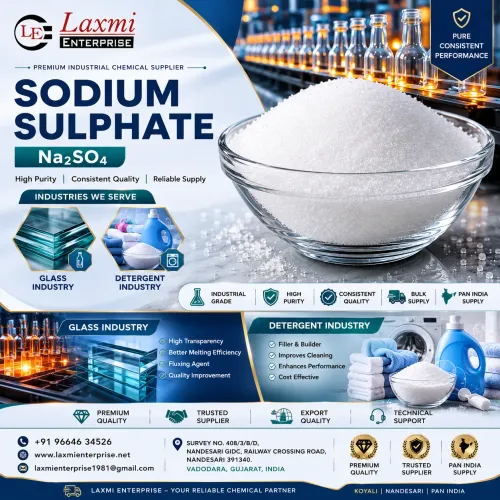
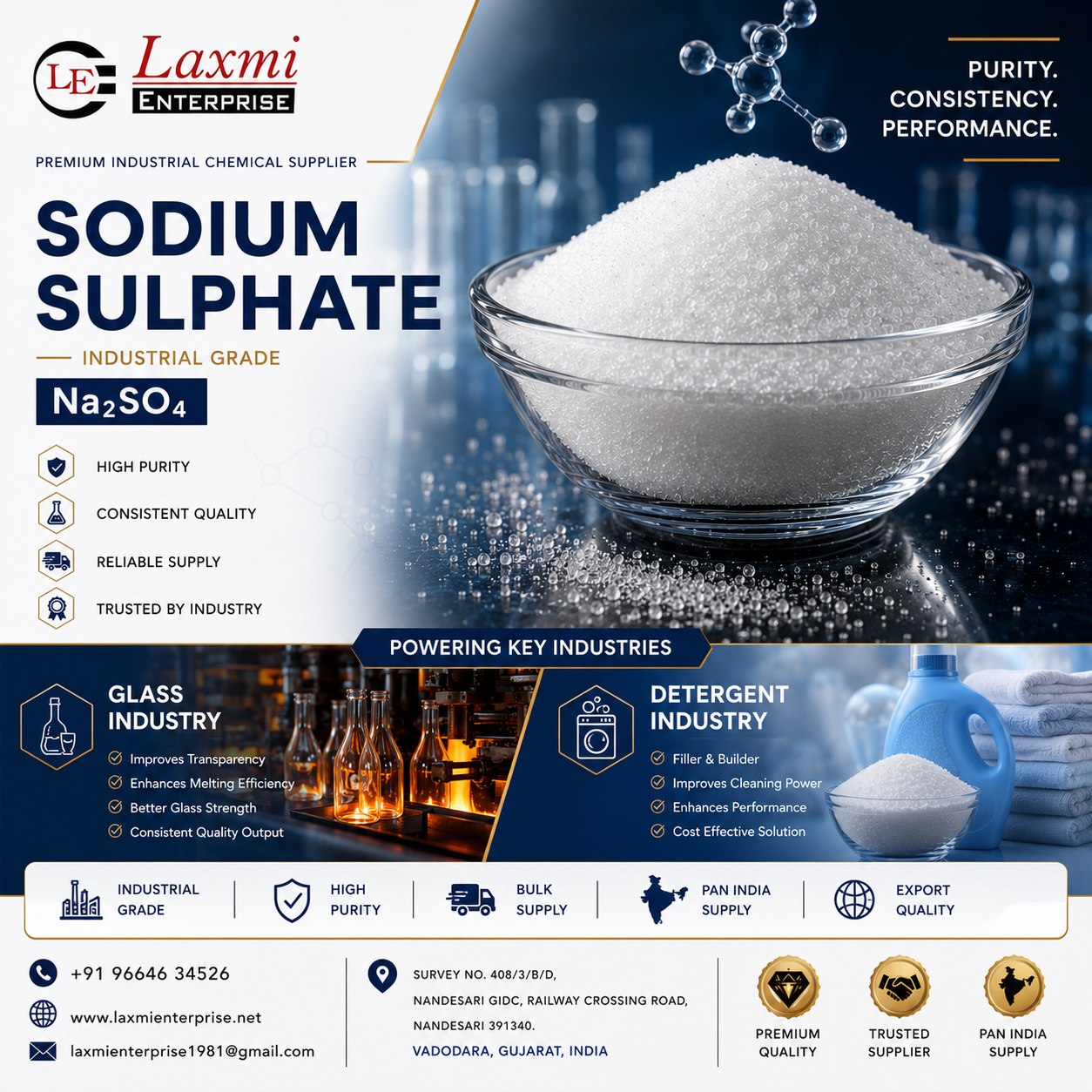
Although sodium sulphate (Na₂SO₄) appears to be a simple white crystalline material, its suitability for industrial applications depends on a combination of chemical, physical, and quality parameters. Manufacturers in industries such as detergents, glass, textiles, pulp and paper, ceramics, and chemicals often establish detailed product specifications before approving a supplier.
A well-prepared technical specification serves as a common language between the manufacturer and the customer. It clearly defines what the supplier will deliver and what the customer expects to receive. This reduces misunderstandings, improves quality consistency, and provides measurable acceptance criteria for every production batch.
For procurement managers, technical specifications help compare suppliers objectively. For production engineers, they provide confidence that the raw material will perform consistently. For quality control laboratories, they establish measurable acceptance limits. For suppliers, they become the benchmark for manufacturing and quality assurance.
This guide explains the complete technical specification of industrial sodium sulphate, the meaning of every major quality parameter, how specifications are interpreted, and why each parameter matters to industrial manufacturing.
Unlike many articles that simply list specification values, this guide explains the practical significance of each parameter and how it influences production performance.
What Is a Technical Specification?
A technical specification is a formal document that describes the required quality characteristics of a product. It defines measurable parameters that determine whether the supplied material is suitable for a particular industrial application.
Think of a technical specification as a contract between the buyer and the supplier. It establishes expectations before production begins and provides objective criteria for evaluating every shipment.
A typical sodium sulphate specification may include:
Chemical purity
Moisture content
Chloride content
Iron content
Water insoluble matter
Particle size distribution
Bulk density
Appearance
Packaging requirements
Storage recommendations
Quality documentation
Each of these parameters contributes to the overall performance of the material in industrial manufacturing.
Why Technical Specifications Matter
Without a technical specification, it becomes difficult to evaluate product quality consistently.
Imagine receiving sodium sulphate from two different suppliers.
Both products look similar.
Both are white.
Both are labelled as sodium sulphate.
Yet one batch performs consistently while the other creates production adjustments.
Why?
The answer often lies in the technical specification.
Small differences in:
Moisture
Particle size
Purity
Chloride
Iron
Packaging quality
may significantly influence manufacturing performance.
A documented specification helps eliminate uncertainty.
Benefits of Technical Specifications
Well-defined specifications help manufacturers:
Improve Production Consistency
Consistent raw materials lead to predictable manufacturing performance.
Reduce Quality Complaints
Products meeting agreed specifications are less likely to create production issues.
Simplify Procurement
Technical specifications allow procurement teams to compare suppliers using objective criteria instead of relying only on commercial quotations.
Improve Laboratory Verification
Quality control laboratories can compare analytical results directly against documented acceptance criteria.
Support Long-Term Supplier Relationships
Clear specifications reduce misunderstandings and improve communication between customers and suppliers.
Who Uses Technical Specifications?
Many departments rely on product specifications.
Procurement Teams
Evaluate suppliers.
Compare quotations.
Approve vendors.
Production Engineers
Confirm product suitability.
Optimize manufacturing.
Reduce process variation.
Quality Control Laboratories
Verify laboratory results.
Approve incoming materials.
Investigate deviations.
Warehouse Teams
Understand storage requirements.
Maintain traceability.
Verify packaging.
Sales Engineers
Recommend suitable grades.
Support customer applications.
Provide technical documentation.
Technical specifications therefore serve the entire manufacturing organization rather than a single department.
Components of a Sodium Sulphate Specification
Although customer requirements differ, most industrial specifications contain similar sections.
Product Identification
This section confirms:
Product name
Chemical formula
Grade
Product description
Correct identification helps avoid purchasing errors.
Chemical Properties
These describe the chemical composition of the product.
Typical parameters include:
Purity
Chloride
Iron
Water insoluble matter
Physical Properties
Physical characteristics influence handling and manufacturing.
Typical properties include:
Particle size
Appearance
Bulk density
Moisture
Packaging Information
Packaging details may specify:
Bag type
Net weight
Labelling
Batch identification
Storage Recommendations
Specifications often include guidance for:
Warehouse conditions
Moisture protection
Handling
Inventory rotation
Documentation
Technical documents may include:
Technical Data Sheet (TDS)
Certificate of Analysis (COA)
Safety Data Sheet (SDS)
Typical Technical Specification Sheet
A professional specification sheet generally contains the following information:
Parameter Purpose
Product Name Identifies the material
Chemical Formula Confirms chemical identity
Appearance Visual quality
Purity Chemical concentration
Moisture Storage and handling
Chloride Impurity control
Iron Product cleanliness
Water Insoluble Matter Contamination level
Particle Size Handling and dissolution
Bulk Density Packaging and dosing
Packaging Transportation and storage
Documentation Quality verification
This format enables procurement teams to compare suppliers using standardized information.
Why Every Parameter Matters
A common mistake is assuming that only purity matters.
In reality, every parameter contributes to product performance.
For example:
A product with excellent purity but excessive moisture may create storage problems.
A product with ideal moisture but inconsistent particle size may perform poorly in automated feeding systems.
A product with acceptable laboratory values but poor packaging may absorb moisture before reaching the customer.
Quality should therefore be evaluated as a complete system rather than focusing on a single characteristic.
Understanding Product Tolerance
No industrial manufacturing process can produce absolutely identical results every time.
For this reason, specifications often define acceptable limits rather than single target values.
The goal is consistency within agreed quality requirements.
Reliable manufacturers maintain tight process control to minimize variation between production batches.
Procurement teams should therefore evaluate long-term consistency instead of focusing on isolated laboratory values.
Frequently Asked Questions
What is a technical specification?
A technical specification is a document describing the required chemical and physical characteristics of sodium sulphate. It provides measurable quality criteria that help manufacturers, laboratories, and procurement teams evaluate the product.
Why are technical specifications important?
Specifications help ensure that sodium sulphate consistently meets manufacturing requirements while reducing quality variation and purchasing uncertainty.
Who prepares technical specifications?
Specifications are typically prepared by manufacturers in consultation with customers, quality departments, and production teams based on application requirements.
Are technical specifications different from a Certificate of Analysis?
Yes.
A specification defines the required quality.
A Certificate of Analysis reports the actual laboratory results for a specific production batch.
Can two suppliers have different specifications?
Yes.
Specifications may differ depending on manufacturing capability, customer requirements, intended application, and quality systems.
Why should procurement teams review specifications before purchasing?
Reviewing specifications helps buyers compare suppliers objectively and determine whether the material meets manufacturing requirements.
Do specifications guarantee product quality?
Specifications establish quality expectations, while laboratory testing verifies whether each production batch complies with those expectations.
Can specifications change over time?
Yes.
Specifications may be updated to reflect new customer requirements, manufacturing improvements, or changes in quality management systems.
Why is documentation included in specifications?
Documentation supports traceability, quality verification, regulatory compliance, and communication between suppliers and customers.
What is the most important part of a specification?
There is no single most important parameter.
Purity, moisture, particle size, chloride, iron, packaging, and documentation all contribute to the product's overall suitability for industrial use.
Industrial chemicals are rarely purchased based on appearance alone. In today's manufacturing environment, procurement decisions are increasingly driven by technical specifications, laboratory verification, process compatibility, and long-term product consistency. Sodium sulphate is no exception.
Although sodium sulphate (Na₂SO₄) appears to be a simple white crystalline material, its suitability for industrial applications depends on a combination of chemical, physical, and quality parameters. Manufacturers in industries such as detergents, glass, textiles, pulp and paper, ceramics, and chemicals often establish detailed product specifications before approving a supplier.
A well-prepared technical specification serves as a common language between the manufacturer and the customer. It clearly defines what the supplier will deliver and what the customer expects to receive. This reduces misunderstandings, improves quality consistency, and provides measurable acceptance criteria for every production batch.
For procurement managers, technical specifications help compare suppliers objectively. For production engineers, they provide confidence that the raw material will perform consistently. For quality control laboratories, they establish measurable acceptance limits. For suppliers, they become the benchmark for manufacturing and quality assurance.
This guide explains the complete technical specification of industrial sodium sulphate, the meaning of every major quality parameter, how specifications are interpreted, and why each parameter matters to industrial manufacturing.
Unlike many articles that simply list specification values, this guide explains the practical significance of each parameter and how it influences production performance.
What Is a Technical Specification?
A technical specification is a formal document that describes the required quality characteristics of a product. It defines measurable parameters that determine whether the supplied material is suitable for a particular industrial application.
Think of a technical specification as a contract between the buyer and the supplier. It establishes expectations before production begins and provides objective criteria for evaluating every shipment.
A typical sodium sulphate specification may include:
Chemical purity
Moisture content
Chloride content
Iron content
Water insoluble matter
Particle size distribution
Bulk density
Appearance
Packaging requirements
Storage recommendations
Quality documentation
Each of these parameters contributes to the overall performance of the material in industrial manufacturing.
Why Technical Specifications Matter
Without a technical specification, it becomes difficult to evaluate product quality consistently.
Imagine receiving sodium sulphate from two different suppliers.
Both products look similar.
Both are white.
Both are labelled as sodium sulphate.
Yet one batch performs consistently while the other creates production adjustments.
Why?
The answer often lies in the technical specification.
Small differences in:
Moisture
Particle size
Purity
Chloride
Iron
Packaging quality
may significantly influence manufacturing performance.
A documented specification helps eliminate uncertainty.
Benefits of Technical Specifications
Well-defined specifications help manufacturers:
Improve Production Consistency
Consistent raw materials lead to predictable manufacturing performance.
Reduce Quality Complaints
Products meeting agreed specifications are less likely to create production issues.
Simplify Procurement
Technical specifications allow procurement teams to compare suppliers using objective criteria instead of relying only on commercial quotations.
Improve Laboratory Verification
Quality control laboratories can compare analytical results directly against documented acceptance criteria.
Support Long-Term Supplier Relationships
Clear specifications reduce misunderstandings and improve communication between customers and suppliers.
Who Uses Technical Specifications?
Many departments rely on product specifications.
Procurement Teams
Evaluate suppliers.
Compare quotations.
Approve vendors.
Production Engineers
Confirm product suitability.
Optimize manufacturing.
Reduce process variation.
Quality Control Laboratories
Verify laboratory results.
Approve incoming materials.
Investigate deviations.
Warehouse Teams
Understand storage requirements.
Maintain traceability.
Verify packaging.
Sales Engineers
Recommend suitable grades.
Support customer applications.
Provide technical documentation.
Technical specifications therefore serve the entire manufacturing organization rather than a single department.
Components of a Sodium Sulphate Specification
Although customer requirements differ, most industrial specifications contain similar sections.
Product Identification
This section confirms:
Product name
Chemical formula
Grade
Product description
Correct identification helps avoid purchasing errors.
Chemical Properties
These describe the chemical composition of the product.
Typical parameters include:
Purity
Chloride
Iron
Water insoluble matter
Physical Properties
Physical characteristics influence handling and manufacturing.
Typical properties include:
Particle size
Appearance
Bulk density
Moisture
Packaging Information
Packaging details may specify:
Bag type
Net weight
Labelling
Batch identification
Storage Recommendations
Specifications often include guidance for:
Warehouse conditions
Moisture protection
Handling
Inventory rotation
Documentation
Technical documents may include:
Technical Data Sheet (TDS)
Certificate of Analysis (COA)
Safety Data Sheet (SDS)
Typical Technical Specification Sheet
A professional specification sheet generally contains the following information:
Parameter Purpose
Product Name Identifies the material
Chemical Formula Confirms chemical identity
Appearance Visual quality
Purity Chemical concentration
Moisture Storage and handling
Chloride Impurity control
Iron Product cleanliness
Water Insoluble Matter Contamination level
Particle Size Handling and dissolution
Bulk Density Packaging and dosing
Packaging Transportation and storage
Documentation Quality verification
This format enables procurement teams to compare suppliers using standardized information.
Why Every Parameter Matters
A common mistake is assuming that only purity matters.
In reality, every parameter contributes to product performance.
For example:
A product with excellent purity but excessive moisture may create storage problems.
A product with ideal moisture but inconsistent particle size may perform poorly in automated feeding systems.
A product with acceptable laboratory values but poor packaging may absorb moisture before reaching the customer.
Quality should therefore be evaluated as a complete system rather than focusing on a single characteristic.
Understanding Product Tolerance
No industrial manufacturing process can produce absolutely identical results every time.
For this reason, specifications often define acceptable limits rather than single target values.
The goal is consistency within agreed quality requirements.
Reliable manufacturers maintain tight process control to minimize variation between production batches.
Procurement teams should therefore evaluate long-term consistency instead of focusing on isolated laboratory values.
Frequently Asked Questions
What is a technical specification?
A technical specification is a document describing the required chemical and physical characteristics of sodium sulphate. It provides measurable quality criteria that help manufacturers, laboratories, and procurement teams evaluate the product.
Why are technical specifications important?
Specifications help ensure that sodium sulphate consistently meets manufacturing requirements while reducing quality variation and purchasing uncertainty.
Who prepares technical specifications?
Specifications are typically prepared by manufacturers in consultation with customers, quality departments, and production teams based on application requirements.
Are technical specifications different from a Certificate of Analysis?
Yes.
A specification defines the required quality.
A Certificate of Analysis reports the actual laboratory results for a specific production batch.
Can two suppliers have different specifications?
Yes.
Specifications may differ depending on manufacturing capability, customer requirements, intended application, and quality systems.
Why should procurement teams review specifications before purchasing?
Reviewing specifications helps buyers compare suppliers objectively and determine whether the material meets manufacturing requirements.
Do specifications guarantee product quality?
Specifications establish quality expectations, while laboratory testing verifies whether each production batch complies with those expectations.
Can specifications change over time?
Yes.
Specifications may be updated to reflect new customer requirements, manufacturing improvements, or changes in quality management systems.
Why is documentation included in specifications?
Documentation supports traceability, quality verification, regulatory compliance, and communication between suppliers and customers.
What is the most important part of a specification?
There is no single most important parameter.
Purity, moisture, particle size, chloride, iron, packaging, and documentation all contribute to the product's overall suitability for industrial use.
Keywords