
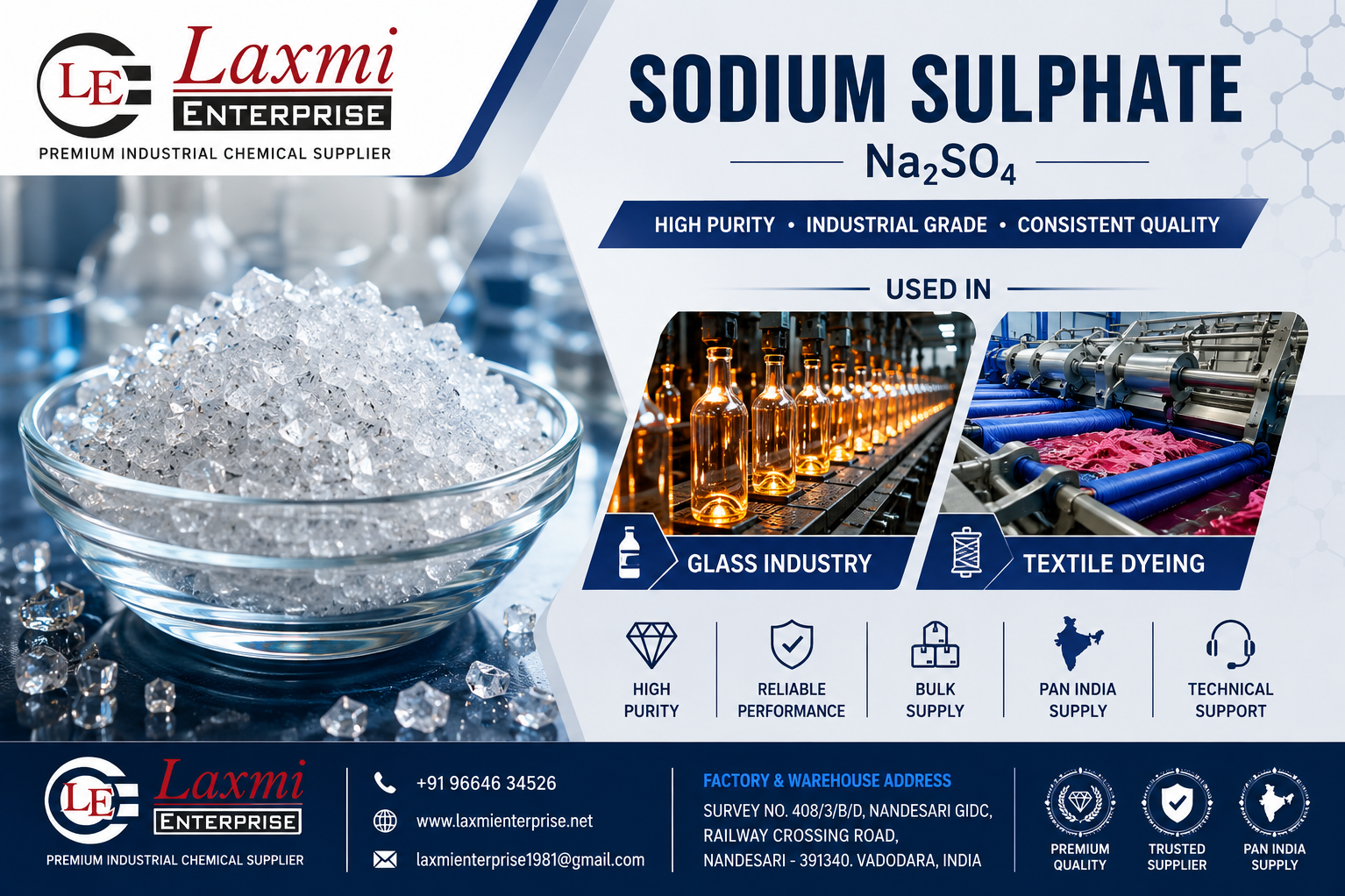
What Is Sodium Sulphate? The Complete Industrial Guide for Manufacturers, Procurement Teams, Engineers, and Industrial Buyers
Every day, millions of products are manufactured using industrial chemicals that most people never notice. From the detergent used to wash clothes and the glass in automobile windshields to textiles, paper, ceramics, and specialty chemicals, many manufacturing processes rely on one essential inorganic compound—sodium sulphate (Na₂SO₄).
Although sodium sulphate is often viewed as a simple white crystalline salt, its industrial importance extends far beyond its appearance. It plays a vital role in improving manufacturing efficiency, controlling chemical processes, maintaining product consistency, and optimizing production costs across a wide range of industries.
For manufacturers, sodium sulphate is more than just a raw material. It is a process chemical whose quality directly influences production performance. Factors such as purity, moisture content, particle size, chloride levels, iron content, and bulk density can affect manufacturing efficiency, product quality, and equipment performance. Because of this, procurement teams, production engineers, quality assurance professionals, and laboratory personnel evaluate sodium sulphate based on technical specifications rather than price alone.
As industrial quality standards continue to evolve, organizations are placing greater emphasis on supplier reliability, laboratory-tested quality, and consistent product performance. Buyers increasingly expect comprehensive technical documentation, Certificates of Analysis (COAs), product specifications, and dependable supply chains before approving a supplier.
This guide has been created to serve as a comprehensive technical reference for anyone involved in the industrial use, purchase, testing, or specification of sodium sulphate. Whether you are new to the product or have years of experience in chemical procurement, this article provides a structured understanding of sodium sulphate from both technical and commercial perspectives.
Throughout this guide, you will learn:
What sodium sulphate is and why it is important
Its chemical identity and physical characteristics
How it became an essential industrial chemical
Why different industries depend on it
How quality influences manufacturing performance
What procurement teams should understand before purchasing
Answers to the most frequently asked questions about sodium sulphate
Rather than presenting isolated facts, this guide explains why each property matters, how it affects industrial operations, and what buyers should consider when evaluating sodium sulphate for their manufacturing processes.
What Is Sodium Sulphate?
Sodium sulphate is an inorganic chemical compound composed of sodium, sulfur, and oxygen. Its chemical formula is Na₂SO₄, representing two sodium atoms, one sulfur atom, and four oxygen atoms. Under normal industrial conditions, it appears as a white crystalline solid with excellent chemical stability.
One of the reasons sodium sulphate is widely used in industry is that it is chemically stable under ordinary storage and handling conditions. It does not burn, is non-explosive, and remains compatible with many industrial formulations. When produced under controlled manufacturing conditions, sodium sulphate offers consistent quality that supports efficient production across numerous industries.
The compound is available in different forms, including anhydrous sodium sulphate and hydrated sodium sulphate. The anhydrous form is the most common choice for industrial applications because it offers better handling characteristics, easier storage, and suitability for a wide range of manufacturing processes.
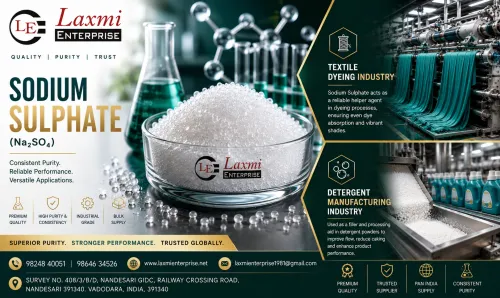
Industrially, sodium sulphate serves different purposes depending on the application. In detergent manufacturing, it acts as a processing aid and filler. In glass production, it contributes to refining the glass melt. In textile processing, it assists dyeing operations by promoting more uniform dye uptake. It also has established uses in pulp and paper processing, ceramics, chemical manufacturing, and other industrial sectors.
Its broad applicability stems from a combination of desirable properties:
Good water solubility
Stable chemical behavior
Consistent crystalline structure
Ease of storage and handling
Cost-effective performance
Compatibility with many manufacturing processes
Because sodium sulphate is used in such diverse industries, there is no single 'ideal' specification. Different applications require different quality characteristics, making laboratory testing and technical specifications essential parts of supplier evaluation.
Understanding the Chemical Identity of Sodium Sulphate
Every industrial chemical has a unique identity that allows manufacturers, laboratories, and procurement teams to communicate accurately. For sodium sulphate, understanding this identity helps avoid confusion with other sodium-based compounds such as sodium sulphite, sodium bisulphate, sodium carbonate, or sodium nitrate.
Basic Chemical Information
Property Details
Chemical Name Sodium Sulphate
Chemical Formula Na₂SO₄
Chemical Family Inorganic Salt
Appearance White crystalline solid
Odor Odorless
Solubility Soluble in water
Nature Neutral inorganic salt
Industrial Form Usually supplied as anhydrous crystals or powder
Although these details may appear straightforward, they are critical during procurement, laboratory testing, documentation, and international trade. Using the correct chemical identity ensures that the right product is specified, purchased, and tested.
For example, confusing sodium sulphate with sodium sulphite could result in significant process issues because the two chemicals have different chemical behaviors and industrial applications.
Why Is Sodium Sulphate So Important?
Many industrial chemicals are designed to perform a single specialized function. Sodium sulphate is different because it contributes to manufacturing in several ways depending on the industry.
Rather than reacting aggressively with other chemicals, sodium sulphate often improves process stability, supports manufacturing efficiency, or enhances physical processing characteristics.
Its importance can be understood through several practical examples:
In detergent manufacturing, sodium sulphate helps achieve consistent product formulation and improves processing efficiency during powder production.
In glass manufacturing, it assists in refining molten glass by helping remove unwanted gas bubbles, contributing to better product quality.
In textile dyeing, sodium sulphate supports uniform dye penetration, leading to more consistent coloration across fabrics.
In pulp and paper processing, it contributes to chemical recovery systems and supports efficient production.
Because of these varied applications, sodium sulphate has become one of the most widely consumed inorganic industrial salts worldwide.
A Brief History of Sodium Sulphate
The industrial story of sodium sulphate extends back several centuries. Naturally occurring deposits of sodium sulphate minerals were recognized long before the development of modern chemical manufacturing. Early civilizations observed these mineral salts in lakes and evaporative deposits, although their industrial value was not fully understood.
As chemical science advanced during the eighteenth and nineteenth centuries, sodium sulphate gained commercial importance. The expansion of the textile industry, followed by rapid growth in glass manufacturing and detergent production, created increasing demand for reliable sources of high-quality sodium sulphate.
The twentieth century marked a major turning point. Improvements in chemical manufacturing enabled producers to recover sodium sulphate from industrial processes and to manufacture it more consistently at commercial scale. Better purification methods, improved drying technology, and laboratory quality control significantly enhanced product consistency.
Today, sodium sulphate is produced through both natural and synthetic routes, supported by advanced analytical laboratories, automated process control, and rigorous quality assurance systems.
The evolution of sodium sulphate mirrors the evolution of modern manufacturing itself—from naturally occurring mineral deposits to precisely controlled industrial production capable of supplying diverse industries around the world.
Why Every Industrial Buyer Should Understand Sodium Sulphate
For procurement professionals, sodium sulphate should never be viewed as a generic commodity. Even products that share the same chemical formula can differ in terms of purity, particle size, moisture content, impurity levels, packaging quality, and manufacturing consistency.
Selecting the right sodium sulphate involves understanding:
The intended industrial application
Required technical specifications
Quality documentation
Laboratory testing methods
Supplier reliability
Storage and logistics considerations
Batch consistency
Long-term supply capability
A knowledgeable buyer evaluates the complete technical profile rather than relying solely on price comparisons. This approach helps reduce production risks, minimize quality-related issues, and establish dependable long-term supply relationships.
FAQ:
1. What is sodium sulphate?
Sodium sulphate is an inorganic salt with the chemical formula Na₂SO₄. It is widely used in industries such as detergents, glass, textiles, pulp and paper, ceramics, and chemical manufacturing because of its stability, water solubility, and consistent industrial performance.
2. Is sodium sulphate a natural or synthetic chemical?
It can be both. Sodium sulphate occurs naturally in mineral deposits and salt lakes, and it is also produced or recovered through various industrial manufacturing processes. The source depends on the producer and the intended application.
3. Why is sodium sulphate used in so many industries?
Its combination of chemical stability, compatibility with numerous manufacturing processes, cost-effectiveness, and reliable performance makes it suitable for a broad range of industrial applications.
4. Is sodium sulphate considered a hazardous chemical?
Under normal industrial handling conditions, sodium sulphate is generally regarded as a stable inorganic chemical. However, it should always be handled according to the applicable Safety Data Sheet (SDS) and workplace safety procedures.
5. What is the difference between sodium sulphate and sodium sulphite?
Although their names are similar, they are different chemical compounds with different chemical properties and industrial uses. Substituting one for the other can lead to process failures or quality issues.
6. Why is sodium sulphate important to procurement teams?
Procurement teams use sodium sulphate in many manufacturing sectors where consistent quality is essential. Understanding specifications, laboratory reports, and supplier capabilities helps ensure reliable production and reduces operational risks.