Why Is Crystallization Important in Sodium Acetate Manufacturing?
Crystallization is one of the most important stages in Sodium Acetate manufacturing because it transforms the dissolved product into a controlled solid form with the desired crystal characteristics. Proper crystallization influences product purity, crystal size, moisture content, handling properties, storage stability, and overall manufacturing consistency.
Although the neutralization reaction produces Sodium Acetate in solution, commercial products supplied to industries are generally obtained after carefully controlled downstream processing. The quality of these downstream operations often determines how consistently the product performs in customer applications.
What Is Crystallization?
Crystallization is the controlled formation of solid crystals from a liquid solution.
In industrial chemical manufacturing, crystallization serves several purposes:
Recover the desired product from solution.
Improve product purity by separating the crystalline phase from dissolved impurities.
Produce a consistent crystal structure.
Prepare the product for downstream drying and packaging.
For Sodium Acetate, manufacturers carefully manage crystallization conditions to achieve reproducible product quality.
Objectives of Crystallization
Objective Manufacturing Benefit Customer Benefit
Product Recovery Efficient separation from solution Reliable product availability
Crystal Formation Uniform crystal development Consistent handling characteristics
Purity Improvement Reduced carryover of impurities Stable manufacturing performance
Moisture Management Easier downstream drying Better storage stability
Batch Consistency Repeatable production Predictable industrial performance
Engineering Insight
Crystallization is not simply a cooling step. It is a carefully controlled process that influences crystal shape, size distribution, filtration behavior, drying efficiency, and the overall quality of the finished product. Even when two manufacturers use the same reaction chemistry, differences in crystallization practices can result in products with different physical characteristics.
How Do Crystals Form?
As the Sodium Acetate solution reaches suitable process conditions, dissolved material begins to arrange itself into an ordered crystalline structure.
Crystal formation generally progresses through three stages:
Development of favorable solution conditions.
Formation of initial crystal nuclei.
Controlled crystal growth.
Manufacturers aim to encourage steady and uniform crystal growth because it supports consistent downstream processing.
Factors Influencing Crystal Quality
Several process variables influence the characteristics of Sodium Acetate crystals.
Process Variable Influence on Crystallization Operational Importance
Solution Concentration Determines crystal formation conditions Supports efficient product recovery
Temperature Profile Influences crystal growth behavior Helps achieve consistent crystal quality
Cooling Rate Affects crystal size distribution Important for filtration and handling
Mixing Conditions Promotes uniform crystal development Improves batch consistency
Residence Time Allows controlled crystal growth Supports reproducible production
Product Purity Influences crystal appearance and quality Supports customer specifications
Laboratory Insight
Many manufacturing facilities perform laboratory crystallization studies before implementing process improvements on a production scale. Small-scale trials help evaluate process changes while minimizing manufacturing risk.
Production of Sodium Acetate Trihydrate
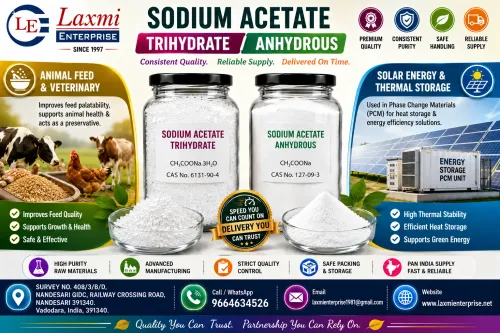
Sodium Acetate Trihydrate contains three molecules of water of crystallization within its crystal structure.
During commercial production, manufacturers establish process conditions that favor the formation of the trihydrate crystal form.
Typical production stages include:
Controlled reaction
Solution clarification (where required)
Concentration
Controlled crystallization
Crystal separation
Quality verification
Packaging
Maintaining stable operating conditions helps ensure reproducible crystal formation.
Production of Sodium Acetate Anhydrous
The manufacture of Sodium Acetate Anhydrous involves additional processing designed to obtain the anhydrous form of the product.
Depending on the production technology, manufacturers may employ controlled drying or other suitable processing methods after crystallization.
The specific sequence depends on:
Plant design
Product specification
Manufacturing technology
Customer requirements
Quality objectives
Because these methods are proprietary, exact process details vary among manufacturers.
Manufacturing Insight
The primary difference between Sodium Acetate Trihydrate and Sodium Acetate Anhydrous lies not in the initial reaction but in the downstream processing and the resulting crystal form. Careful control of these stages allows manufacturers to produce products suited to different industrial applications.
Solid–Liquid Separation
After crystallization, the solid product is separated from the remaining process liquid.
The objectives of this stage include:
Recovering product crystals.
Reducing residual liquid.
Preparing the material for drying or packaging.
Supporting product purity.
Efficient separation contributes to improved downstream processing and overall manufacturing efficiency.
Benefits of Effective Solid–Liquid Separation
Benefit Manufacturing Impact
Improved Product Recovery Higher production efficiency
Reduced Residual Liquid Better drying performance
Cleaner Crystal Surface Improved product quality
Better Moisture Control Enhanced storage stability
Consistent Feed to Drying Stable downstream operation
Drying Technology
Drying is particularly important for products requiring controlled moisture characteristics.
The objectives of drying include:
Achieving the required product specification.
Improving storage stability.
Enhancing free-flowing characteristics.
Preparing the material for packaging.
Manufacturers select drying conditions according to product requirements and process design.
Why Drying Matters
Improper drying may influence:
Product flowability
Packaging performance
Warehouse stability
Customer handling
Product appearance
Controlled drying therefore contributes directly to commercial product quality.
Engineering Insight
Drying should remove only the amount of moisture required by the product specification. Excessive drying may unnecessarily increase production costs, while inadequate drying may affect storage stability and handling characteristics.
Particle Size Management
Particle characteristics are important because they influence:
Mixing behavior
Solution preparation
Material flow
Packaging efficiency
Dust generation
Automated feeding systems
Manufacturers monitor particle characteristics to meet customer specifications.
Milling and Screening
After drying, the product may undergo milling and screening, depending on the desired commercial specification.
Typical objectives include:
Achieving uniform particle distribution.
Removing oversized material.
Improving packaging consistency.
Supporting downstream handling.
The exact process depends on customer requirements and intended applications.
Particle Engineering Objectives
Objective Customer Advantage
Uniform Particle Distribution Improved process consistency
Better Flow Characteristics Easier handling
Controlled Dust Generation Cleaner working environment
Consistent Packaging Improved inventory management
Reliable Dissolution Behavior Better manufacturing performance
Moisture Management
Moisture management continues after production.
Manufacturers protect product quality by:
Using moisture-resistant packaging.
Maintaining dry warehouse conditions.
Monitoring storage environments.
Implementing inventory rotation practices.
These measures help preserve product quality throughout transportation and storage.
Packaging After Production
Once laboratory approval has been completed, Sodium Acetate is packaged according to customer requirements.
Common industrial packaging includes:
Packaging Type Typical Application
25 kg HDPE Bag with Inner Liner Industrial supply
25 kg Woven PP Bag with Inner Liner Bulk manufacturing
Jumbo Bag (FIBC) High-volume industrial users
Customized Packaging Export and OEM requirements
Proper packaging protects the product from moisture, contamination, and mechanical damage during storage and transportation.
Industrial Case Study
A manufacturer supplying textile mills in Surat, Tiruppur, Ahmedabad, and Ludhiana observed customer feedback related to inconsistent product flow during automated dosing.
A technical investigation identified variations in particle size distribution between production batches.
The manufacturer implemented:
Enhanced screening procedures.
Additional particle size monitoring.
Improved process documentation.
Revised packaging controls.
Results:
More consistent material flow.
Reduced handling issues.
Improved customer satisfaction.
Better batch-to-batch reproducibility.
Lower production complaints.
The project demonstrated that downstream processing can significantly influence customer experience even when the underlying chemical composition remains unchanged.
Frequently Asked Questions (FAQ)
1. Why is crystallization important?
Crystallization converts the dissolved Sodium Acetate into a controlled crystalline product, influencing purity, particle characteristics, handling, and overall product quality.
2. Is the crystallization process the same for every manufacturer?
No. Manufacturers use different equipment, operating procedures, and process technologies depending on production capacity, product grade, and proprietary manufacturing practices.
3. Why is drying necessary?
Drying helps achieve the required moisture characteristics, improves storage stability, and supports efficient handling and packaging.
4. Why are particle characteristics important?
Particle size and distribution influence dissolution, material flow, automated dosing, packaging efficiency, and overall manufacturing performance.
5. Can packaging influence product quality?
Yes. Moisture-resistant packaging helps maintain product stability during storage and transportation, reducing the risk of quality deterioration.
6. Why do manufacturers monitor downstream processing?
Downstream operations such as crystallization, drying, screening, and packaging directly influence the physical properties that customers experience during handling and production.
Key Takeaways
The downstream stages of Sodium Acetate manufacturing are just as important as the initial chemical reaction. Controlled crystallization, efficient solid–liquid separation, appropriate drying, particle size management, and protective packaging all contribute to consistent product quality and reliable industrial performance. Manufacturers that optimize these operations are better equipped to supply Sodium Acetate that meets the expectations of industries ranging from textiles and pharmaceuticals to laboratories and chemical manufacturing.
Crystallization is one of the most important stages in Sodium Acetate manufacturing because it transforms the dissolved product into a controlled solid form with the desired crystal characteristics. Proper crystallization influences product purity, crystal size, moisture content, handling properties, storage stability, and overall manufacturing consistency.
Although the neutralization reaction produces Sodium Acetate in solution, commercial products supplied to industries are generally obtained after carefully controlled downstream processing. The quality of these downstream operations often determines how consistently the product performs in customer applications.
What Is Crystallization?
Crystallization is the controlled formation of solid crystals from a liquid solution.
In industrial chemical manufacturing, crystallization serves several purposes:
Recover the desired product from solution.
Improve product purity by separating the crystalline phase from dissolved impurities.
Produce a consistent crystal structure.
Prepare the product for downstream drying and packaging.
For Sodium Acetate, manufacturers carefully manage crystallization conditions to achieve reproducible product quality.
Objectives of Crystallization
Objective Manufacturing Benefit Customer Benefit
Product Recovery Efficient separation from solution Reliable product availability
Crystal Formation Uniform crystal development Consistent handling characteristics
Purity Improvement Reduced carryover of impurities Stable manufacturing performance
Moisture Management Easier downstream drying Better storage stability
Batch Consistency Repeatable production Predictable industrial performance
Engineering Insight
Crystallization is not simply a cooling step. It is a carefully controlled process that influences crystal shape, size distribution, filtration behavior, drying efficiency, and the overall quality of the finished product. Even when two manufacturers use the same reaction chemistry, differences in crystallization practices can result in products with different physical characteristics.
How Do Crystals Form?
As the Sodium Acetate solution reaches suitable process conditions, dissolved material begins to arrange itself into an ordered crystalline structure.
Crystal formation generally progresses through three stages:
Development of favorable solution conditions.
Formation of initial crystal nuclei.
Controlled crystal growth.
Manufacturers aim to encourage steady and uniform crystal growth because it supports consistent downstream processing.
Factors Influencing Crystal Quality
Several process variables influence the characteristics of Sodium Acetate crystals.
Process Variable Influence on Crystallization Operational Importance
Solution Concentration Determines crystal formation conditions Supports efficient product recovery
Temperature Profile Influences crystal growth behavior Helps achieve consistent crystal quality
Cooling Rate Affects crystal size distribution Important for filtration and handling
Mixing Conditions Promotes uniform crystal development Improves batch consistency
Residence Time Allows controlled crystal growth Supports reproducible production
Product Purity Influences crystal appearance and quality Supports customer specifications
Laboratory Insight
Many manufacturing facilities perform laboratory crystallization studies before implementing process improvements on a production scale. Small-scale trials help evaluate process changes while minimizing manufacturing risk.
Production of Sodium Acetate Trihydrate
Sodium Acetate Trihydrate contains three molecules of water of crystallization within its crystal structure.
During commercial production, manufacturers establish process conditions that favor the formation of the trihydrate crystal form.
Typical production stages include:
Controlled reaction
Solution clarification (where required)
Concentration
Controlled crystallization
Crystal separation
Quality verification
Packaging
Maintaining stable operating conditions helps ensure reproducible crystal formation.
Production of Sodium Acetate Anhydrous
The manufacture of Sodium Acetate Anhydrous involves additional processing designed to obtain the anhydrous form of the product.
Depending on the production technology, manufacturers may employ controlled drying or other suitable processing methods after crystallization.
The specific sequence depends on:
Plant design
Product specification
Manufacturing technology
Customer requirements
Quality objectives
Because these methods are proprietary, exact process details vary among manufacturers.
Manufacturing Insight
The primary difference between Sodium Acetate Trihydrate and Sodium Acetate Anhydrous lies not in the initial reaction but in the downstream processing and the resulting crystal form. Careful control of these stages allows manufacturers to produce products suited to different industrial applications.
Solid–Liquid Separation
After crystallization, the solid product is separated from the remaining process liquid.
The objectives of this stage include:
Recovering product crystals.
Reducing residual liquid.
Preparing the material for drying or packaging.
Supporting product purity.
Efficient separation contributes to improved downstream processing and overall manufacturing efficiency.
Benefits of Effective Solid–Liquid Separation
Benefit Manufacturing Impact
Improved Product Recovery Higher production efficiency
Reduced Residual Liquid Better drying performance
Cleaner Crystal Surface Improved product quality
Better Moisture Control Enhanced storage stability
Consistent Feed to Drying Stable downstream operation
Drying Technology
Drying is particularly important for products requiring controlled moisture characteristics.
The objectives of drying include:
Achieving the required product specification.
Improving storage stability.
Enhancing free-flowing characteristics.
Preparing the material for packaging.
Manufacturers select drying conditions according to product requirements and process design.
Why Drying Matters
Improper drying may influence:
Product flowability
Packaging performance
Warehouse stability
Customer handling
Product appearance
Controlled drying therefore contributes directly to commercial product quality.
Engineering Insight
Drying should remove only the amount of moisture required by the product specification. Excessive drying may unnecessarily increase production costs, while inadequate drying may affect storage stability and handling characteristics.
Particle Size Management
Particle characteristics are important because they influence:
Mixing behavior
Solution preparation
Material flow
Packaging efficiency
Dust generation
Automated feeding systems
Manufacturers monitor particle characteristics to meet customer specifications.
Milling and Screening
After drying, the product may undergo milling and screening, depending on the desired commercial specification.
Typical objectives include:
Achieving uniform particle distribution.
Removing oversized material.
Improving packaging consistency.
Supporting downstream handling.
The exact process depends on customer requirements and intended applications.
Particle Engineering Objectives
Objective Customer Advantage
Uniform Particle Distribution Improved process consistency
Better Flow Characteristics Easier handling
Controlled Dust Generation Cleaner working environment
Consistent Packaging Improved inventory management
Reliable Dissolution Behavior Better manufacturing performance
Moisture Management
Moisture management continues after production.
Manufacturers protect product quality by:
Using moisture-resistant packaging.
Maintaining dry warehouse conditions.
Monitoring storage environments.
Implementing inventory rotation practices.
These measures help preserve product quality throughout transportation and storage.
Packaging After Production
Once laboratory approval has been completed, Sodium Acetate is packaged according to customer requirements.
Common industrial packaging includes:
Packaging Type Typical Application
25 kg HDPE Bag with Inner Liner Industrial supply
25 kg Woven PP Bag with Inner Liner Bulk manufacturing
Jumbo Bag (FIBC) High-volume industrial users
Customized Packaging Export and OEM requirements
Proper packaging protects the product from moisture, contamination, and mechanical damage during storage and transportation.
Industrial Case Study
A manufacturer supplying textile mills in Surat, Tiruppur, Ahmedabad, and Ludhiana observed customer feedback related to inconsistent product flow during automated dosing.
A technical investigation identified variations in particle size distribution between production batches.
The manufacturer implemented:
Enhanced screening procedures.
Additional particle size monitoring.
Improved process documentation.
Revised packaging controls.
Results:
More consistent material flow.
Reduced handling issues.
Improved customer satisfaction.
Better batch-to-batch reproducibility.
Lower production complaints.
The project demonstrated that downstream processing can significantly influence customer experience even when the underlying chemical composition remains unchanged.
Frequently Asked Questions (FAQ)
1. Why is crystallization important?
Crystallization converts the dissolved Sodium Acetate into a controlled crystalline product, influencing purity, particle characteristics, handling, and overall product quality.
2. Is the crystallization process the same for every manufacturer?
No. Manufacturers use different equipment, operating procedures, and process technologies depending on production capacity, product grade, and proprietary manufacturing practices.
3. Why is drying necessary?
Drying helps achieve the required moisture characteristics, improves storage stability, and supports efficient handling and packaging.
4. Why are particle characteristics important?
Particle size and distribution influence dissolution, material flow, automated dosing, packaging efficiency, and overall manufacturing performance.
5. Can packaging influence product quality?
Yes. Moisture-resistant packaging helps maintain product stability during storage and transportation, reducing the risk of quality deterioration.
6. Why do manufacturers monitor downstream processing?
Downstream operations such as crystallization, drying, screening, and packaging directly influence the physical properties that customers experience during handling and production.
Key Takeaways
The downstream stages of Sodium Acetate manufacturing are just as important as the initial chemical reaction. Controlled crystallization, efficient solid–liquid separation, appropriate drying, particle size management, and protective packaging all contribute to consistent product quality and reliable industrial performance. Manufacturers that optimize these operations are better equipped to supply Sodium Acetate that meets the expectations of industries ranging from textiles and pharmaceuticals to laboratories and chemical manufacturing.
Keywords