Sodium Sulphate in Paper & Pulp Manufacturing
Technical Product Identity
Property Value
Product Name Sodium Sulphate
Chemical Formula Na₂SO₄
CAS Number 7757-82-6
HSN Code (India) 2833 11 00
Molecular Weight 142.04 g/mol
EINECS Number 231-820-9
Appearance White Crystalline Powder
Primary Application Kraft Pulp Chemical Recovery
Quick Answer
In kraft pulp mills, Sodium Sulphate (CAS No. 7757-82-6, HSN 2833 11 00) functions as a makeup chemical for the chemical recovery cycle. After entering the recovery boiler, it is reduced to sodium sulfide, helping regenerate the white liquor used for wood digestion. Consistent quality, reliable documentation, and stable supply are important for maintaining recovery efficiency and continuous mill operation.
Understanding White Liquor
White liquor is the primary cooking liquor used in kraft pulping.
Its principal active chemicals are:
Sodium Hydroxide (NaOH)
Sodium Sulfide (Na₂S)
These chemicals dissolve lignin while preserving cellulose fibres.
Maintaining the correct composition of white liquor is essential for:
Stable cooking conditions.
Efficient delignification.
Fibre quality.
Chemical recovery performance.
What Is Black Liquor?
After digestion, the spent cooking liquor becomes black liquor.
It contains:
Dissolved lignin.
Organic compounds from wood.
Spent inorganic chemicals.
Sodium salts.
Water.
Instead of being discarded, black liquor is concentrated and processed through the recovery system, allowing chemicals and energy to be recovered.
Recovery Boiler Fundamentals
Quick Answer
The recovery boiler is one of the most important units in a kraft mill. It burns concentrated black liquor to recover energy while converting Sodium Sulphate into sodium sulfide, which is required for regenerating white liquor.
The recovery boiler performs two key functions:
Energy Recovery – Heat generated from burning organic material is used to produce steam for mill operations.
Chemical Recovery – Inorganic chemicals are recovered and recycled, reducing the need for fresh chemicals.
This integrated process contributes to the efficiency and sustainability of kraft pulping.
Green Liquor and Causticizing
After the recovery boiler, the molten inorganic chemicals are dissolved to form green liquor.
Green liquor then undergoes causticizing, where its composition is adjusted to regenerate white liquor for reuse in the digester.
The cycle can be summarized as:
Wood Chips
↓
Digestion
↓
Black Liquor
↓
Evaporation
↓
Recovery Boiler
↓
Green Liquor
↓
Causticizing
↓
White Liquor
↓
Digester
This closed-loop system is one of the defining characteristics of the kraft process.
Why Consistent Sodium Sulphate Quality Matters
Quick Answer
Variations in Sodium Sulphate quality can influence handling, storage, and the chemical recovery system. Procurement teams therefore focus on batch consistency, documentation, and specification compliance rather than relying solely on purchase price.
Commonly reviewed quality parameters include:
Purity.
Moisture.
Water-insoluble matter.
Particle size.
Appearance.
Batch-to-batch consistency.
Incoming inspection helps confirm that supplied material meets agreed specifications.
Laboratory Quality Control
Paper mills often verify incoming material through laboratory testing.
Typical checks include:
Test Purpose
Appearance Visual quality assessment
Purity Specification verification
Moisture Storage and handling suitability
Water-Insoluble Matter Clean processing
Particle Size Handling characteristics
Bulk Density Storage and conveying
Test frequency depends on supplier qualification and the mill's internal quality procedures.
Incoming Material Inspection
Before approving a shipment, mills may verify:
Product identity.
CAS Number: 7757-82-6.
HSN Code: 2833 11 00 (commercial documentation).
Batch number.
COA.
Packaging condition.
Quantity received.
Labelling.
Storage condition during transport.
Maintaining traceable records supports quality management and audit readiness.
Procurement Considerations
A successful procurement program evaluates:
Product
Correct specification.
Batch consistency.
Reliable quality documentation.
Supplier
Technical capability.
Inventory planning.
Customer support.
Quality systems.
Logistics
Delivery reliability.
Packaging options.
Transit protection.
Lead time.
These factors help mills reduce supply risks and maintain continuous production.
Pan-India Supply for Paper Mills
Major kraft paper and pulp manufacturing facilities are located across:
Gujarat
Maharashtra
Uttar Pradesh
Punjab
Haryana
Tamil Nadu
Karnataka
Telangana
Andhra Pradesh
West Bengal
Odisha
Chhattisgarh
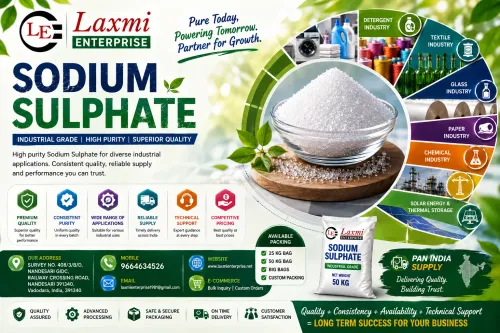
Laxmi Enterprise, located in Nandesari GIDC, Vadodara, Gujarat, supplies industrial-grade Sodium Sulphate (CAS 7757-82-6, HSN 2833 11 00) to customers across Pan India, providing technical documentation, flexible packaging, and dependable logistics for industrial procurement.
Key Takeaways
Sodium Sulphate is an important makeup chemical in the kraft chemical recovery cycle.
Recovery systems regenerate chemicals, improving resource efficiency and reducing fresh chemical consumption.
Procurement decisions should consider product quality, documentation, supplier capability, and logistics together.
Technical documentation—including COA, TDS, and SDS/MSDS—supports traceability and quality assurance.
Consistent supply is essential for continuous mill operations.
Keywords