How Sodium Acetate (Anhydrous & Trihydrate) Is Manufactured
Complete Industrial Manufacturing Process, Reaction Chemistry,
Raw Materials, Quality Control, Process Technology, Plant Operations, CAS Number, HSN Code & Industrial Applications (2026)
Description
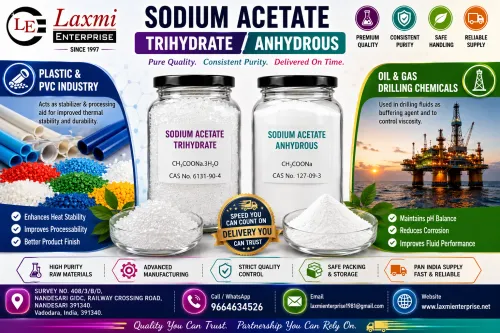
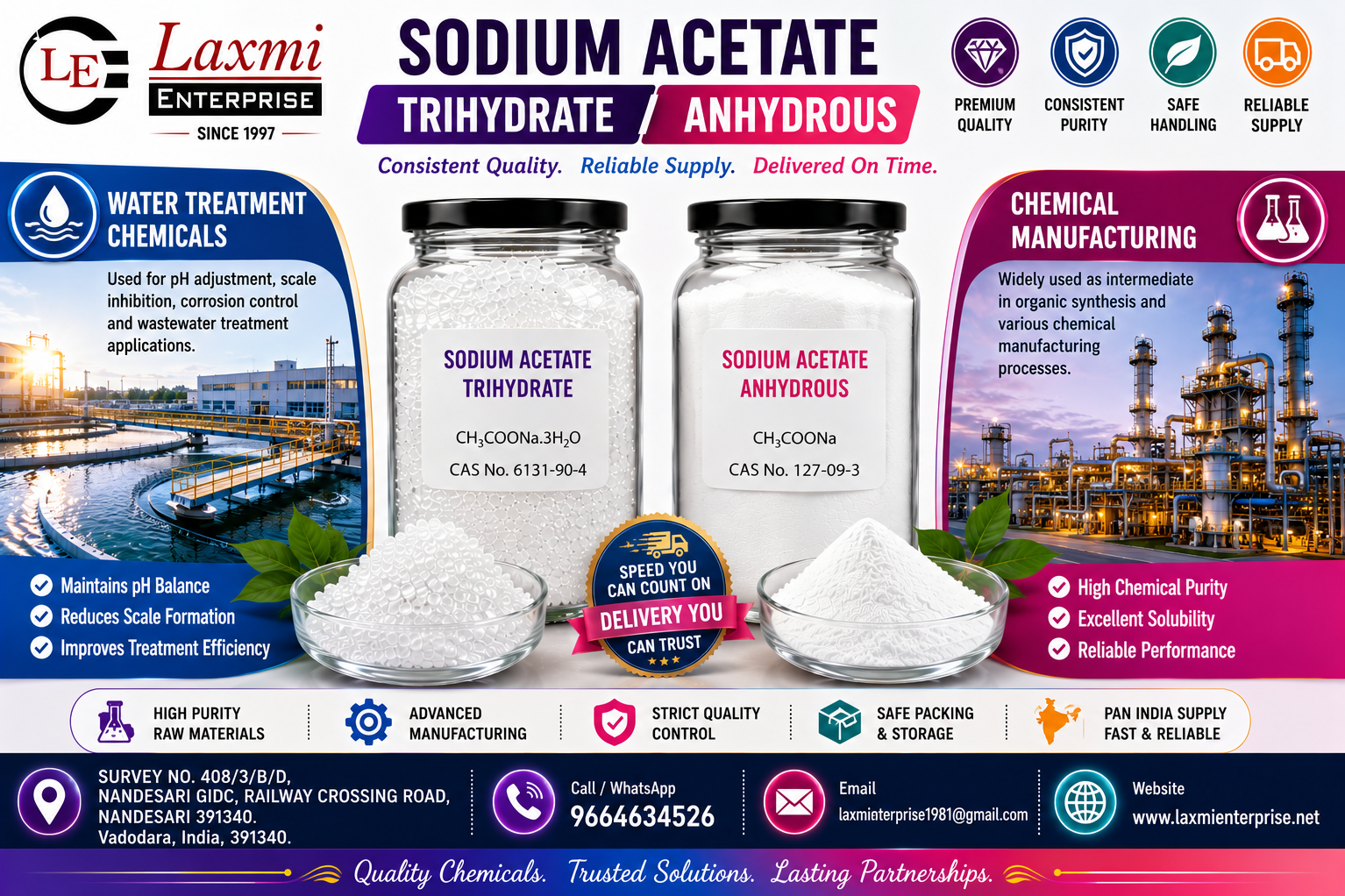
Learn how Sodium Acetate Anhydrous (CAS No. 127-09-3) and Sodium Acetate Trihydrate (CAS No. 6131-90-4) are manufactured on an industrial scale. This comprehensive guide explains raw materials, reaction chemistry, crystallization, drying, quality control, laboratory testing, packaging, storage, process optimization, environmental considerations, and supplier evaluation. Designed for chemical engineers, procurement professionals, laboratories, manufacturers, and industrial buyers.
SEO URL
/how-sodium-acetate-is-manufactured-industrial-process-guide
Primary Keyword
Sodium Acetate Manufacturing Process
Opening Answer
Sodium Acetate is generally manufactured by the controlled neutralization of acetic acid with a suitable sodium source, followed by purification, crystallization, drying (for the anhydrous form), quality testing, and packaging. Although the basic chemistry is straightforward, commercial production requires precise control of raw material quality, reaction conditions, crystallization, moisture management, laboratory testing, and batch consistency to produce Sodium Acetate Anhydrous (CAS No. 127-09-3) and Sodium Acetate Trihydrate (CAS No. 6131-90-4) suitable for industrial, laboratory, food, pharmaceutical, and specialty applications.
Table of Contents
What Is the Manufacturing Process of Sodium Acetate?
Chemical Reaction Explained
Raw Materials Used
Manufacturing Process Overview
Process Flow Diagram (Explained)
Reaction Chemistry
Crystallization Process
Production of Sodium Acetate Trihydrate
Production of Sodium Acetate Anhydrous
Drying Technology
Milling & Screening
Quality Control During Manufacturing
Laboratory Testing
Packaging & Storage
Process Optimization
Safety Considerations
Environmental Management
Frequently Asked Questions
What Is the Manufacturing Process of Sodium Acetate?
The industrial manufacturing of Sodium Acetate involves converting acetic acid into sodium acetate through a carefully controlled neutralization reaction. The resulting solution is purified and processed into either Sodium Acetate Trihydrate or Sodium Acetate Anhydrous, depending on the required commercial product.
While the reaction itself is relatively simple, producing high-quality, consistent Sodium Acetate requires:
High-purity raw materials
Controlled reaction conditions
Accurate pH monitoring
Efficient crystallization
Moisture control
Laboratory quality testing
Reliable packaging
Complete batch traceability
Industrial manufacturers continuously monitor these parameters to ensure product consistency and customer satisfaction.
Chemical Identity
Property Sodium Acetate Anhydrous Sodium Acetate Trihydrate
Chemical Formula CH₃COONa CH₃COONa·3H₂O
CAS Number 127-09-3 6131-90-4
HSN Code 2915 2915
Chemical Family Sodium Salt of Acetic Acid Sodium Salt of Acetic Acid
Commercial Form Powder Crystals
Chemical Reaction
The most common industrial route is the neutralization of Acetic Acid using a sodium-containing alkaline material.
The simplified reaction is:
CH₃COOH + NaOH → CH₃COONa + H₂O
Depending on manufacturing technology and product requirements, producers may use different sodium sources and purification techniques. The specific process varies among manufacturers and is often proprietary.
Manufacturing Insight
Although this reaction appears simple on paper, commercial production requires careful control of reaction temperature, concentration, pH, and impurity levels. Small variations in these parameters can influence crystal quality, moisture content, filtration efficiency, and overall product consistency.
Why Manufacturing Quality Matters
Industrial buyers often assume that every Sodium Acetate product performs the same.
In reality, manufacturing quality influences:
Batch consistency
Product purity
Crystal structure
Moisture characteristics
Storage stability
Process reproducibility
Laboratory performance
Customer satisfaction
For this reason, experienced buyers evaluate manufacturing capability, not only the chemical specification.
Raw Materials Used
The quality of the finished product begins with the quality of incoming raw materials.
Commercial manufacturers generally evaluate each raw material before production starts.
Typical Raw Materials
Raw Material Purpose Importance
Acetic Acid Primary reactant Determines reaction quality
Sodium Source Neutralization Forms Sodium Acetate
Process Water Solution preparation Influences purity
Processing Utilities Manufacturing support Stable production
Raw Material Quality Requirements
Before production begins, manufacturers commonly verify:
Product identity
Purity
Supplier approval
Batch documentation
Storage condition
Traceability
Laboratory acceptance
Strong incoming quality control reduces manufacturing variability.
Laboratory Insight
Professional chemical plants understand that consistent production begins with consistent raw materials. Incoming inspection is therefore one of the most important quality checkpoints in the entire manufacturing process.
Manufacturing Process Overview
Although individual production methods differ between manufacturers, a commercial Sodium Acetate plant generally follows a structured sequence of operations.
Typical Manufacturing Flow
Manufacturing Stage Purpose
Raw Material Inspection Verify incoming quality
Raw Material Charging Prepare the reaction
Controlled Neutralization Produce Sodium Acetate solution
Process Monitoring Maintain reaction stability
Clarification / Filtration Remove unwanted solids where required
Concentration Prepare solution for crystallization
Crystallization Form Sodium Acetate crystals
Separation Recover crystals
Drying (where applicable) Produce required moisture level
Milling & Screening Achieve required particle characteristics
Quality Control Laboratory verification
Packaging Protect product quality
Warehouse Storage Inventory management
Dispatch Customer delivery
Engineering Insight
Each manufacturing stage affects the next. Poor filtration can influence crystallization, inconsistent crystallization can affect drying, and improper drying may influence storage stability. Modern chemical manufacturing therefore focuses on process integration rather than isolated operations.
Process Flow Diagram (Conceptual)
A simplified manufacturing sequence can be visualized as:
Raw Material Inspection
↓
Reaction Preparation
↓
Neutralization
↓
Process Monitoring
↓
Filtration
↓
Solution Concentration
↓
Crystallization
↓
Solid-Liquid Separation
↓
Drying (for Anhydrous Production)
↓
Screening
↓
Quality Testing
↓
Packaging
↓
Warehouse
↓
Dispatch
Why Process Control Is Critical
Modern chemical plants rely on controlled operating procedures to achieve repeatable production.
Key process variables commonly monitored include:
Process Variable Why It Is Important
Temperature Supports reaction stability
pH Influences reaction conditions
Mixing Improves process uniformity
Concentration Affects crystallization
Residence Time Supports process consistency
Crystal Growth Influences final product quality
Moisture Important for storage and handling
Manufacturing Philosophy
High-quality Sodium Acetate is not produced by simply completing a chemical reaction. It is produced by controlling every stage of manufacturing, from raw material inspection to final packaging, with laboratory verification and documented quality assurance at each critical step.
Frequently Asked Questions (FAQ)
1. How is Sodium Acetate manufactured?
It is generally produced through the controlled neutralization of acetic acid with a suitable sodium source, followed by purification, crystallization, quality testing, and packaging.
2. Is the manufacturing process the same for Anhydrous and Trihydrate?
The initial reaction is similar, but downstream processing differs depending on whether the final product is Sodium Acetate Anhydrous or Sodium Acetate Trihydrate.
3. Why is raw material quality important?
High-quality raw materials contribute to consistent reaction performance, improved product purity, and reliable batch-to-batch quality.
4. Why do manufacturers monitor pH and temperature?
These parameters influence reaction stability, crystal formation, and overall manufacturing consistency.
5. What is the role of laboratory testing during manufacturing?
Laboratory testing verifies product quality, supports process control, confirms compliance with specifications, and ensures consistent production before packaging and dispatch.
Key Takeaways
The industrial manufacture of Sodium Acetate combines simple chemistry with sophisticated process engineering. While the neutralization reaction forms the chemical, the final product quality depends on careful control of raw materials, reaction conditions, crystallization, drying, laboratory testing, and packaging. Manufacturers that integrate these controls into a disciplined quality system are better positioned to supply consistent Sodium Acetate for industrial, laboratory, pharmaceutical, food, and specialty applications.
Keywords