
Common Mistakes Companies Make When Purchasing Sodium Sulphate and How to Avoid Them
Every experienced production manager has faced at least one situation where a manufacturing problem was eventually traced back to a raw material that seemed perfectly acceptable when it was purchased.
The quotation looked good.
The delivery arrived on time.
The product appeared normal.
Yet something changed inside the production process.
The detergent powder behaved differently during blending.
The glass furnace required unexpected attention.
The textile dyeing process became difficult to control.
The paper mill noticed changes in process stability.
When situations like these occur, companies often begin investigating machinery, operators and production parameters. Only later do they discover that the real issue started much earlier with the purchasing decision.
Buying Sodium Sulphate is not a difficult process.
Buying it correctly is where experience makes a difference.
Over the years, we have interacted with manufacturers from different industries, and we have noticed that the same purchasing mistakes appear again and again. Fortunately, most of them can be avoided with a little planning.
Mistake One: Choosing Only the Lowest Price
Every business wants to reduce costs.
There is nothing wrong with negotiating competitive prices.
The problem begins when price becomes the only deciding factor.
Two suppliers may offer material that appears identical on paper, but their ability to maintain consistent quality, reliable deliveries and professional support can be completely different.
A small saving on the purchase order can quickly disappear if production slows down, additional quality checks become necessary or deliveries fail to arrive when expected.
The real question should not be, 'Who is offering the lowest price?'
It should be, 'Which supplier gives our factory the greatest confidence?'
That small change in thinking often leads to much better purchasing decisions.
Mistake Two: Ignoring Long-Term Consistency
Receiving one good shipment is encouraging.
Receiving the same quality over the next twenty deliveries is what truly matters.
Manufacturing depends on repeatability.
Operators become familiar with production settings.
Quality departments establish benchmarks.
Production planning becomes more accurate.
This stability is possible only when incoming raw materials remain consistent.
Experienced manufacturers therefore evaluate suppliers over time rather than judging them by a single delivery.
Mistake Three: Treating Every Supplier as the Same
Some companies assume that every supplier simply buys and sells chemicals.
In reality, there is a significant difference between suppliers who understand manufacturing and those who only trade products.
A supplier with industrial experience understands production schedules, inventory planning and the urgency of keeping factories running.
They appreciate that one delayed truck can affect an entire day's production.
They understand that customers need answers quickly when unexpected situations arise.
This practical understanding often becomes more valuable than minor price differences.
Mistake Four: Planning Purchases Too Late
Production planning and procurement should always work together.
Waiting until inventory reaches a critical level creates unnecessary pressure on everyone involved.
Urgent purchases reduce purchasing options.
Transport arrangements become more complicated.
Production teams begin worrying about material availability instead of focusing on manufacturing.
Well-planned purchasing allows suppliers enough time to prepare material, organize dispatch and ensure timely deliveries.
Good planning benefits both the customer and the supplier.
Mistake Five: Overlooking Communication
Every business occasionally faces unexpected challenges.
Road conditions may affect transportation.
Customer demand may increase suddenly.
Production plans may change overnight.
In these situations, communication becomes just as important as the product itself.
Suppliers who provide honest updates allow manufacturers to make informed decisions.
Poor communication creates uncertainty, and uncertainty is something every factory tries to avoid.
Mistake Six: Not Thinking About Future Growth
Many purchasing decisions focus only on today's requirements.
Successful businesses think further ahead.
If production increases over the next two or three years, will the current supplier be able to support larger volumes?
Will they have sufficient inventory?
Can their logistics network handle additional deliveries?
Choosing a supplier capable of growing alongside your business reduces the need for unnecessary supplier changes in the future.
Mistake Seven: Looking Only at the Product
Industrial purchasing is about much more than the chemical itself.
The supplier's reliability, business ethics, customer service, technical understanding and commitment to long-term relationships all influence the overall value they provide.
Many manufacturers have discovered that working with a dependable supplier simplifies purchasing, improves production planning and reduces operational stress.
That value is difficult to express in a quotation but becomes obvious over years of working together.
Building Strong Supplier Relationships
Some of the most successful manufacturing companies in India have worked with the same suppliers for many years.
These relationships continue because both companies understand each other's expectations.
Suppliers know the customer's production cycle.
Customers know they can rely on consistent quality and dependable deliveries.
Trust develops gradually through repeated positive experiences.
Once that trust exists, business becomes much easier for everyone involved.
Why Manufacturers Continue Choosing Experienced Suppliers
Industrial manufacturing leaves very little room for uncertainty.
Production targets must be achieved.
Customer commitments must be honoured.
Quality standards must be maintained.
Experienced suppliers understand these realities because they have worked alongside manufacturers for many years.
Their role extends beyond supplying chemicals.
They become part of the customer's supply chain.
How Laxmi Enterprise Supports Industrial Customers
At Laxmi Enterprise, we understand that our customers depend on consistency.
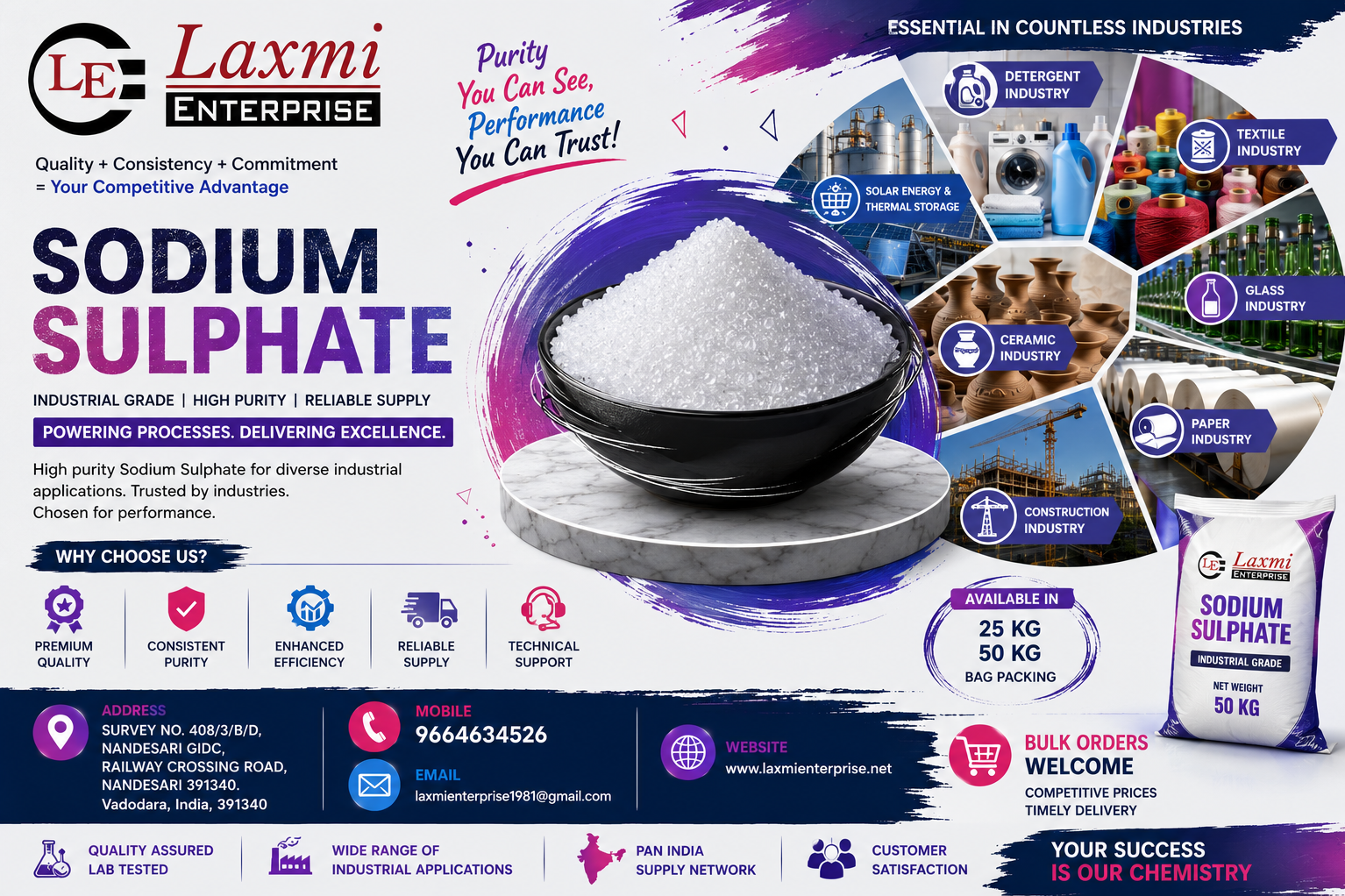
Whether they manufacture detergents, glass, textiles, paper or industrial chemicals, they expect every shipment to arrive on time and perform exactly as expected.
Operating from Nandesari GIDC, Vadodara, we have built long-term relationships with customers across India by focusing on dependable quality, reliable logistics and responsive customer support.
We believe that every delivery reflects our commitment to the customer's business.
That responsibility guides every order we process.
Final Thoughts
Good purchasing decisions are rarely based on one factor.
They combine quality, reliability, communication, experience and long-term thinking.
Companies that recognise this approach usually experience fewer production disruptions, stronger supplier relationships and greater confidence in their manufacturing operations.
Choosing the right Sodium Sulphate supplier is therefore not simply about purchasing a chemical.
It is about selecting a business partner that contributes to your company's stability, efficiency and future growth.
Frequently Asked Questions
What is the biggest mistake companies make when buying Sodium Sulphate?
The most common mistake is selecting a supplier based only on price without evaluating consistency, delivery reliability and long-term service.
Why is consistency more important than a lower price?
Consistent quality helps manufacturers maintain stable production, reduce process variations and avoid unexpected operational costs.
Should manufacturers regularly change suppliers?
Changing suppliers frequently may increase administrative work and create unnecessary production uncertainty. Many manufacturers prefer long-term suppliers who consistently meet their expectations.
How important is communication in industrial supply?
Clear and timely communication helps manufacturers plan production, respond to changing demand and minimise disruption when unexpected situations occur.
Why do industries across India trust Laxmi Enterprise?
Manufacturers choose Laxmi Enterprise because of our consistent product quality, dependable deliveries, professional customer support and years of experience supplying industrial chemicals from Nandesari GIDC, Vadodara to customers across India.
About Laxmi Enterprise
Laxmi Enterprise is a trusted manufacturer, supplier and distributor of industrial chemicals based in Nandesari GIDC, Vadodara, Gujarat. We supply Sodium Sulphate, Sodium Nitrate, Sodium Acetate, Tri Sodium Phosphate and other inorganic chemicals to customers across detergent, textile, glass, paper, ceramic, construction and chemical processing industries.
Our commitment is simple. Deliver consistent quality, provide dependable service and build long-term relationships that help our customers manufacture with confidence.