How to Choose Between Sodium Acetate Anhydrous and Sodium Acetate Trihydrate?
The choice between Sodium Acetate Anhydrous and Sodium Acetate Trihydrate depends on your manufacturing process, formulation requirements, technical specifications, and industry standards. Neither form is universally better. The correct selection should always be based on engineering requirements, laboratory validation, and customer specifications.
Decision Matrix
Selection Criteria Sodium Acetate Anhydrous Sodium Acetate Trihydrate
Water of Crystallization None Three molecules
Physical Form Fine crystalline powder White crystalline crystals
Storage Dry environment Dry environment
Laboratory Applications Widely used Widely used
Textile Applications Selected formulations Selected formulations
Chemical Manufacturing Commonly used Commonly used
Handling Characteristics Free-flowing Crystalline form
Selection Basis Process requirement Process requirement
Industry Selection Matrix
Industry Commonly Evaluated Form Selection Consideration
Textile Processing Anhydrous / Trihydrate Dyeing process requirements
Pharmaceutical Grade specified by formulation Regulatory compliance
Food Processing Food Grade Product approval
Chemical Manufacturing Technical Grade Manufacturing process
Laboratory AR / LR Grade Analytical requirements
Water Treatment Industrial Grade Plant design
Biotechnology Laboratory Grade Research protocol
Leather Industrial Grade Manufacturing formulation
Future Market Trends
Demand for Sodium Acetate continues to expand as industries adopt more controlled manufacturing processes, stricter quality systems, and advanced laboratory practices.
Key market drivers include:
Expansion of the Indian chemical industry
Growth in textile exports
Increased pharmaceutical manufacturing
Higher demand for food processing
Expansion of biotechnology research
Rising investment in water treatment
Stronger quality assurance requirements
Growth of industrial laboratories
Industrial regions such as Vadodara, Ankleshwar, Dahej, Ahmedabad, Surat, Vapi, Mumbai, Pune, Hyderabad, Bengaluru, Chennai, Coimbatore, Tiruppur, Kanpur, Kolkata, Indore, Visakhapatnam, and Ludhiana are expected to remain major demand centers.
Sustainability Insight
Modern manufacturers increasingly evaluate suppliers not only on quality and price but also on responsible packaging, efficient logistics, reduced material waste, documentation accuracy, and long-term supply reliability. Sustainable procurement practices improve operational efficiency while reducing unnecessary environmental impact.
Buyer Decision Tree
Step 1: Identify your industry.
↓
Step 2: Determine the required grade.
↓
Step 3: Confirm whether Anhydrous or Trihydrate is appropriate.
↓
Step 4: Verify the CAS Number.
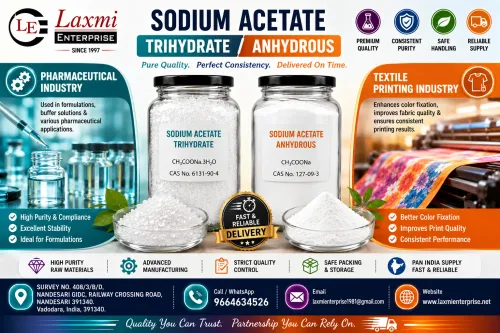
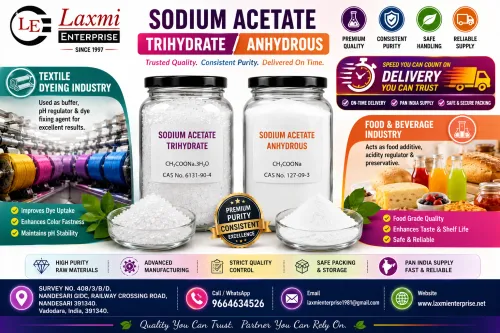
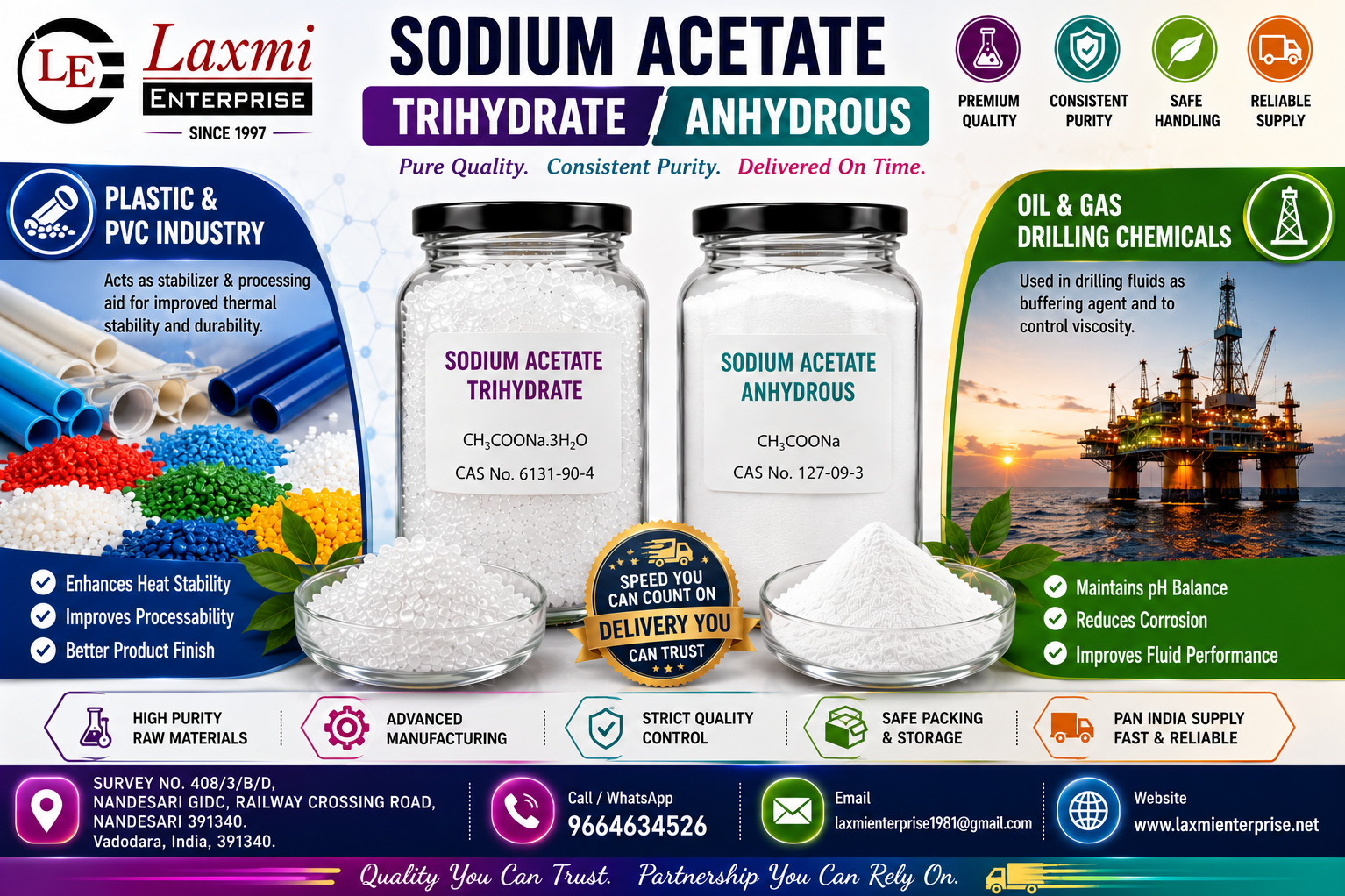
Sodium Acetate Anhydrous – CAS No. 127-09-3
Sodium Acetate Trihydrate – CAS No. 6131-90-4
↓
Step 5: Confirm the HSN Code.
HSN Code: 2915
↓
Step 6: Request:
Certificate of Analysis (COA)
Technical Data Sheet (TDS)
Safety Data Sheet (SDS)
↓
Step 7: Review supplier capability, documentation, packaging, and delivery performance.
↓
Step 8: Conduct incoming material inspection before commercial production.
Expert Recommendations
For most industrial buyers, long-term success depends on:
Selecting the correct grade
Choosing the appropriate hydrate form
Purchasing from qualified suppliers
Reviewing technical documentation
Maintaining proper storage conditions
Performing incoming quality inspections
Monitoring supplier performance regularly
These practices help improve production consistency and reduce operational risk.
Master Frequently Asked Questions (FAQ)
General Information
1. What is Sodium Acetate?
Sodium Acetate is the sodium salt of acetic acid. It is widely used in textile processing, pharmaceuticals, food applications (where approved), laboratories, water treatment, chemical manufacturing, and numerous other industrial processes.
2. What is the CAS Number of Sodium Acetate Anhydrous?
CAS No. 127-09-3
3. What is the CAS Number of Sodium Acetate Trihydrate?
CAS No. 6131-90-4
4. What is the HSN Code of Sodium Acetate?
HSN Code: 2915
5. What is the difference between Anhydrous and Trihydrate?
The primary difference is that the Trihydrate form contains three molecules of water of crystallization, while the Anhydrous form does not. The appropriate selection depends on the intended application.
Quality & Procurement
6. Why should buyers request a COA?
A Certificate of Analysis provides batch-specific quality information and helps verify compliance with the agreed specification.
7. What is the purpose of a Technical Data Sheet (TDS)?
The TDS describes the product's technical characteristics, recommended applications, storage conditions, and handling guidance.
8. Why is an SDS important?
A Safety Data Sheet provides information on safe handling, storage, first aid, spill response, and emergency procedures.
9. How should Sodium Acetate be stored?
Store it in a clean, dry warehouse, protected from moisture, in its original sealed packaging, and follow FIFO inventory practices.
10. Why is batch traceability important?
Batch traceability supports quality investigations, customer audits, regulatory compliance, and inventory management.
Industrial Applications
11. Which industries commonly use Sodium Acetate?
Major industries include textiles, garments, pharmaceuticals, food processing, laboratories, biotechnology, water treatment, leather, cosmetics, chemicals, paints, adhesives, electronics, and research institutions.
12. Which grade should I choose?
The correct grade depends on your industry, application, customer specification, and applicable regulatory requirements.
13. Can one grade be used for every industry?
No. Different industries require different quality standards and specifications.
14. Is Industrial Grade suitable for food or pharmaceutical use?
No. Food and pharmaceutical applications generally require grades manufactured for those specific uses and applicable regulatory requirements.
15. Why is supplier consistency important?
Consistent suppliers help maintain product quality, reduce production variability, and support long-term manufacturing stability.
Glossary of Important Terms
Term Meaning
Acetate Salt or ester derived from acetic acid
Buffer Solution A solution that resists rapid changes in pH
CAS Number Unique international chemical identification number
HSN Code Harmonized System of Nomenclature used for taxation and trade
COA Certificate of Analysis
TDS Technical Data Sheet
SDS Safety Data Sheet
Quality Assurance (QA) System designed to prevent quality problems
Quality Control (QC) Testing and inspection to verify quality
Traceability Ability to track a product through the supply chain
Batch Number Unique identification assigned to a production batch
Industrial Grade Product manufactured for industrial applications
AR Grade Analytical Reagent Grade
LR Grade Laboratory Reagent Grade
FIFO First In, First Out inventory method
About Laxmi Enterprise
Laxmi Enterprise, located in Nandesari GIDC, Vadodara, Gujarat, supplies Sodium Acetate Anhydrous (CAS No. 127-09-3) and Sodium Acetate Trihydrate (CAS No. 6131-90-4) to customers across India.
Serving industries in Ahmedabad, Surat, Bharuch, Ankleshwar, Dahej, Vapi, Mumbai, Navi Mumbai, Pune, Nashik, Chennai, Coimbatore, Tiruppur, Hyderabad, Bengaluru, Kanpur, Ludhiana, Kolkata, Indore, Jaipur, Visakhapatnam, and other industrial regions, the company focuses on dependable supply, technical documentation, consistent quality, and responsive customer support.
Expert Conclusion
Sodium Acetate has become an indispensable industrial chemical because of its versatility, chemical stability, and compatibility with a wide range of manufacturing processes. Whether used in textile dyeing, pharmaceutical production, food processing, laboratory research, water treatment, biotechnology, or chemical manufacturing, its performance depends on selecting the correct grade, maintaining disciplined quality control, and sourcing from reliable suppliers.
Industrial buyers should evaluate more than price when selecting a supplier. Product consistency, documentation, traceability, technical support, logistics capability, and long-term supply reliability all contribute to lower total manufacturing costs and more stable production.
For organizations seeking dependable supplies of Sodium Acetate Anhydrous and Sodium Acetate Trihydrate, partnering with an experienced supplier that emphasizes quality assurance and customer support helps strengthen procurement confidence and operational performance.
Keywords