Here’s a clear and detailed explanation of the Sodium Sulfate Chemical Recovery Cycle, especially relevant for industries like pulp & paper (Kraft process), textile dyeing, and chemical manufacturing:
Sodium Sulfate Chemical Recovery Cycle
1. Introduction
Sodium sulfate (Na₂SO₄) is a key component in many industrial chemical systems. In the Kraft pulping process and similar operations, it plays a vital role in chemical recovery, helping convert waste materials into reusable chemicals—thus reducing both cost and environmental impact.
Step-by-Step Cycle
(a) Generation of Black Liquor (Waste Stream)
During processes like Kraft pulping, wood chips are cooked with white liquor (NaOH + Na₂S).
The reaction dissolves lignin, producing black liquor, which contains:
Organic matter (lignin residues)
Inorganic chemicals (Na₂CO₃, Na₂SO₄, Na₂S, NaOH)
Sodium Sulfate’s Role
Sodium sulfate acts as a makeup chemical in the recovery cycle.
When sulfur losses occur (via vent gases or other processes), Na₂SO₄ is added to maintain sulfur balance.
It also helps regulate the Na/S ratio, essential for efficient pulping chemistry.
Environmental & Economic Benefits
* Reduces chemical cost by recycling sodium and sulfur.
* Minimizes solid and liquid waste discharge.
* Recovers energy from organic materials in black liquor.
* Improves sustainability and environmental compliance
Summarize or rewrite the page (for SEO or clarity).
Create new SEO-optimized content to boost ranking for keywords like
“sodium sulfate for dye exhaustion, ” “salt for reactive dyeing, ” or “sodium sulfate manufacturer in India.”
Explain the chemistry behind sodium sulfate’s role in dye exhaustion and how it relates to recovery or sustainability.
Design a product page layout or infographic (for website or brochure).
Which option would you like me to do?
Sodium Sulfate for Reactive Dyeing
1. Introduction
Sodium Sulfate (Na₂SO₄), commonly known as Glauber’s salt (in its decahydrate form)
plays a vital role in reactive dyeing of cotton and other cellulosic fibers.
It acts as a dyeing auxiliary chemical that controls the exhaustion (absorption) of dyes onto fibers, ensuring uniform and vibrant shades.
Role in Reactive Dyeing Process
Reactive dyes form a covalent bond with the hydroxyl groups of cellulose under alkaline conditions.
However, since both reactive dyes and cotton fibers carry negative charges in water, they repel each other
This is where sodium sulfate becomes essential.
Sustainability & Recovery
In modern dyehouses, spent dye liquor containing sodium sulfate can be:
Treated via crystallization or evaporation to recover Na₂SO₄.
Reused in subsequent dye baths, reducing fresh salt consumption.
This creates a closed-loop system, lowering TDS discharge and improving eco-compliance.
Sodium Sulfate Export – Asia Pacific Market Overview
1. Introduction
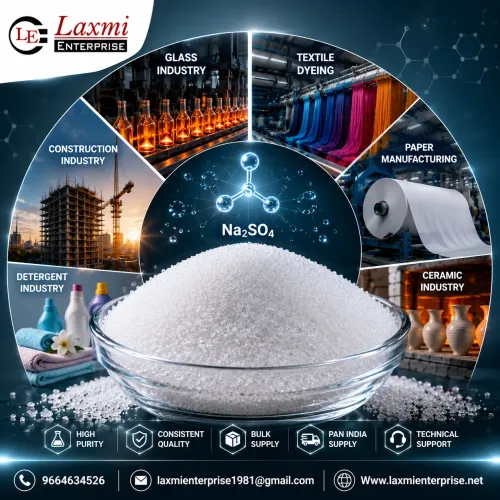
Sodium Sulfate (Na₂SO₄) is a high-volume inorganic chemical used across multiple industries including textile dyeing, detergent manufacturing, glass production, and paper processing.
In the Asia–Pacific region (APAC) — home to some of the world’s largest textile and detergent industries — demand for sodium sulfate continues to grow steadily.
Key Applications Driving Export Demand
Textile Industry:
Used as a leveling and exhausting agent in reactive dyeing.
High consumption in Bangladesh, India, Indonesia, and Vietnam.
Detergent Manufacturing:
Acts as a filler and flow aid in powder detergents.
🪟* Glass Industry:
Used as a refining agent to remove bubbles from molten glass.
Pulp & Paper:
Used in the Kraft process for chemical recovery.
Market Trends in Asia Pacific
* Shift toward eco-friendly textile processing, increasing use of recoverable sodium sulfate.
* Rising detergent consumption in South and Southeast Asia.
*Export–import integration — many exporters offering end-to-end solutions from raw material supply to logistics.
* Recovery and reuse systems being adopted to reduce TDS load in effluent.
*Why Choose Laxmi Enterprise
* Reliable Quality: Consistent purity and particle size control.
* Multiple Grades: Textile, detergent, and industrial grades.
* Flexible Supply: Bulk, bagged, and customized packaging.
* Export Expertise: Experience in Asia–Pacific logistics and
compliance.
* Sustainability Commitment: Support for salt recovery and eco-processing.
Seawater Salt and Sodium Sulfate in Textile & Paper Industries
1. Overview
Sodium Sulfate (Na₂SO₄) and Seawater Salt (Marine Salt / Sodium Chloride) are essential inorganic salts widely used in textile dyeing,
kraft paper manufacturing, and chemical recovery systems.
A. Seawater Salt & Sodium Sulfate in Textile Dyeing
Role in Reactive Dyeing
Reactive dyes and cellulosic fibers both carry negative charges in aqueous solution.
To enable dye–fiber bonding, salts like sodium sulfate or sodium chloride (seawater salt) are added to:
Both play critical roles in dye exhaustion, alkaline balance, and chemical regeneration across multiple industrial processes.
Sodium Sulfate Chemical Recovery Cycle
1. Introduction
Sodium sulfate (Na₂SO₄) is a key component in many industrial chemical systems. In the Kraft pulping process and similar operations, it plays a vital role in chemical recovery, helping convert waste materials into reusable chemicals—thus reducing both cost and environmental impact.
Step-by-Step Cycle
(a) Generation of Black Liquor (Waste Stream)
During processes like Kraft pulping, wood chips are cooked with white liquor (NaOH + Na₂S).
The reaction dissolves lignin, producing black liquor, which contains:
Organic matter (lignin residues)
Inorganic chemicals (Na₂CO₃, Na₂SO₄, Na₂S, NaOH)
Sodium Sulfate’s Role
Sodium sulfate acts as a makeup chemical in the recovery cycle.
When sulfur losses occur (via vent gases or other processes), Na₂SO₄ is added to maintain sulfur balance.
It also helps regulate the Na/S ratio, essential for efficient pulping chemistry.
Environmental & Economic Benefits
* Reduces chemical cost by recycling sodium and sulfur.
* Minimizes solid and liquid waste discharge.
* Recovers energy from organic materials in black liquor.
* Improves sustainability and environmental compliance
Summarize or rewrite the page (for SEO or clarity).
Create new SEO-optimized content to boost ranking for keywords like
“sodium sulfate for dye exhaustion, ” “salt for reactive dyeing, ” or “sodium sulfate manufacturer in India.”
Explain the chemistry behind sodium sulfate’s role in dye exhaustion and how it relates to recovery or sustainability.
Design a product page layout or infographic (for website or brochure).
Which option would you like me to do?
Sodium Sulfate for Reactive Dyeing
1. Introduction
Sodium Sulfate (Na₂SO₄), commonly known as Glauber’s salt (in its decahydrate form)
plays a vital role in reactive dyeing of cotton and other cellulosic fibers.
It acts as a dyeing auxiliary chemical that controls the exhaustion (absorption) of dyes onto fibers, ensuring uniform and vibrant shades.
Role in Reactive Dyeing Process
Reactive dyes form a covalent bond with the hydroxyl groups of cellulose under alkaline conditions.
However, since both reactive dyes and cotton fibers carry negative charges in water, they repel each other
This is where sodium sulfate becomes essential.
Sustainability & Recovery
In modern dyehouses, spent dye liquor containing sodium sulfate can be:
Treated via crystallization or evaporation to recover Na₂SO₄.
Reused in subsequent dye baths, reducing fresh salt consumption.
This creates a closed-loop system, lowering TDS discharge and improving eco-compliance.
Sodium Sulfate Export – Asia Pacific Market Overview
1. Introduction
Sodium Sulfate (Na₂SO₄) is a high-volume inorganic chemical used across multiple industries including textile dyeing, detergent manufacturing, glass production, and paper processing.
In the Asia–Pacific region (APAC) — home to some of the world’s largest textile and detergent industries — demand for sodium sulfate continues to grow steadily.
Key Applications Driving Export Demand
Textile Industry:
Used as a leveling and exhausting agent in reactive dyeing.
High consumption in Bangladesh, India, Indonesia, and Vietnam.
Detergent Manufacturing:
Acts as a filler and flow aid in powder detergents.
🪟* Glass Industry:
Used as a refining agent to remove bubbles from molten glass.
Pulp & Paper:
Used in the Kraft process for chemical recovery.
Market Trends in Asia Pacific
* Shift toward eco-friendly textile processing, increasing use of recoverable sodium sulfate.
* Rising detergent consumption in South and Southeast Asia.
*Export–import integration — many exporters offering end-to-end solutions from raw material supply to logistics.
* Recovery and reuse systems being adopted to reduce TDS load in effluent.
*Why Choose Laxmi Enterprise
* Reliable Quality: Consistent purity and particle size control.
* Multiple Grades: Textile, detergent, and industrial grades.
* Flexible Supply: Bulk, bagged, and customized packaging.
* Export Expertise: Experience in Asia–Pacific logistics and
compliance.
* Sustainability Commitment: Support for salt recovery and eco-processing.
Seawater Salt and Sodium Sulfate in Textile & Paper Industries
1. Overview
Sodium Sulfate (Na₂SO₄) and Seawater Salt (Marine Salt / Sodium Chloride) are essential inorganic salts widely used in textile dyeing,
kraft paper manufacturing, and chemical recovery systems.
A. Seawater Salt & Sodium Sulfate in Textile Dyeing
Role in Reactive Dyeing
Reactive dyes and cellulosic fibers both carry negative charges in aqueous solution.
To enable dye–fiber bonding, salts like sodium sulfate or sodium chloride (seawater salt) are added to:
Both play critical roles in dye exhaustion, alkaline balance, and chemical regeneration across multiple industrial processes.
Keywords