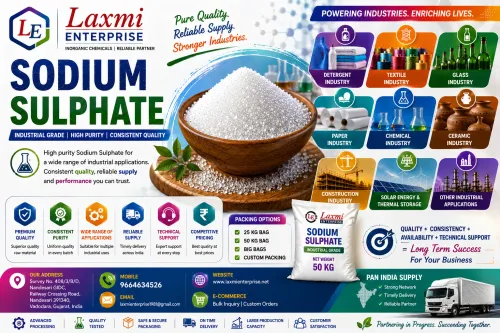
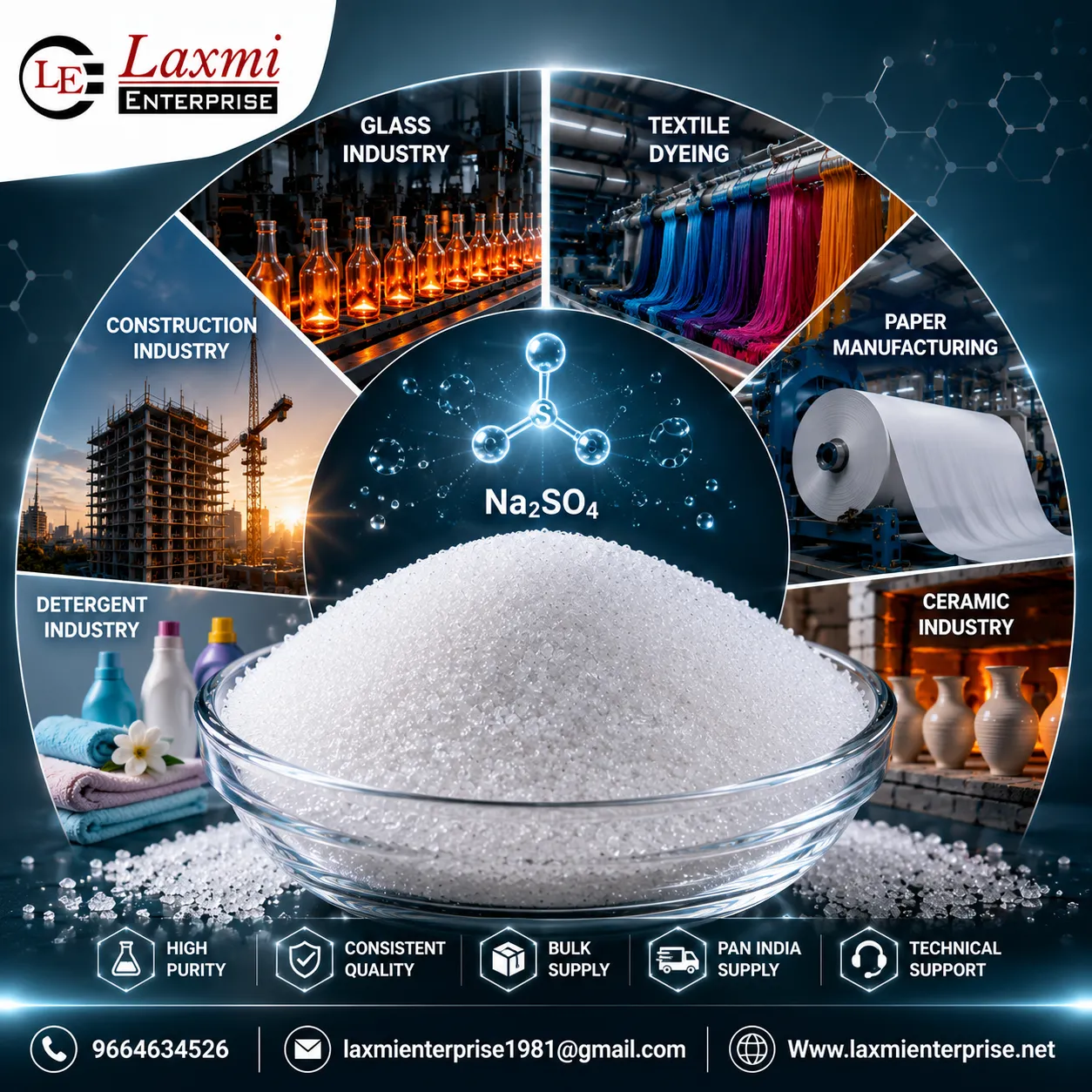
Major Industrial Applications of Sodium Sulphate
One of the primary reasons sodium sulphate has remained one of the world's most important industrial chemicals is its remarkable versatility. Unlike specialty chemicals designed for a single application, sodium sulphate supports a wide variety of manufacturing processes. Its chemical stability, consistent physical properties, and compatibility with industrial operations make it an essential raw material across numerous sectors.
Every industry uses sodium sulphate differently. In some applications, it functions as a process aid, while in others it improves manufacturing efficiency, supports chemical reactions, or contributes to product consistency. Because every industry has unique requirements, procurement teams should understand not only where sodium sulphate is used, but also why it is used and which quality parameters are most important for each application.
Sodium Sulphate in the Detergent Industry
The detergent industry is one of the largest consumers of sodium sulphate worldwide. Powder detergent manufacturers value sodium sulphate because it contributes to efficient production and helps maintain consistent product characteristics.
Modern detergent manufacturing demands reliable raw materials with consistent particle size, controlled moisture, and dependable flowability. Variations in these parameters can affect blending efficiency, packaging operations, and product uniformity.
What detergent manufacturers typically evaluate
Consistent particle size
Good flowability
Low moisture
Reliable packaging
Stable batch quality
Uniform appearance
For detergent manufacturers, consistency is often more valuable than achieving the highest possible purity.
FAQs – Detergent Industry
Why is sodium sulphate used in detergent manufacturing?
It supports efficient manufacturing, improves product consistency, and contributes to stable powder processing.
What quality parameters are most important for detergent manufacturers?
Particle size, moisture content, flowability, and batch consistency are commonly evaluated.
Can inconsistent sodium sulphate affect detergent production?
Yes. Variations in physical properties may influence blending, packaging efficiency, and production consistency.
Sodium Sulphate in Glass Manufacturing
The glass industry uses sodium sulphate during glass production because it contributes to refining the molten glass. High-quality sodium sulphate helps manufacturers achieve consistent production while supporting finished product quality.
Glass manufacturers generally place significant emphasis on purity because unwanted impurities may influence product appearance or manufacturing efficiency.
Glass manufacturers typically monitor
Chemical purity
Iron content
Chloride content
Product consistency
Laboratory certification
Reliable batch quality
Because glass production often operates continuously, maintaining consistent raw material quality is especially important.
FAQs – Glass Industry
Why does the glass industry use sodium sulphate?
It assists in the glass manufacturing process by supporting refining operations and improving production consistency.
Why is iron content important for glass manufacturers?
Low iron levels are often preferred because they help maintain the desired optical characteristics of finished glass products.
Why do glass manufacturers request laboratory reports?
Laboratory reports provide confidence that each batch complies with technical specifications before production.
Sodium Sulphate in Textile Dyeing
Textile processing requires precise process control to achieve uniform color, consistent dye uptake, and reproducible manufacturing results.
Sodium sulphate has long been used in textile dyeing because of its role in supporting uniform processing conditions.
Textile manufacturers generally emphasize
Product consistency
Reliable dissolution
Controlled impurities
Uniform particle size
Stable quality
For continuous textile production, consistency between deliveries helps maintain production efficiency.
FAQs – Textile Industry
Why is sodium sulphate used during textile dyeing?
It helps support consistent dyeing conditions and contributes to uniform processing.
Why is product consistency important for textile manufacturers?
Consistent raw materials help reduce process variation and improve repeatability across production batches.
Does particle size matter in textile processing?
Yes. Uniform particle size contributes to predictable dissolution and handling.
Sodium Sulphate in Kraft Pulp and Paper Manufacturing
The pulp and paper industry depends on reliable raw materials that support efficient processing and long-term operational stability.
Because many paper mills operate continuously, raw material consistency becomes particularly important.
Paper manufacturers generally evaluate
Purity
Consistency
Moisture
Packaging quality
Supply reliability
Laboratory documentation
Reliable supply often becomes just as important as product quality because production interruptions can be expensive.
FAQs – Pulp & Paper Industry
Why is sodium sulphate important in pulp and paper manufacturing?
It supports specific stages of the kraft pulping process and contributes to consistent manufacturing operations.
Why do paper mills emphasize supplier reliability?
Continuous production requires dependable deliveries and consistent raw material quality.
What documentation do paper manufacturers commonly request?
Technical specifications, Certificates of Analysis, and Safety Data Sheets are commonly reviewed.
Sodium Sulphate in Chemical Manufacturing
Chemical manufacturers frequently use sodium sulphate in processes where stable composition and predictable quality are essential.
Unlike some industries that prioritize appearance, chemical manufacturers often focus on laboratory values and repeatable specifications.
Typical purchasing priorities include
Purity
Batch consistency
Reliable laboratory testing
Technical documentation
Stable manufacturing
Because chemical reactions require predictable inputs, quality consistency directly supports process stability.
FAQs – Chemical Manufacturing
Why is laboratory consistency important?
Reliable laboratory results help manufacturers maintain stable production conditions.
Why do chemical companies request Certificates of Analysis?
COAs verify that the supplied batch complies with agreed technical specifications.
Why is process consistency valuable?
Consistent raw materials reduce production adjustments and improve manufacturing reliability.
Sodium Sulphate in Ceramic Manufacturing
Ceramic manufacturers value raw materials that contribute to controlled production processes and consistent finished products.
Although ceramic formulations vary considerably, suppliers capable of maintaining consistent product quality often become preferred long-term partners.
FAQs – Ceramic Industry
Does ceramic manufacturing require consistent sodium sulphate quality?
Yes. Consistency helps manufacturers maintain stable production and predictable product quality.
Why are technical specifications important?
Specifications allow ceramic manufacturers to compare suppliers objectively.
Sodium Sulphate in Leather Processing
Leather processing involves carefully controlled chemical operations where raw material consistency influences manufacturing efficiency.
Procurement teams generally emphasize
Stable quality
Reliable deliveries
Product consistency
Documentation
Technical support
FAQs – Leather Industry
Why is supplier consistency important?
Consistent suppliers reduce operational uncertainty and support stable production.
Why do leather manufacturers request technical documentation?
Documentation helps verify product quality and supports quality management systems.
Emerging Industrial Applications
As manufacturing technologies continue to evolve, sodium sulphate is finding applications in additional industries.
These include:
Advanced chemical formulations
Specialty manufacturing
Energy-related technologies
Environmental processes
Industrial processing systems
Although these markets are still developing, demand for high-quality sodium sulphate continues to expand as manufacturers seek reliable and consistent raw materials.
How Procurement Teams Select the Right Sodium Sulphate
One of the biggest mistakes organizations make is assuming that sodium sulphate is a generic commodity. In reality, procurement teams evaluate suppliers based on technical capability, quality assurance, and long-term reliability.
A structured procurement process typically includes:
Step 1 – Define the application
Understand how sodium sulphate will be used in the manufacturing process.
Step 2 – Establish technical specifications
Specify purity, moisture, particle size, chloride, iron, bulk density, and other relevant parameters.
Step 3 – Review supplier documentation
Evaluate the Technical Data Sheet (TDS), Certificate of Analysis (COA), Safety Data Sheet (SDS), and product specifications.
Step 4 – Assess quality systems
Understand the supplier's laboratory capabilities, quality assurance procedures, and batch consistency.
Step 5 – Evaluate logistics
Confirm packaging quality, warehouse practices, inventory availability, and delivery performance.
Step 6 – Monitor long-term performance
Regularly review supplier consistency, documentation accuracy, and customer support.
This approach helps organizations move from price-based purchasing to value-based procurement.
The Global Sodium Sulphate Market
Sodium sulphate is traded internationally and remains an essential raw material for industries on every continent. Demand is driven by sectors such as detergents, glass, textiles, pulp and paper, and chemicals.
Market trends increasingly emphasize:
Consistent quality
Supply chain reliability
Technical documentation
Sustainable manufacturing practices
Long-term supplier partnerships
As industries become more quality-focused, suppliers are expected to provide not only product but also technical expertise and dependable support.
The Indian Sodium Sulphate Market
India is home to a diverse manufacturing base that consumes sodium sulphate across numerous industries. Growing production in detergents, textiles, glass, paper, and specialty chemicals has increased the need for reliable domestic supply.
Industrial buyers in India are increasingly looking for suppliers that can provide:
Consistent product quality
Timely deliveries
Complete technical documentation
Responsive technical support
Reliable inventory management
Long-term supply capability
For companies operating in industrial hubs such as Gujarat, Maharashtra, Tamil Nadu, Rajasthan, Uttar Pradesh, and West Bengal, dependable logistics and batch consistency are often critical purchasing factors.
Frequently Asked Questions
1. Which industry consumes the largest quantity of sodium sulphate?
The detergent industry is one of the largest global consumers, although demand also remains significant in glass, textile, pulp and paper, and chemical manufacturing.
2. Does every industry use the same sodium sulphate specification?
No. Specifications vary depending on the manufacturing process and quality requirements.
3. Why do procurement teams request a COA?
A Certificate of Analysis confirms the laboratory results for the supplied batch and helps verify compliance with agreed specifications.
4. Why is supplier consistency important?
Consistent suppliers reduce production risk, improve manufacturing efficiency, and support long-term operational stability.
5. Should buyers evaluate laboratory capabilities?
Yes. A supplier with strong laboratory systems is better equipped to maintain consistent quality and provide reliable technical documentation.
6. Can packaging influence product quality?
Yes. Proper packaging helps protect sodium sulphate from moisture, contamination, and handling damage during storage and transportation.
7. Why is long-term supplier performance important?
Long-term consistency often has a greater impact on manufacturing success than short-term price savings.
8. Is technical support valuable after purchase?
Yes. Technical guidance can help customers understand specifications, laboratory reports, storage recommendations, and application requirements.
9. Why should procurement teams work closely with quality departments?
Collaboration ensures that commercial decisions align with technical requirements and manufacturing objectives.
10. What qualities define a reliable sodium sulphate supplier?
Reliable suppliers provide consistent quality, transparent documentation, dependable deliveries, technical expertise, responsive customer service, and robust quality assurance systems.
Keywords