

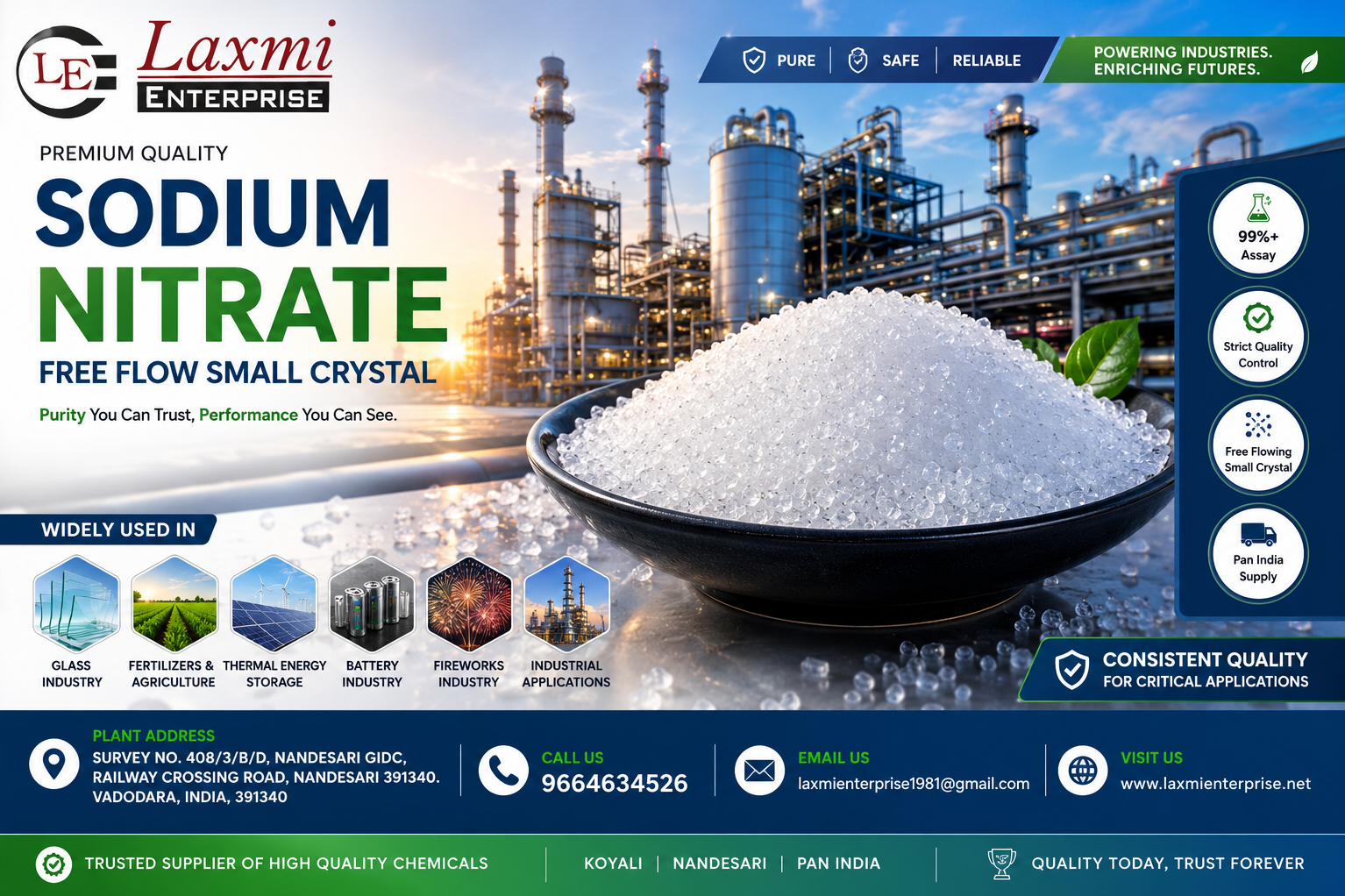
How Sodium Nitrate Free Flow is Manufactured (Industrial Overview)
Sodium Nitrate (NaNO₃) is one of the most important inorganic nitrate salts used across modern industries. While users often focus on purity and chemical composition, the manufacturing process plays a significant role in determining the product's physical quality, flowability, storage stability, and industrial performance.
The objective of manufacturing Free Flow Sodium Nitrate is not only to achieve the required chemical purity but also to produce uniform crystalline particles that offer excellent handling characteristics throughout storage, transportation, and industrial processing.
Industrial manufacturers employ controlled production techniques to ensure that every batch maintains consistent particle size, low moisture content, and high chemical stability. These characteristics directly influence product performance in automated feeding systems, blending operations, and continuous manufacturing processes.
Although manufacturing technologies may vary among producers, the primary goal remains the same: to deliver a chemically consistent, free-flowing product that performs reliably under industrial operating conditions.
Manufacturing Objectives
The production of Free Flow Sodium Nitrate is designed to achieve several important objectives:
High chemical purity
Uniform crystal formation
Controlled particle size distribution
Excellent flowability
Low residual moisture
Reduced dust generation
Improved storage stability
Consistent batch-to-batch quality
Meeting these objectives ensures that the product can be handled efficiently while maintaining reliable performance across different industries.
Typical Manufacturing Stages
While proprietary manufacturing methods differ among producers, the industrial production of Free Flow Sodium Nitrate generally includes several controlled stages:
1. Raw Material Selection
Production begins with carefully selected raw materials that meet established quality standards. The purity of these materials significantly influences the quality of the finished product.
Quality checks at this stage typically include:
Chemical purity verification
Impurity assessment
Moisture evaluation
Batch traceability
2. Controlled Chemical Processing
Selected raw materials undergo controlled processing to produce Sodium Nitrate with consistent chemical composition. Manufacturing parameters such as temperature, concentration, and reaction conditions are carefully monitored to maintain product quality.
Process consistency is essential for achieving reliable industrial performance.
3. Crystal Formation
One of the most critical stages is crystal formation.
During this stage, manufacturing conditions are optimized to produce:
Uniform crystals
Controlled particle size
High purity
Good flow characteristics
The crystal structure has a direct impact on product handling and dissolution performance.
4. Drying
After crystallization, the product is carefully dried to remove excess moisture.
Proper drying helps achieve:
Low moisture content
Improved storage stability
Better flowability
Reduced caking tendency
Moisture control is one of the defining characteristics of a high-quality Free Flow product.
5. Screening and Particle Size Control
The dried material is screened to achieve a consistent particle size distribution.
Uniform granules contribute to:
Better blending
Accurate dosing
Faster dissolution
Improved handling
Consistent production results
6. Quality Inspection
Before packaging, every batch undergoes quality verification to ensure it meets the required specifications.
Typical inspections include:
Appearance
Purity
Moisture
Particle size
Flowability
Bulk density
Packaging quality
Only compliant material proceeds to packaging.
Why the Free Flow Process Matters
Many industrial problems are not caused by chemical composition but by poor physical characteristics.
For example:
Bridging inside silos
Hopper blockages
Inconsistent feeding
Material lumping
Uneven mixing
Excessive dust
A well-manufactured Free Flow Sodium Nitrate minimizes these issues, helping manufacturers improve productivity and reduce maintenance.
Industrial Benefits of a Well-Manufactured Product
High-quality Free Flow Sodium Nitrate provides several operational advantages:
Reliable storage performance
Smooth hopper discharge
Consistent screw feeder operation
Improved blending efficiency
Faster production startup
Reduced manual intervention
Lower material losses
Better inventory management
Stable product quality
These benefits become increasingly important in automated production environments where raw material consistency directly affects manufacturing efficiency.
Expert Advice for Industrial Buyers
When evaluating Sodium Nitrate suppliers, don't compare products on price alone. A technically reliable product often delivers greater value by reducing production downtime, improving process consistency, and minimizing waste.
Consider the following before placing an order:
Request a recent Certificate of Analysis (COA).
Confirm that the product is a true Free Flow grade with consistent particle size.
Ensure moisture levels are controlled.
Verify the supplier's ability to maintain batch-to-batch consistency.
Ask about available packing options (25 kg, 50 kg, and 500 kg Jumbo Bags).
Review storage and transportation recommendations.
Confirm technical support and documentation are available when needed.
A dependable supplier contributes not only to product quality but also to the reliability of your manufacturing operations.
Manufacturing & Procurement FAQs
Why is crystal size controlled during manufacturing?
Uniform crystal size improves material flow, enhances blending, supports accurate dosing, and ensures more consistent performance in industrial processes.
Why is drying an important manufacturing step?
Drying reduces residual moisture, helping maintain free-flowing characteristics, improve storage stability, and minimize the risk of caking.
Does the manufacturing process affect product quality?
Yes. Manufacturing conditions influence crystal structure, particle size, moisture content, and overall consistency, all of which affect industrial performance.
Why is batch consistency important?
Consistent batches help manufacturers maintain stable production conditions, reduce quality variations, and improve process reliability over time.
What is the role of quality inspection before packaging?
Quality inspection verifies that the finished product meets the required specifications for purity, appearance, moisture, particle size, and flowability before dispatch.
Why should buyers request a recent COA?
A recent COA confirms that the specific batch being supplied has been tested and meets the declared quality specifications, providing confidence in product consistency.
What are the standard commercial packing sizes?
For industrial supply, the standard packing options are:
25 kg Bags
50 kg Bags
500 kg Jumbo Bags
These sizes are suitable for most manufacturing, storage, and logistics requirements.
How can proper manufacturing reduce production downtime?
A well-manufactured Free Flow product minimizes bridging, lump formation, and inconsistent feeding, allowing automated systems to operate more efficiently with fewer interruptions.
Why is supplier reliability important in long-term procurement?
Reliable suppliers help ensure consistent product quality, timely deliveries, technical documentation, and dependable customer support. This contributes to stable production planning and reduces the risk of unexpected supply disruptions.
What should industries look for besides price?
Price is only one factor. Buyers should also consider:
Product quality
Batch consistency
Technical support
Documentation (COA & SDS)
Packaging quality
Supply reliability
Delivery performance
Industry experience
These factors often have a greater impact on long-term operational efficiency than the initial purchase cost.