How Sodium Nitrate Works in Glass Manufacturing A Complete Technical Guide for Glass Manufacturers
Introduction
The quality of glass begins long before raw materials enter the furnace.
Every successful glass manufacturer understands that consistent production depends on selecting the right combination of silica sand, soda ash, limestone and specialty additives. Each ingredient has a specific purpose during melting, refining and forming. When one material performs differently from expected, furnace efficiency, glass clarity and production stability may all be affected.
Among the specialty chemicals used in selected glass formulations, Sodium Nitrate plays an important technical role. Although it represents a relatively small percentage of the glass batch, its contribution during melting can significantly influence production consistency and finished glass quality.
For production engineers, furnace operators, procurement managers and quality control professionals, understanding how Sodium Nitrate functions inside the glass furnace helps improve purchasing decisions and manufacturing performance.
What is Sodium Nitrate
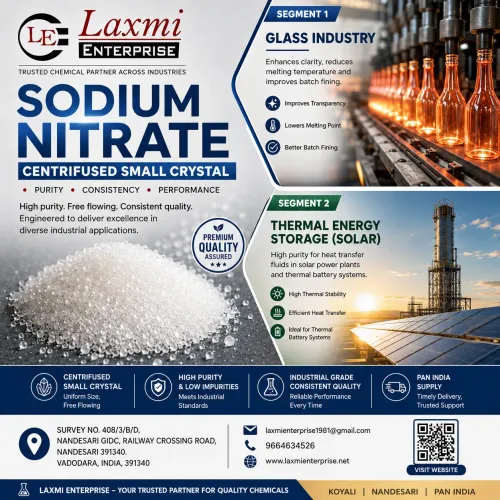
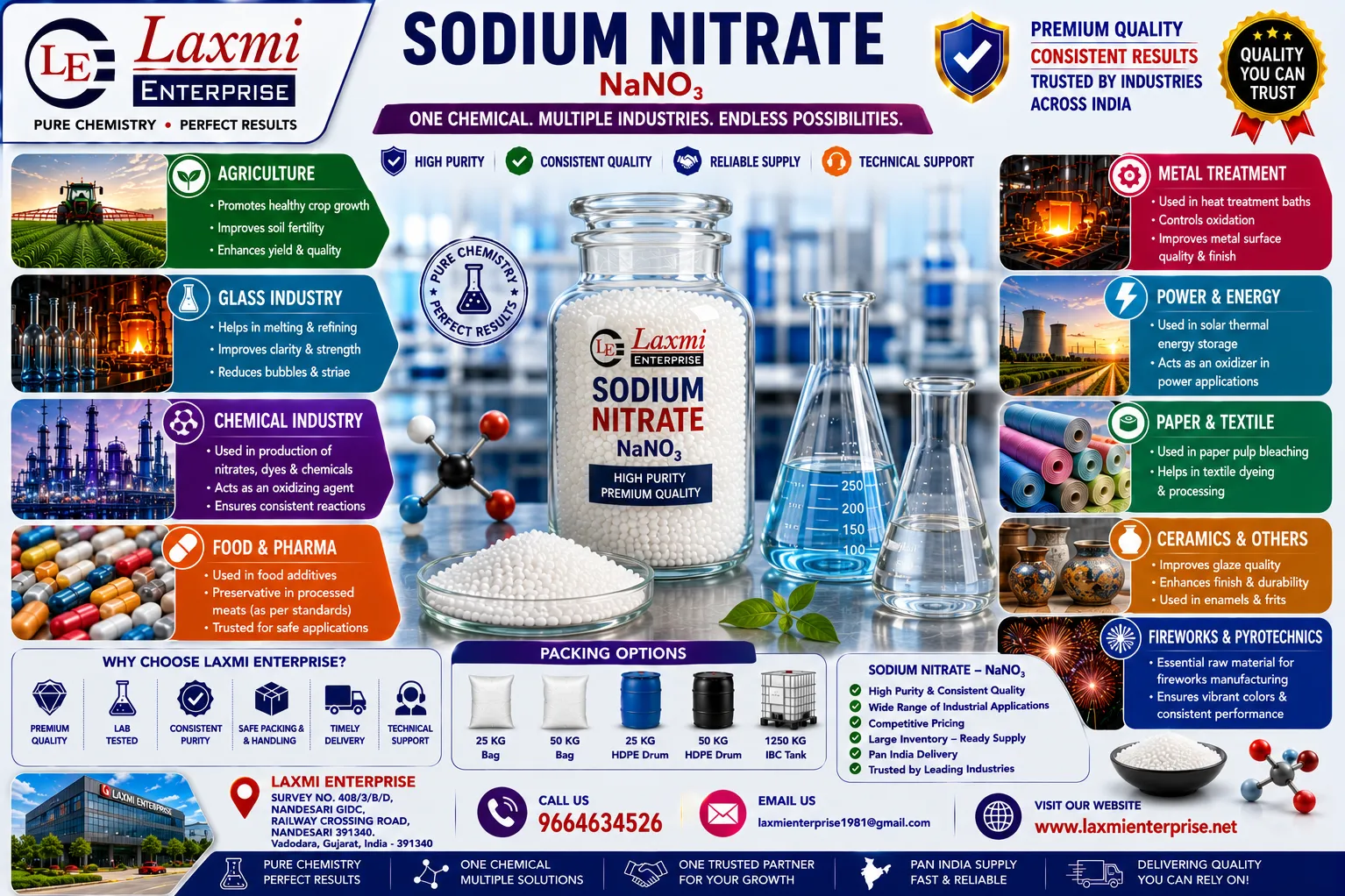
Sodium Nitrate is an inorganic nitrate salt with the chemical formula NaNO3.
It is supplied as a white crystalline material with excellent water solubility and stable chemical properties.
Because of its oxidizing characteristics, Sodium Nitrate is used in selected industrial processes where controlled oxidation is required.
In the glass industry, it is primarily valued for its ability to assist oxidation reactions during the melting stage.
Why Glass Manufacturing Requires Oxidizing Agents
Glass production is not simply the melting of sand.
A glass batch contains multiple raw materials that react together at high temperatures.
During melting, gases are released.
Organic impurities may be present.
Certain metallic compounds can influence glass colour.
If these reactions are not properly controlled, manufacturers may experience
Small bubbles trapped inside the glass
Uneven colour
Reduced transparency
Surface defects
Lower production efficiency
Oxidizing agents help create a cleaner melting environment by supporting controlled chemical reactions inside the furnace.
How Sodium Nitrate Functions During Glass Melting
As furnace temperatures increase, Sodium Nitrate gradually decomposes.
During this process, oxygen becomes available within the molten glass.
This oxygen assists oxidation reactions inside the melt.
A controlled oxidizing atmosphere helps improve melting conditions and supports cleaner glass production.
Production engineers value this predictable behaviour because it contributes to consistent furnace performance.
Benefits of Using High Quality Sodium Nitrate
When manufacturers use consistent industrial grade Sodium Nitrate, several production advantages may be observed.
Improved melting consistency.
Better oxidation control.
Reduced process variation.
More predictable furnace operation.
Improved batch repeatability.
Stable production conditions.
Better control of finished glass quality.
These benefits become particularly important in continuous furnace operations where production continues twenty four hours a day.
Why Purity Matters
Not all Sodium Nitrate performs identically.
High purity material provides greater consistency during manufacturing.
Lower impurity levels help reduce unnecessary variability inside the furnace.
Manufacturers therefore evaluate suppliers carefully before approving long term procurement agreements.
Consistent purity also helps production engineers maintain established process parameters.
The Importance of Particle Size
Many buyers focus only on chemical purity.
However, particle size can also influence production.
Uniform particle distribution provides
Better blending with other batch materials.
Improved material flow.
Consistent charging.
Reduced segregation during transportation.
Easier handling in automated systems.
These practical advantages contribute to more consistent production.
Moisture Control
Moisture is another important quality parameter.
Excess moisture may create handling difficulties during storage.
Material flow becomes less predictable.
Packaging performance may also be affected.
Industrial manufacturers therefore prefer suppliers who maintain proper storage conditions before dispatch.
Storage Recommendations
Glass manufacturers generally follow several good storage practices.
Store material indoors.
Protect from rain.
Avoid excessive humidity.
Keep bags sealed until use.
Rotate warehouse inventory.
Maintain clean storage conditions.
Proper storage helps preserve product quality throughout the storage period.
Procurement Considerations for Glass Manufacturers
When purchasing Sodium Nitrate, experienced procurement teams evaluate several factors beyond price.
Product consistency.
Supplier experience.
Inventory availability.
Packaging quality.
Delivery reliability.
Commercial flexibility.
Technical documentation.
Long term supply capability.
These considerations reduce procurement risk while supporting continuous production.
Practical Advice from Industrial Experience
Manufacturers sometimes change suppliers to reduce purchase cost.
However, frequent supplier changes can introduce unnecessary production variation.
Every supplier may have slightly different manufacturing methods.
Physical characteristics may vary.
Handling behaviour may change.
Production teams may need to adjust operating conditions.
Many successful glass manufacturers therefore prefer long term partnerships with suppliers who consistently deliver dependable quality.
How Laxmi Enterprise Supports Glass Manufacturers
Laxmi Enterprise supplies industrial grade Sodium Nitrate from Nandesari GIDC, Vadodara to glass manufacturers throughout India.
We understand that continuous furnace operation depends on reliable raw materials.
Our focus is on
Consistent product quality.
Dependable deliveries.
Professional documentation.
Flexible packaging.
Responsive customer support.
Long term supply partnerships.
Every shipment is supplied with the understanding that reliable raw materials contribute directly to stable manufacturing.
Final Thoughts
Glass manufacturing is one of the most technically demanding industrial processes.
Every raw material influences furnace behaviour and finished product quality.
Sodium Nitrate performs an important technical function by supporting oxidation during melting and helping manufacturers maintain consistent production conditions.
Manufacturers who understand both the chemistry and the commercial aspects of Sodium Nitrate purchasing are better positioned to improve production efficiency and build long term manufacturing success.
Frequently Asked Questions About Sodium Nitrate in Glass Manufacturing
What is the purpose of Sodium Nitrate in glass manufacturing
Sodium Nitrate acts as an oxidizing agent in selected glass manufacturing processes. It helps maintain controlled oxidation conditions during melting and supports consistent glass production.
Does every glass manufacturer use Sodium Nitrate
No. Its use depends on the glass formulation, manufacturing process and product requirements.
Why is high purity Sodium Nitrate important
High purity helps reduce unwanted impurities, supports stable furnace conditions and improves production consistency.
Does Sodium Nitrate improve glass clarity
When used according to the manufacturing process, Sodium Nitrate helps maintain oxidation conditions that contribute to producing high quality glass.
Can poor quality Sodium Nitrate affect furnace performance
Variations in raw material quality may influence melting behaviour, process stability and overall production consistency.
What industries purchase Sodium Nitrate for glass manufacturing
Float glass manufacturers, container glass manufacturers, solar glass producers, specialty glass manufacturers and decorative glass manufacturers may use Sodium Nitrate depending on their formulations.
What packaging is suitable for glass manufacturers
Twenty five kilogram bags, fifty kilogram bags, one thousand kilogram jumbo bags and bulk industrial supply depending on consumption.
What should procurement managers evaluate before purchasing
Product purity, consistency, supplier reliability, packaging, delivery schedules, inventory availability and technical support.
Can Sodium Nitrate be supplied regularly throughout the year
Yes. Industrial suppliers generally support planned monthly, quarterly and annual supply arrangements.
Why do manufacturers choose long term suppliers
Long term suppliers provide consistent quality, dependable deliveries, better communication and improved production planning.
Can Sodium Nitrate be supplied across India
Yes. Laxmi Enterprise supplies industrial customers across Gujarat, Maharashtra, Rajasthan, Madhya Pradesh, Uttar Pradesh, Delhi NCR, Haryana, Punjab, Karnataka, Telangana, Andhra Pradesh, Tamil Nadu, Odisha, West Bengal and other industrial regions.
Where is Laxmi Enterprise located
Survey No. 408/3/B/D, Nandesari GIDC, Railway Crossing Road, Nandesari, Vadodara, Gujarat 391340.
Expert Insight
One observation seen across successful glass manufacturing companies is that they rarely evaluate Sodium Nitrate only on its purchase price. Instead, they assess how consistently it performs over months of production. A small improvement in production stability can often be more valuable than a small reduction in raw material cost. This practical, long-term perspective is one reason experienced manufacturers place significant emphasis on supplier consistency and quality.
About Laxmi Enterprise
Laxmi Enterprise is a trusted manufacturer, supplier and distributor of industrial chemicals based in Nandesari GIDC, Vadodara, Gujarat. We supply Sodium Nitrate, Sodium Sulphate, Sodium Acetate, Tri Sodium Phosphate and other industrial chemicals to manufacturers across glass, chemical processing, engineering, ceramic, heat treatment, textile, paper, construction, water treatment and allied industries throughout India.
Our focus is on consistent product quality, dependable logistics, professional customer support and long-term supply relationships that help manufacturers achieve reliable production and sustainable business growth.
Introduction
The quality of glass begins long before raw materials enter the furnace.
Every successful glass manufacturer understands that consistent production depends on selecting the right combination of silica sand, soda ash, limestone and specialty additives. Each ingredient has a specific purpose during melting, refining and forming. When one material performs differently from expected, furnace efficiency, glass clarity and production stability may all be affected.
Among the specialty chemicals used in selected glass formulations, Sodium Nitrate plays an important technical role. Although it represents a relatively small percentage of the glass batch, its contribution during melting can significantly influence production consistency and finished glass quality.
For production engineers, furnace operators, procurement managers and quality control professionals, understanding how Sodium Nitrate functions inside the glass furnace helps improve purchasing decisions and manufacturing performance.
What is Sodium Nitrate
Sodium Nitrate is an inorganic nitrate salt with the chemical formula NaNO3.
It is supplied as a white crystalline material with excellent water solubility and stable chemical properties.
Because of its oxidizing characteristics, Sodium Nitrate is used in selected industrial processes where controlled oxidation is required.
In the glass industry, it is primarily valued for its ability to assist oxidation reactions during the melting stage.
Why Glass Manufacturing Requires Oxidizing Agents
Glass production is not simply the melting of sand.
A glass batch contains multiple raw materials that react together at high temperatures.
During melting, gases are released.
Organic impurities may be present.
Certain metallic compounds can influence glass colour.
If these reactions are not properly controlled, manufacturers may experience
Small bubbles trapped inside the glass
Uneven colour
Reduced transparency
Surface defects
Lower production efficiency
Oxidizing agents help create a cleaner melting environment by supporting controlled chemical reactions inside the furnace.
How Sodium Nitrate Functions During Glass Melting
As furnace temperatures increase, Sodium Nitrate gradually decomposes.
During this process, oxygen becomes available within the molten glass.
This oxygen assists oxidation reactions inside the melt.
A controlled oxidizing atmosphere helps improve melting conditions and supports cleaner glass production.
Production engineers value this predictable behaviour because it contributes to consistent furnace performance.
Benefits of Using High Quality Sodium Nitrate
When manufacturers use consistent industrial grade Sodium Nitrate, several production advantages may be observed.
Improved melting consistency.
Better oxidation control.
Reduced process variation.
More predictable furnace operation.
Improved batch repeatability.
Stable production conditions.
Better control of finished glass quality.
These benefits become particularly important in continuous furnace operations where production continues twenty four hours a day.
Why Purity Matters
Not all Sodium Nitrate performs identically.
High purity material provides greater consistency during manufacturing.
Lower impurity levels help reduce unnecessary variability inside the furnace.
Manufacturers therefore evaluate suppliers carefully before approving long term procurement agreements.
Consistent purity also helps production engineers maintain established process parameters.
The Importance of Particle Size
Many buyers focus only on chemical purity.
However, particle size can also influence production.
Uniform particle distribution provides
Better blending with other batch materials.
Improved material flow.
Consistent charging.
Reduced segregation during transportation.
Easier handling in automated systems.
These practical advantages contribute to more consistent production.
Moisture Control
Moisture is another important quality parameter.
Excess moisture may create handling difficulties during storage.
Material flow becomes less predictable.
Packaging performance may also be affected.
Industrial manufacturers therefore prefer suppliers who maintain proper storage conditions before dispatch.
Storage Recommendations
Glass manufacturers generally follow several good storage practices.
Store material indoors.
Protect from rain.
Avoid excessive humidity.
Keep bags sealed until use.
Rotate warehouse inventory.
Maintain clean storage conditions.
Proper storage helps preserve product quality throughout the storage period.
Procurement Considerations for Glass Manufacturers
When purchasing Sodium Nitrate, experienced procurement teams evaluate several factors beyond price.
Product consistency.
Supplier experience.
Inventory availability.
Packaging quality.
Delivery reliability.
Commercial flexibility.
Technical documentation.
Long term supply capability.
These considerations reduce procurement risk while supporting continuous production.
Practical Advice from Industrial Experience
Manufacturers sometimes change suppliers to reduce purchase cost.
However, frequent supplier changes can introduce unnecessary production variation.
Every supplier may have slightly different manufacturing methods.
Physical characteristics may vary.
Handling behaviour may change.
Production teams may need to adjust operating conditions.
Many successful glass manufacturers therefore prefer long term partnerships with suppliers who consistently deliver dependable quality.
How Laxmi Enterprise Supports Glass Manufacturers
Laxmi Enterprise supplies industrial grade Sodium Nitrate from Nandesari GIDC, Vadodara to glass manufacturers throughout India.
We understand that continuous furnace operation depends on reliable raw materials.
Our focus is on
Consistent product quality.
Dependable deliveries.
Professional documentation.
Flexible packaging.
Responsive customer support.
Long term supply partnerships.
Every shipment is supplied with the understanding that reliable raw materials contribute directly to stable manufacturing.
Final Thoughts
Glass manufacturing is one of the most technically demanding industrial processes.
Every raw material influences furnace behaviour and finished product quality.
Sodium Nitrate performs an important technical function by supporting oxidation during melting and helping manufacturers maintain consistent production conditions.
Manufacturers who understand both the chemistry and the commercial aspects of Sodium Nitrate purchasing are better positioned to improve production efficiency and build long term manufacturing success.
Frequently Asked Questions About Sodium Nitrate in Glass Manufacturing
What is the purpose of Sodium Nitrate in glass manufacturing
Sodium Nitrate acts as an oxidizing agent in selected glass manufacturing processes. It helps maintain controlled oxidation conditions during melting and supports consistent glass production.
Does every glass manufacturer use Sodium Nitrate
No. Its use depends on the glass formulation, manufacturing process and product requirements.
Why is high purity Sodium Nitrate important
High purity helps reduce unwanted impurities, supports stable furnace conditions and improves production consistency.
Does Sodium Nitrate improve glass clarity
When used according to the manufacturing process, Sodium Nitrate helps maintain oxidation conditions that contribute to producing high quality glass.
Can poor quality Sodium Nitrate affect furnace performance
Variations in raw material quality may influence melting behaviour, process stability and overall production consistency.
What industries purchase Sodium Nitrate for glass manufacturing
Float glass manufacturers, container glass manufacturers, solar glass producers, specialty glass manufacturers and decorative glass manufacturers may use Sodium Nitrate depending on their formulations.
What packaging is suitable for glass manufacturers
Twenty five kilogram bags, fifty kilogram bags, one thousand kilogram jumbo bags and bulk industrial supply depending on consumption.
What should procurement managers evaluate before purchasing
Product purity, consistency, supplier reliability, packaging, delivery schedules, inventory availability and technical support.
Can Sodium Nitrate be supplied regularly throughout the year
Yes. Industrial suppliers generally support planned monthly, quarterly and annual supply arrangements.
Why do manufacturers choose long term suppliers
Long term suppliers provide consistent quality, dependable deliveries, better communication and improved production planning.
Can Sodium Nitrate be supplied across India
Yes. Laxmi Enterprise supplies industrial customers across Gujarat, Maharashtra, Rajasthan, Madhya Pradesh, Uttar Pradesh, Delhi NCR, Haryana, Punjab, Karnataka, Telangana, Andhra Pradesh, Tamil Nadu, Odisha, West Bengal and other industrial regions.
Where is Laxmi Enterprise located
Survey No. 408/3/B/D, Nandesari GIDC, Railway Crossing Road, Nandesari, Vadodara, Gujarat 391340.
Expert Insight
One observation seen across successful glass manufacturing companies is that they rarely evaluate Sodium Nitrate only on its purchase price. Instead, they assess how consistently it performs over months of production. A small improvement in production stability can often be more valuable than a small reduction in raw material cost. This practical, long-term perspective is one reason experienced manufacturers place significant emphasis on supplier consistency and quality.
About Laxmi Enterprise
Laxmi Enterprise is a trusted manufacturer, supplier and distributor of industrial chemicals based in Nandesari GIDC, Vadodara, Gujarat. We supply Sodium Nitrate, Sodium Sulphate, Sodium Acetate, Tri Sodium Phosphate and other industrial chemicals to manufacturers across glass, chemical processing, engineering, ceramic, heat treatment, textile, paper, construction, water treatment and allied industries throughout India.
Our focus is on consistent product quality, dependable logistics, professional customer support and long-term supply relationships that help manufacturers achieve reliable production and sustainable business growth.
Keywords