Industrial Applications of Sodium Nitrate: A Comprehensive Technical Guide for Glass Manufacturing, Heat Treatment, Chemical Processing, Metal Finishing, Water Treatment, Ceramics, Specialty Chemicals, Laboratories, Explosives, and Emerging Technologies
Introduction
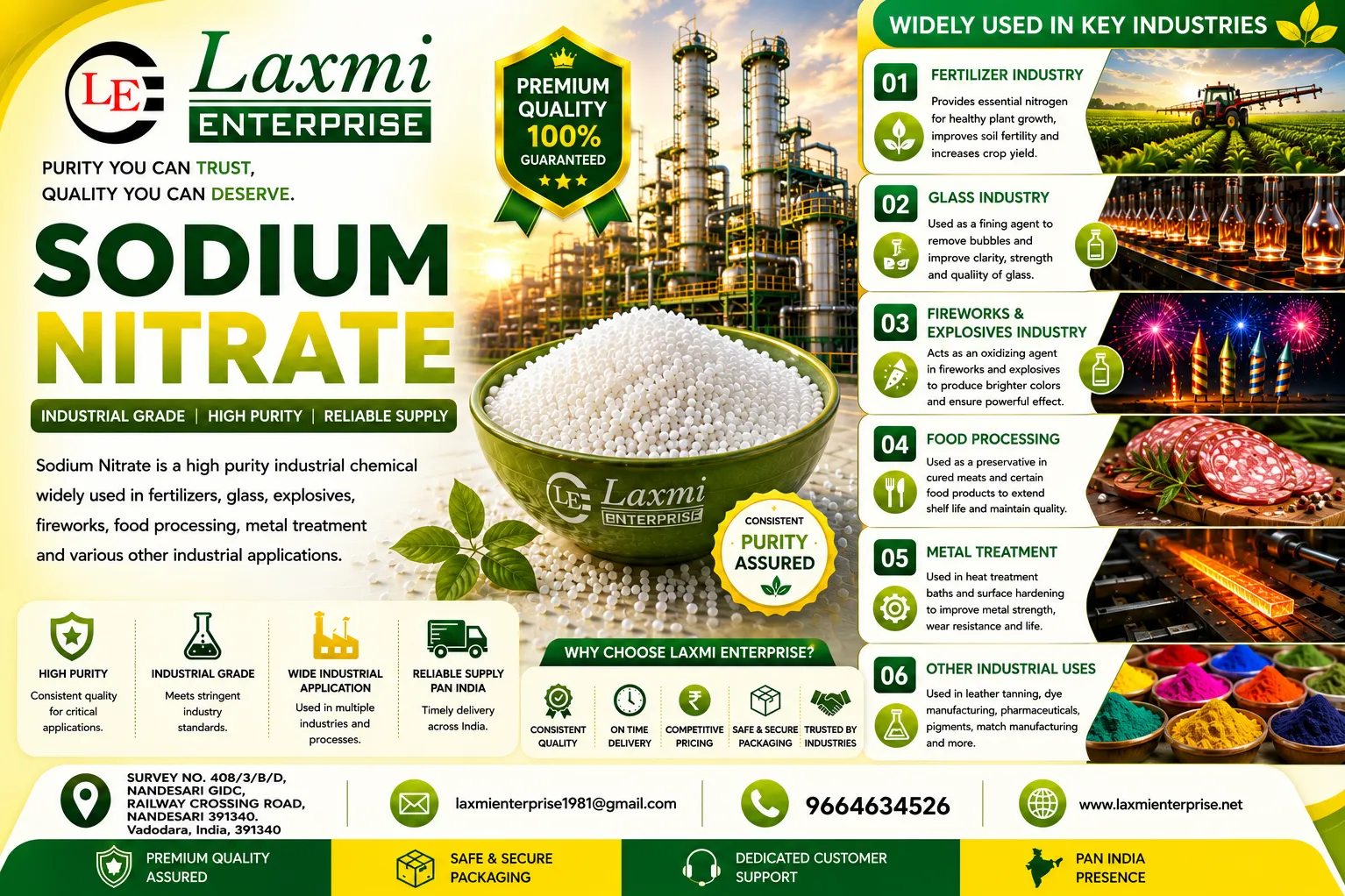
Sodium nitrate (NaNO₃), commonly known as Chile Saltpeter or Nitrate of Soda, is one of the most versatile inorganic chemicals used across numerous industrial sectors. While its chemical formula appears simple, its combination of high nitrate content, excellent water solubility, strong oxidizing characteristics, thermal stability, and chemical compatibility makes it an essential raw material in modern manufacturing.
Industrial buyers rarely purchase sodium nitrate simply because it meets a chemical specification. They select a grade based on how effectively it performs in a specific application. A glass manufacturer prioritizes optical clarity and low impurity levels, while a heat-treatment facility focuses on thermal stability and molten salt performance. Chemical manufacturers seek predictable reaction behavior, whereas laboratories demand exceptional analytical purity.
Understanding the relationship between sodium nitrate's physical and chemical properties and its industrial performance enables engineers, procurement teams, quality managers, and R& D professionals to make informed purchasing decisions.
This guide examines the major industrial applications of sodium nitrate, the technical requirements for each sector, and the future opportunities driving demand.
Chemical Properties That Make Sodium Nitrate Valuable
Several characteristics contribute to sodium nitrate's broad industrial use.
High Water Solubility
Sodium nitrate dissolves rapidly in water, allowing:
Fast solution preparation
Uniform concentration
Efficient chemical reactions
Easy dosing in industrial systems
Excellent Chemical Stability
Under recommended storage conditions, sodium nitrate maintains:
Chemical purity
Crystal structure
Consistent composition
Reliable process performance
Strong Oxidizing Characteristics
The nitrate ion provides controlled oxidizing capability required in several industrial processes.
Applications include:
Glass refining
Chemical synthesis
Metal processing
Specialty manufacturing
Proper handling and process controls are essential because oxidizing materials can intensify combustion when in contact with incompatible substances.
High Thermal Stability
Sodium nitrate performs well under elevated temperatures, making it useful in:
Molten salt systems
Heat treatment
Thermal processing
Industrial heating operations
Glass Manufacturing Industry
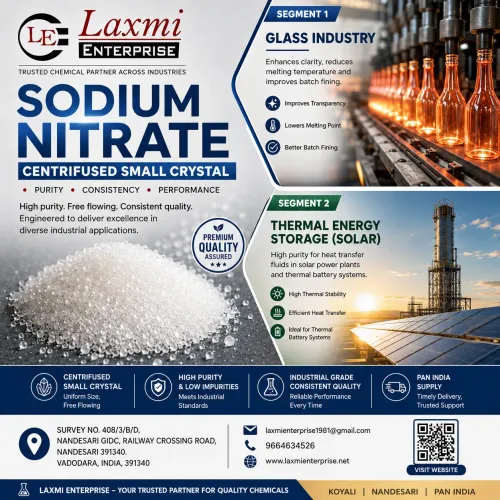
The glass industry is among the largest industrial consumers of sodium nitrate.
Role During Glass Melting
During melting, sodium nitrate contributes to refining by supporting the removal of entrapped gases, helping produce a more homogeneous glass melt.
Benefits include:
Improved optical quality
Reduced gaseous inclusions
Better melt homogeneity
Enhanced transparency
Improved surface finish
Applications
Glass manufacturers use sodium nitrate in the production of:
Float glass
Container glass
Optical glass
Decorative glass
Specialty technical glass
Purchasing Considerations
Glass manufacturers generally evaluate:
Purity
Moisture content
Chloride level
Insoluble matter
Particle size consistency
These factors influence melting behavior and final glass quality.
Molten Salt Heat Treatment
Sodium nitrate is widely used in molten salt systems because of its thermal characteristics.
Typical applications include:
Uniform component heating
Controlled thermal processing
Temperature stabilization
Industrial heat transfer operations
Advantages include:
Excellent heat transfer
Stable operating conditions
Uniform temperature distribution
Reduced thermal gradients
Heat Transfer Systems
Molten nitrate salts are used in industrial heat transfer applications requiring stable thermal media.
Benefits include:
Efficient heat storage
High heat capacity
Uniform temperature control
Reduced thermal fluctuations
These systems are commonly engineered using carefully controlled salt compositions designed for the required operating temperature range.
Chemical Manufacturing
Sodium nitrate serves as a raw material and reagent in numerous chemical manufacturing processes.
Applications include:
Nitrate chemistry
Oxidation reactions
Inorganic synthesis
Intermediate production
Specialty chemical manufacturing
Its predictable chemical behavior makes it suitable for controlled industrial reactions.
Specialty Chemical Production
Many specialty chemical manufacturers use sodium nitrate during:
Catalyst preparation
Chemical formulations
Surface treatment chemistry
Process intermediates
Consistent quality contributes to reproducible manufacturing outcomes.
Metal Processing Industry
Metal processing operations use sodium nitrate in selected oxidation and thermal treatment applications.
Examples include:
Surface treatment
Oxidation processes
Controlled thermal operations
Process chemistry
Product consistency supports stable industrial performance.
Metallurgical Applications
Within metallurgical industries, sodium nitrate may be incorporated into processes requiring controlled oxidizing conditions or elevated-temperature salt systems.
Engineers evaluate:
Chemical purity
Thermal behavior
Process compatibility
Contaminant levels
Laboratory Applications
Analytical laboratories use sodium nitrate for:
Reagent preparation
Analytical chemistry
Instrument calibration support
Educational demonstrations
Research activities
Laboratory-grade materials emphasize high purity and controlled impurity profiles.
Research and Development
Universities, industrial research centers, and technology organizations utilize sodium nitrate in:
Materials research
Process development
Chemical investigations
Pilot-scale studies
Experimental design
Reliable chemical quality supports reproducible scientific results.
Ceramic Industry
Certain ceramic manufacturing processes use sodium nitrate in formulations and thermal processing where controlled chemical behavior is required.
Applications vary according to:
Product composition
Manufacturing method
Desired material properties
Water Treatment Applications
Industrial water treatment facilities may use nitrate-containing chemicals in specialized treatment processes where technically appropriate.
Engineers evaluate:
Water chemistry
Process objectives
Regulatory requirements
System compatibility
Chemical selection should always be based on site-specific engineering evaluation.
Explosives Industry
Sodium nitrate is used in legitimate industrial applications involving explosive formulations, particularly in mining, quarrying, and civil engineering, under strict regulatory controls.
Because these applications involve specialized safety, security, and legal requirements, all handling, storage, transportation, and use must comply with applicable regulations and be performed only by qualified organizations.
Fertilizer Manufacturing
Sodium nitrate has historically been used as a nitrogen-containing fertilizer due to its nitrate nitrogen content.
Modern agricultural use depends on:
Local regulations
Crop requirements
Soil conditions
Nutrient management practices
Selection should follow agronomic recommendations and applicable regulatory guidance.
Food Industry
Certain nitrate compounds have specialized applications within regulated food sectors.
However, the suitability of sodium nitrate depends on jurisdiction-specific food regulations and product requirements. Manufacturers should always comply with applicable food safety standards and legal requirements.
Pharmaceutical and Biotechnology Research
Research organizations may use sodium nitrate in laboratory investigations involving:
Analytical chemistry
Biological research
Process development
Instrument calibration
Material selection depends on purity requirements and applicable quality standards.
Environmental Applications
Environmental laboratories and research institutions may use sodium nitrate for:
Analytical testing
Environmental studies
Process evaluations
Scientific investigations
Appropriate handling and disposal procedures should always be followed.
Renewable Energy
Nitrate salts play an important role in thermal energy storage technologies, particularly in concentrated solar power (CSP) systems. While commercial heat-transfer formulations often use blends of nitrate salts, sodium nitrate is a key component because it contributes to thermal stability and heat storage capacity.
Typical advantages include:
Efficient thermal energy storage
High operating temperatures
Reliable heat transfer
Long service life when properly managed
Emerging High-Technology Applications
Research continues into new applications for sodium nitrate in:
Advanced thermal storage systems
Functional materials
Sustainable process technologies
Smart manufacturing
Energy-efficient industrial systems
Innovation is expanding the range of potential industrial uses.
Selecting the Right Grade
Industrial buyers should evaluate sodium nitrate based on:
Chemical Purity
Higher purity improves consistency and reduces the risk of contamination in sensitive processes.
Moisture Content
Low moisture supports:
Better flowability
Longer storage stability
Reduced caking
Particle Size Distribution
Particle size affects:
Dissolution rate
Material handling
Feeding accuracy
Dust generation
Bulk Density
Bulk density influences:
Packaging efficiency
Storage capacity
Feeding system performance
Documentation
Professional suppliers should provide, where applicable:
Certificate of Analysis (COA)
Technical Data Sheet (TDS)
Safety Data Sheet (SDS)
Batch traceability records
Choosing a Reliable Sodium Nitrate Supplier
Industrial buyers should consider:
Manufacturing consistency
Product quality
Technical expertise
Laboratory capabilities
Inventory availability
Packaging options
Documentation support
Supply reliability
Customer service
Regulatory compliance
Long-term partnerships with dependable suppliers help reduce operational risk and ensure continuity of supply.
Future Market Outlook
Global demand for sodium nitrate is expected to evolve with growth in:
Renewable energy infrastructure
Specialty glass manufacturing
High-performance chemicals
Advanced materials
Sustainable industrial processes
Smart manufacturing technologies
Manufacturers investing in quality, innovation, and digital transformation will be well positioned to support these emerging markets.
Conclusion
Sodium nitrate remains one of the most versatile industrial inorganic chemicals due to its unique combination of chemical stability, solubility, thermal properties, and oxidizing characteristics. Its applications span glass manufacturing, heat treatment, chemical synthesis, laboratory research, specialty chemicals, thermal energy storage, and many other industrial sectors. Selecting the appropriate grade, ensuring consistent quality, and working with a technically capable supplier are essential for maximizing process performance and operational reliability. As industries continue to adopt advanced manufacturing and sustainable technologies, sodium nitrate will remain an important material supporting industrial innovation and growth.
Frequently Asked Questions (FAQ)
Why is sodium nitrate widely used in industrial applications?
Its high purity, water solubility, thermal stability, predictable chemical behavior, and oxidizing properties make it suitable for a wide range of manufacturing processes.
Which industry consumes significant quantities of sodium nitrate?
The glass manufacturing industry is one of the major industrial users, where sodium nitrate contributes to glass refining and improved melt quality.
How does particle size affect industrial performance?
Particle size influences dissolution speed, feeding consistency, dust generation, flowability, and overall process efficiency.
Why is product purity important?
Higher purity minimizes contaminants that could affect chemical reactions, glass quality, thermal processing, or laboratory accuracy.
What documents should industrial buyers request from suppliers?
Common technical documents include the Certificate of Analysis (COA), Technical Data Sheet (TDS), Safety Data Sheet (SDS), and batch traceability records.
What factors should be considered when selecting a supplier?
Buyers should evaluate product quality, manufacturing consistency, technical support, inventory availability, documentation, packaging options, and supply reliability.
Is sodium nitrate suitable for renewable energy applications?
Yes. Sodium nitrate is an important component in certain molten salt formulations used for thermal energy storage in concentrated solar power systems and related high-temperature heat-transfer applications.
What future industries are expected to increase sodium nitrate demand?
Growth is anticipated in renewable energy, specialty chemicals, advanced materials, high-performance glass, digital manufacturing, and sustainable industrial technologies.
Introduction
Sodium nitrate (NaNO₃), commonly known as Chile Saltpeter or Nitrate of Soda, is one of the most versatile inorganic chemicals used across numerous industrial sectors. While its chemical formula appears simple, its combination of high nitrate content, excellent water solubility, strong oxidizing characteristics, thermal stability, and chemical compatibility makes it an essential raw material in modern manufacturing.
Industrial buyers rarely purchase sodium nitrate simply because it meets a chemical specification. They select a grade based on how effectively it performs in a specific application. A glass manufacturer prioritizes optical clarity and low impurity levels, while a heat-treatment facility focuses on thermal stability and molten salt performance. Chemical manufacturers seek predictable reaction behavior, whereas laboratories demand exceptional analytical purity.
Understanding the relationship between sodium nitrate's physical and chemical properties and its industrial performance enables engineers, procurement teams, quality managers, and R& D professionals to make informed purchasing decisions.
This guide examines the major industrial applications of sodium nitrate, the technical requirements for each sector, and the future opportunities driving demand.
Chemical Properties That Make Sodium Nitrate Valuable
Several characteristics contribute to sodium nitrate's broad industrial use.
High Water Solubility
Sodium nitrate dissolves rapidly in water, allowing:
Fast solution preparation
Uniform concentration
Efficient chemical reactions
Easy dosing in industrial systems
Excellent Chemical Stability
Under recommended storage conditions, sodium nitrate maintains:
Chemical purity
Crystal structure
Consistent composition
Reliable process performance
Strong Oxidizing Characteristics
The nitrate ion provides controlled oxidizing capability required in several industrial processes.
Applications include:
Glass refining
Chemical synthesis
Metal processing
Specialty manufacturing
Proper handling and process controls are essential because oxidizing materials can intensify combustion when in contact with incompatible substances.
High Thermal Stability
Sodium nitrate performs well under elevated temperatures, making it useful in:
Molten salt systems
Heat treatment
Thermal processing
Industrial heating operations
Glass Manufacturing Industry
The glass industry is among the largest industrial consumers of sodium nitrate.
Role During Glass Melting
During melting, sodium nitrate contributes to refining by supporting the removal of entrapped gases, helping produce a more homogeneous glass melt.
Benefits include:
Improved optical quality
Reduced gaseous inclusions
Better melt homogeneity
Enhanced transparency
Improved surface finish
Applications
Glass manufacturers use sodium nitrate in the production of:
Float glass
Container glass
Optical glass
Decorative glass
Specialty technical glass
Purchasing Considerations
Glass manufacturers generally evaluate:
Purity
Moisture content
Chloride level
Insoluble matter
Particle size consistency
These factors influence melting behavior and final glass quality.
Molten Salt Heat Treatment
Sodium nitrate is widely used in molten salt systems because of its thermal characteristics.
Typical applications include:
Uniform component heating
Controlled thermal processing
Temperature stabilization
Industrial heat transfer operations
Advantages include:
Excellent heat transfer
Stable operating conditions
Uniform temperature distribution
Reduced thermal gradients
Heat Transfer Systems
Molten nitrate salts are used in industrial heat transfer applications requiring stable thermal media.
Benefits include:
Efficient heat storage
High heat capacity
Uniform temperature control
Reduced thermal fluctuations
These systems are commonly engineered using carefully controlled salt compositions designed for the required operating temperature range.
Chemical Manufacturing
Sodium nitrate serves as a raw material and reagent in numerous chemical manufacturing processes.
Applications include:
Nitrate chemistry
Oxidation reactions
Inorganic synthesis
Intermediate production
Specialty chemical manufacturing
Its predictable chemical behavior makes it suitable for controlled industrial reactions.
Specialty Chemical Production
Many specialty chemical manufacturers use sodium nitrate during:
Catalyst preparation
Chemical formulations
Surface treatment chemistry
Process intermediates
Consistent quality contributes to reproducible manufacturing outcomes.
Metal Processing Industry
Metal processing operations use sodium nitrate in selected oxidation and thermal treatment applications.
Examples include:
Surface treatment
Oxidation processes
Controlled thermal operations
Process chemistry
Product consistency supports stable industrial performance.
Metallurgical Applications
Within metallurgical industries, sodium nitrate may be incorporated into processes requiring controlled oxidizing conditions or elevated-temperature salt systems.
Engineers evaluate:
Chemical purity
Thermal behavior
Process compatibility
Contaminant levels
Laboratory Applications
Analytical laboratories use sodium nitrate for:
Reagent preparation
Analytical chemistry
Instrument calibration support
Educational demonstrations
Research activities
Laboratory-grade materials emphasize high purity and controlled impurity profiles.
Research and Development
Universities, industrial research centers, and technology organizations utilize sodium nitrate in:
Materials research
Process development
Chemical investigations
Pilot-scale studies
Experimental design
Reliable chemical quality supports reproducible scientific results.
Ceramic Industry
Certain ceramic manufacturing processes use sodium nitrate in formulations and thermal processing where controlled chemical behavior is required.
Applications vary according to:
Product composition
Manufacturing method
Desired material properties
Water Treatment Applications
Industrial water treatment facilities may use nitrate-containing chemicals in specialized treatment processes where technically appropriate.
Engineers evaluate:
Water chemistry
Process objectives
Regulatory requirements
System compatibility
Chemical selection should always be based on site-specific engineering evaluation.
Explosives Industry
Sodium nitrate is used in legitimate industrial applications involving explosive formulations, particularly in mining, quarrying, and civil engineering, under strict regulatory controls.
Because these applications involve specialized safety, security, and legal requirements, all handling, storage, transportation, and use must comply with applicable regulations and be performed only by qualified organizations.
Fertilizer Manufacturing
Sodium nitrate has historically been used as a nitrogen-containing fertilizer due to its nitrate nitrogen content.
Modern agricultural use depends on:
Local regulations
Crop requirements
Soil conditions
Nutrient management practices
Selection should follow agronomic recommendations and applicable regulatory guidance.
Food Industry
Certain nitrate compounds have specialized applications within regulated food sectors.
However, the suitability of sodium nitrate depends on jurisdiction-specific food regulations and product requirements. Manufacturers should always comply with applicable food safety standards and legal requirements.
Pharmaceutical and Biotechnology Research
Research organizations may use sodium nitrate in laboratory investigations involving:
Analytical chemistry
Biological research
Process development
Instrument calibration
Material selection depends on purity requirements and applicable quality standards.
Environmental Applications
Environmental laboratories and research institutions may use sodium nitrate for:
Analytical testing
Environmental studies
Process evaluations
Scientific investigations
Appropriate handling and disposal procedures should always be followed.
Renewable Energy
Nitrate salts play an important role in thermal energy storage technologies, particularly in concentrated solar power (CSP) systems. While commercial heat-transfer formulations often use blends of nitrate salts, sodium nitrate is a key component because it contributes to thermal stability and heat storage capacity.
Typical advantages include:
Efficient thermal energy storage
High operating temperatures
Reliable heat transfer
Long service life when properly managed
Emerging High-Technology Applications
Research continues into new applications for sodium nitrate in:
Advanced thermal storage systems
Functional materials
Sustainable process technologies
Smart manufacturing
Energy-efficient industrial systems
Innovation is expanding the range of potential industrial uses.
Selecting the Right Grade
Industrial buyers should evaluate sodium nitrate based on:
Chemical Purity
Higher purity improves consistency and reduces the risk of contamination in sensitive processes.
Moisture Content
Low moisture supports:
Better flowability
Longer storage stability
Reduced caking
Particle Size Distribution
Particle size affects:
Dissolution rate
Material handling
Feeding accuracy
Dust generation
Bulk Density
Bulk density influences:
Packaging efficiency
Storage capacity
Feeding system performance
Documentation
Professional suppliers should provide, where applicable:
Certificate of Analysis (COA)
Technical Data Sheet (TDS)
Safety Data Sheet (SDS)
Batch traceability records
Choosing a Reliable Sodium Nitrate Supplier
Industrial buyers should consider:
Manufacturing consistency
Product quality
Technical expertise
Laboratory capabilities
Inventory availability
Packaging options
Documentation support
Supply reliability
Customer service
Regulatory compliance
Long-term partnerships with dependable suppliers help reduce operational risk and ensure continuity of supply.
Future Market Outlook
Global demand for sodium nitrate is expected to evolve with growth in:
Renewable energy infrastructure
Specialty glass manufacturing
High-performance chemicals
Advanced materials
Sustainable industrial processes
Smart manufacturing technologies
Manufacturers investing in quality, innovation, and digital transformation will be well positioned to support these emerging markets.
Conclusion
Sodium nitrate remains one of the most versatile industrial inorganic chemicals due to its unique combination of chemical stability, solubility, thermal properties, and oxidizing characteristics. Its applications span glass manufacturing, heat treatment, chemical synthesis, laboratory research, specialty chemicals, thermal energy storage, and many other industrial sectors. Selecting the appropriate grade, ensuring consistent quality, and working with a technically capable supplier are essential for maximizing process performance and operational reliability. As industries continue to adopt advanced manufacturing and sustainable technologies, sodium nitrate will remain an important material supporting industrial innovation and growth.
Frequently Asked Questions (FAQ)
Why is sodium nitrate widely used in industrial applications?
Its high purity, water solubility, thermal stability, predictable chemical behavior, and oxidizing properties make it suitable for a wide range of manufacturing processes.
Which industry consumes significant quantities of sodium nitrate?
The glass manufacturing industry is one of the major industrial users, where sodium nitrate contributes to glass refining and improved melt quality.
How does particle size affect industrial performance?
Particle size influences dissolution speed, feeding consistency, dust generation, flowability, and overall process efficiency.
Why is product purity important?
Higher purity minimizes contaminants that could affect chemical reactions, glass quality, thermal processing, or laboratory accuracy.
What documents should industrial buyers request from suppliers?
Common technical documents include the Certificate of Analysis (COA), Technical Data Sheet (TDS), Safety Data Sheet (SDS), and batch traceability records.
What factors should be considered when selecting a supplier?
Buyers should evaluate product quality, manufacturing consistency, technical support, inventory availability, documentation, packaging options, and supply reliability.
Is sodium nitrate suitable for renewable energy applications?
Yes. Sodium nitrate is an important component in certain molten salt formulations used for thermal energy storage in concentrated solar power systems and related high-temperature heat-transfer applications.
What future industries are expected to increase sodium nitrate demand?
Growth is anticipated in renewable energy, specialty chemicals, advanced materials, high-performance glass, digital manufacturing, and sustainable industrial technologies.
Keywords