

Industrial Applications of Sodium Nitrate Free Flow
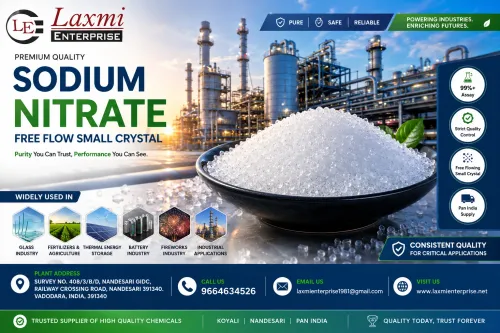
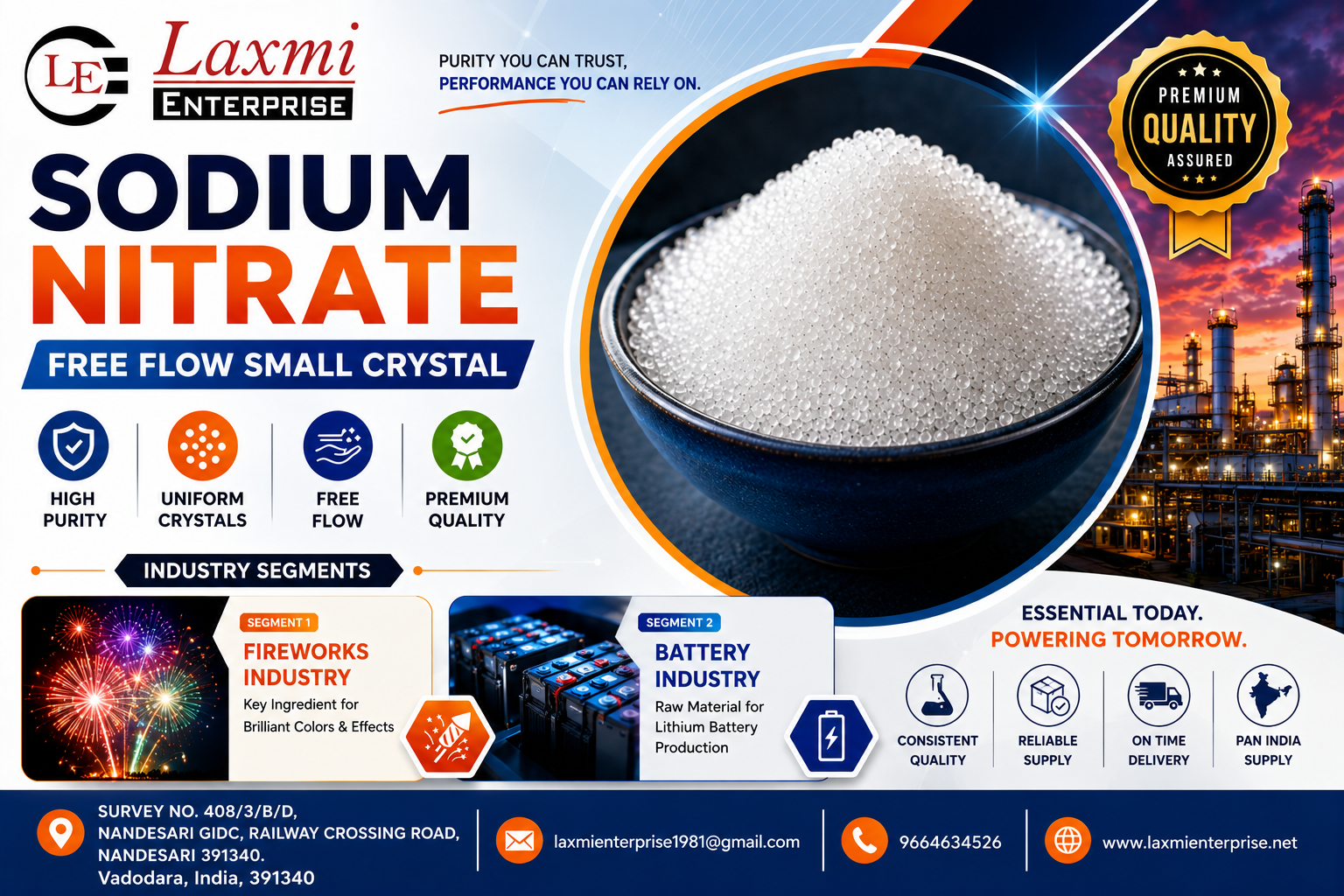
Sodium Nitrate Free Flow has established itself as one of the most versatile inorganic chemicals used in modern manufacturing. Its high purity, consistent crystal size, rapid water solubility, and excellent free-flowing characteristics make it an indispensable raw material across numerous industries.
Although the same chemical compound is supplied to different industries, its role varies depending on the manufacturing process. In some applications, Sodium Nitrate serves as an oxidizing agent, while in others it functions as a nitrate source, process chemical, heat transfer component, or formulation ingredient.
Selecting the correct product specification is essential because every industry has unique quality expectations regarding purity, particle size, moisture content, and packaging.
Below are the major industries where Sodium Nitrate Free Flow delivers measurable operational benefits.
Chemical Processing Industry
The chemical processing industry is one of the largest consumers of Sodium Nitrate Free Flow. It is widely used in the manufacture of inorganic chemicals, specialty chemicals, industrial intermediates, and process formulations.
Manufacturers value the product because it offers consistent quality, excellent dissolution characteristics, and reliable feeding performance in automated production systems.
Benefits
High purity supports consistent reactions.
Uniform crystal size improves blending.
Rapid dissolution reduces preparation time.
Free-flowing granules improve automated dosing.
Low moisture minimizes process variation.
Related Article: Sodium Nitrate Free Flow for Chemical Processing Industry
Glass Manufacturing Industry
In glass manufacturing, Sodium Nitrate is used during batch preparation to support oxidation and improve melt quality. It contributes to cleaner glass production and helps manufacturers maintain consistent processing conditions.
Its free-flowing nature also improves raw material handling before charging the furnace.
Benefits
Consistent batch preparation.
Improved raw material flow.
Reliable furnace charging.
Better handling efficiency.
Stable production quality.
Related Article: Sodium Nitrate Free Flow for Glass Manufacturing Industry
Ceramic Industry
Ceramic manufacturers use Sodium Nitrate in selected formulations where oxidation control and raw material consistency are important.
Uniform particle size assists in homogeneous mixing and contributes to consistent product quality.
Benefits
Better raw material blending.
Improved formulation consistency.
Reliable process control.
Reduced handling losses.
Related Article: Sodium Nitrate Free Flow for Ceramic Industry
Pigment Manufacturing
Pigment manufacturers require raw materials with predictable chemical behavior and controlled impurity levels.
Free Flow Sodium Nitrate supports efficient production by providing consistent physical and chemical characteristics.
Benefits
High product consistency.
Controlled impurity levels.
Uniform mixing.
Reliable production quality.
Related Article: Sodium Nitrate Free Flow for Pigment Manufacturing
Metal Refining Industry
The metal refining sector utilizes Sodium Nitrate in selected oxidation processes where controlled chemical performance is essential.
Manufacturers prefer Free Flow material because it improves handling and reduces interruptions caused by lump formation.
Benefits
Stable process conditions.
Improved material handling.
Consistent chemical quality.
Better production efficiency.
Related Article: Sodium Nitrate Free Flow for Metal Refining Industry
Thermal Energy Storage
Sodium Nitrate is an important component in molten salt systems used for industrial heat transfer and thermal energy storage.
High purity and consistent composition contribute to reliable thermal performance.
Benefits
High thermal stability.
Reliable product quality.
Consistent blending.
Long-term storage performance.
Related Article: Sodium Nitrate Free Flow for Thermal Energy Storage Systems
Laboratory Chemical Manufacturing
Laboratory chemical manufacturers require high-quality raw materials with documented specifications and traceability.
Free Flow Sodium Nitrate supports accurate weighing, easy handling, and reproducible laboratory formulations.
Benefits
Easy weighing.
Rapid dissolution.
High purity.
Reliable laboratory performance.
Related Article: Sodium Nitrate Free Flow for Laboratory Chemical Manufacturing
Specialty Chemical Industry
Specialty chemical manufacturers depend on consistent raw materials to maintain product quality and batch reproducibility.
Free Flow Sodium Nitrate provides dependable handling characteristics and stable chemical composition.
Benefits
Consistent manufacturing.
Reliable formulations.
Improved handling.
Batch-to-batch uniformity.
Related Article: Sodium Nitrate Free Flow for Specialty Chemical Manufacturing
Water Treatment Chemical Manufacturing
Manufacturers producing industrial water treatment chemicals often use Sodium Nitrate in specialized formulations requiring controlled nitrate content.
Consistent purity helps maintain product reliability.
Benefits
Stable formulation quality.
Reliable chemical composition.
Improved production efficiency.
Related Article: Sodium Nitrate Free Flow for Water Treatment Chemicals
Fertilizer Manufacturing
Sodium Nitrate serves as a nitrogen-containing raw material in selected fertilizer formulations.
Industrial users value its consistent composition and excellent handling properties.
Benefits
Reliable nitrogen content.
Easy blending.
Uniform granule size.
Consistent quality.
Related Article: Sodium Nitrate Free Flow for Fertilizer Manufacturing
Industrial Salt Blending
Manufacturers producing custom industrial salt blends require raw materials with consistent particle size and excellent flowability.
Free Flow Sodium Nitrate enhances blending accuracy and reduces segregation.
Benefits
Uniform blending.
Better flowability.
Improved storage.
Consistent formulations.
Related Article: Sodium Nitrate Free Flow for Industrial Salt Blending
Available Commercial Packing
To meet the needs of different industries, Sodium Nitrate Free Flow is commonly supplied in:
Packing Size Recommended Users
25 kg Bag Small and medium manufacturing units
50 kg Bag Regular industrial production
500 kg Jumbo Bag Large-scale manufacturing and bulk handling
Proper packaging helps protect the product from moisture during transportation and storage while improving warehouse efficiency.
Expert Advice for Industrial Buyers
Selecting the right Sodium Nitrate Free Flow product involves more than comparing prices. Consider these technical factors before making a purchase:
Match the product grade to your application.
Verify chemical purity and physical specifications.
Request a recent Certificate of Analysis (COA).
Ensure the packing size suits your handling system (25 kg, 50 kg, or 500 kg Jumbo Bag).
Confirm that the product is genuinely free-flowing with controlled particle size.
Store the material in a cool, dry, and well-ventilated warehouse.
Work with suppliers who provide consistent quality and technical documentation.
A technically suitable product can improve process efficiency, reduce downtime, and support long-term manufacturing reliability.
Industry Application FAQs
Why is Sodium Nitrate used in so many industries?
Sodium Nitrate combines high purity, excellent water solubility, stable chemical properties, and reliable flowability, making it suitable for a wide range of industrial applications.
Which industry consumes the largest quantity of Sodium Nitrate?
The chemical processing industry is among the largest consumers due to its extensive use in chemical manufacturing and industrial formulations. Consumption patterns vary depending on regional industrial demand.
Why is Free Flow Sodium Nitrate preferred for automated plants?
Its free-flowing granules move efficiently through hoppers, feeders, and conveyors, reducing blockages and improving dosing accuracy in automated production systems.
Can the same Sodium Nitrate grade be used across different industries?
Some industries may use similar grades, while others require application-specific specifications. Buyers should always confirm that the product meets the technical requirements of their intended use.
Does packaging affect product quality?
Yes. Properly sealed 25 kg, 50 kg, and 500 kg Jumbo Bags help protect the product from moisture and contamination, preserving its free-flowing characteristics during storage and transportation.
What should buyers discuss with a supplier before ordering?
Important topics include product specifications, purity, particle size, packing options, COA availability, storage recommendations, delivery schedules, and technical support.
How can a reliable supplier benefit industrial operations?
A dependable supplier provides consistent product quality, timely deliveries, technical documentation, and responsive support, helping manufacturers maintain stable production and reduce supply-related risks.