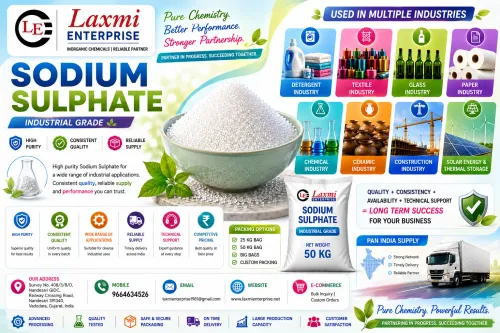


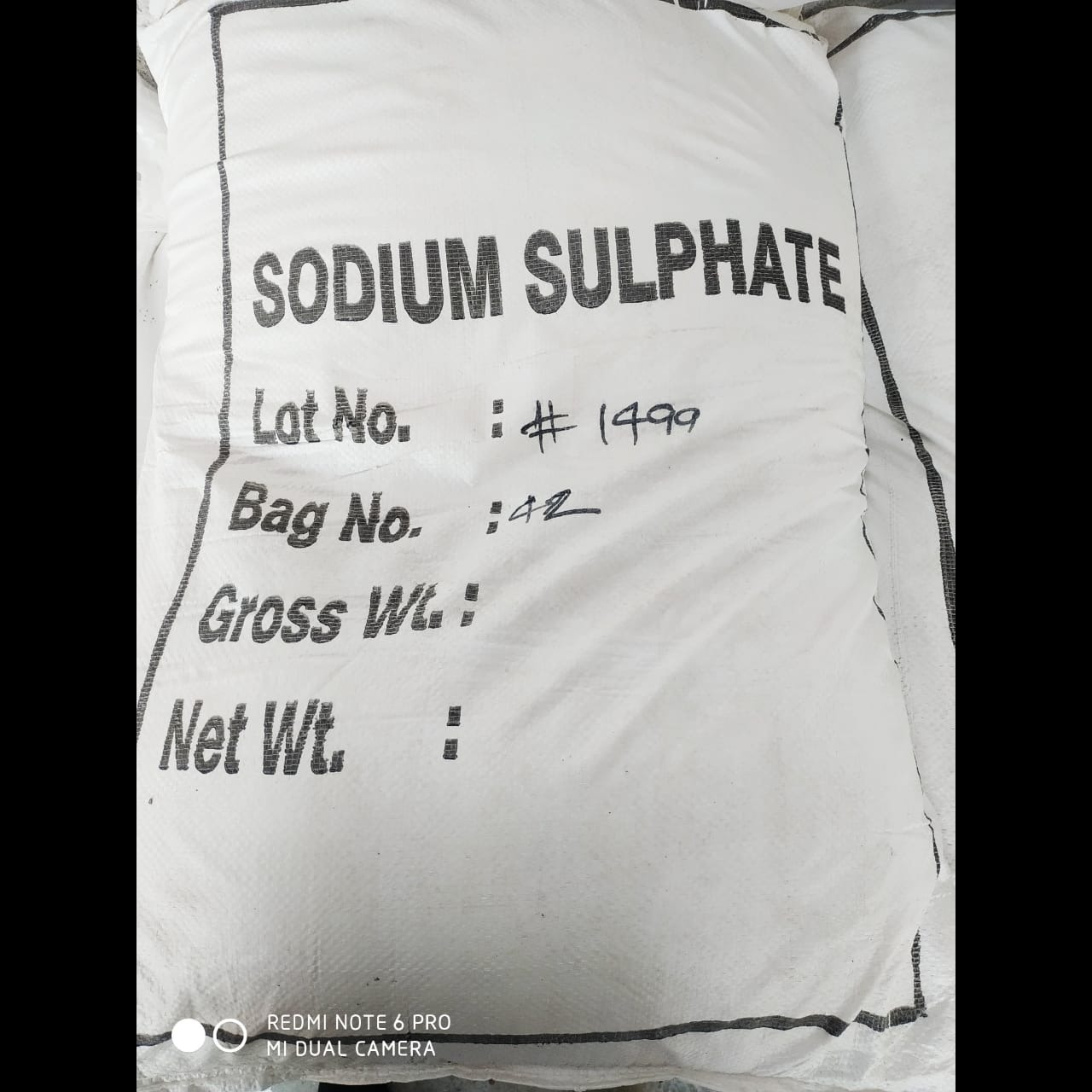
Sodium Sulfate (Na₂SO₄) — often referred to as Glauber’s Salt in its hydrated form (Na₂SO₄·10H₂O) — is widely used as a drying and dehydration agent in both laboratory and industrial applications. Here’s a detailed overview:
🔹 Chemical Information
Chemical Name: Sodium Sulfate
Molecular Formula: Na₂SO₄
Molar Mass: 142.04 g/mol (anhydrous)
CAS Number: 7757-82-6 (anhydrous)
Appearance: White crystalline solid or powder
Solubility: Soluble in water; insoluble in ethanol
🔹 Role as a Drying and Dehydration Agent
1. Laboratory Use (Drying Agent in Organic Chemistry)
Purpose: Sodium sulfate is used to remove traces of water from organic solvent extracts after liquid–liquid extraction.
Mechanism: The anhydrous form (Na₂SO₄) absorbs water molecules to form its hydrated form (Na₂SO₄·10H₂O).
Advantages:
Chemically inert (does not react with most organic compounds)
High capacity for water absorption (up to 25% of its weight)
Inexpensive and easy to handle
Procedure Example: After an organic extraction, add a small amount of anhydrous sodium sulfate to the organic layer. Once the solid remains free-flowing and no clumps are visible, the liquid is dry.
2. Industrial Applications
In Detergent Production: Helps in removing moisture and as a filler to maintain product stability.
In Paper and Glass Manufacturing: Acts as a dehydrating agent during processing.
In Dyeing and Textile: Used to remove excess moisture and improve dye uptake consistency.
🔹 Safety & Handling
Non-toxic and non-flammable, but should be handled with care to avoid dust inhalation.
Store in a dry, airtight container to prevent hydration from atmospheric moisture.
🔹 Typical Specifications
Property Specification
Purity ≥ 99%
Moisture ≤ 0.5%
pH (1% solution) 6–8
Appearance White crystalline powder
Sodium Sulfate in Sugar Refining Processes
🔹 Overview
Sodium Sulfate (Na₂SO₄) is an inorganic salt widely used in the sugar industry for its ability to improve crystallization, clarification, and drying during the refining of both cane and beet sugar. Its effectiveness lies in its role as a crystallization modifier and process aid that enhances product yield and quality.
🔹 Functions in Sugar Refining
Improvement of Crystallization
Sodium sulfate helps in controlling the viscosity of sugar syrups, leading to better crystal formation during crystallization.
It reduces the solubility of impurities in the mother liquor, improving the purity and size uniformity of sugar crystals.
Acts as a salting-out agent, promoting the separation of sucrose from molasses.
Clarification and Purification
During clarification, sodium sulfate aids in the precipitation of colloidal impurities, such as proteins and polysaccharides.
It helps in reducing color formation and removing metallic ions that can catalyze unwanted color reactions.
Drying Agent in Final Stages
Used as a drying and dehydration aid in the final stages of refining to remove residual moisture from sugar crystals.
Ensures free-flowing, non-caking sugar during packaging and storage.
Equipment Protection
Sodium sulfate can help prevent scale formation and corrosion in evaporators and crystallizers when used in appropriate dosages.
🔹 Benefits
Enhances crystal clarity and whiteness
Improves yield and recovery of refined sugar
Reduces impurity carryover into final product
Acts as a cost-effective process additive
Safe and non-toxic under normal handling conditions
🔹 Dosage & Application
Typically added in small concentrations (ppm levels) during clarification or crystallization stages.
Exact dosage depends on syrup concentration, temperature, and type of sugar (cane or beet).
Should be applied under controlled process conditions to avoid over-sulfation.
🔹 Specifications
Property Typical Value
Chemical Formula Na₂SO₄
Purity ≥ 99%
Appearance White crystalline powder
Solubility in Water 28 g/100 g water at 25°C
pH (1% solution) 6–8
Density 2.66 g/cm³
🔹 Safety & Handling
Stable and non-hazardous under normal use.
Avoid inhalation of dust; use appropriate personal protective equipment (PPE).
Store in a cool, dry, and well-ventilated area away from moisture.
. Packaging
Available in 25 kg / 50 kg HDPE bags with inner liner or custom packaging as per customer requirement.
Fermentation Support with Sodium Sulfate (Na₂SO₄)
🔹 Overview
Sodium Sulfate is an inorganic salt that plays a supportive but critical role in fermentation processes by helping maintain ionic balance, osmotic pressure, and nutrient stability in the fermentation medium. While it is not a nutrient itself, its presence contributes to a favorable environment for microbial activity and optimal fermentation yields.
🔹 Functions in Fermentation
Maintaining Ionic and Osmotic Balance
Sodium sulfate provides sodium (Na⁺) and sulfate (SO₄²⁻) ions that help maintain electrolyte balance in the fermentation broth.
This stabilizes microbial cells by regulating osmotic pressure, preventing cell lysis or shrinkage under stress conditions.
Especially beneficial in high-sugar or molasses-based fermentation, where osmotic stress can reduce microbial efficiency.
Sulfur Source for Microbial Metabolism
The sulfate ion (SO₄²⁻) acts as a secondary sulfur source for microorganisms that require sulfur for the synthesis of amino acids (like cysteine and methionine) and enzymes.
This supports healthy yeast or bacterial growth, improving fermentation consistency.
Buffering and pH Stability
Sodium sulfate helps in buffering the fermentation medium, minimizing sharp pH fluctuations that can inhibit microbial activity.
Stable pH promotes longer active fermentation periods and higher yields of target products (e.g., ethanol, lactic acid, enzymes).
Prevention of Foaming and Impurities
Reduces surface tension in the medium, minimizing foaming during vigorous fermentation.
Helps precipitate unwanted impurities or metal ions that could inhibit microbial enzymes.
Improvement of Product Clarity and Recovery
In post-fermentation processing, sodium sulfate assists in clarifying broths and separating solids, improving downstream filtration and purification.
🔹 Applications
Industry Function of Sodium Sulfate
Ethanol Production Enhances yeast activity and improves fermentation rate
Enzyme Fermentation Maintains ionic balance and stabilizes protein formation
Amino Acid Fermentation Provides sulfur for metabolic synthesis
Food & Beverage Fermentation Supports microbial stability and reduces contamination risk
Pharmaceutical Bioprocessing Used as a stabilizer in cell culture and fermentation media
🔹 Benefits
Improves fermentation efficiency and yield
Enhances microbial health and enzyme activity
Stabilizes pH and ionic strength of the medium
Reduces process variability and contamination risks
Cost-effective and easy to handle
🔹 Typical Usage
Dosage: Usually in the range of 0.05%–0.5% w/v, depending on fermentation type and medium composition.
Form: Added as anhydrous sodium sulfate or pre-dissolved in water before sterilization.
🔹 Technical Specifications
Property Typical Value
Chemical Formula Na₂SO₄
Purity ≥ 99%
Appearance White crystalline powder
Solubility 28 g/100 g water at 25°C
pH (1% solution) 6–8
Stability Stable under normal fermentation conditions
🔹 Safety & Handling
Non-toxic and non-flammable
Avoid inhalation of dust during handling
Store in airtight containers to prevent moisture absorption
🔹 Packaging Options
25 kg / 50 kg HDPE bags with inner liner
Bulk supply available for industrial fermentation units
Sodium Sulfate in Baking Processes
🔹 Overview
Sodium Sulfate is an inorganic salt sometimes used in the baking industry as a processing aid to improve dough handling, consistency, and product quality. While it is not a direct ingredient for flavor or nutrition, its role lies in enhancing processing efficiency and product uniformity.
🔹 Functions in Baking
Dough Conditioning
Sodium sulfate helps stabilize dough structure by interacting with proteins (gluten) and maintaining ionic balance.
Improves elasticity and extensibility, leading to better dough handling and reduced stickiness.
Control of Moisture and Water Activity
Acts as a minor drying agent to manage moisture in dough, preventing over-hydration or excessive stickiness.
Helps maintain uniform water distribution, improving texture and crumb structure of baked goods.
Improvement of Dough Mixing
Facilitates uniform mixing of ingredients by controlling ionic strength in the dough.
Helps enzymes and yeast function optimally, leading to consistent rise and fermentation.
Support for Yeast Activity
Provides sulfate ions, which are required in trace amounts for yeast metabolism and enzyme function.
Contributes to stable fermentation in dough, improving volume and uniformity.
Enhancement of Final Product Quality
Supports the formation of uniform crumb structure.
Reduces surface defects in baked goods, improving appearance and shelf-life.
🔹 Applications
Type of Product Function of Sodium Sulfate
Bread Dough conditioner and structure enhancer
Cakes & Pastries Moisture and texture regulator
Cookies Supports uniform mixing and browning
Industrial Bakery Mixes Processing aid for consistency
🔹 Benefits
Improves dough handling and elasticity
Stabilizes moisture content and texture
Supports yeast activity and fermentation
Enhances product uniformity and appearance
Safe and non-toxic at regulated usage levels
🔹 Typical Usage
Dosage: Generally 0.1%–0.5% w/w of flour weight depending on dough formulation.
Form: Anhydrous sodium sulfate is preferred for precise moisture and ion control.
🔹 Technical Specifications
Property Typical Value
Chemical Formula Na₂SO₄
Purity ≥ 99%
Appearance White crystalline powder
Solubility 28 g/100 g water at 25°C
pH (1% solution) 6–8
🔹 Safety & Handling
Non-toxic, non-flammable, and generally recognized as safe (GRAS) in regulated baking quantities
Avoid dust inhalation; handle with standard industrial hygiene
Store in dry, airtight containers to prevent caking
🔹 Packaging Options
25 kg / 50 kg HDPE bags with moisture-resistant liner
Bulk supply for industrial bakeries
If you want, I can combine all uses of Sodium Sulfate (Drying Agent, Sugar Refining, Fermentation Support, and Baking Processing Aid) into one professional product brochure for Laxmi Enterprise, ready for website or client sharing. This would make it look very industrial and customer-friendly.
Do you want me to do that?
Industrial Food Uses of Sodium Sulfate
🔹 Overview
Sodium Sulfate is a versatile food-grade inorganic salt used as a processing aid, drying agent, and functional additive in various industrial food processes. It is valued for its stability, inertness, and non-toxicity in regulated quantities.
🔹 Key Functions in Food Processing
Drying and Dehydration Agent
Sodium sulfate helps remove trace moisture from food powders, extracts, and intermediate products.
Ensures longer shelf life, prevents clumping, and maintains free-flowing characteristics in powdered foods such as milk powder, starch, and protein powders.
Sugar Industry
Sugar Refining: Enhances crystallization, color reduction, and clarification.
Improves yield and purity of refined sugar, molasses, and liquid sugar syrups.
Acts as a crystal size regulator for uniform sugar granules.
Fermentation Support
Provides sulfate ions and electrolyte balance in fermentation media.
Supports yeast and bacterial activity in ethanol, enzyme, amino acid, and other microbial fermentation processes.
Improves fermentation efficiency, product yield, and consistency.
Baking Industry
Acts as a processing aid in dough preparation:
Stabilizes moisture content and ionic balance.
Improves dough elasticity, yeast activity, and fermentation.
Enhances final product texture, crumb structure, and uniformity.
Food Additive Processing Aid
Used in beverage and starch processing to manage ionic strength.
Assists in clarification of edible oils, juices, and syrups.
Helps in metal ion precipitation during food processing, protecting flavor and color.
Industrial Food Dry Blends
Maintains flowability and prevents caking in powdered blends, spices, and dry mixes.
Acts as a carrier or stabilizer for certain additives during manufacturing.
🔹 Benefits in Food Industry
Supports consistent quality and texture of food products
Enhances product shelf life and processing efficiency
Non-toxic and safe at regulated usage levels
Cost-effective and easy to handle
🔹 Typical Usage Levels
Usually 0.05%–0.5% w/w depending on the application (sugar refining, baking, fermentation, or drying).
Food-grade sodium sulfate is used in controlled amounts as a processing aid, not as a direct nutrient.
🔹 Technical Specifications
Property Typical Value
Chemical Formula Na₂SO₄
Purity ≥ 99%
Appearance White crystalline powder
Solubility in Water 28 g/100 g at 25°C
pH (1% solution) 6–8
Stability Stable under normal food processing conditions
🔹 Safety & Handling
Non-toxic, non-flammable
GRAS status for food applications when used as a processing aid
Avoid dust inhalation and store in airtight, moisture-free containers
🔹 Packaging
25 kg / 50 kg HDPE bags with inner liner
Bulk supply for industrial food and fermentation units
- sodium sulphate
- sodium sulfate
- Na2SO4
- CAS 7757-82-6 (anhydrous)
- CAS 7727-73-3 (decahydrate)
- E514
- EC 231-820-9
- sodium sulphate SDS
- sodium sulphate MSDS
Synonyms & Alternative Terms
- Glauber's salt
- mirabilite
- thenardite
- sulfate of soda
- salt cake
- disodium sulfate
Promotional Keywords for Chemical Industry
- sodium sulphate supplier
- sodium sulphate manufacturer
- sodium sulphate exporter
- bulk sodium sulphate
- industrial sodium sulphate
- sodium sulphate price
Location-Based Keywords
- sodium sulphate supplier in Vadodara
- sodium sulphate manufacturer in Gujarat
- buy sodium sulphate in India
- sodium sulphate exporter Asia Pacific
Keyword Types by Intent
- Informational: what is sodium sulphate, uses of sodium sulphate
- Commercial: sodium sulphate price per kg, supplier comparison
- Transactional: buy sodium sulphate online, bulk sodium sulphate for sale
- Long-tail: sodium sulphate for detergents, sodium sulphate for glass industry
(INDUSTRIAL FOOD SODIUM SULFATE USES.LAXMI ENTERPRISE.VADODRA.GUJARAT.INDIA.)