
Industrial Grade vs. Technical Grade Sodium Sulphate: Complete Comparison Guide for Industrial Buyers (2026)
Primary Keyword: Industrial Grade Sodium Sulphate vs Technical Grade Sodium Sulphate
Secondary Keywords: Sodium Sulphate Grades, Sodium Sulphate Specification, Industrial Sodium Sulphate, Technical Grade Sodium Sulphate, Sodium Sulphate Supplier India
Technical Product Identity
Property Details
Product Name Sodium Sulphate
Chemical Formula Na₂SO₄
CAS Number 7757-82-6
HSN Code (India) 2833 11 00
Molecular Weight 142.04 g/mol
EINECS Number 231-820-9
Appearance White crystalline powder or granules
Quick Answer
The terms Industrial Grade and Technical Grade Sodium Sulphate are commonly used in the chemical industry, but there is no single global standard that defines these grades. Different suppliers and end-use industries may use these labels differently. Buyers should compare the actual technical specification, Certificate of Analysis (COA), Technical Data Sheet (TDS), and application requirements rather than relying only on the grade name.
Why Grade Names Can Be Misleading
A purchase order that simply states 'Industrial Grade Sodium Sulphate' may not provide enough information.
For accurate procurement, buyers should specify:
Intended application.
Required purity.
Moisture limits.
Water-insoluble matter.
Particle size (if relevant).
Chloride or iron limits (where required).
Packaging.
Documentation.
Clear specifications reduce the risk of receiving material that does not meet process requirements.
Understanding Industrial Grade
Quick Answer
The term Industrial Grade is generally used for Sodium Sulphate intended for industrial manufacturing applications. However, the exact quality parameters depend on the supplier's specification and the buyer's agreed requirements.
Industrial Grade Sodium Sulphate may be supplied for applications such as:
Powder detergent manufacturing.
Glass production.
Textile dyeing.
Kraft pulping.
Selected chemical manufacturing.
The required specification should always be confirmed before purchase.
Understanding Technical Grade
Quick Answer
Technical Grade is another commonly used commercial description. Like Industrial Grade, it does not have one universally accepted specification. The actual quality requirements should be verified through technical documentation and the agreed purchase specification.
Buyers should request:
COA.
TDS.
SDS/MSDS.
Batch traceability.
Product specification.
These documents provide more meaningful information than the grade name alone.
Side-by-Side Comparison
Feature Industrial Grade Technical Grade
Universal Standard No No
Common Industrial Use Yes Yes
Specification Defined by Supplier & Buyer Yes Yes
COA Recommended Yes Yes
TDS Recommended Yes Yes
SDS/MSDS Recommended Yes Yes
The comparison shows that documentation and specifications are more important than terminology.
What Buyers Should Compare
Quick Answer
Instead of comparing grade names, buyers should compare measurable technical parameters that affect their manufacturing process.
Key parameters include:
Parameter Importance
Purity Product consistency
Moisture Storage and handling
Water-Insoluble Matter Process cleanliness
Particle Size Mixing and dissolution
Iron (where specified) Application-specific
Chloride (where specified) Process-specific
Appearance Incoming inspection
Batch Consistency Stable production
Application-Based Selection
Detergent Manufacturing
Procurement teams commonly focus on:
Flowability.
Particle size.
Moisture.
Batch consistency.
Glass Manufacturing
Glass manufacturers often evaluate:
Purity.
Iron content.
Water-insoluble matter.
Documentation.
Textile Processing
Textile processors typically review:
Purity.
Chloride (where specified).
Dissolution characteristics.
Moisture.
Kraft Pulping
Paper and pulp manufacturers generally prioritize:
Consistent quality.
Traceability.
Reliable documentation.
Documentation Matters More Than Grade Names
Industrial buyers should request:
Certificate of Analysis (COA).
Technical Data Sheet (TDS).
Safety Data Sheet (SDS/MSDS).
Batch identification.
Commercial documents.
These records support quality verification, traceability, and supplier evaluation.
Common Procurement Mistakes
Avoid these common issues:
Ordering by grade name alone.
Not defining technical specifications.
Skipping COA review.
Ignoring batch traceability.
Choosing a supplier based only on price.
Not confirming packaging requirements.
A structured procurement process helps reduce these risks.
Supplier Evaluation Checklist
Technical Capability
Product specification available.
COA provided.
TDS available.
SDS/MSDS available.
Batch traceability.
Operational Capability
Inventory availability.
Packaging flexibility.
Dispatch planning.
Delivery reliability.
Commercial Capability
Transparent quotations.
Clear communication.
Long-term supply support.
Pan-India Supply
Manufacturers across Gujarat, Maharashtra, Rajasthan, Delhi NCR, Uttar Pradesh, Punjab, Haryana, Madhya Pradesh, Chhattisgarh, Odisha, West Bengal, Karnataka, Telangana, Andhra Pradesh, Tamil Nadu, Kerala, Jharkhand, and Assam require Sodium Sulphate for a wide range of industrial applications.
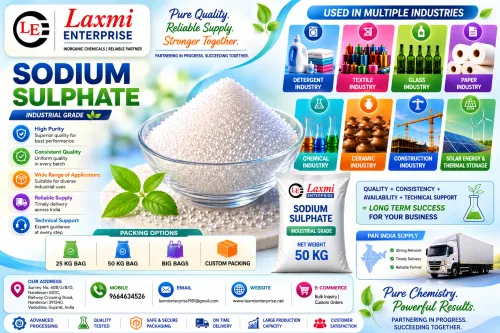
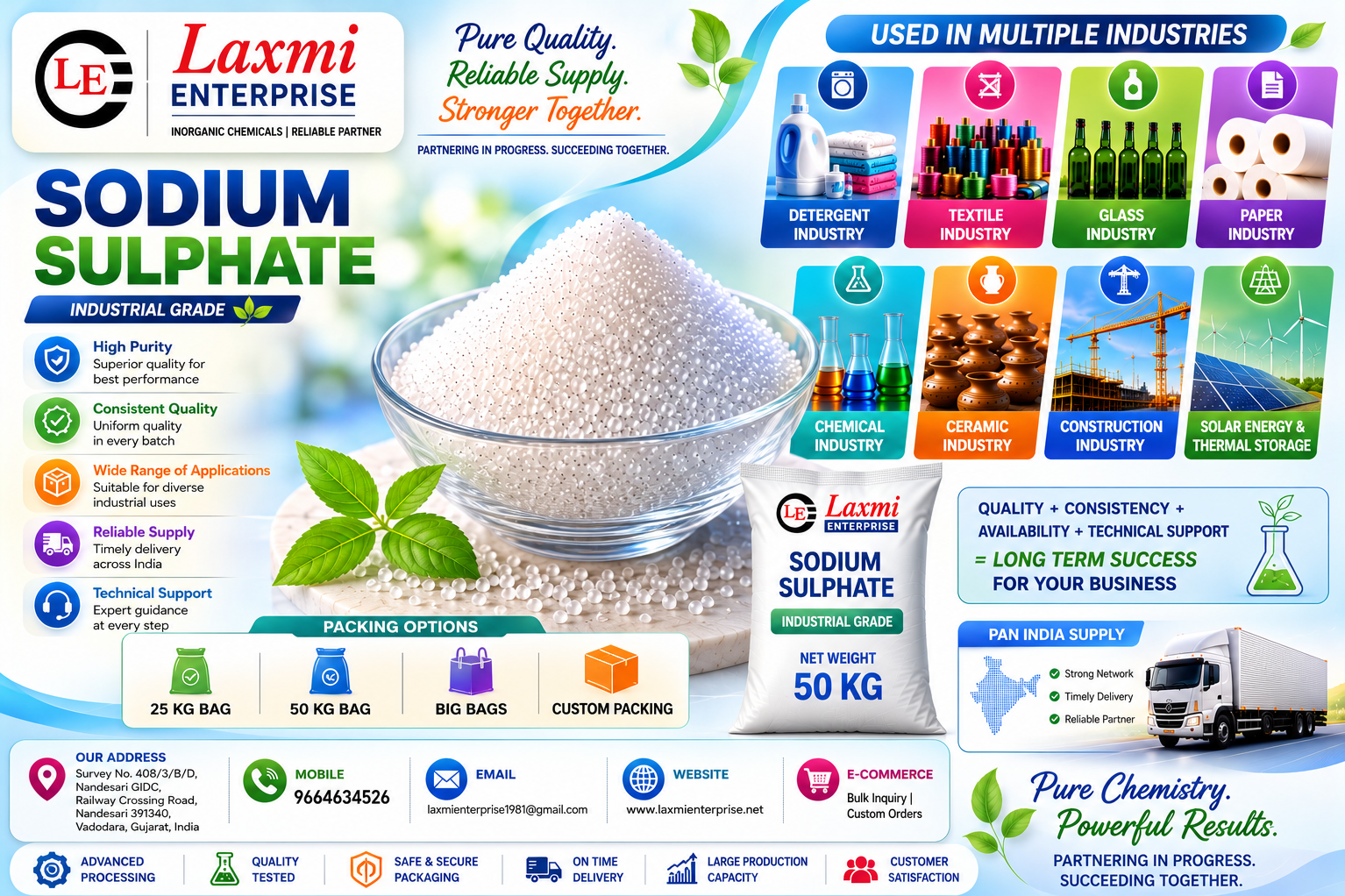
Laxmi Enterprise, based in Nandesari GIDC, Vadodara, Gujarat, supplies Sodium Sulphate (CAS No. 7757-82-6, HSN Code 2833 11 00) across Pan India, supporting industries such as detergents, glass, textiles, kraft pulp, and chemical manufacturing with technical documentation, flexible packaging, and reliable logistics.
Buyer Checklist
Before placing an order:
✔ Confirm the intended application.
✔ Verify CAS Number: 7757-82-6.
✔ Verify HSN Code: 2833 11 00.
✔ Define the required technical specification.
✔ Request COA, TDS, and SDS/MSDS.
✔ Confirm packaging.
✔ Review supplier capability.
✔ Agree on delivery schedules.
Frequently Asked Questions
Is Industrial Grade always better than Technical Grade?
Not necessarily. Neither term has a universal definition. The correct choice depends on the agreed specification and the intended application.
Can different suppliers use different grade definitions?
Yes. Grade terminology can vary. Buyers should compare technical specifications rather than relying solely on product names.
Why is documentation important?
COA, TDS, and SDS/MSDS provide objective information about the product, helping buyers verify quality and maintain traceability.
Why include the CAS Number and HSN Code?
The CAS Number (7757-82-6) uniquely identifies Sodium Sulphate, while the HSN Code (2833 11 00) supports invoicing, GST, customs, and logistics in India.
Conclusion
When purchasing Sodium Sulphate, the grade name should be viewed as a commercial description rather than a complete technical specification. Buyers achieve better procurement outcomes by defining measurable quality requirements, reviewing supporting documentation, and selecting suppliers with consistent quality systems and dependable logistics.
For industrial buyers across Pan India, Laxmi Enterprise, located in Nandesari GIDC, Vadodara, Gujarat, supplies Sodium Sulphate (CAS No. 7757-82-6, HSN Code 2833 11 00) with comprehensive technical documentation, flexible packaging, and reliable supply for detergent, glass, textile, kraft pulp, and chemical manufacturing applications.