Industrial Grades of Sodium Nitrate Explained Technical Grade High Purity Grade and Application Based Selection
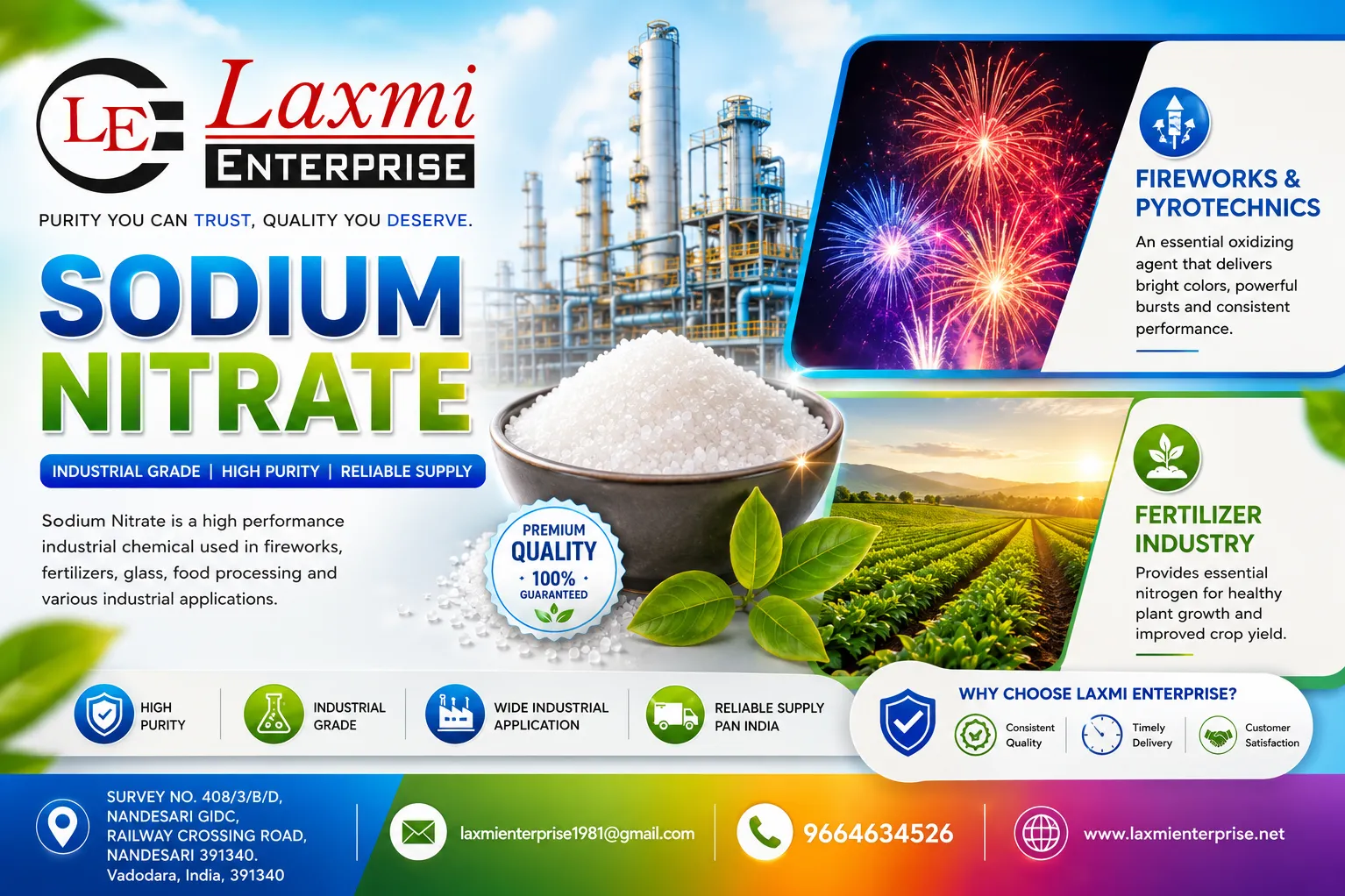
Sodium nitrate is one of the most versatile industrial chemicals used across manufacturing, chemical processing, glass production, metal treatment, laboratories, heat transfer systems, agriculture, and many specialized industrial applications. Although many buyers search for sodium nitrate as a single product, experienced procurement professionals understand that not every sodium nitrate grade performs the same way.
Selecting the wrong grade can increase production costs, reduce product quality, create unwanted impurities, or even affect regulatory compliance. Understanding industrial grades of sodium nitrate allows purchasing managers, production engineers, quality control teams, and chemical buyers to select the most suitable material for their manufacturing process.
This guide explains the different grades of sodium nitrate, their technical specifications, purity levels, manufacturing considerations, industrial applications, and practical selection criteria.
Why Sodium Nitrate Is Available in Multiple Grades
Every industry has different performance requirements.
Some industries simply require a reliable oxidizing agent.
Others require an extremely pure chemical with almost no contaminants.
Some industries prioritize low cost.
Others prioritize consistency and predictable chemical behavior.
Because of these varying requirements, manufacturers produce sodium nitrate in several industrial grades.
Each grade is designed for specific applications while maintaining acceptable purity and chemical performance.
What Determines Sodium Nitrate Grade
Industrial grading depends on several quality parameters.
These include
Chemical purity
Moisture content
Water insoluble matter
Chloride concentration
Sulphate concentration
Heavy metal impurities
Particle size distribution
Bulk density
Crystal uniformity
Storage stability
Flow characteristics
Packaging quality
Quality documentation
Batch consistency
Testing standards
Every manufacturer establishes specification limits according to customer requirements.
Main Industrial Grades of Sodium Nitrate
The most common industrial grades include
Technical Grade
Industrial Grade
High Purity Grade
Laboratory Grade
Analytical Grade
Reagent Grade
Electronic Grade
Customized Industrial Grade
Each grade serves different industries and quality expectations.
Technical Grade Sodium Nitrate
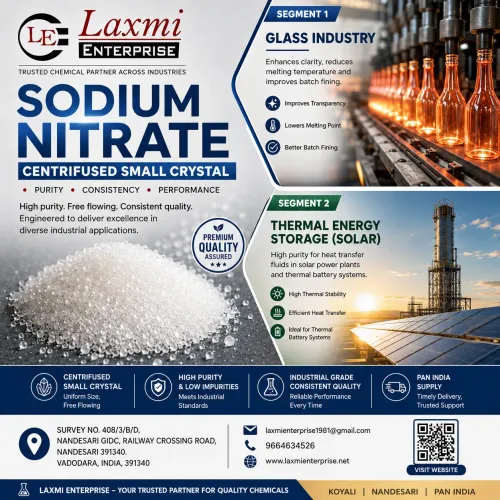
Technical grade sodium nitrate is the most widely used industrial product.
It offers an excellent balance between cost and performance.
Typical purity ranges from approximately 98 percent to more than 99 percent depending on manufacturing methods and supplier specifications.
This grade is suitable for large volume industrial production where extremely high purity is not essential.
Common Uses of Technical Grade Sodium Nitrate
Technical grade sodium nitrate is extensively used in
Glass manufacturing
Chemical manufacturing
Heat treatment
Metal finishing
Explosives manufacturing
Mining operations
Construction chemicals
Water treatment
Industrial oxidation processes
Pigment production
Ceramic manufacturing
General chemical processing
Most industrial buyers purchase this grade because it provides reliable performance with competitive pricing.
Advantages of Technical Grade
Affordable pricing
Reliable chemical performance
Large scale availability
Suitable for continuous production
Easy handling
Good storage stability
High production consistency
Widely accepted industrial specifications
Excellent supply chain availability
Cost effective for bulk purchases
High Purity Sodium Nitrate
High purity sodium nitrate undergoes stricter manufacturing controls and quality inspection.
Additional purification removes unwanted contaminants.
The result is a product with significantly lower impurity levels.
High purity grades may exceed 99.5 percent or even higher depending on customer specifications.
Industries Requiring High Purity Sodium Nitrate
High purity material is commonly used in
Pharmaceutical manufacturing
Fine chemical production
Laboratory chemicals
Research institutions
Electronic materials
Precision chemical synthesis
Optical glass production
Specialty catalysts
Analytical laboratories
Advanced manufacturing
These industries demand excellent chemical consistency.
Why High Purity Matters
Even tiny amounts of contaminants may affect
Reaction efficiency
Catalyst performance
Crystal growth
Chemical stability
Optical clarity
Analytical accuracy
Research reproducibility
Finished product quality
Therefore high purity sodium nitrate becomes essential for sensitive manufacturing processes.
Industrial Grade Sodium Nitrate
Industrial grade generally refers to sodium nitrate manufactured specifically for commercial production applications.
The specifications are optimized for manufacturing efficiency rather than laboratory precision.
This grade often provides excellent value for industries consuming hundreds of tons annually.
Laboratory Grade Sodium Nitrate
Laboratory grade sodium nitrate is manufactured with strict analytical quality control.
Each batch undergoes extensive testing.
Certificates of analysis accompany shipments.
Laboratories require accurate and reproducible chemical composition for experimental work.
Analytical Grade Sodium Nitrate
Analytical grade is intended for
Chemical analysis
Calibration
Instrument testing
Educational laboratories
Scientific research
Reference standards
Quality control laboratories
This material offers higher purity than general industrial grades.
Particle Size Classification
Apart from purity, sodium nitrate is also classified according to particle size.
Fine Powder
Suitable for rapid dissolution.
Medium Crystal
Preferred for controlled handling.
Coarse Crystal
Useful where dust reduction is important.
Granular Grade
Excellent for bulk industrial applications.
Customized Particle Size
Prepared according to customer production requirements.
Particle size influences
Flowability
Mixing performance
Packing density
Reaction rate
Storage behavior
Dust generation
Moisture Content Importance
Moisture content directly affects
Storage life
Flow properties
Packaging stability
Chemical handling
Production efficiency
Manufacturers carefully control moisture during production and packaging.
Low moisture products typically exhibit better long term storage performance.
Chloride Content Considerations
Certain industries require very low chloride levels.
Excess chloride may contribute to
Equipment corrosion
Product contamination
Reduced chemical performance
Quality issues
High purity applications therefore specify maximum chloride limits.
Sulphate Content
Sulphate concentration is another quality parameter.
Some industrial applications tolerate moderate sulphate levels.
Others require minimal sulphate contamination.
Manufacturers adjust purification processes according to customer specifications.
Water Insoluble Matter
Water insoluble material represents impurities that do not dissolve.
High quality sodium nitrate typically contains very low insoluble matter.
Low insoluble content improves
Solution clarity
Filtration efficiency
Equipment cleanliness
Chemical consistency
Heavy Metal Control
Modern industries increasingly demand low heavy metal concentrations.
Quality manufacturers routinely test for
Lead
Cadmium
Mercury
Arsenic
Other trace metals
This is especially important for
Food related applications
Pharmaceutical production
Specialty chemicals
Research laboratories
Bulk Density and Handling
Bulk density influences
Transportation efficiency
Storage capacity
Packaging selection
Automatic feeding systems
Process equipment calibration
Consistent bulk density improves manufacturing reliability.
Packaging Based Grade Selection
Packaging also differs according to customer needs.
Twenty five kilogram bags
Fifty kilogram bags
Jumbo bags
Bulk truck loading
Container shipments
Moisture resistant packaging
Export packaging
Customized industrial packaging
Proper packaging preserves chemical quality throughout transportation.
Application Based Grade Selection Guide
Glass Manufacturing
Technical grade generally provides excellent performance.
Chemical Manufacturing
Industrial grade offers cost effective operation.
Research Laboratories
Analytical or laboratory grade is preferred.
Fine Chemicals
High purity sodium nitrate is recommended.
Metal Treatment
Technical grade normally meets production requirements.
Heat Transfer Systems
Industrial grade with consistent purity is commonly selected.
Electronic Applications
High purity grades minimize contamination risk.
Cost Versus Purity
Increasing purity generally increases production cost.
Additional purification requires
Extra processing
Additional quality testing
Advanced equipment
Higher manufacturing standards
More detailed documentation
Buyers should select the lowest acceptable impurity level that still satisfies production requirements.
Over specifying purity unnecessarily increases procurement costs.
Questions Buyers Should Ask Suppliers
What is the guaranteed purity?
Is a certificate of analysis available?
What is the moisture specification?
What is the chloride limit?
What is the sulphate limit?
What is the particle size distribution?
What packaging options are available?
Is every production batch tested?
Can customized specifications be supplied?
What international standards are followed?
Storage Requirements for All Grades
Regardless of grade, sodium nitrate should be stored
In dry environments
Away from moisture
Inside sealed containers
Away from reducing materials
Away from combustible substances
With proper warehouse ventilation
Protected from contamination
Proper storage preserves product quality throughout its shelf life.
Quality Assurance Practices
Reliable manufacturers maintain
Incoming raw material inspection
Process quality control
Laboratory analysis
Batch traceability
Documented testing
Packaging inspection
Final shipment verification
These systems ensure consistent product quality.
Industries Benefiting from Proper Grade Selection
Glass manufacturers
Chemical producers
Mining companies
Heat treatment facilities
Metal processing industries
Research organizations
Laboratories
Construction chemical manufacturers
Water treatment companies
Agricultural chemical producers
Each industry benefits by matching sodium nitrate grade to production requirements.
Future Demand for Specialized Grades
Industrial manufacturing continues moving toward higher efficiency and tighter quality control.
As production technologies advance, demand for customized sodium nitrate grades is expected to increase.
Manufacturers capable of supplying consistent purity, customized particle size, and application specific specifications will remain preferred partners across global industries.
Conclusion
Industrial sodium nitrate is available in multiple grades because different industries require different levels of purity, consistency, particle size, and performance. Technical grade remains the preferred choice for large scale manufacturing due to its balance of quality and cost, while high purity, laboratory, and analytical grades serve specialized industries where contamination control is critical. Careful evaluation of purity, moisture, chloride, sulphate, particle size, and quality documentation helps buyers select the most suitable grade for reliable production, improved efficiency, and long term value.
Frequently Asked Questions
What is technical grade sodium nitrate?
Technical grade sodium nitrate is an industrial quality product generally used in glass manufacturing, chemical processing, mining, metal treatment, construction chemicals, and other commercial applications where high reliability and competitive pricing are required.
What is high purity sodium nitrate?
High purity sodium nitrate is manufactured with stricter quality controls and lower impurity levels. It is commonly used in laboratories, research, pharmaceutical manufacturing, electronics, and fine chemical production.
Which sodium nitrate grade is best for glass manufacturing?
Technical grade sodium nitrate is widely preferred for glass manufacturing because it provides consistent performance while remaining cost effective for large scale production.
Why is purity important when selecting sodium nitrate?
Purity affects chemical reactions, product quality, equipment performance, contamination risk, and manufacturing consistency. The required purity depends on the intended industrial application.
Does particle size matter?
Yes. Particle size influences dissolution speed, mixing efficiency, flowability, dust formation, storage behavior, and feeding performance in automated production systems.
What quality certificate should suppliers provide?
Reputable suppliers typically provide a Certificate of Analysis that includes purity, moisture, chloride, sulphate, water insoluble matter, and other relevant quality parameters for each production batch.
How should sodium nitrate be stored?
Store sodium nitrate in sealed containers in a cool, dry, and well ventilated area away from moisture, combustible materials, and incompatible chemicals to maintain product quality.
Can sodium nitrate specifications be customized?
Yes. Many manufacturers can supply customized purity levels, particle sizes, packaging options, and quality specifications based on customer requirements.
Which industries commonly use technical grade sodium nitrate?
Technical grade sodium nitrate is widely used in glass manufacturing, chemical processing, mining, explosives, metal finishing, heat treatment, ceramics, construction chemicals, and water treatment industries.
How can buyers choose the correct sodium nitrate grade?
Buyers should evaluate application requirements, purity, impurity limits, particle size, moisture content, packaging, quality documentation, regulatory needs, and supplier consistency before making a purchasing decision.
Sodium nitrate is one of the most versatile industrial chemicals used across manufacturing, chemical processing, glass production, metal treatment, laboratories, heat transfer systems, agriculture, and many specialized industrial applications. Although many buyers search for sodium nitrate as a single product, experienced procurement professionals understand that not every sodium nitrate grade performs the same way.
Selecting the wrong grade can increase production costs, reduce product quality, create unwanted impurities, or even affect regulatory compliance. Understanding industrial grades of sodium nitrate allows purchasing managers, production engineers, quality control teams, and chemical buyers to select the most suitable material for their manufacturing process.
This guide explains the different grades of sodium nitrate, their technical specifications, purity levels, manufacturing considerations, industrial applications, and practical selection criteria.
Why Sodium Nitrate Is Available in Multiple Grades
Every industry has different performance requirements.
Some industries simply require a reliable oxidizing agent.
Others require an extremely pure chemical with almost no contaminants.
Some industries prioritize low cost.
Others prioritize consistency and predictable chemical behavior.
Because of these varying requirements, manufacturers produce sodium nitrate in several industrial grades.
Each grade is designed for specific applications while maintaining acceptable purity and chemical performance.
What Determines Sodium Nitrate Grade
Industrial grading depends on several quality parameters.
These include
Chemical purity
Moisture content
Water insoluble matter
Chloride concentration
Sulphate concentration
Heavy metal impurities
Particle size distribution
Bulk density
Crystal uniformity
Storage stability
Flow characteristics
Packaging quality
Quality documentation
Batch consistency
Testing standards
Every manufacturer establishes specification limits according to customer requirements.
Main Industrial Grades of Sodium Nitrate
The most common industrial grades include
Technical Grade
Industrial Grade
High Purity Grade
Laboratory Grade
Analytical Grade
Reagent Grade
Electronic Grade
Customized Industrial Grade
Each grade serves different industries and quality expectations.
Technical Grade Sodium Nitrate
Technical grade sodium nitrate is the most widely used industrial product.
It offers an excellent balance between cost and performance.
Typical purity ranges from approximately 98 percent to more than 99 percent depending on manufacturing methods and supplier specifications.
This grade is suitable for large volume industrial production where extremely high purity is not essential.
Common Uses of Technical Grade Sodium Nitrate
Technical grade sodium nitrate is extensively used in
Glass manufacturing
Chemical manufacturing
Heat treatment
Metal finishing
Explosives manufacturing
Mining operations
Construction chemicals
Water treatment
Industrial oxidation processes
Pigment production
Ceramic manufacturing
General chemical processing
Most industrial buyers purchase this grade because it provides reliable performance with competitive pricing.
Advantages of Technical Grade
Affordable pricing
Reliable chemical performance
Large scale availability
Suitable for continuous production
Easy handling
Good storage stability
High production consistency
Widely accepted industrial specifications
Excellent supply chain availability
Cost effective for bulk purchases
High Purity Sodium Nitrate
High purity sodium nitrate undergoes stricter manufacturing controls and quality inspection.
Additional purification removes unwanted contaminants.
The result is a product with significantly lower impurity levels.
High purity grades may exceed 99.5 percent or even higher depending on customer specifications.
Industries Requiring High Purity Sodium Nitrate
High purity material is commonly used in
Pharmaceutical manufacturing
Fine chemical production
Laboratory chemicals
Research institutions
Electronic materials
Precision chemical synthesis
Optical glass production
Specialty catalysts
Analytical laboratories
Advanced manufacturing
These industries demand excellent chemical consistency.
Why High Purity Matters
Even tiny amounts of contaminants may affect
Reaction efficiency
Catalyst performance
Crystal growth
Chemical stability
Optical clarity
Analytical accuracy
Research reproducibility
Finished product quality
Therefore high purity sodium nitrate becomes essential for sensitive manufacturing processes.
Industrial Grade Sodium Nitrate
Industrial grade generally refers to sodium nitrate manufactured specifically for commercial production applications.
The specifications are optimized for manufacturing efficiency rather than laboratory precision.
This grade often provides excellent value for industries consuming hundreds of tons annually.
Laboratory Grade Sodium Nitrate
Laboratory grade sodium nitrate is manufactured with strict analytical quality control.
Each batch undergoes extensive testing.
Certificates of analysis accompany shipments.
Laboratories require accurate and reproducible chemical composition for experimental work.
Analytical Grade Sodium Nitrate
Analytical grade is intended for
Chemical analysis
Calibration
Instrument testing
Educational laboratories
Scientific research
Reference standards
Quality control laboratories
This material offers higher purity than general industrial grades.
Particle Size Classification
Apart from purity, sodium nitrate is also classified according to particle size.
Fine Powder
Suitable for rapid dissolution.
Medium Crystal
Preferred for controlled handling.
Coarse Crystal
Useful where dust reduction is important.
Granular Grade
Excellent for bulk industrial applications.
Customized Particle Size
Prepared according to customer production requirements.
Particle size influences
Flowability
Mixing performance
Packing density
Reaction rate
Storage behavior
Dust generation
Moisture Content Importance
Moisture content directly affects
Storage life
Flow properties
Packaging stability
Chemical handling
Production efficiency
Manufacturers carefully control moisture during production and packaging.
Low moisture products typically exhibit better long term storage performance.
Chloride Content Considerations
Certain industries require very low chloride levels.
Excess chloride may contribute to
Equipment corrosion
Product contamination
Reduced chemical performance
Quality issues
High purity applications therefore specify maximum chloride limits.
Sulphate Content
Sulphate concentration is another quality parameter.
Some industrial applications tolerate moderate sulphate levels.
Others require minimal sulphate contamination.
Manufacturers adjust purification processes according to customer specifications.
Water Insoluble Matter
Water insoluble material represents impurities that do not dissolve.
High quality sodium nitrate typically contains very low insoluble matter.
Low insoluble content improves
Solution clarity
Filtration efficiency
Equipment cleanliness
Chemical consistency
Heavy Metal Control
Modern industries increasingly demand low heavy metal concentrations.
Quality manufacturers routinely test for
Lead
Cadmium
Mercury
Arsenic
Other trace metals
This is especially important for
Food related applications
Pharmaceutical production
Specialty chemicals
Research laboratories
Bulk Density and Handling
Bulk density influences
Transportation efficiency
Storage capacity
Packaging selection
Automatic feeding systems
Process equipment calibration
Consistent bulk density improves manufacturing reliability.
Packaging Based Grade Selection
Packaging also differs according to customer needs.
Twenty five kilogram bags
Fifty kilogram bags
Jumbo bags
Bulk truck loading
Container shipments
Moisture resistant packaging
Export packaging
Customized industrial packaging
Proper packaging preserves chemical quality throughout transportation.
Application Based Grade Selection Guide
Glass Manufacturing
Technical grade generally provides excellent performance.
Chemical Manufacturing
Industrial grade offers cost effective operation.
Research Laboratories
Analytical or laboratory grade is preferred.
Fine Chemicals
High purity sodium nitrate is recommended.
Metal Treatment
Technical grade normally meets production requirements.
Heat Transfer Systems
Industrial grade with consistent purity is commonly selected.
Electronic Applications
High purity grades minimize contamination risk.
Cost Versus Purity
Increasing purity generally increases production cost.
Additional purification requires
Extra processing
Additional quality testing
Advanced equipment
Higher manufacturing standards
More detailed documentation
Buyers should select the lowest acceptable impurity level that still satisfies production requirements.
Over specifying purity unnecessarily increases procurement costs.
Questions Buyers Should Ask Suppliers
What is the guaranteed purity?
Is a certificate of analysis available?
What is the moisture specification?
What is the chloride limit?
What is the sulphate limit?
What is the particle size distribution?
What packaging options are available?
Is every production batch tested?
Can customized specifications be supplied?
What international standards are followed?
Storage Requirements for All Grades
Regardless of grade, sodium nitrate should be stored
In dry environments
Away from moisture
Inside sealed containers
Away from reducing materials
Away from combustible substances
With proper warehouse ventilation
Protected from contamination
Proper storage preserves product quality throughout its shelf life.
Quality Assurance Practices
Reliable manufacturers maintain
Incoming raw material inspection
Process quality control
Laboratory analysis
Batch traceability
Documented testing
Packaging inspection
Final shipment verification
These systems ensure consistent product quality.
Industries Benefiting from Proper Grade Selection
Glass manufacturers
Chemical producers
Mining companies
Heat treatment facilities
Metal processing industries
Research organizations
Laboratories
Construction chemical manufacturers
Water treatment companies
Agricultural chemical producers
Each industry benefits by matching sodium nitrate grade to production requirements.
Future Demand for Specialized Grades
Industrial manufacturing continues moving toward higher efficiency and tighter quality control.
As production technologies advance, demand for customized sodium nitrate grades is expected to increase.
Manufacturers capable of supplying consistent purity, customized particle size, and application specific specifications will remain preferred partners across global industries.
Conclusion
Industrial sodium nitrate is available in multiple grades because different industries require different levels of purity, consistency, particle size, and performance. Technical grade remains the preferred choice for large scale manufacturing due to its balance of quality and cost, while high purity, laboratory, and analytical grades serve specialized industries where contamination control is critical. Careful evaluation of purity, moisture, chloride, sulphate, particle size, and quality documentation helps buyers select the most suitable grade for reliable production, improved efficiency, and long term value.
Frequently Asked Questions
What is technical grade sodium nitrate?
Technical grade sodium nitrate is an industrial quality product generally used in glass manufacturing, chemical processing, mining, metal treatment, construction chemicals, and other commercial applications where high reliability and competitive pricing are required.
What is high purity sodium nitrate?
High purity sodium nitrate is manufactured with stricter quality controls and lower impurity levels. It is commonly used in laboratories, research, pharmaceutical manufacturing, electronics, and fine chemical production.
Which sodium nitrate grade is best for glass manufacturing?
Technical grade sodium nitrate is widely preferred for glass manufacturing because it provides consistent performance while remaining cost effective for large scale production.
Why is purity important when selecting sodium nitrate?
Purity affects chemical reactions, product quality, equipment performance, contamination risk, and manufacturing consistency. The required purity depends on the intended industrial application.
Does particle size matter?
Yes. Particle size influences dissolution speed, mixing efficiency, flowability, dust formation, storage behavior, and feeding performance in automated production systems.
What quality certificate should suppliers provide?
Reputable suppliers typically provide a Certificate of Analysis that includes purity, moisture, chloride, sulphate, water insoluble matter, and other relevant quality parameters for each production batch.
How should sodium nitrate be stored?
Store sodium nitrate in sealed containers in a cool, dry, and well ventilated area away from moisture, combustible materials, and incompatible chemicals to maintain product quality.
Can sodium nitrate specifications be customized?
Yes. Many manufacturers can supply customized purity levels, particle sizes, packaging options, and quality specifications based on customer requirements.
Which industries commonly use technical grade sodium nitrate?
Technical grade sodium nitrate is widely used in glass manufacturing, chemical processing, mining, explosives, metal finishing, heat treatment, ceramics, construction chemicals, and water treatment industries.
How can buyers choose the correct sodium nitrate grade?
Buyers should evaluate application requirements, purity, impurity limits, particle size, moisture content, packaging, quality documentation, regulatory needs, and supplier consistency before making a purchasing decision.
Keywords