

Industrial Process Design for Sodium Acetate Manufacturing
Reactor Design, Process Flow, Equipment Selection, Utility Integration, Process Automation & Production Optimization
A successful Sodium Acetate manufacturing plant is not defined by the size of its reactor or the number of machines it contains. It is defined by how efficiently every process is connected, controlled, and optimized.
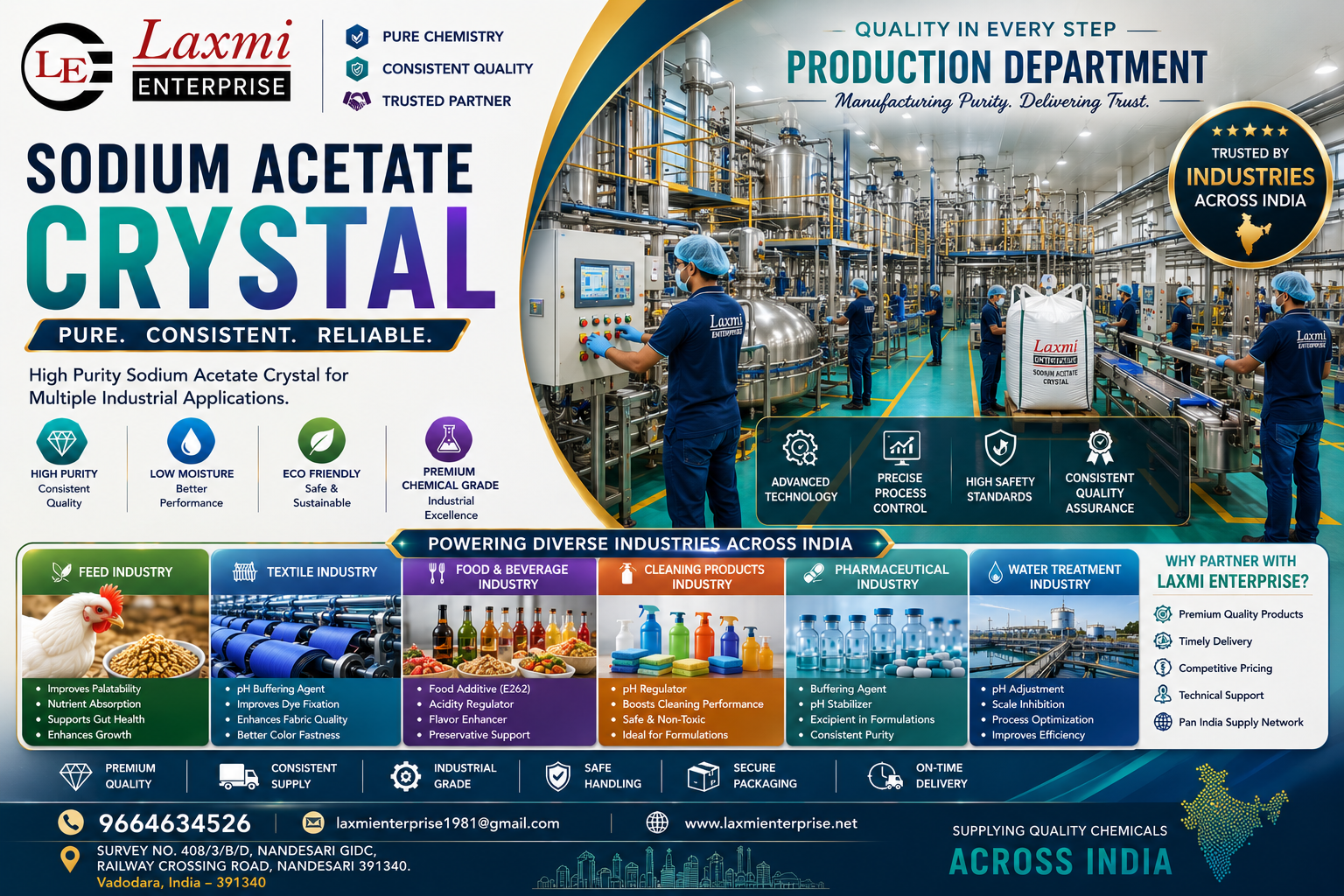
From the moment raw materials enter the facility until finished bags are loaded for dispatch, every operation must function as part of a coordinated manufacturing system. The reactor must produce a consistent solution, the crystallizer must generate uniform crystals, the dryer must achieve the required moisture level, and the packaging line must preserve product quality until it reaches the customer.
Poor plant design often leads to excessive energy consumption, production bottlenecks, inconsistent quality, high maintenance costs, and reduced manufacturing capacity. In contrast, a well-designed process improves productivity, minimizes waste, simplifies maintenance, and helps manufacturers consistently meet customer specifications.
This guide explains how Sodium Acetate manufacturing plants are designed, how major equipment works together, and why process engineering plays a critical role in product quality, operational efficiency, and long-term manufacturing success.
Why Process Design Matters
Many people think manufacturing quality depends mainly on laboratory testing.
In reality, laboratory testing verifies quality—it does not create it.
Quality is created during manufacturing through:
Stable process design
Correct equipment selection
Controlled operating conditions
Reliable utilities
Skilled operators
Continuous monitoring
When these elements work together, quality becomes predictable rather than accidental.
Engineering Insight
The best manufacturing plants do not rely on operators making constant adjustments. Instead, they are designed so that normal operating conditions naturally produce consistent results.
Good engineering reduces variation before it occurs.
Understanding a Manufacturing Process
Every chemical manufacturing process follows a logical sequence.
Each production stage prepares material for the next operation.
For Sodium Acetate manufacturing, a simplified process includes:
Raw material receiving
Storage
Reaction
Clarification
Concentration
Crystallization
Solid-liquid separation
Drying
Particle sizing
Packaging
Finished goods storage
Dispatch
Although this sequence appears simple, every step influences product quality and plant efficiency.
The Manufacturing Philosophy
Modern chemical plants are designed around three objectives:
Product Quality
Every batch should consistently meet customer specifications.
Process Efficiency
Equipment should maximize production while minimizing waste and downtime.
Safe Operation
Plants should operate safely for employees, equipment, and the environment.
A successful manufacturing system balances all three objectives rather than optimizing only one.
The Heart of the Plant: The Reactor
The reactor is where the chemical transformation begins.
Its purpose is not simply to complete a reaction but to create a stable and uniform process solution for downstream operations.
Engineers evaluate several design considerations when selecting a reactor:
Production capacity
Mixing performance
Heat transfer
Material compatibility
Cleaning requirements
Automation capability
A well-designed reactor helps maintain consistent reaction conditions from batch to batch.
Why Mixing Is Critical
Mixing is often underestimated in chemical manufacturing.
Its purpose extends beyond simply combining raw materials.
Effective mixing helps:
Maintain uniform concentration
Improve heat distribution
Prevent localized reactions
Increase process stability
Support consistent product quality
Poor mixing can create uneven operating conditions that affect crystallization and downstream processing.
Engineering Example
Imagine adding sugar to a cup of tea without stirring.
Some areas become very sweet while others remain almost unchanged.
A poorly mixed reactor behaves similarly. Concentration differences develop inside the vessel, making consistent manufacturing much more difficult.
Heat Transfer in Chemical Processing
Chemical reactions often require careful temperature control.
Heating or cooling too quickly may influence downstream operations.
Engineers therefore design systems that provide:
Controlled heating
Efficient cooling
Uniform temperature distribution
Stable operating conditions
Heat exchangers, jackets, and temperature control systems work together to maintain the desired process conditions.
Material Transfer Between Equipment
Once the reaction is complete, the product solution moves through several processing stages.
Reliable transfer systems help:
Reduce contamination risk
Minimize product loss
Improve production efficiency
Maintain continuous workflow
Engineers design pipelines and pumps to match the physical properties of the process solution.
Process Flow Should Be Simple
One common mistake in plant design is creating unnecessary complexity.
Every additional pump, valve, transfer line, or storage tank increases:
Maintenance requirements
Energy consumption
Cleaning time
Failure opportunities
Experienced engineers aim for the simplest process capable of achieving production objectives.
Equipment Selection
Every major piece of equipment influences manufacturing performance.
Common equipment includes:
Storage Tanks
Used for raw materials and intermediate process solutions.
Reactors
Provide controlled reaction conditions.
Filters
Remove unwanted suspended materials before crystallization.
Crystallizers
Produce the required crystal characteristics.
Centrifuges or Filters
Separate crystals from the remaining process liquid.
Dryers
Reduce moisture to the specified level.
Screening Equipment
Produces a more consistent particle size distribution.
Packaging Systems
Protect product quality during storage and transportation.
Utility Systems
Utilities are often called the 'hidden factory.'
Although they never become part of the final product, they keep the plant operating.
Typical utilities include:
Steam
Cooling water
Electricity
Compressed air
Process water
Instrument air
Poor utility reliability can stop production even when all process equipment is functioning correctly.
Why Automation Is Becoming Essential
Modern manufacturing increasingly relies on automation.
Automation helps maintain:
Stable operating conditions
Repeatable production
Better traceability
Reduced human error
Faster process monitoring
Operators continue to play a critical role, but automation improves consistency by controlling routine operations.
Instrumentation and Monitoring
Manufacturing decisions depend on accurate process information.
Plants commonly monitor:
Temperature
Pressure
Flow
Liquid level
pH
Conductivity
Reliable instrumentation allows production teams to identify deviations before they become quality problems.
Quality Insight
High-quality manufacturing is based on measurement rather than assumption.
Accurate process data allows operators to make informed decisions and supports continuous improvement.
Production Bottlenecks
Every manufacturing system has at least one operation that limits overall production capacity.
Common bottlenecks include:
Slow crystallization
Limited drying capacity
Packaging speed
Utility availability
Laboratory release time
Improving the bottleneck often increases total plant productivity more effectively than upgrading other equipment.
Designing for Maintenance
Equipment should be easy to inspect, clean, and maintain.
Maintenance-friendly design helps reduce:
Unplanned shutdowns
Repair costs
Production interruptions
Safety risks
Preventive maintenance generally costs less than emergency repairs.
Sustainability in Plant Design
Modern manufacturing facilities increasingly focus on:
Energy efficiency
Water conservation
Heat recovery
Waste minimization
Resource optimization
Improving process efficiency often reduces both operating costs and environmental impact.
Digital Manufacturing
Advanced manufacturing plants increasingly integrate:
Manufacturing Execution Systems (MES)
Enterprise Resource Planning (ERP)
Supervisory Control and Data Acquisition (SCADA)
Digital maintenance systems
Production dashboards
These technologies improve visibility across the entire production process.
Illustrative Industrial Example
A manufacturer experiences frequent production delays during the drying stage.
Initial investigations focus on replacing the dryer.
However, engineering analysis reveals that inconsistent crystallization is producing excessive fine particles, which retain more moisture and reduce drying efficiency.
After optimizing crystallization instead of replacing equipment, drying performance improves, energy consumption decreases, and production capacity increases.
This example highlights the importance of understanding how different process stages influence one another.
Common Process Design Challenges
Challenge Possible Cause Operational Impact Recommended Engineering Approach
Frequent process variation Inconsistent operating conditions Batch variability Improve process monitoring
Slow production Equipment bottleneck Reduced output Identify and optimize constraint
High energy use Poor heat integration Increased operating cost Improve utility efficiency
Repeated maintenance Complex equipment layout Downtime Simplify plant design where practical
Product inconsistency Weak process control Customer complaints Standardize operating procedures
Procurement Insight
Industrial buyers increasingly evaluate manufacturing capability in addition to product specifications.
Useful questions include:
Is the plant highly automated?
How are process parameters monitored?
What production capacity is available?
Are preventive maintenance programs implemented?
How is batch consistency maintained?
These questions help assess whether a supplier can reliably support long-term business requirements.
Key Takeaways
A Sodium Acetate manufacturing plant is much more than a collection of equipment. It is an integrated engineering system where reactors, crystallizers, dryers, utilities, instrumentation, and quality systems work together to produce consistent products efficiently and safely. Strong process design improves product quality, reduces operating costs, supports sustainability, and increases customer confidence.
Frequently Asked Questions (FAQ)
1. What is process design in Sodium Acetate manufacturing?
Process design is the engineering activity of planning how raw materials move through reaction, crystallization, drying, packaging, and quality control to consistently produce Sodium Acetate that meets defined specifications.
2. Why is reactor design important?
A properly designed reactor promotes uniform mixing, controlled temperature, and stable reaction conditions, creating a consistent process solution for downstream operations.
3. How does mixing affect product quality?
Good mixing helps maintain uniform concentration and temperature throughout the reactor. Poor mixing may create localized variations that can influence crystallization and overall process consistency.
4. Why are utility systems considered critical?
Steam, cooling water, compressed air, electricity, and process water support manufacturing operations. Interruptions to these systems can reduce productivity or stop production altogether.
5. What is a production bottleneck?
A bottleneck is the operation that limits the maximum production rate of the entire manufacturing system. Improving the bottleneck often has the greatest impact on plant capacity.
6. How does automation improve manufacturing?
Automation helps maintain stable operating conditions, reduces manual intervention, improves traceability, and provides real-time process monitoring for more consistent production.
7. What process parameters are commonly monitored?
Manufacturers commonly monitor temperature, pressure, flow, liquid level, pH, conductivity, and other parameters relevant to maintaining stable production.
8. Why is plant layout important?
An efficient layout reduces unnecessary material handling, simplifies maintenance, improves safety, and supports smoother production flow.
9. How can manufacturers improve energy efficiency?
Energy efficiency may be improved through better heat integration, optimized utility systems, preventive maintenance, efficient equipment selection, and continuous monitoring of process performance.
10. What should industrial buyers ask about a supplier's manufacturing facility?
Buyers can ask about production capacity, process automation, quality systems, maintenance programs, traceability, utility reliability, and how the manufacturer ensures consistent batch quality over time.
11. Does modern process design support sustainability?
Yes. Well-designed plants often reduce energy consumption, minimize waste, optimize water use, and improve overall resource efficiency while maintaining product quality.
12. Why is equipment selection important?
Selecting equipment that matches the production process helps improve operational reliability, simplify maintenance, support consistent product quality, and enable future expansion or automation.