

🇮🇳* Sodium Acetate – Industrial Applications in India
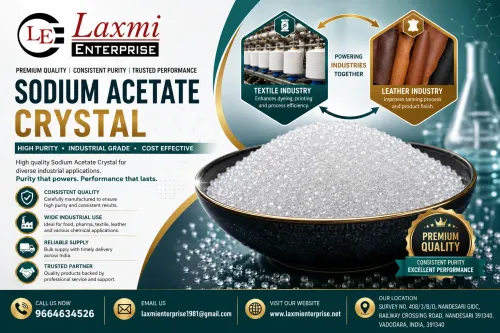
1. Textile Industry
Primary Use: Buffering and neutralizing agent in dyeing and finishing.
Used in aniline dye and disperse dye processes to maintain consistent pH.
Prevents color migration and uneven shades in fabric dyeing.
Acts as a pickling neutralizer after dyeing with sulfur or vat dyes.
Major Users: Textile processors in Gujarat, Tamil Nadu, Maharashtra.
2. Leather Tanning Industry
Function: Buffer and pH control agent in chrome tanning.
Helps maintain acidity for effective chrome fixation.
Enhances leather softness and grain tightness.
Industrial Hubs: Kanpur, Chennai, Ranipet, Kolkata.
3. Electroplating Industry
Function: Electroplating bath stabilizer and buffer.
Used in nickel, zinc, and copper plating baths to stabilize metal ions.
Improves brightness, ductility, and pH control.
Used by: Metal finishing units, hardware, and automotive component manufacturers in Maharashtra, Gujarat, and Haryana.
4. Food Industry (Food-Grade Sodium Acetate)
Application: Used as preservative (E262) and flavor enhancer.
Found in snack foods, chips, pickles, and baked goods.
Controls acidity and enhances salt-and-vinegar flavor.
Note: Only food-grade sodium acetate is approved for consumption (regulated by FSSAI in India).
5. Pharmaceutical & Laboratory Use
Function: Buffering and reagent applications.
Maintains pH in biochemical reactions and pharmaceutical formulations.
Used in preparation of acetate buffers for analytical testing.
Key Users: Pharmaceutical plants in Hyderabad, Mumbai, and Ahmedabad.
6. Dyes & Pigment Manufacturing
Role: Intermediate and buffering agent.
Maintains pH during azo dye synthesis.
Prevents premature precipitation or hydrolysis of dye intermediates.
Industrial Areas: Ankleshwar, Vapi, Nandesari, Tarapur.
7. Soap & Detergent Industry
Application: pH control and stabilizer for liquid detergent formulations.
Helps neutralize strong acids and maintain product consistency.
Prevents rancidity in soap bases.
8. Rubber & Chemical Manufacturing
Role: Process aid and buffering salt.
Used in production of synthetic rubber, photographic chemicals, and heat packs.
In exothermic heat packs, sodium acetate trihydrate acts as a latent heat storage material.
9. Oil & Gas / Petrochemical Industry
Application: Used as a corrosion inhibitor and buffer in drilling fluids and petrochemical formulations.
Helps control pH in acidic environments and reduces metal corrosion.
10. Water Treatment
Function: Carbon source for denitrification in wastewater treatment plants.
Promotes biological activity to remove nitrates.
Used by: Effluent treatment plants (ETPs) in chemical, dye, and textile industries.
* Market Insight – India
Parameter Details
Common Forms Anhydrous and Trihydrate
HS Code 29152990
Major Manufacturing States Gujarat, Maharashtra, Tamil Nadu
Typical Purity 98–99% (Technical), 99.5%+ (Food/Pharma Grade)
Price Range (2025) ₹25–₹60 per kg (depending on grade and bulk quantity)
Major Producers/Traders Loba Chemie, Merck India, Tata Chemicals, local chemical traders (Vadodara, Ankleshwar, Vapi, etc.)
Would you like me to prepare a detailed product catalog entry for Sodium Acetate
Function in Electroplating Baths
pH Buffering:
Sodium acetate maintains the bath’s pH within the optimal range (typically 4–6 for many plating systems).
It resists rapid pH fluctuations caused by hydrogen ion formation at the cathode during plating.
This helps ensure uniform metal deposition and stable current efficiency.
Bath Stabilization:
Prevents precipitation of metal hydroxides that can occur when pH drifts upward.
Stabilizes complex ions in solution — particularly metal-acetate complexes — which improves bath life and consistency.
Improves Brightness and Ductility:
When used in combination with brighteners or complexing agents, sodium acetate enhances deposit smoothness, luster, and adhesion.
Complexing Agent (Mild):
Acetate ions form weak complexes with certain metal ions (Ni²⁺, Cu²⁺, Zn²⁺), moderating metal ion activity and improving deposit control.
* Typical Applications
Plating Type Sodium Acetate Role Typical Concentration pH Range
Nickel Acetate Plating Buffer and stabilizer 5–50 g/L 4.0–5.5
Zinc Acetate Plating Bath stabilizer and pH controller 10–40 g/L 4.5–6.0
Copper Acetate Plating Complexing and buffering agent 5–30 g/L 4.0–6.0
Cadmium Acetate Bath pH stabilizer and complexing agent 10–25 g/L 5.0–6.0
// Chemical Properties
Property Value
Molecular Formula CH₃COONa
Molecular Weight 82.03 g/mol
Appearance White crystalline powder
Solubility Soluble in water and alcohol
pH (5% solution) 7.5–9.0
Melting Point ~324 °C (decomposes)
* Advantages in Plating Systems
Maintains bath uniformity and metal ion stability.
Extends bath life and reduces maintenance.
Enhances throwing power (metal distribution over complex shapes).
Compatible with other buffering systems (boric acid, citrates, etc.).
. Safety and Handling
Non-toxic and non-corrosive under normal conditions.
Avoid moisture absorption; store in airtight containers.
Use gloves and goggles during handling.
Sodium Acetate and Metal Deposition Quality in Electroplating
1. Role in Metal Ion Control
Sodium acetate (CH₃COONa) dissociates into acetate ions (CH₃COO⁻), which form weak complexes with metal ions (Ni²⁺, Cu²⁺, Zn²⁺, etc.).
This controlled complexation slows down the metal ion reduction rate at the cathode, producing:
Finer grain deposits
Better surface leveling
Improved brightness and ductility
2. pH Buffering Effect
During electroplating, hydrogen evolution near the cathode tends to lower pH, while anodic reactions can raise it locally.
Sodium acetate acts as a buffering agent, maintaining pH stability in the range ideal for deposition (typically 4.0–6.0).
Sodium Acetate as a pH Buffer Solution
1. Principle of the Sodium Acetate Buffer
Sodium acetate (CH₃COONa) is the conjugate base of a weak acid — acetic acid (CH₃COOH).
When these two components are present together in solution, they create a buffer system that resists changes in pH.
Buffer pair:
CH₃COOH (weak acid)
↔
CH₃COO⁻ (from CH₃COONa)
+
H⁺
CH₃COOH (weak acid)↔CH₃COO⁻ (from CH₃COONa)+H⁺
This equilibrium allows the solution to absorb small amounts of acid or base without large changes in pH — ideal for maintaining controlled conditions in chemical, biological, and industrial processes.
2. Chemical Reaction
When acetic acid and sodium acetate are mixed:
CH₃COOH + NaOH → CH₃COONa + H₂O
CH₃COOH + NaOH → CH₃COONa + H₂O
This mixture forms a sodium acetate–acetic acid buffer, commonly called an acetate buffer.
3. Buffer Equation
The Henderson–Hasselbalch equation describes its pH:
For acetic acid, pKa ≈ 4.76 at 25 °C
The buffer is effective in the pH range of 3.8 – 6.0
4. Typical Laboratory Preparation
*Example: 0.1 M Acetate Buffer, pH 4.75
• sodium acetate
• sodium acetate anhydrous
• sodium acetate trihydrate
• sodium acetate buffer
• sodium acetate CAS 127-09-3
• sodium acetate E262
• sodium ethanoate
• sodium salt of acetic acid
• sodium acetic acid
• sodium CH3COO
• natrii acetas
• hot ice (trihydrate)
• sodium acetate hydrate
• sodium acetate CAS 127-09-3 (anhydrous)
• sodium acetate CAS 6131-90-4 (trihydrate)
• sodium acetate EC 204-823-8
• E number E262
• sodium acetate CAS 127-09-3 (anhydrous)
• sodium acetate CAS 6131-90-4 (trihydrate)
• sodium acetate EC 204-823-8
• E number E262
Materials:
0.1 M Acetic acid (CH₃COOH)
0.1 M Sodium acetate (CH₃COONa)
Procedure:
Mix 50 mL of 0.1 M acetic acid with 50 mL of 0.1 M sodium acetate.
Check pH with a calibrated pH meter — it should be around 4.75.
Adjust slightly using acid (CH₃COOH) or base (NaOH) if needed.
Dilute to 100 mL with distilled water.
Result: Stable buffer maintaining pH ~4.7 even after small acid/base additions.
5. Industrial Applications in India
Industry Purpose of Sodium Acetate Buffer
Textile & Dyeing Maintains pH during dye fixation and color development.
Electroplating Stabilizes bath pH (nickel, zinc, and copper acetate baths).
Pharmaceutical Maintains pH for formulations, enzyme assays, and biological media.
Food & Beverage pH control in sauces, pickles, and processed foods (E262 additive).
Water Treatment Buffer for biological wastewater and denitrification processes.
Leather Tanning Maintains acidic conditions for chrome tanning.